Duan Yongping 6/1 Snowball said that FSD fell asleep for 40 minutes-compared with him personally, what is more worth discussing is that the public's awareness of smart driving is three levels lower
On June 1, 2026, investor Duan Yongping shared Tesla's FSD experience on the Snowball account "The Avenue is Intangible and I have Style", talking about "accidentally falling asleep for 40 minutes in the middle." This passage was posted on the Chinese Internet. In the same period, Jiangxi Ganzhou Emergency Management Bureau just announced on May 21 an investigation report on a smart driving accident at 4 a.m. on October 2, 2025-Chang 'an Qiyuan A07 pure electric sedan (L2 class smart driving assist) was driven by the driver on the Ji-Guangzhou Expressway. After activating the smart driving and taking off the steering wheel with both hands for more than 5 minutes, it hit a malfunctioning semi-trailer parked in the left lane, killing the family of three in the car. Together, the two things point to the biggest cognitive gap in China's automobile safety in 2026-the "smart driving, autonomous driving, FSD" widely believed by the public and the L0 to L5 classification in the national standard, which is three levels apart. At present, the mainstream of passenger cars on the market in China is L2 or L2+(the time to sell off cannot exceed 15 seconds). Only two cars in the country (Changan Deep Blue SL03 and Jihu Alpha S6) received the first batch of L3 access licenses in December 2025, and the operating domain is extremely strict. No civilian passenger car is allowed to sleep while in use.
Let's put out the original text of what happened on June 1st.
On this day, investor Duan Yongping posted a paragraph of his experience with Tesla FSD on the Snowball account "The road is invisible and I am shaped". Original words--
"I have a section of Highway 1 from the Bay Area (San Francisco) to Pebble Beach. I didn't pay attention to anything. I just set the address in the garage and pressed automatic driving. I also tried once and accidentally fell asleep for 40 minutes in the middle. It's been a long time since I drove another car. My luxury car has already been covered with thick dust."
This passage was quickly forwarded by a screenshot. The reason is simple-an influential investor publicly admitted that he fell asleep for 40 minutes using FSD while driving at high speeds.
Later, some netizens reminded in the comment area that the Tesla FSD is currently L2-level assisted driving and is not allowed to sleep while driving in any area, and should not be over-promoted.
Duan Yongping himself also responded: "I know I shouldn't sleep, but I accidentally fell asleep wearing sunglasses. I don't know what level FSD is, but I've hardly taken over it except for parking."
This is the end of the matter in itself.
But I want to put it together with something else.
Another thing about ## is an investigation report from Jiangxi
On May 21, 2026, the Emergency Management Bureau of Ganzhou City, Jiangxi Province officially announced an investigation report on a traffic accident. The accident occurred at around 4:00 a.m. on October 2, 2025, about 7 months after the report was released.
The report timeline is written in detail--
At 22:45 on September 30, 2025, Zhang Mou, Zhang Mouhua and Yao Moufeng drove a Chang 'an Qiyuan A07 pure electric small sedan No. Guangdong SDH6395 to enter Jiangxi from the Jianyuaishi Provincial Boundary of Jianyang-Guangzhou Expressway. The destination is Sanqing Mountain Scenic Area.
At 3:08 a.m. on October 2, the vehicle drove into the Ningdu East Service Area of the Jiant-Guangzhou Expressway to charge. Leaving the service area at 3:54.
At 3:59:34, the driver Zhang took the initiative to activate the smart driving assistance mode and separated his hands from the steering wheel.
At about 4:00, the vehicle hit a heavy semi-trailer tractor Su K92240 parked in the left lane at 1408km+721m on the Jiguang Expressway.
All three people in the car died.
The investigation report also stated clearly why this semi-trailer was parked in the left lane-at 3:41 on October 2, the truck driver Tan Moubing gradually slowed down and stalled during overtaking. After the inspection, the reason was that he would not switch between the main and auxiliary fuel tanks, resulting in the main fuel tank being exhausted and the vehicle eventually stalled and stopped in the left fast lane. He got off the car and placed four warning cones, but the maximum distance did not exceed 45 meters, which did not meet the 150-meter standard required by relevant regulations.
The report concluded that both parties are responsible. Car driver Zhang used the intelligent driving assistance system at night to fail to detect the road conditions ahead in time and take effective avoidance measures, which was one of the important causes of the accident. Truck driver Tan Moubing drove a vehicle whose parts did not meet technical standards on the road. After a failure occurred, he stopped in the carriageway without setting warning signs as required. This was also one of the important causes of the accident.
Zhang was exempted from punishment for his death due to an accident. Tan Moubing was taken criminal coercive measures by the judicial authorities.
This investigation report was successively forwarded by various media in late May. When Duan Yongping's words appeared on June 1, public discussion was still brewing. The two things collide together, and the entire Chinese Internet has been very intensive in the past two days.
These two things come together to expose a bigger problem
What is more worth discussing than the two things themselves is the same thing they point to together--
There is a difference of three levels between "smart driving" in public perception and "autonomous driving classification" in the national standard.
If this fault is not resolved, similar accidents and misuses will continue to occur.
first explains the classification clearly
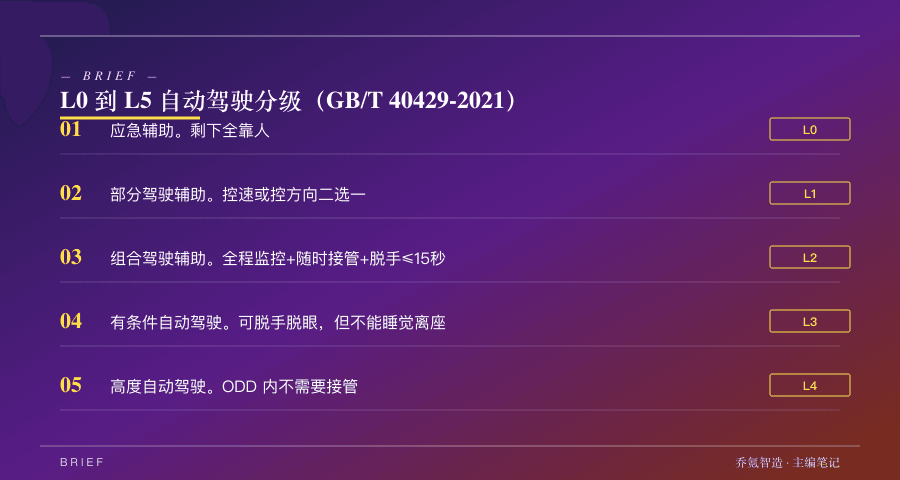
China will implement the national recommended standard for "Automobile Driving Automation Classification" in March 2022. This national standard divides car driving automation into six levels, from L0 to L5.
- L0: Emergency assistance. The system can help in an emergency, but the rest depends on people.
- L1: Partial driving assistance. The system can control speed or direction, choose one or the other.
- L2: Combined driving assistance. The system can control speed and direction at the same time, but the driver must monitor the entire process and take over at any time.
- L3: Conditional autonomous driving. The system can drive a vehicle within a specific operating domain (ODD). The driver can temporarily remove his hands and eyes, but he must respond to the takeover request at any time and is not allowed to leave the driving position or sleep.
- L4: Highly autonomous driving. The system can be driven independently in specific operating regions and the driver does not need to take over at any time.
- L5: Fully autonomous driving. The system is fully responsible for any environment and any conditions.
The words "smart driving, smart driving, assisted driving, autonomous driving, FSD, Autopilot, NOA, pilot assistance" that the public says every day correspond to a specific level from L0 to L5, but the public does not know which gear they are using.
What is the mainstream passenger car on the market?
As of June 2026, the vast majority of intelligent driving functions of domestic commercial passenger cars are at L2 or L2+ level .
Including but not limited to-Tesla FSD (China version), Huawei ADS, Xiaopeng XNGP, Ideal AD Max, NIO NOP+, BYD Eye of God, Chang 'an Qiyuan series, Wenjie series, zero-running series, Xiaomi SU7 smart driving.
These functions are all L2 or L2+ in the national standard, which means that-the driver must monitor the vehicle throughout the entire process and must be ready to take over at any time. ** The time to get rid of the vehicle should usually not exceed 15 seconds (each car company has a slight difference, some 30 seconds later. Forced lock).*
So how many L3 cars are there?
On December 15, 2025, the Ministry of Industry and Information Technology officially announced the first batch of L3 conditional autonomous driving vehicle access permits.
The first batch is only two models- Changan Deep Blue SL03 and Extreme Fox Alpha S6.
The L3 access of these two models has very strict operating domain restrictions--
- Changan Deep Blue SL03: Only in designated areas in Chongqing, the maximum speed shall not exceed 50km/h, and automatic driving is only allowed in a single lane.
- Extreme Fox Alpha S6: Only on certain routes in Beijing, the maximum speed shall not exceed 80km/h, and single lanes are also restricted.
Chang 'an received the first domestic L3 special license plate "Yu AD0001Z" on December 20, 2025. Jihu received the L3 license plate "Beijing AA0001Z" on December 23.
Except for these two vehicles, before June 2026, all other passenger cars on the market in China will be L2 or L2+*, and none will be L3.
L3 No sleeping allowed
This is a detail that many people don't know.
According to the national standard GB/T 40429-2021 "Automobile Driving Automation Classification" and the "Beijing City Autonomous Vehicles Regulations" implemented in April 2025--
Level L3 autonomous driving allows the driver to temporarily disengage from the driving task (hands off, eyes off) under specific conditions that meet the operating range, However, the driver is not allowed to deeply disengage from the driving task -cannot leave the driving position, cannot sleep, and cannot engage in other activities that conflict with driving safety.
L3 mandatory installation of a data recording device (DSSAD,"black box") to record data at least 90 seconds before the accident as the core basis for liability determination.
In other words--
Under the national standard and current regulations, no passenger car sold on the market in China is allowed to sleep while using smart driving.
L2 cannot be sold. L3 can be sold but cannot sleep. L4 and L5 have not yet been allowed for passenger cars in China.
Therefore, Duan Yongping's "falling asleep for 40 minutes" and "taking off the steering wheel with both hands" in the Jiangxi accident are not allowed under current China regulations at any level.
QKPFX15 How did this cognitive fault come from?
This fault does not come from a single aspect, but is caused by multiple parties together.
First, the use of words is confusing.
"Smart driving, intelligent driving, assisted driving, autonomous driving, FSD, Autopilot, NOA, NCA, pilot assistance, urban pilot, high-speed pilot, intelligent pilot, PILOT, HiPilot, XNGP, ADS, AD Max, NOP+"-These words point to different levels in the promotion of different car companies, but are mixed in public awareness.
The full name of the three letters FSD is Full Self-Driving, which literally means "fully autonomous driving", but the version actually sold in China is L2 level assisted driving. This gap is one of the sources of user cognitive errors.
Second, car companies tend to use stronger terms in marketing.
Domestic car companies generally position their smart driving products as "L2+" rather than "L3". There are two reasons, one is technical gaps and the other is legal responsibilities.
L3's legal liability is very complex-once the system is activated within the ODD and an accident occurs, the liability may be attributed to the car company or system supplier. The responsibility of L2 lies entirely with the driver, which is most beneficial to the car company.
However, in terms of marketing, car companies hope to make users feel that this system is "similar to autonomous driving", because this can create a product premium and form competitive differentiation.
This tension of "legal liability L2 + marketing rhetoric L3+" is the norm in the industry from 2024 to 2026.
3. The demonstration effect of opinion leaders and the media.
Investors, KOL, car critics, and car owners bloggers shared content such as "I don't have to take over even driving FSD/NOA/NCA" and "watching videos, eating, drinking coffee, and making phone calls on high-speed roads" on social platforms.
After watching it, the public formed a recognition-"It turns out that when you open it, you can let go."
Duan Yongping's description this time is not an isolated example. In the past two years, such contents as "Smart Driving Hands Off","Smart Driving Hands Off N Miles" and "I Don't Have to Move Smart Driving" have been widely spread in Douyin, Xiaohongshu, Station B, and Weibo.
There is a serious imbalance between this demonstration effect and the official science popularization of "correct use of smart driving."
Fourth, supervision is accelerating but cannot keep up with the market speed.
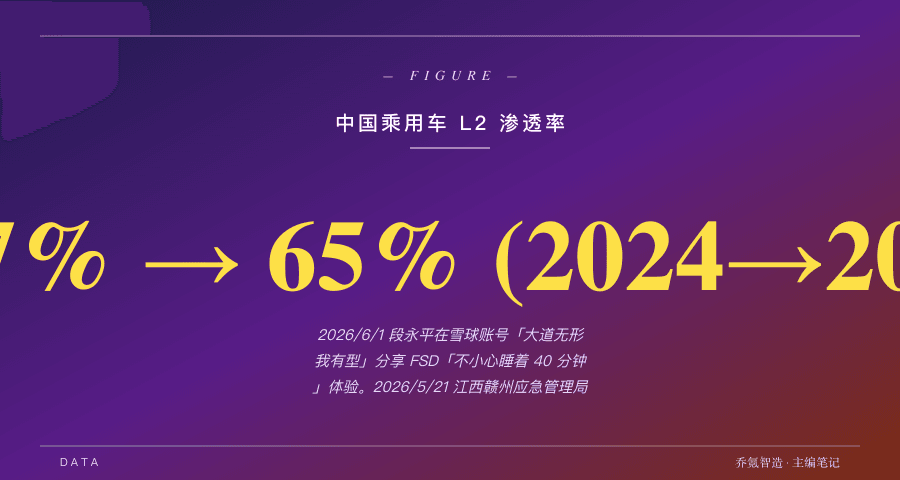
The national standard will be implemented in March 2022, the first batch of L3 pilot consortium licenses (9 vehicles) will be issued in June 2024, and the first batch of L3 mass production access (2 vehicles) will be issued in December 2025. During the same period, the penetration rate of L2 and above increased from 55.7% in 2024 to an estimated 65% in 2025.
Supervision follows the line of "strict access and strict regulation". The market is following the route of "fast laying, fast scale". The middle area between these two routes is the place where cognitive faults are most likely to go wrong.
How did the cognitive fault work in the accident in Jiangxi
Go back to more than 5 minutes at 4 a.m. on October 2, 2025.
At 3:59:34, the driver Zhang activated smart driving and took off the steering wheel with both hands. It hit the semitrailer at about 4:00. Less than a minute in between.
The smart driving of this Chang 'an Qiyuan A07 is L2. According to the L2 national standard, the driver must monitor the entire process and let go for no more than 15 seconds.
Zhang chose to take off the steering wheel with both hands, violating L2 operating specifications.
But when he did this action, he probably didn't know that "taking off the steering wheel with both hands" was prohibited under the L2 framework. In his understanding, it may be "This car has smart driving, I turn it on, it can drive on its own"-this is a direct result of the cognitive gap mentioned above.
The truck is also responsible. The driver will not cut the main and auxiliary fuel tanks, the vehicle will stall and stop in the fast lane on the left side, the warning cone will be up to 45 meters (much lower than the 150 meters required by regulations), and the alarm will not be reported in time. These are all safety regulations issues for the freight industry and have nothing to do with smart driving.
But If Zhang keeps his hands on the steering wheel and his eyes on the road -according to the minimum requirements of L2-he will likely find an abnormality in front of him with a few hundred meters left and make emergency avoidance or deceleration. An L2 car has sufficient reaction time to a stationary cart 200 meters away under the normal supervision of the driver.
This is a typical form of tragedy caused by cognitive faults-it's not that cars can't work, it's not that roads can't work, but that "what users think cars can do" far exceeds "what cars can actually do."
QKPFX17 What does QK mean to ordinary people
If you drive a new energy vehicle, or consider buying a new energy vehicle, or if someone at home drives a new energy vehicle, here are 3 specific things.
First, find out what class your car is actually in.
Open the vehicle manual and see the official classification of the intelligent driving system. It is not the marketing terms such as "L2+","smart driving","NOA" and "pilot", but the terms L0 to L5 in the national standard.
As of June 2026, unless you buy Changan Deep Blue SL03 (in Chongqing ODD) or Jihu Alpha S6 (in Beijing ODD), your smart driving car has a high probability of being L2 or L2+.
Second, L2 will always monitor + take over at any time.
L2's clear requirements--
- hands cannot be separated from the steering wheel (usually not more than 15 seconds)
- Eyes should look ahead
- cannot sleep, watch videos, eat, and make phone calls
- must be ready to take over
If you can't do it, either don't start smart driving, or keep yourself focused after starting it.
Third, marketing terms and legal responsibilities should be viewed separately.
The promotional skills of car companies often give people the feeling that "this car can drive itself." However, once an accident occurs, the definition of legal liability is still based on the national standard classification-if an accident occurs at level L2, the responsibility lies with the driver.
The "Beijing City Autonomous Vehicles Regulations" that came into effect in April 2025 clearly require L3 vehicles to be mandatory to install DSSAD "black boxes" and record data 90 seconds before the accident as the core basis for responsibility determination. L2 vehicles do not have this set of mandatory requirements, and it is more difficult to have objective evidence of accident responsibility.
This means-if you drive an L2 car and cause an accident, you are likely to bear full liability for compensation, and there is no black box to help you prove that there is a problem with the system.
Last
The discussion on smart driving during the week of June 2026 seems to have erupted because of the collision between Duan Yongping's remarks and the Jiangxi investigation report.
But looking down on the next level, it is a concentrated manifestation of the structural problem of "L2 penetration has increased from 30% to 65% in China's automobile industry in the past four years, but public awareness and regulatory details have failed to keep up."
Looking further down, there is the gap between the speed of technological development and the speed of "social education with standardized use." This gap is also emerging in other areas-AI tools, generated video, smart clients, medical AI-where every new technology is rolled out, there is a window where "technical capabilities" far exceed "users know how to use them."
This wave of smart driving is the most conspicuous and costly one at present.
Duan Yongping himself responded after being reminded by netizens-"I know I shouldn't sleep." This is his personal correction.
But broader revisions require--
- car companies are more restrained in marketing rhetoric and do not blur the boundary between L2 and L3+.
- regulation is clearer on the mandatory constraints on L2 use specifications (such as hard limits on off-hand time, mandatory DSSAD to sink to L2).
- media and opinion leaders clearly mark the grading and operating specifications when sharing the smart driving experience.
- users themselves must figure out where the boundaries of this set of functions lie before using the new features.
Only when these four parties move forward at the same time can the cognitive gap be slowly filled.
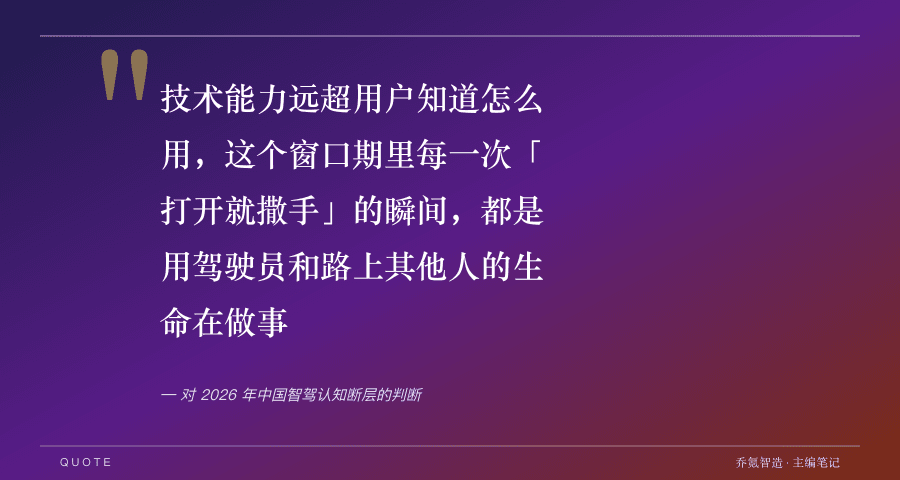
Before that, every moment of "opening and letting go" was done with the lives of the driver and other people on the road.
This should not be something that happens often.