NVIDIA buys default entry for open source models for $12.9 billion
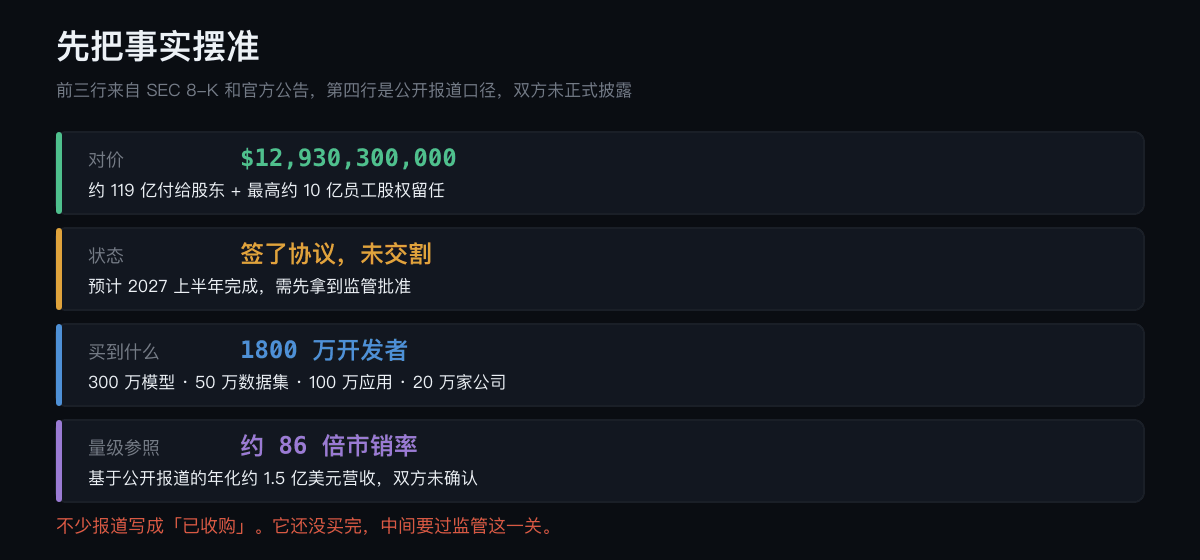
On September 2, Nvidia signed a final agreement with Hugging Face for a consideration of US$12.9303 billion, of which approximately 11.9 billion was paid to shareholders and a maximum of approximately 1 billion was employee equity retention. Let's make one mistake clear: the transaction has not yet been completed, and the 8-K states that it is expected to be delivered in the first half of 2027 and will be subject to supervision. Calculated based on publicly reported revenue, this price is equivalent to approximately 86 times the market-to-sales rate, which is obviously not based on revenue. Huang Renxun promised not to require developers to use Nvidia computing power. The word used in this promise is required, which constrains mandatory, not default: the example code on the model page, which backend the deployment button points to, and which benchmark runs on, these are what 12.9 billion yuan buys. The platform's own data shows that the top 200 downloaded models account for 49.6% of the downloads on the entire platform. If you want to affect distribution, you don't need to touch those 3 million models.
On September 2, Nvidia signed a final agreement with Hugging Face for a consideration of US$12.9303 billion. The next day, Huang Renxun announced the matter on his official blog.
Let's make one mistake clear: the deal has not yet been completed. The 8-K document states that delivery is expected to be completed in the first half of 2027, provided that necessary regulatory approvals are obtained. The current status is that the agreement has been signed, not that the purchase has been completed.
The price structure is also in the document: approximately $11.9 billion will be paid to Hugging Face shareholders, and an equity retention plan of up to approximately $1 billion will be paid to Hugging Face employees who join Nvidia.
This is the second-largest acquisition in Nvidia's history.
What I want to talk about is another thing: what exactly does the $12.9 billion buy, and how this money will change the interface developers encounter every day.
1. This price does not buy income
Hugging Face has never officially disclosed the size of its revenue. The figure circulated in public reports is around US$150 million per year, which neither party has confirmed, so the following arithmetic can only be used as a reference: 12.9 billion to 150 million, which is about 86 times the market-to-sales ratio.
Even if this number is inaccurate, the magnitude of the magnitude is clear. This price has nothing to do with income.
According to the official blog, there are 18 million developers, researchers and creators on this platform, 3 million models, 500,000 datasets, 1 million applications, and more than 200,000 companies in use.
Nvidia bought this position.
To be specific: When today's open source models around the world are to be published, where are they posted by default; when a developer wants to find, download, and test a model, which page does he open by default?
This position used to have no owner. There is now.
2. Last year, it rejected Nvidia
There is one detail worth looking at together.
According to public reports, Hugging Face rejected Nvidia's investment offer of about US$500 million last year, with a corresponding valuation of about 7 billion yuan, citing concerns that controlling the investment would undermine its neutrality. This article has also not been officially confirmed.
This year, its CEO publicly stated that he had contacted Huang Renxun on his own initiative.
There was a year between refusal and initiative.
My judgment is that what has changed this year is accounts.
Hugging Face plays the role of a public infrastructure: open source models around the world are published, stored, and distributed here. Weighting files often go up to tens of gigabytes, and bandwidth and storage costs rise with the size of the models. But its revenue structure cannot support this role, and annual revenue of more than $100 million (if that figure is roughly correct) does not match the magnitude of traffic it undertakes.
Neutrality has costs, and this cost keeps rising. It was affordable last year, but it can't be paid this year.
This in itself is more noteworthy than who bought it.
3. Promise to control "coercion" but not "default"
Huang Renxun gave a clear promise in the announcement, the original text read:
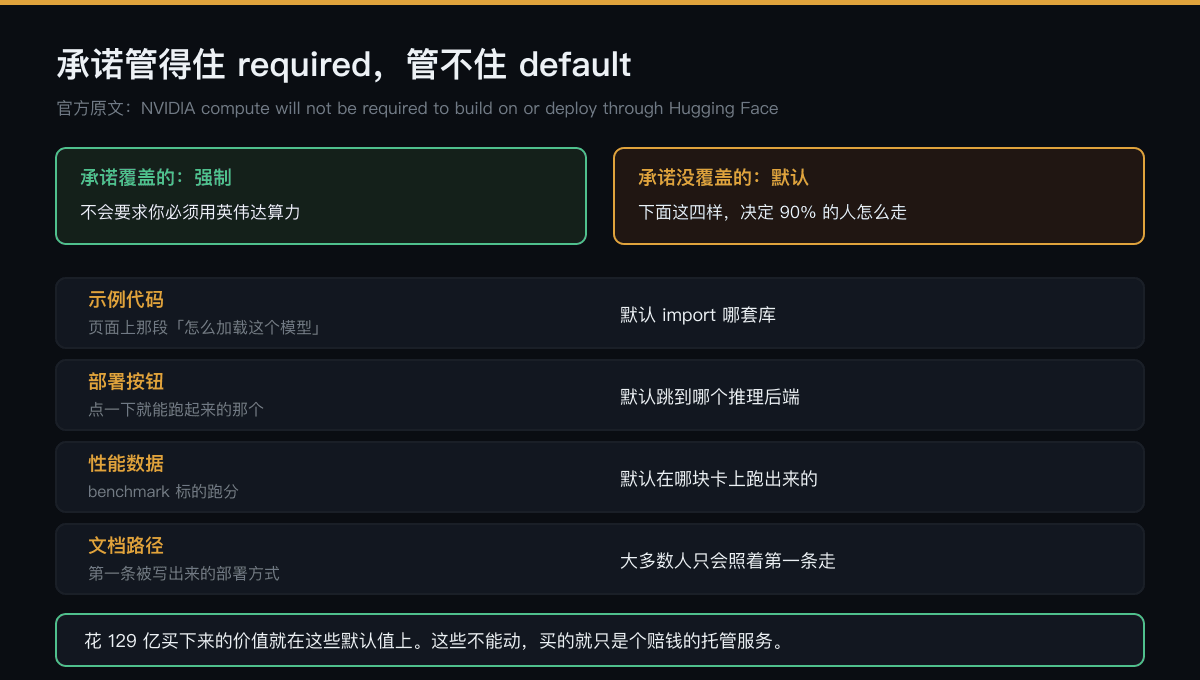
Developers will choose the models they want, the frameworks they want, the clouds and inference service providers they want and the computing platforms they want. NVIDIA compute will not be required to build on or deploy through Hugging Face.
To flip it over, developers choose what model, what framework, what cloud and reasoning service provider, and what computing platform they want to use. Building or deploying on Hugging Face will not be required to use Nvidia's computing power.
I think this promise is true and it is not difficult to keep.
Because the value of controlling the distribution portal has never been "mandatory".
Think about how you use this platform yourself. You search for a model and open its page. The page reads:
A sample code that tells you how to load it. A deployment button that jumps to an inference service after clicking. A piece of performance data marked on what hardware it ran on. A series of installation commands is used to install a certain tool chain.
None of these things have the word "mandatory". But they determine which path most people try to take for the first time. Most people continue to walk the road they took for the first time.
In the example code, which library is imported by default, which backend the deployment button points to by default, which card the benchmark runs on by default, and which deployment path appears first in the document. These are all default values and are not within the bounds of the promise of "required".
Nvidia may not necessarily do this. But you should see that the value of what you buy for 12.9 billion yuan is at these default values. If these default values cannot be moved, the money will just buy a loss-making hosting service.
Therefore, what should be looked at is whether these default values have changed in the next two years. It is useless to focus on commitments. The developer can observe this matter themselves and does not need to wait for anyone to announce it.
4. To affect distribution, you don't need to touch 3 million models
There is a feature in the ecological structure of this platform that many people have not noticed.
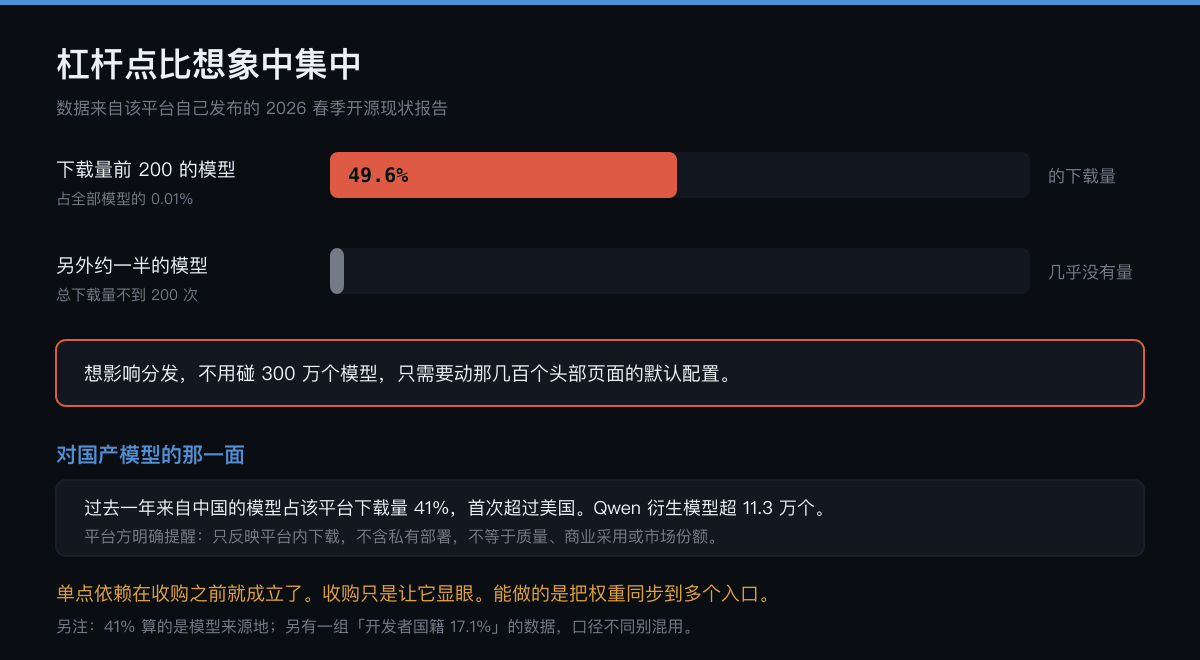
According to Hugging Face's own data in its open source status report in the spring of 2026: the top 200 models in downloads accounted for 49.6% of all platform downloads. These 200 models only account for 0.01% of all models on the platform.
There is another entry in the same report: About half of the models have a total download of less than 200 times.
This is an extremely concentrated distribution of heads.
What it means is: If you want to affect model distribution in this ecosystem, you don't need to move 3 million models, you only need to affect the default page configuration of those hundreds of head models. The workload of this matter is so small that it can be ignored.
This also explains why this position is worth 12.9 billion. The leverage ratio is too high.
5. What does it mean for domestic open source models
There is also another figure in the same report that is more direct to domestic model makers: in the past year, models from China accounted for 41% of the platform's downloads, surpassing the United States for the first time.
In addition, Ali's Qwen series has more than 113,000 derivative models, more than Google and Meta combined; the total number of models with the Qwen label exceeds 200,000.
These two numbers have to be read together with the reminder given by Hugging Face itself. They made it clear in the report: This only measures download behavior on the platform, does not include private deployment, does not represent commercial adoption, and cannot be used as a direct indicator of model quality or market share. Moreover, 41% isthe source of the model, and another set of data saying "China developers account for 17.1% of downloads" is based onthe nationality of the developers. The two standards are completely different and are often quoted in mixed terms.
Putting aside the issue of caliber, there is a structural fact that holds true: the overseas distribution of domestic open source models is highly concentrated on one platform.
I want to emphasize that this matter was already like this before this acquisition. Acquisitions do not create this risk, just make it visible.
This is a single point of dependence at the technical level and has little to do with who the buyer is. Change buyers, or don't sell, and the degree of dependence will be the same.
For a team making a model, what can be done is very specific: weights are sent to multiple platforms simultaneously, not just push one entry; domestic images and platforms should keep updated, and don't wait for problems in overseas channels to make up for them; if there are corporate customers who rely on your model, give them a way to obtain it without going through the platform.
These things are not costly to do, and no matter whether the deal is finally approved or not, there will be no loss in doing it.
6. This is not the first time and it will not be the last time
There have been several rounds in which the infrastructure that developers rely on has been bought out by commercial companies. Code hosting, package management, and mirror warehouse, the paths are all similar: a project grows out of the community and becomes a public facility that everyone uses by default, then finds that its income cannot support this scale, and is finally taken over by a wealthy company.
Every time an acquisition is announced, the promise is to "keep it open."
Most of them have indeed remained open. What changes are the default values, the priorities, and the things that are not written in the announcement: which function is done first, which integration comes first, and which type of user needs are met first.
My judgment is that the commercialization of such infrastructure is structural and has little to do with which company takes over. As long as its cost curve and revenue curve do not match, this day will come sooner or later.
To be fair: Without this money, whether Hugging Face could support its current scale is a problem in itself. Storage and bandwidth in the open source ecosystem are not free, someone has to pay. This and the fear of weakening neutrality are two things that are true at the same time.
7. What to look forward to
Regulatory approval. Delivery is expected in the first half of 2027, with supervision in the middle. For a company with an absolute share of AI computing power to acquire the most important distribution platform for open source models, the review will not be easy. There is no answer yet.
Default value. As I said above, this is the most important thing to watch. Sample code, deployment portals, inference back-end, benchmark hardware, any of these things starting to tilt in a single direction are more telling than the wording in the announcement.
Will developers vote with their feet? What keeps people are habits and network effects, and there are no technical barriers. If you really want to move, it is not so difficult technically. What is difficult is that everyone moves together. So there is a high probability that nothing will happen in the short term, but in the long run, it depends on the previous one.
Will other platforms fill in positions? Concentration of heads means that the threshold for replacements is actually not high. As long as the hundreds of head models can be synchronized well, there will be an opportunity to undertake part of the distribution needs.
Last
$12.9 billion, with a price-to-sales ratio of 86 times (if that revenue figure is roughly true), bought the default entry point for open source models around the world.
This price doesn't make sense in the traditional financial framework, but makes sense in the framework of distribution rights.
For those who use this platform every day, there will be no feeling on delivery day. Changes will occur after a revision: you notice that the import line in the example code has been changed, or the deployment button has jumped somewhere else.
That was the moment when the 12.9 billion yuan came into effect.
few sentences boundary
The transaction amount, agreement signing date, delivery time, and consideration structure are from Nvidia's 8-K document filed with the SEC and official blog announcements. The transaction has not yet been completed and still requires regulatory approval.
Hugging Face's revenue scale and its rejection of Nvidia's investment last year came from public reports that were not officially disclosed by both parties. The price-to-sales ratio calculation based on this in this article can only be used as a magnitude reference.
The ecological data comes from Hugging Face's own open source status report, which clearly states that these numbers only reflect activity within the platform and cannot be directly used as a measure of model quality, commercial adoption or market share.
The platform scale figures are based on the official announcement, but are slightly different from the report according to different time points.