Mobile phones and computers are rising in prices, and memory is being snatched away by AI data centers
People who change mobile phones and computers this year feel that it is expensive. The reasons are very concentrated: the proportion of mobile phone material costs used to be 10% to 15%, but in February this year it has reached 30% to 40%, becoming the most expensive single part. Even Apple has adjusted the price. Conventional memory contract prices actually rose by 93% to 98% in the first quarter. HBM, which originated in AI data centers: Micron said that to store the same amount of data, it would consume about three times the amount of wafers as ordinary memory; and according to estimates by analysts, its selling price per bit is about 6 times that of ordinary memory. Calculated, the income from making HBM on the same wafer is about twice that of making ordinary memory. Your mobile phone memory is actually bidding for the same wafer as the AI accelerator card. What is even more counter-intuitive is that the more violently HBM expands production, the tighter the memory of consumer electronics will be.
People who change mobile phones and computers this year probably have the same feeling: Why is it expensive again?
The reasons this time are concentrated. Taking apart the bill of materials for a mobile phone, memory used to only accountfor 10% to 15%of the cost of the whole machine. In February this year, this proportion had risen to30% to 40%. By August, market research firm Jibang Consulting judged that memory had becomethe most expensive partin mobile phones, and even Apple was forced to adjust its retail price due to rising material costs.
The cost of a chip that stores data exceeds the processor of a mobile phone.
The source of this matter is not in the mobile phone industry, but in the AI data center thousands of kilometers away.
1. How much is it bullish first
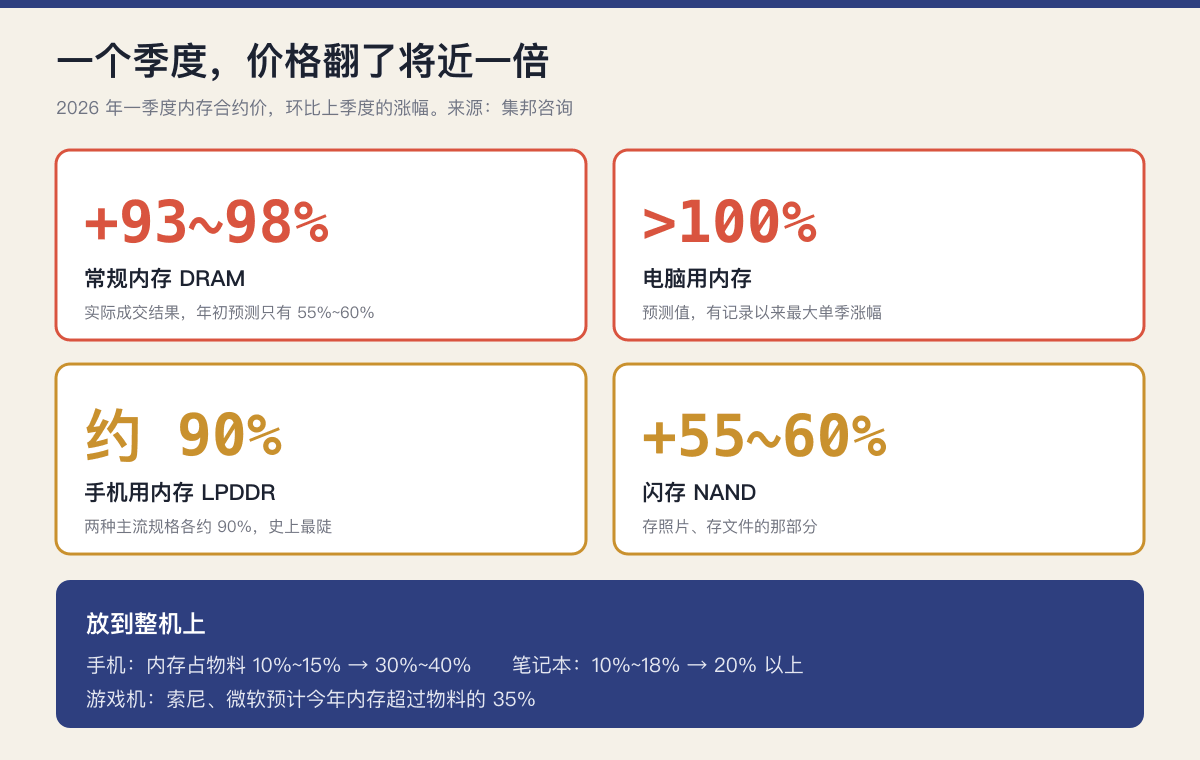
Contract prices are signed between memory manufacturers and mobile phone and computer brands on a quarterly basis. The contract price for the first quarter of this year is as follows:
Conventional memory (DRAM) rose by about 93% to 98% in a quarter. This is the result of actual transactions. The forecast at the beginning of the year was still 55% to 60%. In February, it was raised to 90% to 95%, which was finally higher than the increase.
In terms of categories, memory for computers is expected to rise by more than 100% in a single quarter, the largest quarterly increase on record; the two mainstream memory for mobile phones each rose by about 90%, which is also the steepest in history; flash memory (NAND) for storing photos and files rose by 55% to 60%.
In one quarter, prices nearly doubled.
Put it on the whole machine, it's the beginning: the cost of memory in the mobile phone has increased from more than 10% to 30% to 40%. Notebooks have increased from 10% to 18% to more than 20%. Game consoles are even more exaggerated. Sony and Microsoft expect memory to account for more than 35% of material costs this year.
2. Why only memory?
"AI is in great demand, so it is out of stock." This sentence is correct, but it is too rough. What is missing and why it is so lacking depends on the account of a wafer.
Memory is made on a wafer. The production capacity is as much as the memory can be cut out from a wafer.
AI data centers use a special type of memory calledHBM (High-Bandwidth Memory). You can understand it as stacking several layers of memory chips, opening them up with thousands of vertical channels, and pasting them next to the AI accelerator card to make the data run fast enough.
The problem is that it costs a lot of chips.
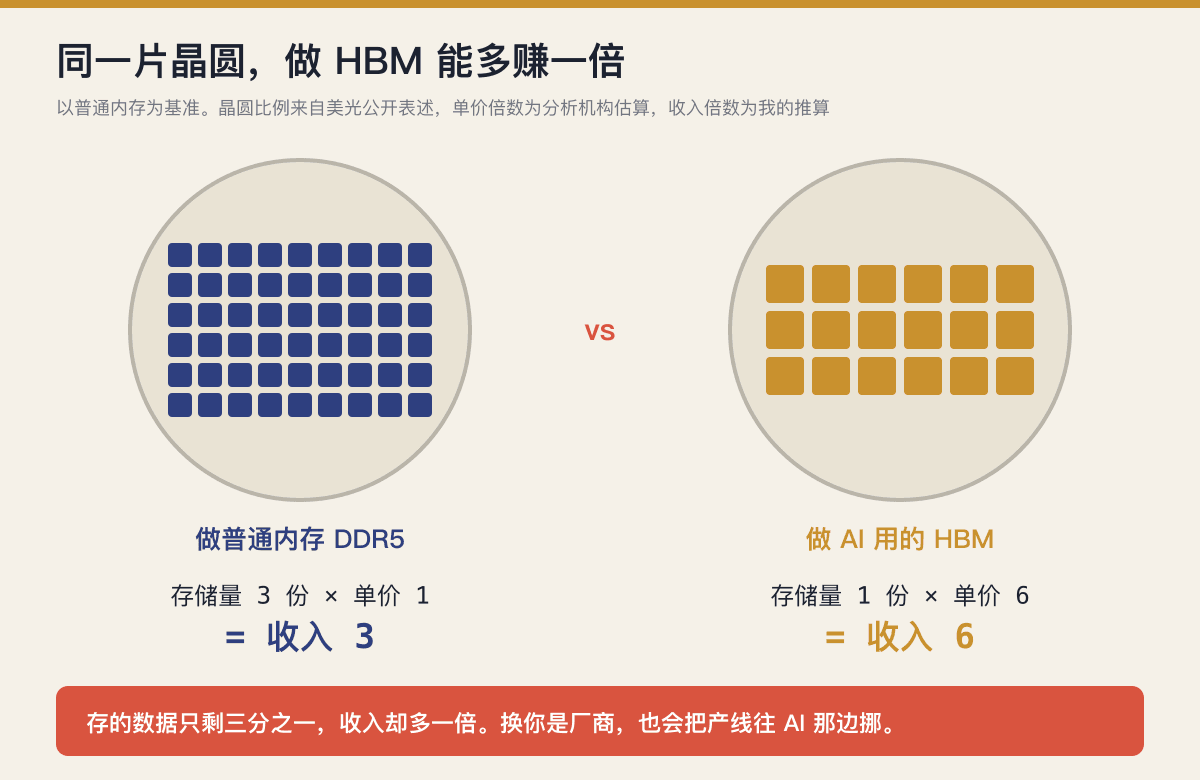
Micron gave a figure at a chip industry conference this year: to store the same amount of data, the HBM3E requires about three times the wafer required by ordinary DDR5 memory, and the proportion to the next generation HBM4 will be even higher.
The reason is not just the large chip area. Wider interfaces, several times more memory cells, vias that penetrate the chip, and yield losses when stacked layers are all eating the wafer.
So why do manufacturers still do it?
Because it's much more expensive. According to estimates by analysts, for every bit stored in HBM, the cost is about three times that of ordinary memory, but the selling price is about six times.
Put these two numbers together and you can calculate the account for a wafer:
If you take the same wafer to make HBM, only one-third of the data can be stored, but each wafer will be sold for six times the price. Calculated, the income from making HBM on this wafer is about twice that of making ordinary memory.
If you were a manufacturer, you would move your production line that way.
3. Your mobile phone is competing for the same wafer with the AI accelerator card
This is my most direct understanding of this round of price increases:
The few memories in your mobile phone and the AI acceleration card in the data center are bidding for the same wafer. The other party bid twice as much for each piece.
No one is plotting here, it is a very simple business account.
Another set of estimates from analysts better illustrate this mismatch: HBM only accounts for about 10% of all memory shipped bits, about 15% of the wafers used, but nearly half of the revenue.
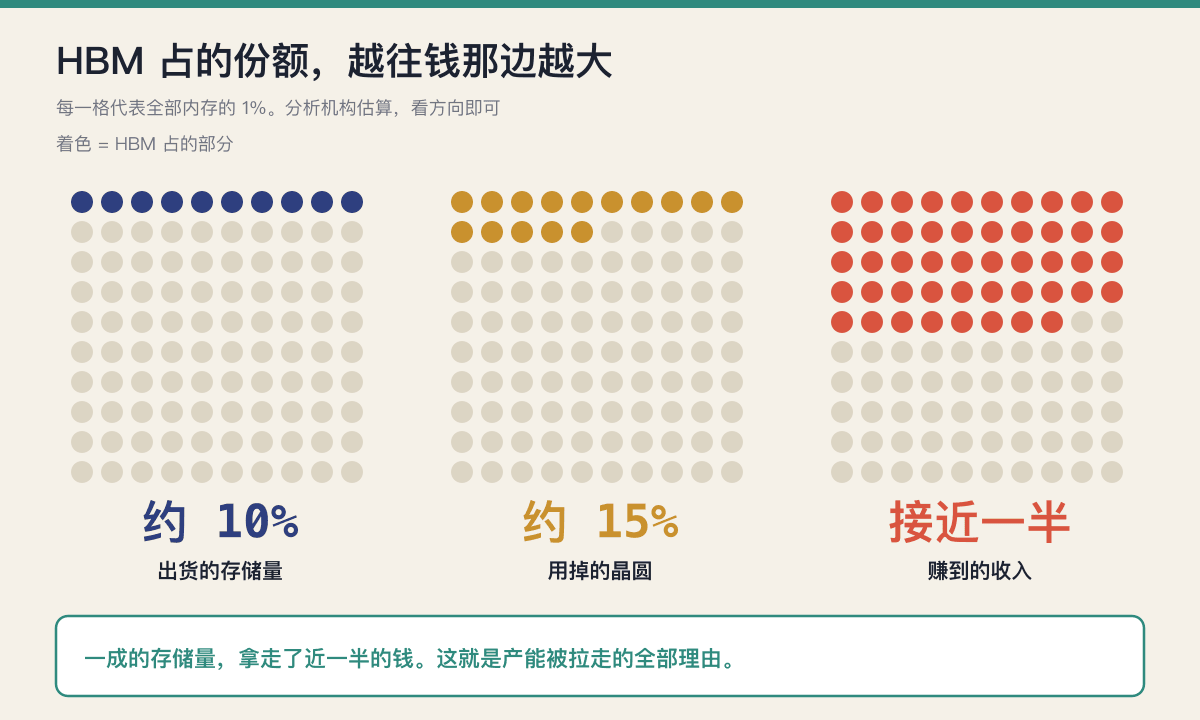
There is also a very counterintuitive corollary: the more HBM expands, the tighter the memory of mobile phones and computers will be.
Intuitively, it is a good thing for manufacturers to expand production. If there is more supply, prices should be lowered. But this round of expansion is HBM. For every extra HBM you make, you have to take away about three ordinary memory wafers. Before the new factory is actually put into production, this is basically a zero-sum game. The more the AI takes, the less the consumer electronics side.
And HBM itself is stuck. It also needs to go into advanced packaging after completing the chip. The packaging delivery period in the report has been scheduled to 52 to 78 weeks. If HBM's supply does not come up, AI will continue to increase prices and grab wafers.
4. Price increase is only the first level
As costs rise, there are only three things brands can do: raise prices, reduce allocations, and sell less. All three things are happening this year.
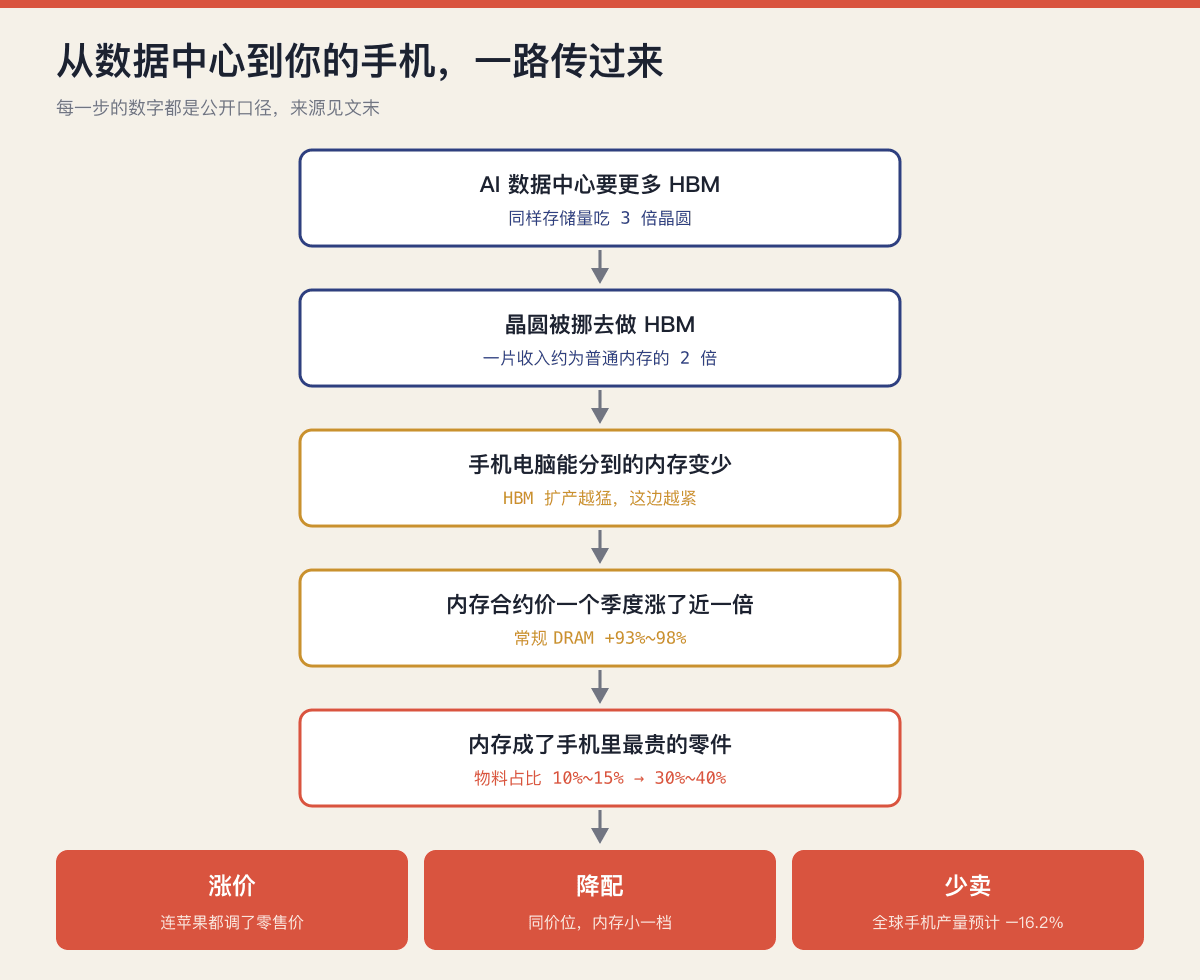
Everyone has already felt the price increase.
The downgrading ismore concealed. Jibang Consulting reminded in December last year that brands began to increase prices while reducing configurations. At the same price point, the memory may be a notch smaller, which you can't see without carefully comparing the parameters.
Selling lessis the ultimate result. Jibang's forecast for global mobile phone production this year is a year-on-year decrease of 10% in February anda year-on-year decrease of 16.2% by June, or approximately 1.05 billion units.
One industry produces less than one-sixth of its products in a year because another industry is competing for its raw materials.
5. When will I recover?
This part is all institutional predictions and can only look at one direction.
Some investment banks have judged that the shortage of ordinary memory will continue until around the first quarter of 2027. According to reports, HBM's production capacity is about 120,000 wafers per month at the end of this year, and will reach more than 145,000 wafers next year. However, Jibang estimates that HBM still has a gap of nearly 20% this year.
According to the logic in Section 3, as long as HBM is still short, manufacturers have no reason to return production capacity to mobile phones and computers. Therefore, the prerequisite for easing is either that demand on the AI side cools down, or that new fab is put into production in large numbers. Neither of these things will be visible in the short term.
6. Three things that are useful to you
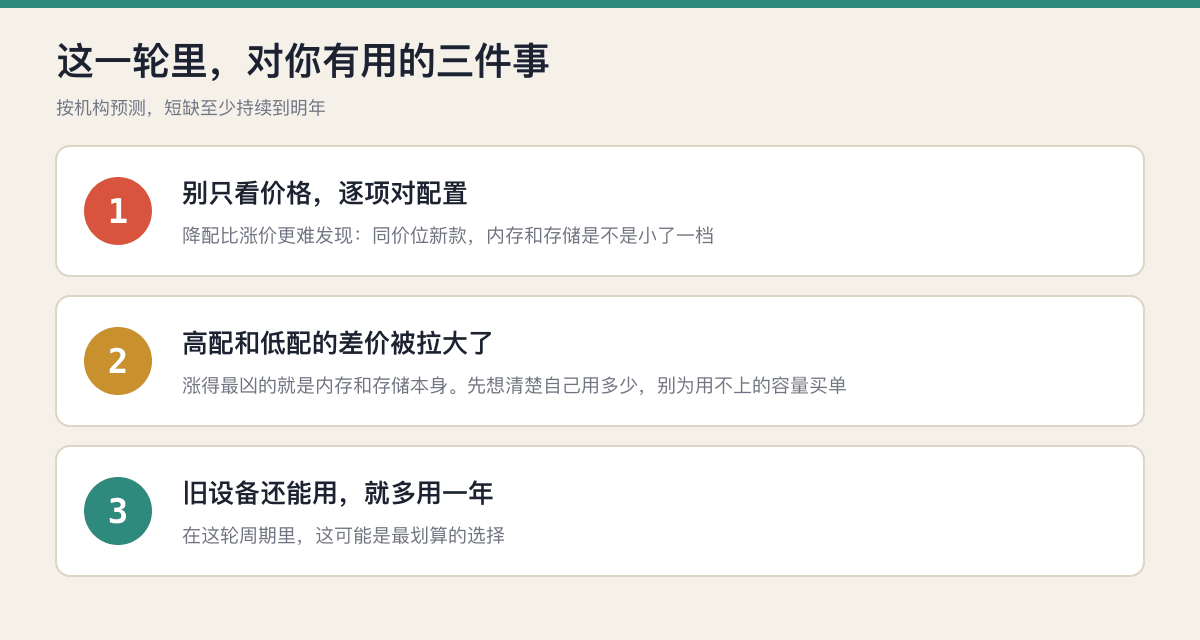
First, when buying mobile phones and computers this year, don't just look at the price, but check the configuration item by item. Reducing the ratio and increasing the price is easier to ignore. For the new model at the same price, whether the memory and storage are a notch smaller than the previous generation, it is worth taking a look at the parameter table.
Second, the premium for large-capacity versions has been increased. The ones that have increased the most are memory and storage itself, so for the same model, the difference between the high and low configurations will be greater than before. Think clearly about how much you use first, and don't pay more for the capacity you don't need.
Third, if the equipment on hand can still be used, using it for an extra year is the most cost-effective option in this cycle. According to current agency forecasts, this round will last until at least next year.
Last
In the past, when AI was far away from ordinary people, it meant that its capabilities were far away from us.
This time it was very close to us, just coming from the cost side. When an industry explodes, the first thing ordinary people realize is that it makes something more expensive, and what it can do comes behind.
few sentences boundary
The increase in memory contract prices, the proportion of mobile phones and notebook materials, and mobile phone production forecasts all come from a report publicly released by TrendForce. Among them, 93% to 98% are actual transaction results in the first quarter, and the rest are institutional forecasts.
The claim that HBM uses about three times as many wafers as DDR5 comes from Micron's public statement, which is aimed at the comparison between HBM3E and DDR5 of the same process and the same number of bits.
HBM costs about 3 times per bit, sells for about 6 times, and the number of units of 10% of bits, 15% of wafers, and nearly half of revenue are estimated by analysis agencies. They are not disclosed by manufacturers, but only depends on the direction. "The income of a wafer is about twice" is calculated by dividing 6 by 3, which is just an order of magnitude.
The duration of the shortage and production capacity figures are institutional forecasts and reporting standards. This article does not constitute any purchase or investment advice.