Meitu's AI business, the largest cost goes to the app store
In the first half of the year, Meitu's revenue increased by 22% and net profit increased by 40%. Everyone said that AI made it make money, and insiders were worried that computing power would eat up profits. Taking apart the original semi-annual report, the largest cost is the share paid to payment channels such as Apple and Google: 375.6 million yuan, accounting for 59.5% of the cost of sales and 2.8 times the cost of computing power and cloud. Counter-intuitively, the computing power consumed by users has increased by about 113%, while the cost of computing power and cloud has only increased by 25%, because 96% of the output comes from its deliberately narrow self-developed model. The largest toll is charged when users click to purchase, and the growth rate of overseas paying users is about twice that of mainland China. The more successful the voyage, the heavier the share. Another change is that the ceiling of subscriptions has been opened: the average paying user is about 200 yuan a year, and the number for some high-spending users is more than 10 times. The judgment is given at the end of the text and which three numbers will be reflected if the judgment is wrong.
Many people have read Meitu's report card for the first half of this year: revenue was 2.213 billion yuan, an increase of 22%; net profit attributable to the parent company was 619 million yuan, an increase of 40%.
So there was a popular saying: AI made Mito make money.
Insiders usually add one worry: AI burns computing power on a per-time basis. The more people use it and the harder it is used, the faster the cost will rise, and the profits will be eaten up sooner or later.
To be honest, when I saw its gross profit margin drop by 3.8 percentage points, my first reaction was the same.
However, in the original semi-annual report, costs are listed item by item. After taking it apart, the answer is quite different from these two statements:
The largest part of Mito's costs is the share paid to the application store, which is 2.8 times the combined computing power and cloud. On the other hand, it suppresses the computing power the most.
First, confirm first: it did earn money
There is no doubt about this, the numbers are solid.
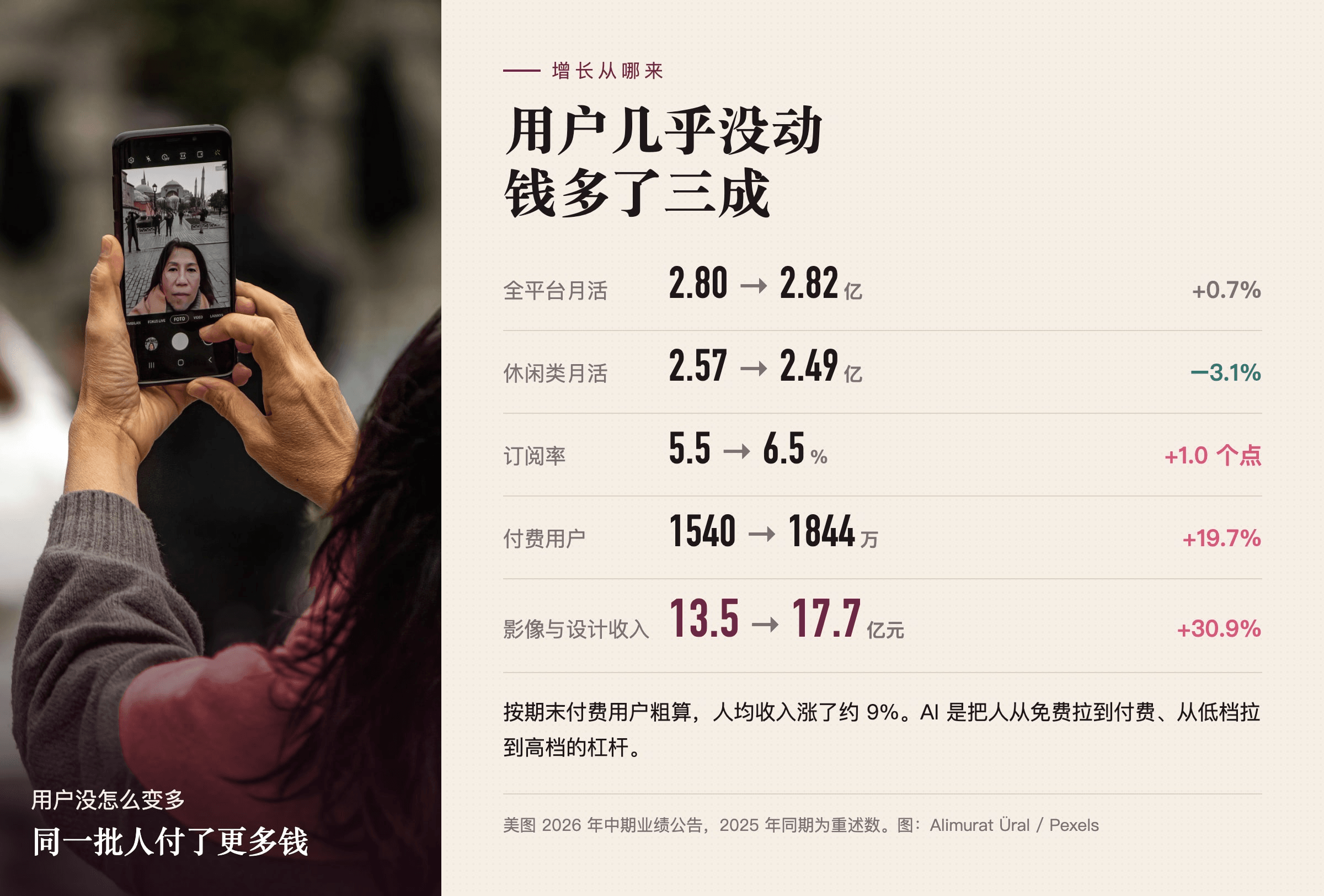
In the first half of the year, revenue from imaging and design products was 1.769 billion yuan, an increase of 30.9%, accounting for 80% of total revenue. There were 18.44 million paying users, an increase of 19.7%. The annual revenue of "productivity applications" for work scenarios such as e-commerce and oral video has reached approximately 620 million yuan.
The adjusted net profit was 652 million yuan, an increase of 39.5%.
But where growth comes from is worth taking a closer look.
The entire platform has a monthly activity of 282 million yuan, compared with 280 million yuan in the same period last year, almost unchanged. Among them, monthly activities for leisure applications such as retouching and taking photos dropped by 3.1%.
The number of users has not increased much, but the money has increased by 30%. There are two reasons: the subscription rate has increased from 5.5% to 6.5%, and based on a rough calculation of end-of-period paying users, per capita income has increased by about 9%.
In other words, what Mito did this year was to receive more money from the same group of people. AI function is the lever that pulls people from free to paid, and from low-end to high-end.
2. The gross profit margin dropped by 3.8 points. Where did it go?
Revenue rose 22%, and cost of sales rose 41%, from 448 million yuan to 631 million yuan. Gross profit margin dropped from 75.3% to 71.5%.
The semi-annual report broke up the 631 million yuan into several pieces. I follow the original figures and then use the growth rate to launch the same period last year. Put them together:
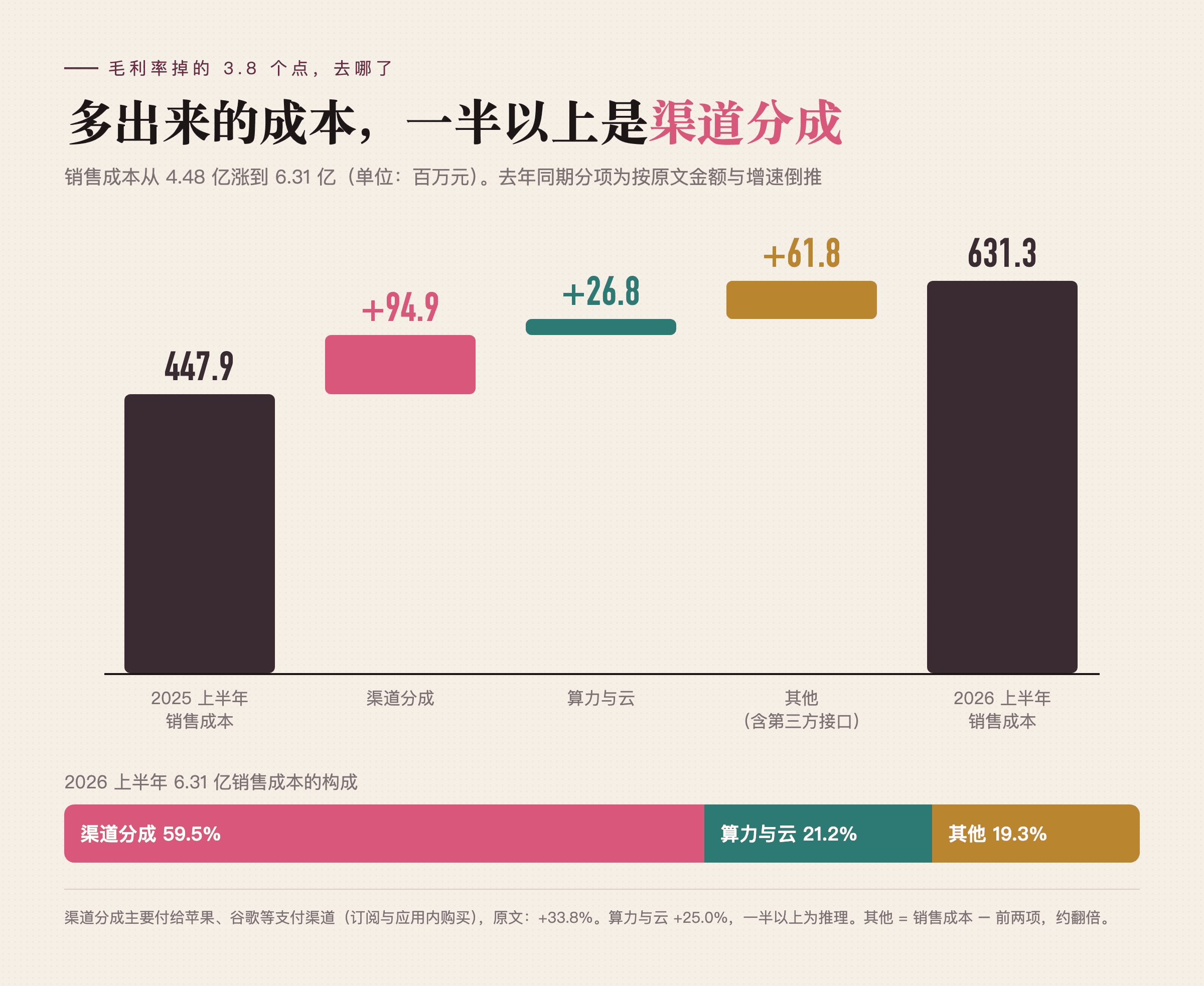
Payment channel share: 375.6 million yuan, an increase of 33.8%. The original text states that it is mainly paid to payment channels such as Apple and Google, corresponding to subscriptions and in-app purchases. This accounted for 59.5% of the total cost of sales.
Cost of computing power and cloud: 134.1 million yuan, an increase of 25.0%. More than half of it is reasoning and computing power.
The remaining approximately 121.6 million yuan, including the cost of third-party model interfaces, etc., was approximately 60 million yuan in the same period last year, more than doubling.
The total cost was increased by 183.5 million yuan: 94.9 million more channel shares, 26.8 million more computing power and cloud, and 61.8 million more others.
Of the extra costs, more than half is channel share, and the computing power only accounts for less than 15%.
3. The first counter-intuition: computing power is the one you need to worry about the least
This is what I think deserves the most attention of experts in this financial report.
In the first half of the year, the AI power points consumed by users increased by approximately 113%. During the same period, the cost of computing power and cloud only increased by 25%.
The usage has more than doubled, and the bill has only increased by a quarter.
The reason is written in two sentences: more than 96% of the output comes from Meitu's self-developed model. This self-developed model is deliberately "narrow".
There was a paragraph in the chairman's letter that was very straightforward: they did not allow the model to handle all possible requests, but only stared at the few things that determined whether a portrait looked good or not, re-lighting, makeup, hairstyle, and portrait details. A small model that only practices these few things can outperform a large model in its own field, but the training cost is much lower.
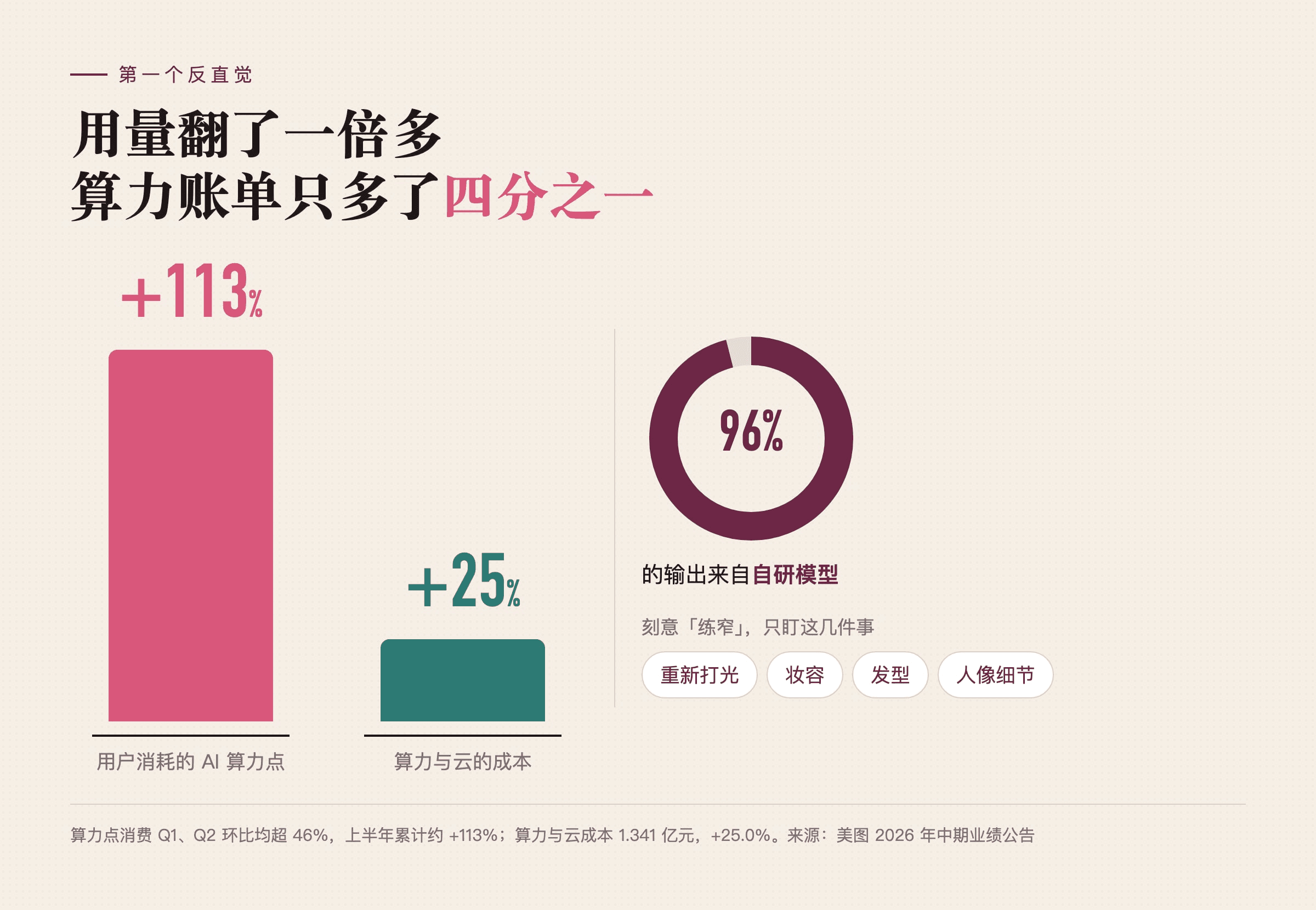
The significance of this incident is that what AI applications fear most is "the more they use, the more they lose." Miitu basically suppresses it in its own home court.
Cost pressures actually appear on the other side. The original text acknowledges that those new AI-native applications that are still in the early stages haverelatively high model interface costs per unit of income; while mature products such as Meitu Xiuxiu and BeautyCam have basically the same gross profit margins as in previous periods.
This coincides with the other cost that has more than doubled: new products are still using a large number of external models, and this part can only be suppressed when they are also replaced with self-developed "narrow models." The company's own statement is that new products are verified first, users are attracted first, and gross profit is optimized later.
4. The second counter-intuition: tolls are collected in the app store
Back to the biggest cost.
Of every 100 yuan of income, about 17 yuan is paid to payment channels, about 6 yuan for computing power and cloud, and about 5.5 yuan for other costs, and the remaining 71.5 yuan is gross profit.
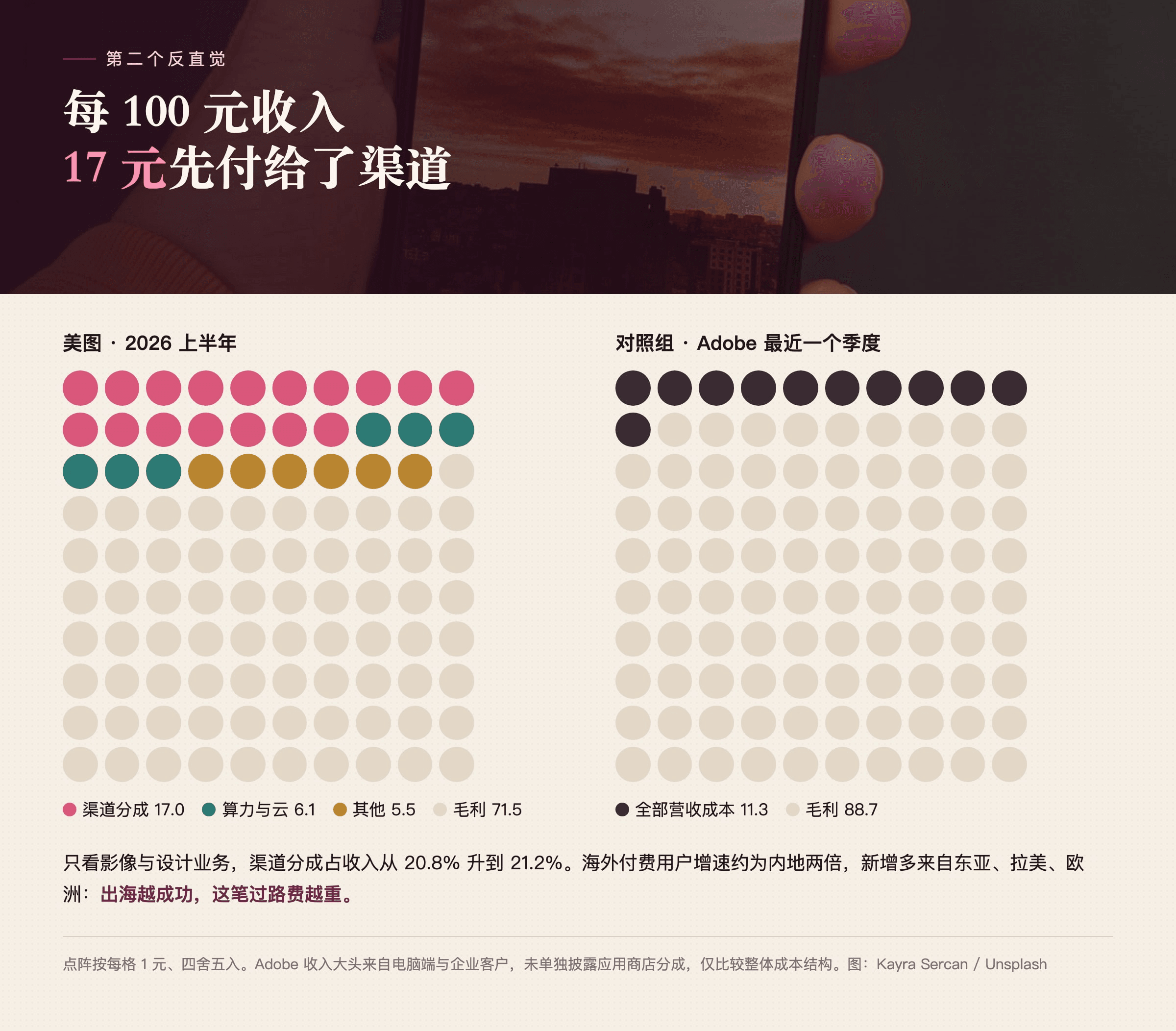
If we only look at the imaging and design business, the proportion of channel share in its revenue increased from 20.8% in the same period last year to 21.2%. The share increased by 33.8%, faster than the 30.9% growth rate of this business revenue.
Why does the share increase faster than the income? There is a saying in the financial report that can be matched: the growth of overseas paying users is about twice that of mainland China, and most of the new overseas paying users come from regions with high customer unit prices such as East Asia, Latin America, and Europe.
In these markets, Apple and Google's app stores are basically unavoidable when users pay.
So there is a structural inference here: the more successful Meitu is going to sea, the greater the proportion of this toll will be. Meitu didn't do anything wrong. This is the rule of the mobile app business.
Take a control group and see it better. In Adobe's most recent quarter, total revenue costs accounted for only 11.3% of revenue, and gross profit margin was 88.7%. The bulk of its revenue comes from computers and corporate customers, which is very different from Meitu's revenue structure. Meitu accounts for 17% of total revenue based on channel division alone.
5. The third change: the subscription ceiling has been opened
This is the most promising part of this financial report, and it also happens to be related to tolls.
Traditional subscriptions have one drawback: each user pays at most that much money per month, and the gear is fixed.
Meitu has connected Agent to its products this year, so users can let it complete a complete set of e-commerce maps and an entire video in one go. The more work you do, the more power points you consume, and the more money you pay.
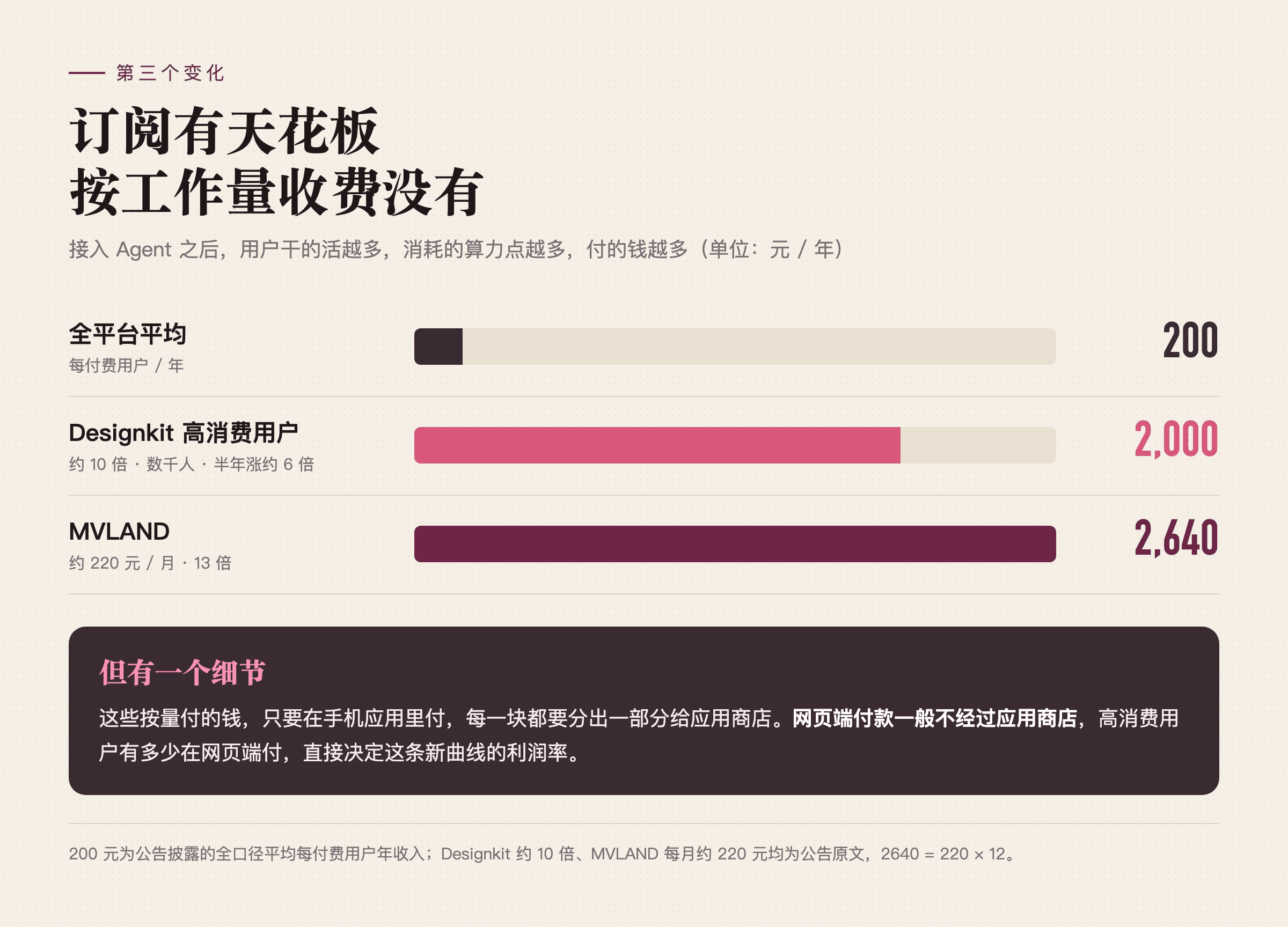
The original text gives several numbers:
The average annual revenue per paying user for the entire platform is about 200 yuan. There are thousands of users in the Designkit, and the annual consumption is about 10 times this number, which is about 2000 yuan. This group of people has grown about six times since December last year. MVLAND, which makes music videos, costs about 220 yuan per paying user per month, which is 13 times the average.
The chairman's original words were to the effect that the consumption limit of productivity users is determined by how much the product can accomplish for them. The past price range is no longer able to frame it.
I agree with this sentence. But it also means something else: a portion of each piece of money paid according to workload, as long as it is paid in a mobile app, will have to be given to the app store.
Designkit has a web end. When calculating its revenue in the original text, it says "the web end and mobile end are combined, after deducting payment channel commissions and refunds." Web-side payments generally do not go through the app store. How many productivity users pay on the web will directly affect the profit margin of this new growth curve.
6. My judgment
Put three things together:
First, Miitu's greatest ability in AI is to do a narrow thing well and cheaply. Doubled the amount, and the cost of computing power only increased by a quarter, relying on 96% of self-developed output and deliberately narrow models. This is something many AI application companies have not yet done.
Second, its profit margin ceiling is now mainly determined by distribution channels, and the model has been suppressed. The channel share is 2.8 times that of computing power, and as the number of users who go overseas and high-priced customers increases, the proportion is still rising.
Third, where the gross profit margin will go next depends on two things. The first is whether the model interface cost of early AI applications can be replaced by self-developed models like mature products; the second is how many high-consumption productivity users pay directly on the web side.
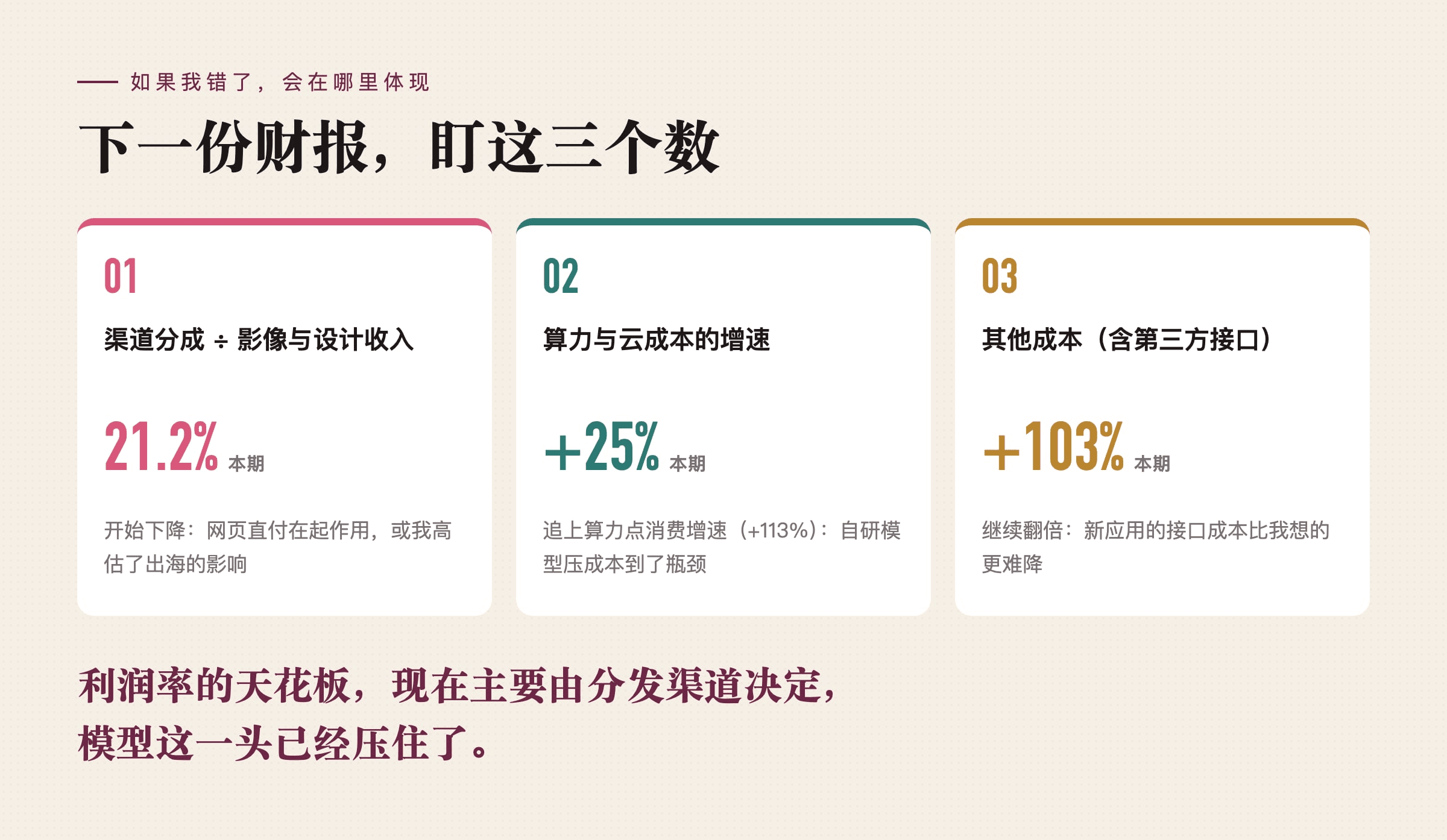
If my judgment is wrong, it will be reflected in these three numbers in the next financial report:
- channel share as a proportion of imaging and design revenue: If it starts to decline, it means that direct payment from the web is at work, or I overestimated the impact of going to sea.
- computing power and cloud cost growth: If it catches up with or even exceeds the growth rate of computing power point consumption, it means that the ability of self-developed models to suppress costs has reached a bottleneck
- "Other Costs": If we continue to double, it means that the interface cost of new applications is more difficult to reduce than I thought
7. Reasons for the Opposition
These reasons are all valid and must be viewed together.
Channel sharing is not unique to Meitu. All mobile applications have to be paid for, which in exchange for global distribution, one-click payment and user trust. Without an application store, many overseas users simply cannot reach it.
A gross profit margin of 71.5% is a very high level in any industry. Among the 3.8 points decline, advertising revenue declined, accounting for 23.9% to 18.7%. This is also one of the main reasons, and it is not all about AI.
The company took the initiative to seek growth first. In the verification stage, new AI applications pursue user size rather than gross profit margins, which is a reasonable product rhythm.
So this article is not saying that there is a problem with Miitu. On the contrary, its accounts are the healthier of the AI application companies I have read. All I want to say is: Who will the profits of an AI application company end up in? The answer may be different from what you think.
Last
Everyone discussed whether AI applications could make money and used to staring at the model: whether the model was strong enough and whether the computing power was cheap enough.
Meitu's account book gives a different reminder: on the model side, it has already pressed down the cost beautifully; the largest toll is collected at the moment the user clicks "buy."
The money earned by an AI application must first pass the model test, and then it must pass the test too much. Many people only count the previous level.
few sentences boundary
All Meitu's figures come from the original text of its 2026 interim results announcement, and the same period in 2025 is a restatement of continuing operations. The channel share, computing power and cloud costs for the same period last year were reversed using the amount and growth rate given in the original text;"other costs" are calculated by subtracting these two items from the cost of sales, including third-party model interfaces, etc., and the original text is not listed separately.
"Per capita income will increase by about 9%" is a rough calculation based on end-of-period paying users, which is not what the company disclosed.
Adobe's figures come from its public financial report for the quarter ended August 28, 2026. The proportion of revenue to cost is calculated by dividing revenue by revenue;Adobe does not separately disclose the application store share, and only compares the overall cost structure in this article.
This article does not constitute any investment advice.
Photo sources: cover Valeri Mak / Pexels; text Alimurat Üral / Pexels, Kayra Sercan / Unsplash.