iFlytek's half-year revenue of 11.6 billion yuan is still losing money: it is using education money to support a big model
iFlytek's revenue in the first half of the year was 11.6 billion yuan, with a parent loss of 204 million yuan and a non-deduction loss of 637 million yuan. Losses in the first half of the year are an old rule. What is worth watching is the structure of the accounts: for every 100 yuan of income, R & D spent 21.8 yuan, more than sales; for the first time, the income from open platforms exceeded that of education, but the gross profit was only 40% of that of education. Compared with Intelligent Spectrum and MiniMax, the industry-wide gross profit of selling models is around 20%. iFlytek's ability to make profits throughout the year relies on educating these old businesses. The problem is that the old business is slowing down. The computing power bill in R & D has doubled every year. The fixed increase of 4 billion yuan has 60% of the investment power, and there is still 21.7 billion yuan receivable on the account. At the end of the article, three numbers that can be tested in the three quarterly reports are given.
In the semi-annual report released by iFlytek in August, the headline figures were as follows: revenue was 11.6 billion yuan, an increase of 6.5%; net profit attributable to the parent company was 204 million yuan, a little less than the same period last year.
Scroll down one line: After deducting one-time money such as government subsidies and investment income, the loss was 637 million yuan, an increase of 75% over the same period last year.
There are two common sayings surrounding this report card. One is that "iFlytek has lost money again", and the other is that "iFlytek loses money in the first half of every year and earns it back in the second half."
Both statements are only half true. Looking at the notes to this report, the annual reports of the past few years, and the interim reports of two pure large model companies during the same period, there is another picture:
iFlytek is using the money earned from educating these old businesses to support a large model business that is not yet profitable. And these two ends, one is becoming slower and the other is becoming more expensive.
1. Let's make it clear first: Losing in the first half of the year is indeed an old rule
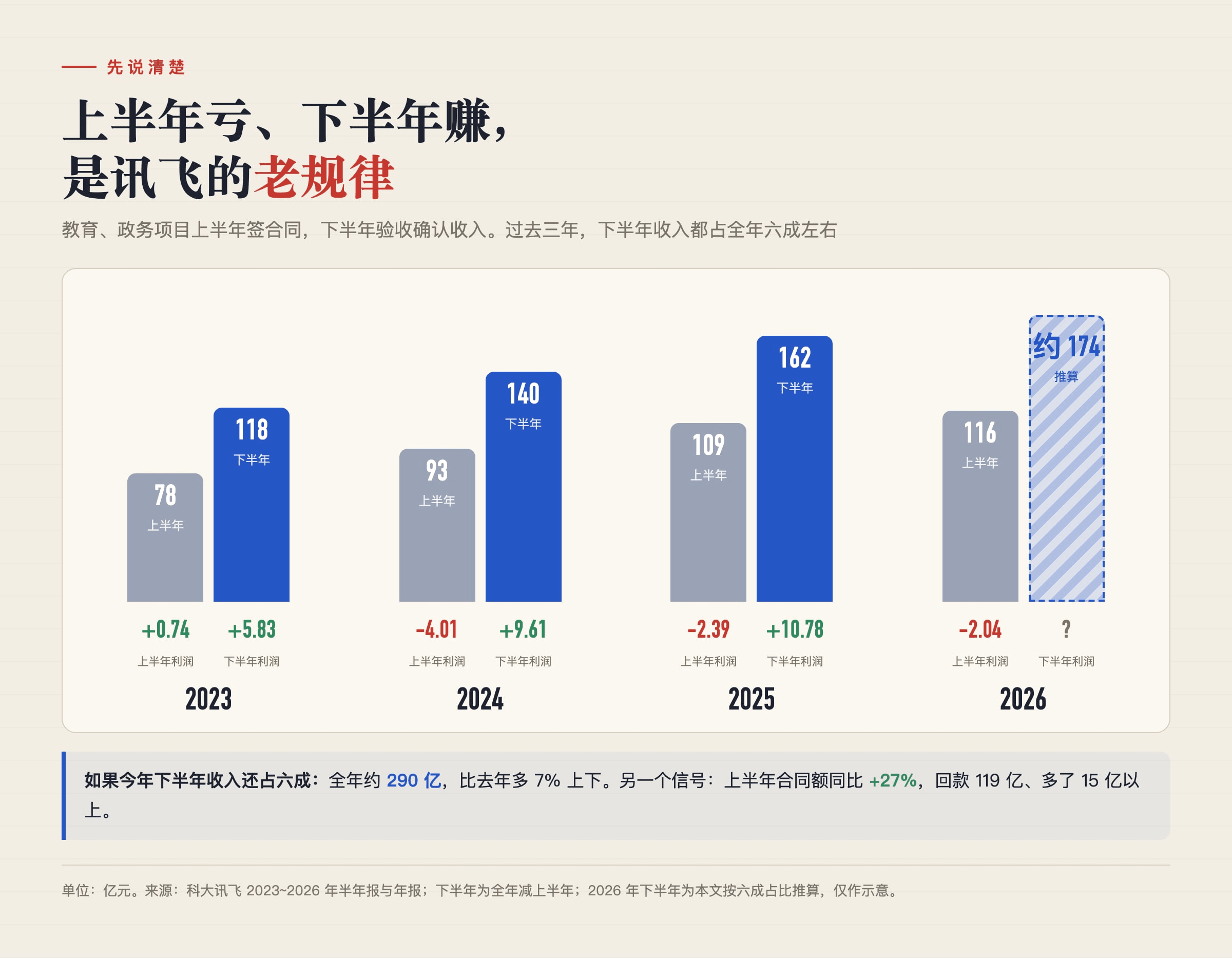
iFlytek's business is highly seasonal. For projects such as education and government affairs, contracts are signed and plans are made in the first half of the year, and income is accepted and recognized in the second half of the year.
In the past three years,revenue in the second half of the year accounted for about 60% of the whole year, and almost all profits occurred in the second half of the year:
Earned 74 million yuan in the first half of 2023 and 583 million yuan in the second half; lost 401 million yuan in the first half of 2024 and 961 million yuan in the second half; lost 239 million yuan in the first half of 2025 and earned 1.078 billion yuan in the second half.
Therefore, just looking at the "loss of 200 million yuan in the first half of the year" does not explain anything. If revenue in the second half of this year still accounts for 60%, the annual revenue will be about 29 billion yuan, about 7% more than last year. There is also a more positive signal in the report: thecontract value in the first half of the year increased by 27% year-on-year, and the return was 11.9 billion yuan, an increase of more than 1.5 billion yuan.
Loss in itself is not a problem. What is worth seeing is the structure of this account.
2. For every 100 yuan of income, where did it end up?
I divided the income statement per 100 yuan of income, like a small ticket:
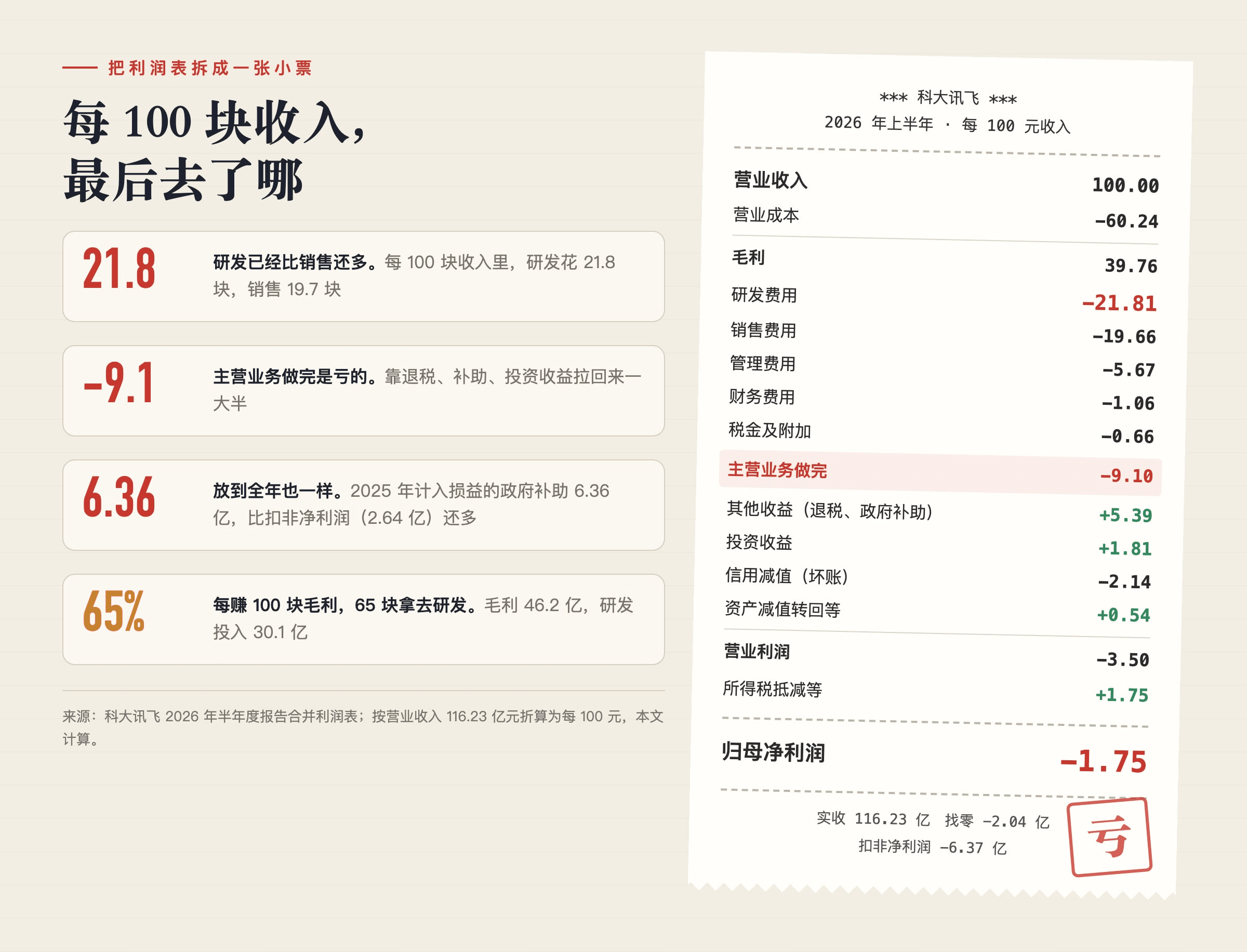
For 100 yuan of income, 60.2 yuan of cost will be deducted first, leaving a gross profit of 39.8 yuan.
Then there are three big expenses:21.8 yuan for research and development, 19.7 yuan for sales , and 5.7 yuan for management. Note that there is already more research and development than sales. After deducting tax and interest, the main business was completed, and the income was lost by 9.1 yuan for every 100 yuan.
What brought back the losses was money outside the main business: other income of 5.4 yuan (mainly software tax refunds and government subsidies) and investment income of 1.8 yuan. Coupled with the income tax credit, the final loss was 1.75 yuan for every 100 yuan of income.
Another algorithm is more intuitive: the gross profit in the first half of the year was 4.62 billion yuan, and the company's R & D investment was 3.01 billion yuan. For every 100 yuan in gross profit earned, 65 yuan is spent on research and development.
The same applies throughout the year. For the whole year of 2025, iFlytek's government subsidies included in current profits and losses are 636 million yuan, andthe non-net profit deducted is only 264 million yuan. The subsidies are more than the profits of its main business.
Three or Two Engines: Those who make money are slowing down, those who grow are not making money
IFlytek's revenue can be broken down into a very complicated picture: education, open platforms, hardware, medical care, automobiles, government affairs, operators...
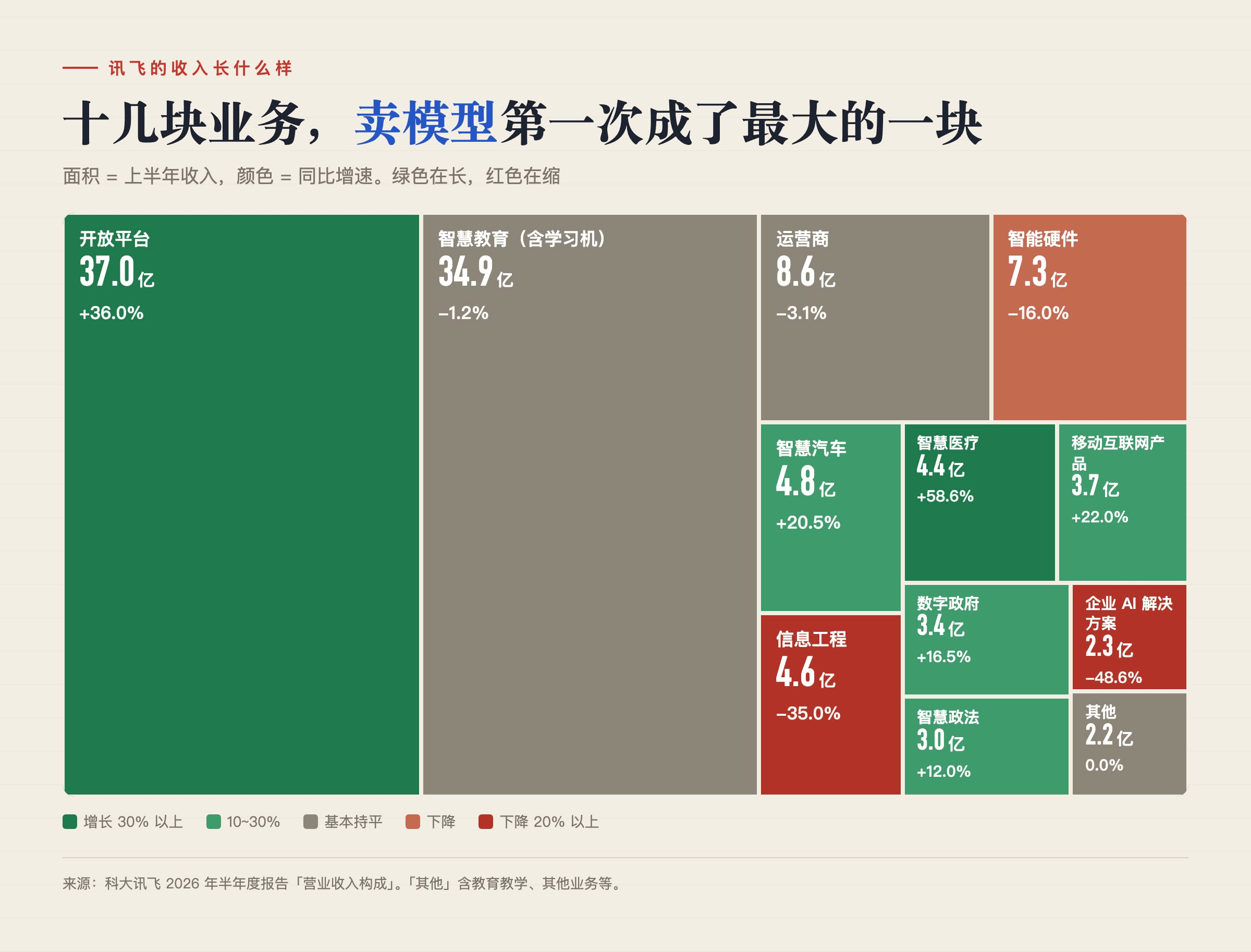
The most important ones are two, which together account for more than 60% of the revenue:
Smart education (including learning machines): 3.49 billion yuan, down 1.2%, and gross profit margin was 51.7%.
Open platform (selling AI capabilities and large model interfaces): 3.71 billion yuan, an increase of 36%, and gross profit margin of 20.2%.
Revenue from open platforms surpassed education for the first time this year, becoming iFlytek's largest business. The report said that revenue from large model interfaces and MaaS platforms increased by approximately 70%, with 3.22 million large model developers, more than doubling in one year.
But you will make a mistake just by looking at income. Calculate the gross profit of the two businesses:
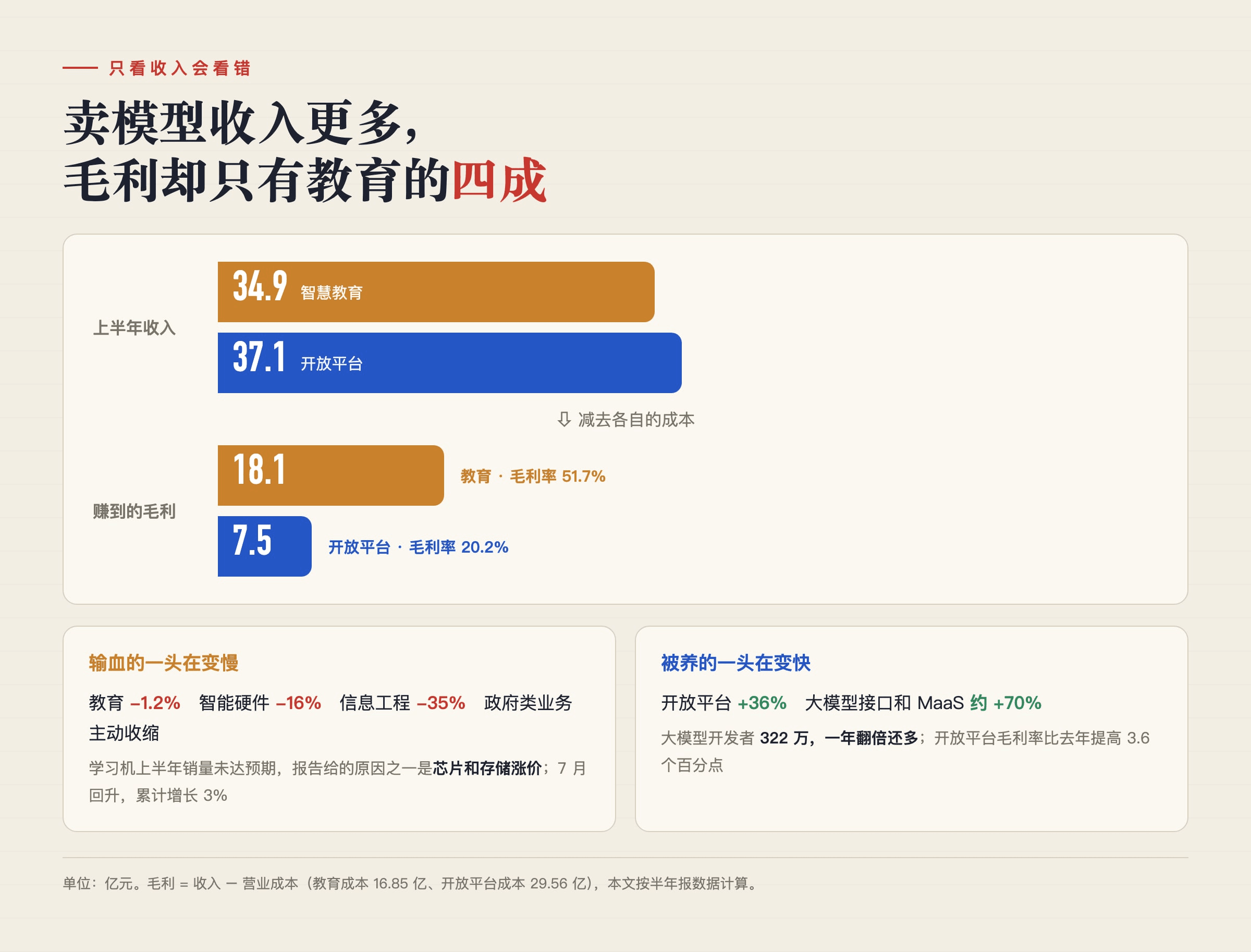
The gross profit earned from education is 1.81 billion yuan, and the open platform is 750 million yuan. Open platforms generate more income than education, but the gross profit earned is only 40% of education.
This is what I call "using education money to support a big model": an old business with a gross profit margin of 50% is giving blood to a new business with a gross profit margin of 20%.
The trouble is that these transfusions have slowed down this year. Education is declining, smart hardware is down by 16%, government project business companies are actively shrinking, and information engineering is down by 35%. The sales of learning machines in the first half of the year did not meet expectations. One of the reasons reported wasthe price increase in chips and storage. That was what I wrote about in September: the AI data center took away the memory, and the cost of learning machines increased accordingly.
4. Control group: For the business of selling models, the gross profit of the entire industry is 20%
iFlytek's open platform gross profit is only 20%. Is it not doing a good job?
I compared two purely large model companies that had just listed in Hong Kong stocks this year. They also issued interim reports in August:
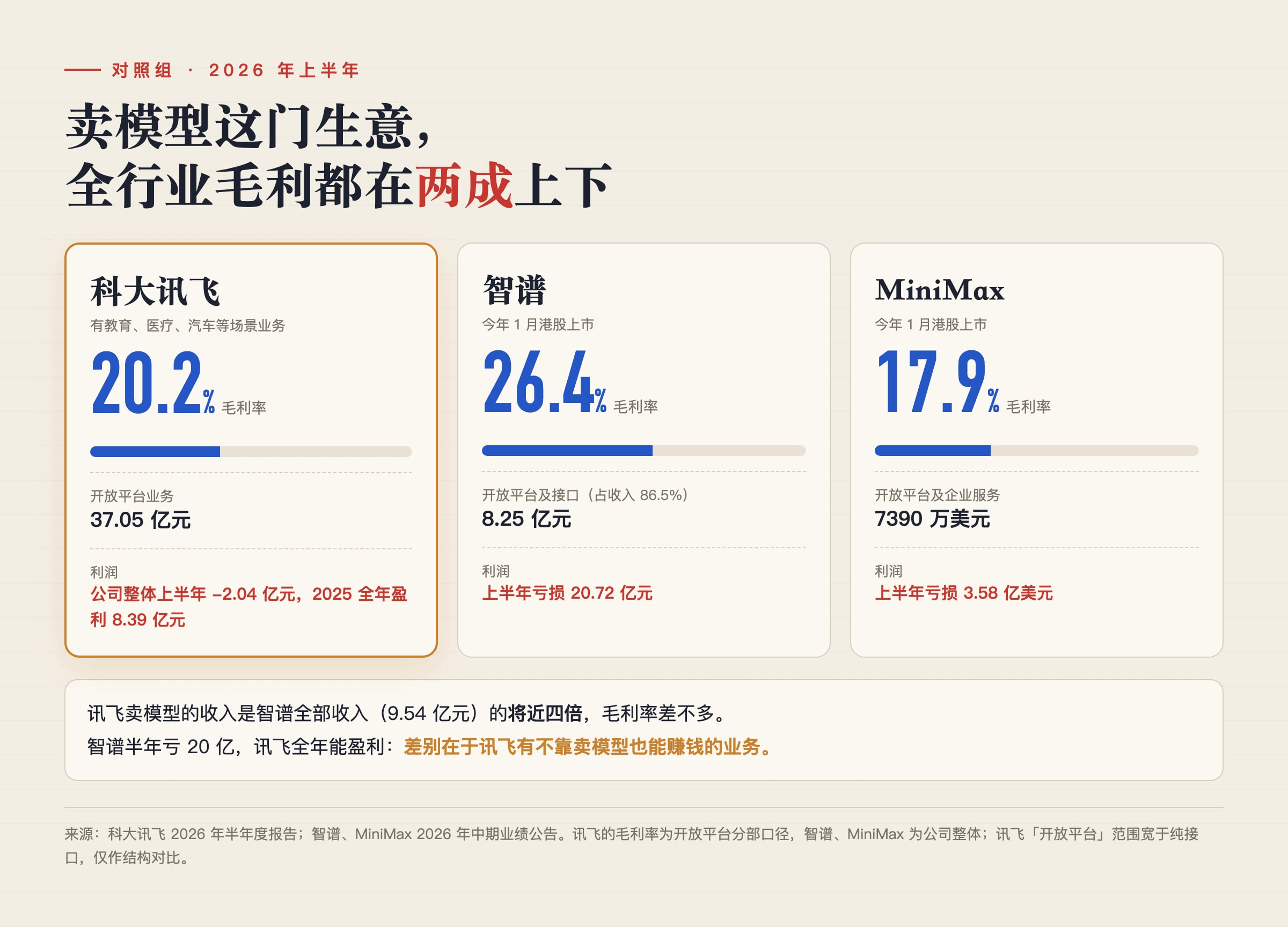
Zhipu:Revenue in the first half of the year was 954 million yuan, including 825 million yuan for open platforms and interfaces,a gross profit margin of 26.4%, and a loss of 2.072 billion yuan.
MiniMax:First-half revenue was $117 million,gross margin was 17.9%, and loss of $358 million.
The three companies have different perspectives. iFlytek's "open platform" has a wider scope than simply selling interfaces. But the structure is very clear: the gross profit of the entire industry is only about 20% for selling models. The interface price has reached one or two yuan per million tokens, and iFlytek's own lightweight models are also priced in this range.
In this context, iFlytek's position is different. Its revenue from selling models (3.7 billion yuan) is nearly four times that of Intelligent Vision's total revenue, and its gross profit margin is similar; but Intelligent Vision lost 2 billion yuan in half a year, and iFlytek can be profitable throughout the year. The difference is that iFlytek has a business that can make money without selling models.
Therefore, iFlytek's strategy is essentially to "sell models using scenarios": load models into learning machines, review machines, hospital systems, and car cabins, and collect money by product and project, not by token. Medical care grew by 59%, and automobiles grew by 20%, both of which are based on this path.
5. More and more money is flowing to computing power
Research and development is iFlytek's biggest expense. There is a detailed list in the notes, which I think is the most worth reading of the entire report:
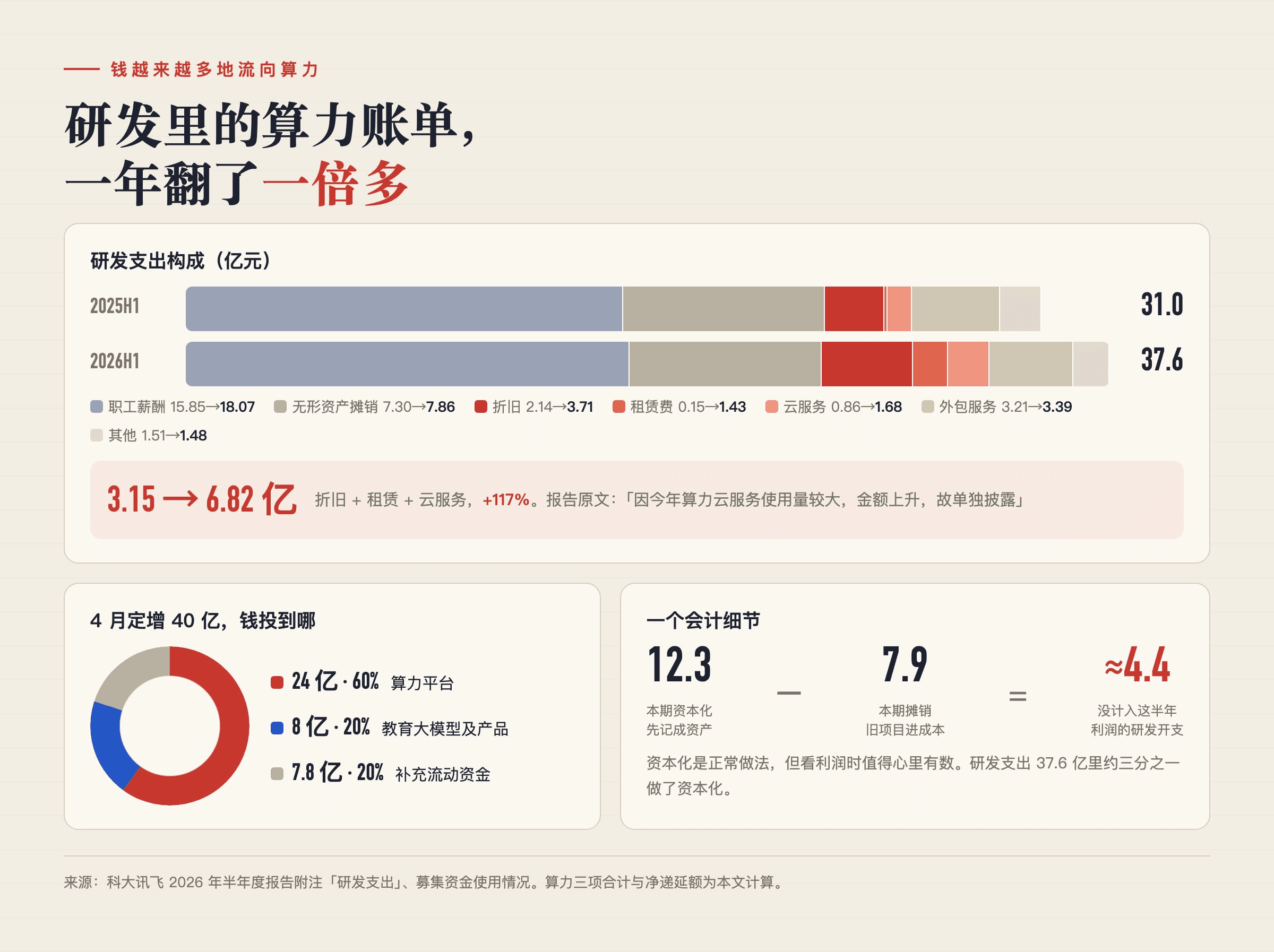
R & D expenditure in the first half of the year was 3.76 billion yuan, of which wages were 1.81 billion yuan, accounting for nearly half. But the fastest increases were three: depreciation rose from 210 million to 370 million, rental fees rose from 15 million to 143 million, and cloud services rose from 86 million to 168 million. The report also added a special explanation: Because computing cloud services have been used a lot this year and the amount has increased, it is listed separately.
These three items are basically money for computing power, which adds up from 320 million to 680 million, more than doubling in one year.
Where does the money come from? In April this year, iFlytek raised 4 billion yuan in a targeted additional issuance. The purpose is clearly written:2.4 billion yuan is invested in "computing power platforms", accounting for 60% ; 800 million yuan is invested in education models and related products; and the rest is to replenish working capital.
There is also an accounting detail that is easily overlooked: of the 3.76 billion R & D expenditure, 1.23 billion was capitalized, recorded as assets first, and later slowly amortized; 790 million yuan was amortized into costs from previously capitalized projects during the same period. Every time we go in and out, about 400 million yuan in R & D expenditures were not included in the profit for the past six months. Capitalization itself is a normal practice, and many technology companies handle it this way, but it is worth knowing when looking at profits.
6. There is still 21.7 billion on the account
Finally, there is accounts receivable, which is an old problem for iFlytek.
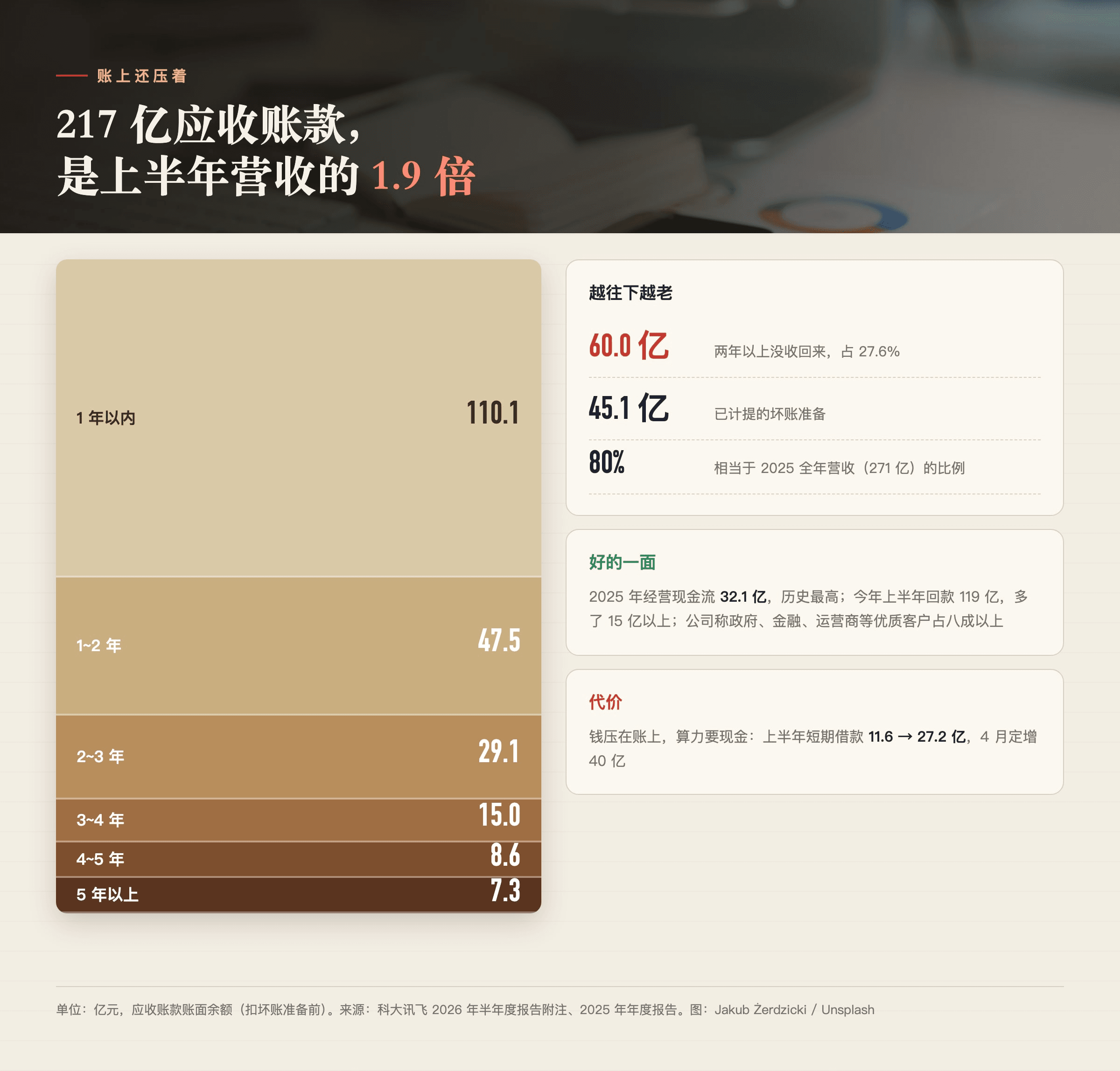
As of the end of June, the balance of accounts receivable was 21.76 billion yuan, 1.9 times the revenue in the first half of the year and equivalent to 80% of last year's revenue. Among them, 6 billion yuan has been confiscated more than two years, and about 4.5 billion yuan has been provided for bad debts.
Most of the money was left over from government, schools, and operator projects in the past few years. The company said that high-quality customers such as government, finance, and operators account for more than 80% of accounts receivable. There is a high probability that the money will be recovered, but it is slow.
On the bright side, the return of money is improving: operating cash flow in 2025 is 3.2 billion yuan, the highest in history; the return of money in the first half of this year is also 1.5 billion yuan more. But as long as the more than 20 billion yuan is placed on the books, iFlytek will have to borrow money and raise funds to support computing power, an investment that requires immediate cash withdrawal. Short-term borrowings increased from 1.16 billion yuan to 2.72 billion yuan in the first half of the year.
7. My judgment
First, the most difficult hurdle in iFlytek's turn is who will pay to maintain the model. The bill for computing power is accelerating (computing power in research and development doubles in one year), while the old business of maintaining models is slowing down (education, hardware, and government projects are all declining). This scissors difference is the most important place to focus on next.
Second, in the domestic price environment, it is difficult to make money by "selling models by token". iFlytek's bet is "selling models using scenarios." The gross margins of Smart Spectrum and MiniMax illustrate how difficult it is to do a pure interface business. iFlytek's advantage is that it has scenarios such as education, medical care, and automobiles that are willing to pay for results. This is the biggest difference between it and pure model companies.
Third, some of these judgments can be tested in the third quarterly report in late October:
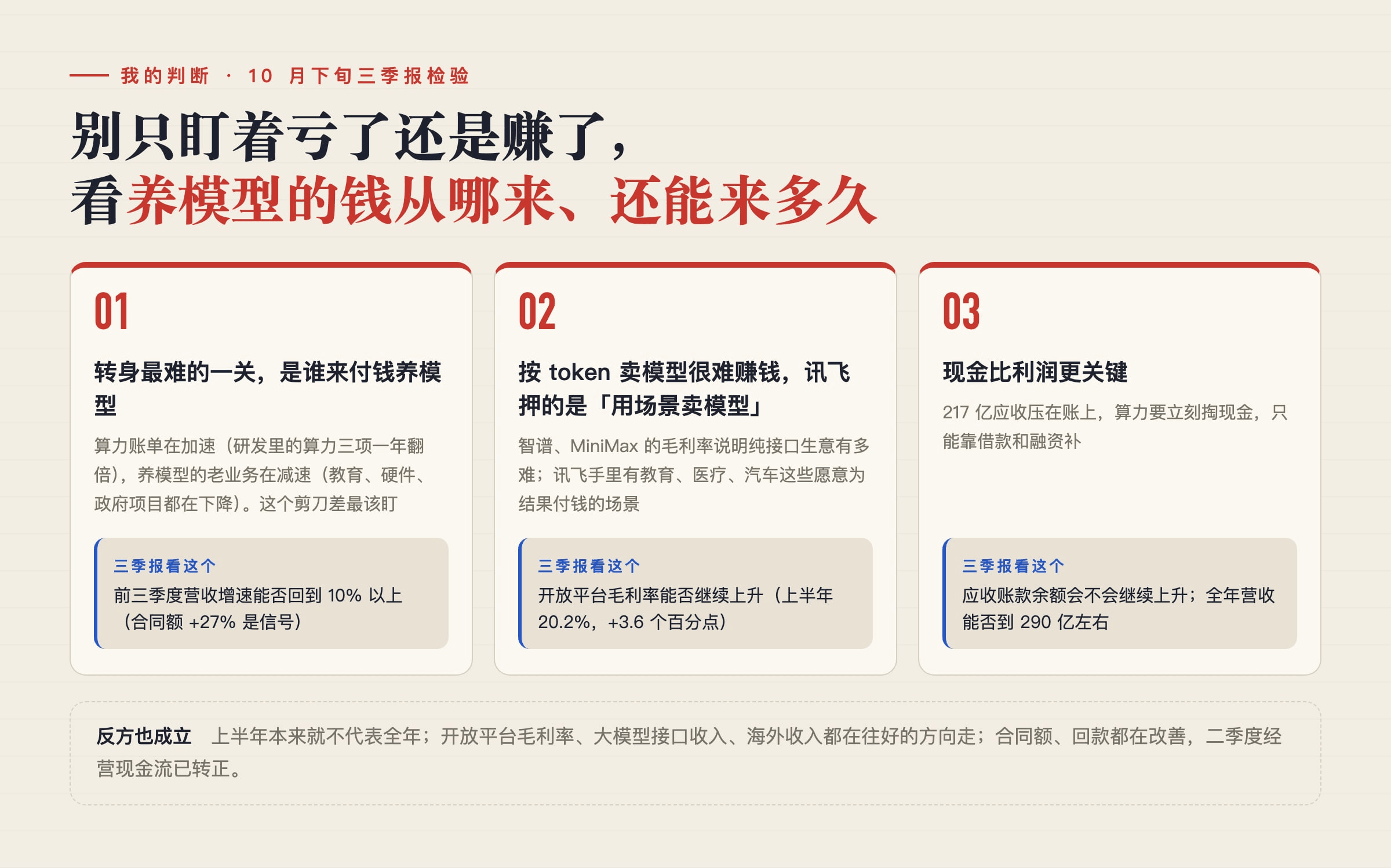
Whether revenue growth in the first three quarters can return to more than 10%(a 27% increase in contract value is a signal); whether the gross profit margin of open platforms can continue to rise (increased by 3.6 percentage points in the first half of the year); whether the balance of accounts receivable will continue to rise.
8. Reasons for the Opposition
I agree with these and have to be looked at together.
The first half of the year does not represent the whole year. According to the pattern of the past three years, the second half of the year will be iFlytek's profit season, and it is too early to draw conclusions.
The quality of new business is getting better. The gross profit margin of open platforms has increased by 3.6 percentage points a year, the revenue of large model interfaces has increased by 70%, and overseas revenue has increased by 62%. These are all moving in the right direction.
Contracts and payments are improving. The contract value increased by 27%, the refund increased by 1.5 billion yuan, and the operating cash flow in the second quarter has turned positive.
Therefore, iFlytek may not be able to do so. Just discussing iFlytek, don't just focus on "losing or making money", what's more worth watching is where the money to raise models comes from and how long it will last. This is a question that all companies that want to make money from big models need to answer.
few sentences boundary
iFlytek's figures come from its original 2026 semi-annual report and regular reports in previous years; the split of "revenue per 100 yuan", the gross profit of the two businesses, the total of computing power, and the projection of annual revenue are all calculated by me. The full-year projection assumes that the proportion of revenue in the second half of the year is the same as that in the past three years.
Data from Smart Spectrum and MiniMax comes from the 2026 interim results released by the two companies. The business calibers of the three "open platforms" are not exactly the same. The comparison only depends on the structure and cannot be accurately compared item by item.
This article does not constitute any investment advice.
Photo sources: Allen Y / Unsplash on the cover; Leo Wieling on the inside, Jakub erdzicki/ Unsplash.