How many years will it take to buy a graphics card to pay back your money? This account is being calculated for the entire industry
For renting an H100 for an hour, some people charge $7.43 and others charge $1.02, which is more than 7 times the difference. If you are the one buying the card, you have to earn back your money by relying on this jump-start price. I calculated it based on the 8-card complete machine being distributed to US$250,000 to US$300,000 per card, a utilization rate of 90%, and a gross profit margin of 50%: the listing price will cost 1.07 years, the average market price will be 2.29 years, and the lowest bidding price will take 7.77 to 9.33 years. However, there is a fixed number on the depreciation table: CoreWeave is amortized on a straight-line basis over six years, extending from four years to six years in 2023;Nebius is amortized on four years; Amazon is amortized from three years to four years and then to six years, and retracted part of it by five years in early 2025. The extensions of several major manufacturers add up to about US$18 billion in depreciation per year, while NVIDIA releases a new generation of structures every 18 to 24 months. When you put the two tables together, you will see one thing: the profit and loss line can be directly solved. Choosing four years is equivalent to betting that the rent can be held at US$1.98 to US$2.38, and choosing six years is equivalent to betting that the rent can be held at US$1.32 to US$1.59. The lowest market bidding price is 1.02, which is not even enough to reach the lower limit of the six-year line. Depreciation life has gone beyond the scope of accounting technology and is a bet on renting floors in the future.
Let's start with a numerical anomaly.
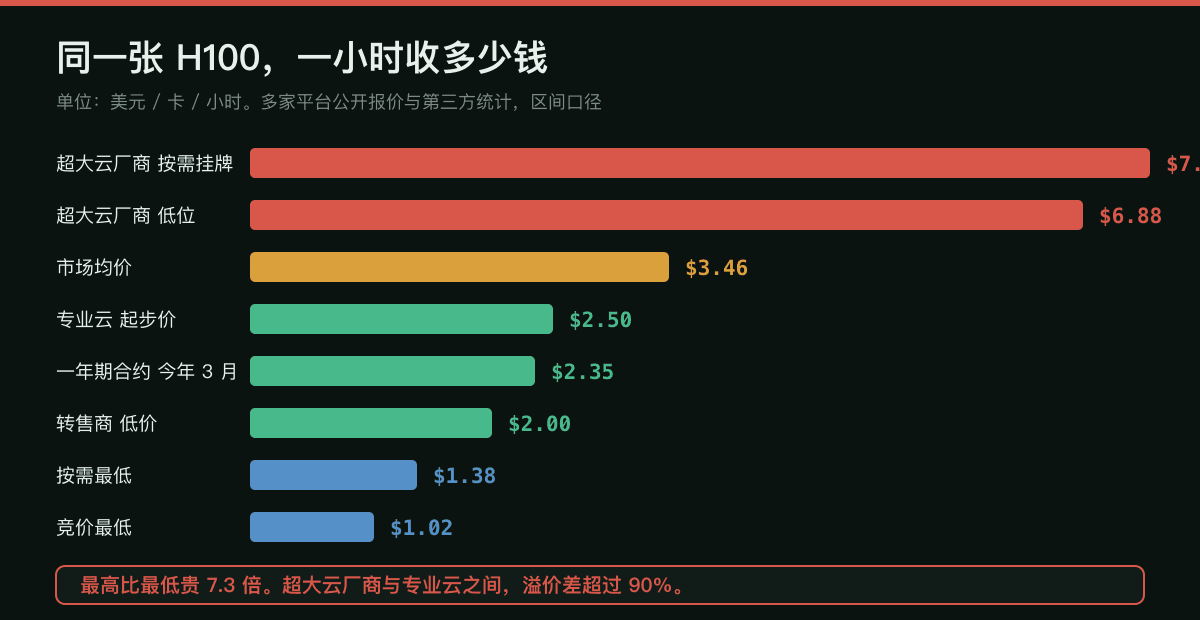
For an H100 graphics card, rent it for an hour, some people charge$7.43, others charge$1.02.
The same model, the same generation, the difference is more than 7 times.
This is not about who is pricing indiscriminately. Hyper-large cloud manufacturers bundle compliance and ecological services, and professional computing power platforms only sell bare computing power. The premium difference between the two exceeds 90%, with several levels of on-demand, annual subscription, and bidding in between.
But if you are the one buying the card, the price difference becomes a fatal question: how much you pay for something, you have to earn back at a price that jumps between $1 and $7.
This article will calculate this account again.
1. Make the cost clear first
The "single card price" of the H100 that can be found online ranges from US$27,500 to US$40,000, which is a big difference. The reason is thatthis card is usually not just sold. The H100 in SXM form is mainly sold as a 4-card or 8-card complete machine. The so-called single card price is mostly the selling price or the converted price.
Therefore, the algorithm that is closer to real capital expenditure is to spread it on a whole basis.
The price range for an 8-card HGX machine is US$140,000 to US$350,000, and the mainstream training configuration is approximatelyUS$250,000 to US$300,000. Spread it to each card, and that's$31,250 to $37,500.
I use these two numbers to calculate the following accounts, and give intervals but not points.
The other two assumptions are also put out first so that you can check it yourself:
The annual utilization rate is 90%, which means that 7,884 hours can be rented out a year. This number is not low, with 92% to 95% of people in the industry reporting.
The gross profit margin is 50%, and electricity, computer room, network, and operation and maintenance are deducted from the rent.
2. How many years will it take to recover the capital?
Replace the rental stalls above one by one:
| rental stall | USD/hour | 31.25 million per card | 37,500 per card |
|---|---|---|---|
| Super cloud manufacturers are listed | 7.43 | 1.07 years | 1.28 years |
| average market price | 3.46 | 2.29 years | 2.75 years |
| Professional cloud starting price | 2.50 | 3.17 years | 3.81 years |
| One-year contract (March this year) | 2.35 | 3.37 years | 4.05 years |
| Reseller low price | 2.00 | 3.96 years | 4.76 years |
| Minimum on demand | 1.38 | 5.74 years | 6.89 years |
| Lowest bid | 1.02 | 7.77 years | 9.33 years |
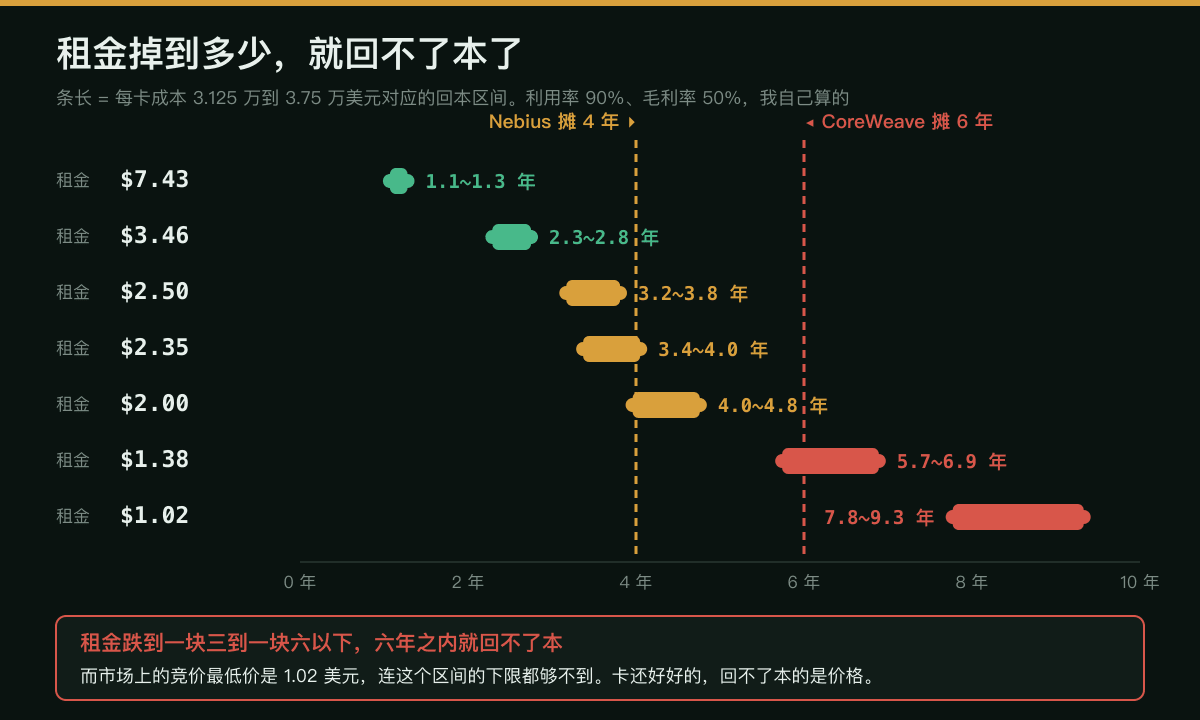
From 1 year to 9 years, the span is nine times.
Who rents the same card to and at what price determines whether it pays back in one year or nine years.
What is written on the depreciation table is a fixed number.
3. What is this fixed number?
This is the interesting part.
CoreWeave uses a six-year straight-line depreciation. This is written in its prospectus, and it will extend that periodfrom four years to six yearsin 2023.
Nebius spent four years. The two companies are doing almost the same business, renting cards such as H100 and H200.
The major manufacturers have also collectively made longer adjustments: Amazon has moved from 3 years to 4 years (2020) and then to 6 years (2023); Microsoft has moved from 4 years to 6 years; and Google has also moved to 6 years. The extensions of these companies add up toapproximately US$18 billion in annual depreciation.
If you count less depreciation, the current profit will look good.
But the directions are not consistent. At the beginning of 2025, Amazon retracted the service life of some servers from 6 years to 5 years, giving the reason that technology iteration is accelerating.
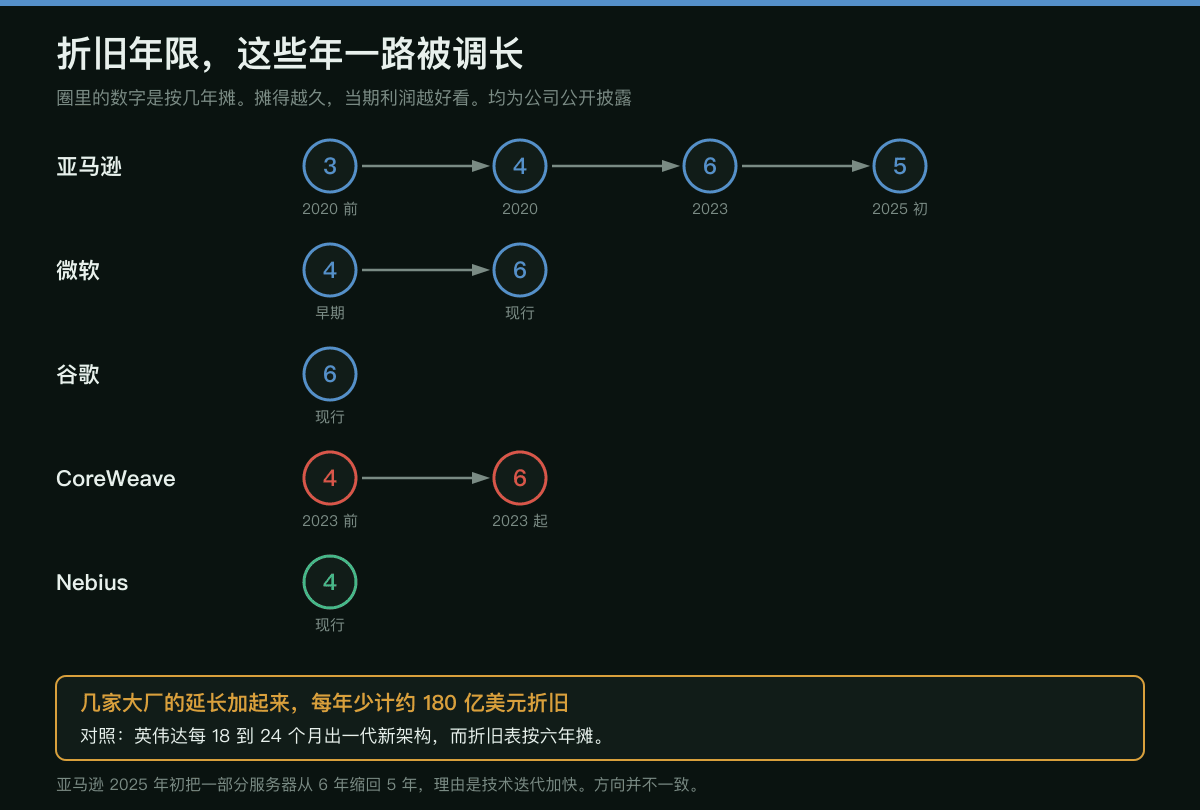
Taken together, a comparison is very eye-catching:
Nvidia releases a new structure every 18 to 24 months, and the depreciation table is amortized over six years.
When a card has four years of life left in the account, it has been replaced on the market for two to three generations.
4. The most expert level: Depreciation period is actually a bet
When you add the return table in Section 2 and the depreciation period in Section 3, you will see something that is usually not stated clearly.
The profit and loss line can be directly solved:cost per card ÷ (years × 7,884 hours × 50% gross profit) .
Choosing four-year depreciation is equivalent to betting that the rent will last between $1.98 and $2.38. Below this range, you will not be able to recover your capital within four years.
Choosing six-year depreciation is equivalent to betting that the rent will last between $1.32 and $1.59. Below this range, you will not be able to recover your capital within six years.
(The two numbers are because there are two levels of cost caliber: 31.25 million per card corresponds to the lower limit, and 37,500 corresponds to the upper limit.)
The lowest bidding price on the market is US$1.02, which is not even enough to reach the lower limit of the six-year line.
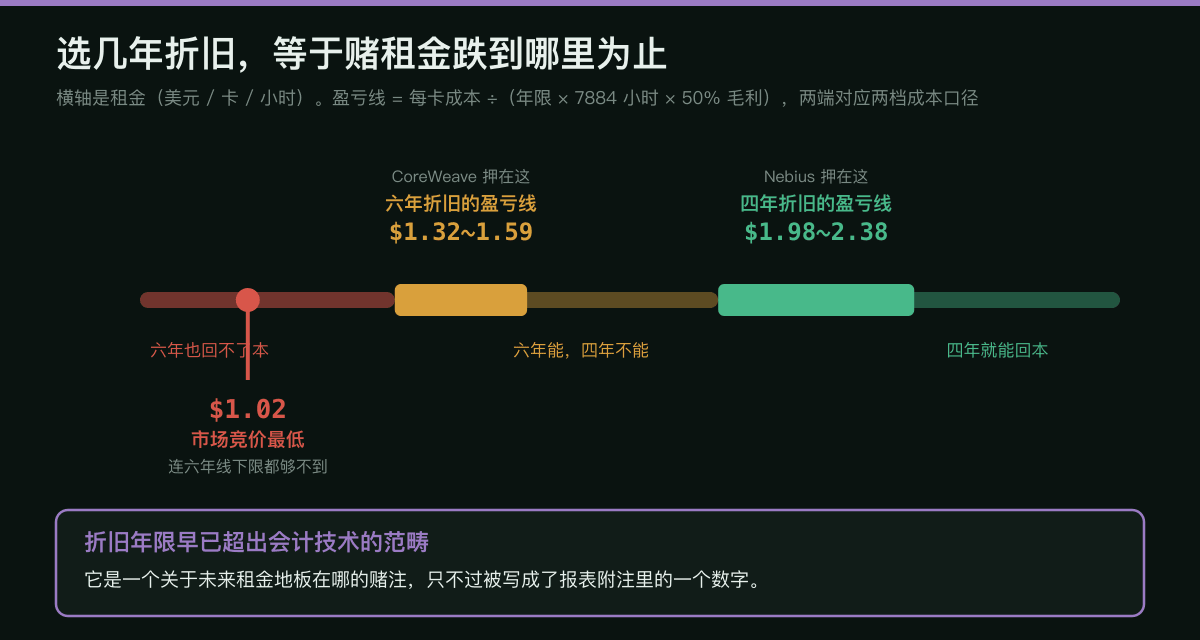
Therefore, the matter of depreciation life has exceeded the scope of accounting technology. It's a bet on where the rental floor will be in the future, but it's written as a number in the notes to the report.
Those who chose six years bet that the rent could be kept between 1.3 and 1.6 yuan. Those who chose four years bet conservatively and bet around 2 yuan. Both sides are betting on the same thing, but the bets are different.
An investor made this matter public in November last year, accusing several major manufacturers of depreciation by five to six years, while the actual economic life is close to two to three years. According to his calculations, depreciation will be undercalculated and profits will be overstated by approximatelyUS$176 billionfrom 2026 to 2028. Need to be clear: this is an investor's public opinion, not a regulatory determination.
5, but the short side's statement is not entirely correct
The other side must be put in its entirety here, because the evidence of the opposition is solid.
CoreWeave's management said they speak by the data. The 2020 batch of A100s is now fully booked; for the 2022 batch of H100s, one contract expired and wasimmediately re-leased at 95% of the original price; another contract for A100 was signedin 2029, spanning nine years.
The evidence in the hands of the bears is equally hard:the rent of the A100 has dropped from 15 to 30 yuan an hour to 3 to 6 yuan an hour, a drop of about 80% (this is in RMB and cannot be directly compared with the previous US dollar figure). The H100 itself has gone a similar path, falling from about $8 an hour in the early days to less than $2 for multiple resellers.
These two sets of facts may seem to be fighting, but they are both true.
My understanding is that they measure not the same thing:
Spot rents fell, which means that the marginal pricing of old cards moved down after the supply of new cards came in. The old card is full of orders, which means that there are still people who want the already installed production capacity.
These two things can happen at the same time: after prices fall, more customers with limited budgets can afford it, and utilization rates rise instead of falling.
Therefore, the debate about graphics card life may itself be misguided. There is no answer to "How many years can this card last?" nor can there be any answer to "Will the rent be repaid when it expires?" What should be asked is: At the current price, can it earn back its capital before it is scrapped?
One more sentence to add: The "useful life" in accounting and the "still used" in business are two yardsticks. A contract spanning nine years proves that someone is willing to pay for installed capacity, but it does not mean that a certain card can run for nine years.
6. There is another counter-intuitive fact
Everyone defaults that AI computing power continues to reduce prices. This was not the case in the first half of this year.
The one-year lease price of the H100 has increased from US$1.70 per card per hour in October 2025 to US$2.35 in March 2026, an increase of 40%. Some suppliers 'H series have already sold out. In China, the computing power gap still exceeds 35% as of April this year, and some H100 bookings are scheduled for the first quarter of 2027.
At the same time, the price at the reseller was falling.
So there is no equilibrium price in this market at all. The high-end complete machine, with full interconnection and large memory, is still tight, while the general and scattered computing power is surplus.
This explains the initial seven-fold spread: it is not a temporary misalignment,but two separate markets.
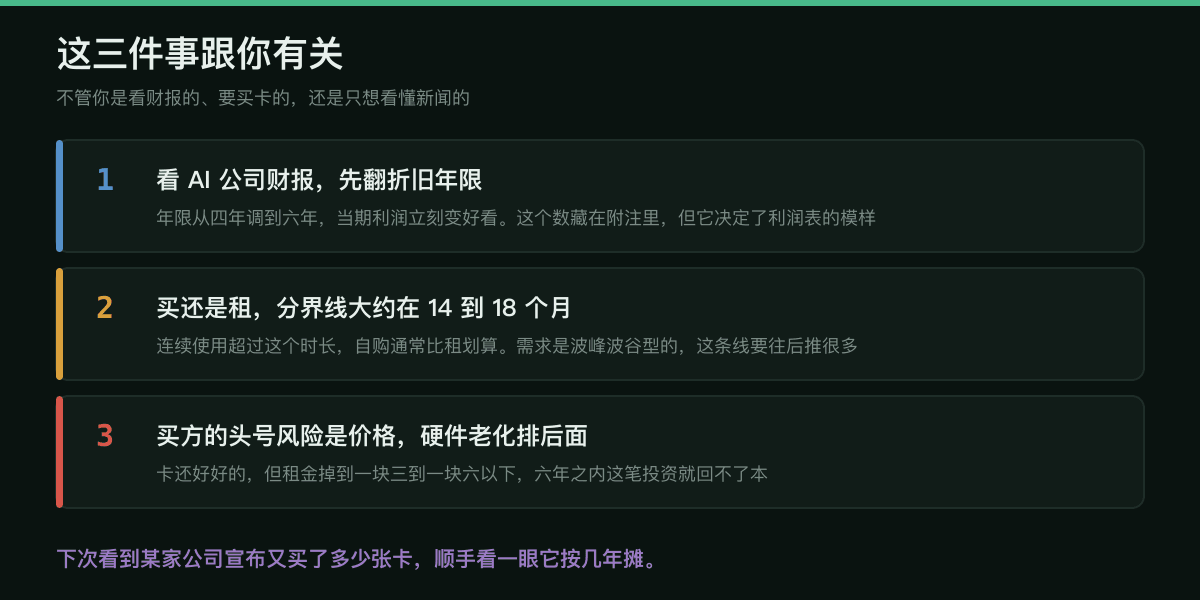
7. What does this have to do with ordinary people
Three things.
First, part of the profits you see of an AI company are based on depreciation assumptions. For the same business and the same card, the term is adjusted from four years to six years, and the current profits will immediately turn better. So looking at the financial report of an asset-heavy AI company, thedepreciation period is worth looking at first. It is hidden in the notes, but it determines the appearance of the income statement.
Second, there is a rough dividing line between buying or renting a card. There is a public saying that if you use it continuously for more than14 to 18 months, self-purchasing is usually more cost-effective than renting. If your needs are peak and trough shaped, that line will be pushed back a lot.
Third, if you are the buyer, the risk of a downward trend in rent is much greater than the risk of a broken card. As you can see from the table above, the card itself is still in good shape, but as long as the rent falls below the range of one thousand three to one thousand six, the investment will not be able to recover within six years. What hurts is the price, but hardware aging comes back.
Last
This article is not about saying who's false accounts. Six-year depreciation is a publicly disclosed and compliant accounting policy, and Nebius 'choice of four years is also compliant.
Here's another thing I want to say: in an industry where new structures are 18 months old and rents can swing between $1 and $7, the question of "how many years will this device last" is itself impossible to give a safe answer.
So that number of years became a bet. The bet will be verified, just a few years.
The next time you see a company announcing how many more cards it has bought, it is worth taking a look at how many years it has distributed these cards. That figure tells more about its judgment on the future than the purchase amount.
few sentences boundary
Rental stalls come from public quotations and third-party statistics from multiple platforms, which are of an interval, and there will be differences from different sources at the same time. The set of changes from 1.70 to 2.35 for one-year contracts comes from third-party data agencies.
The depreciation period comes from public disclosures by various companies (CoreWeave's six-year period is written in the prospectus, Nebius's four-year period and adjustments by several major manufacturers are also public information).
I built the cost-recovery model myself, and all three assumptions are written in the first section: the capital cost per card is US$31,250 or US$37,500 (based on the 8-card complete machine of US$250,000 and US$300,000), the annual utilization rate is 90%, and the gross profit margin is 50%. The profit and loss line is inversely solved by these three assumptions: cost ÷ (years × 7,884 × 50%). If the conclusion changes, the formula is very simple and you can check it yourself.
The estimate of $176 billion comes from an investor's public accusation andis not a regulatory determination, which is stated in the article.
The A100 group of 15 to 30 yuan and 3 to 6 yuan is RMB and is not compared with the US dollar figures in the text.
CoreWeave's debt and loss scale and A100 contracts spanning 2029 are public information. This article does not judge the solvency of any company, nor does it constitute investment advice.