AI companies are starting to build their own mobile phones, and their 24-hour computing power accounts will be transferred to you.
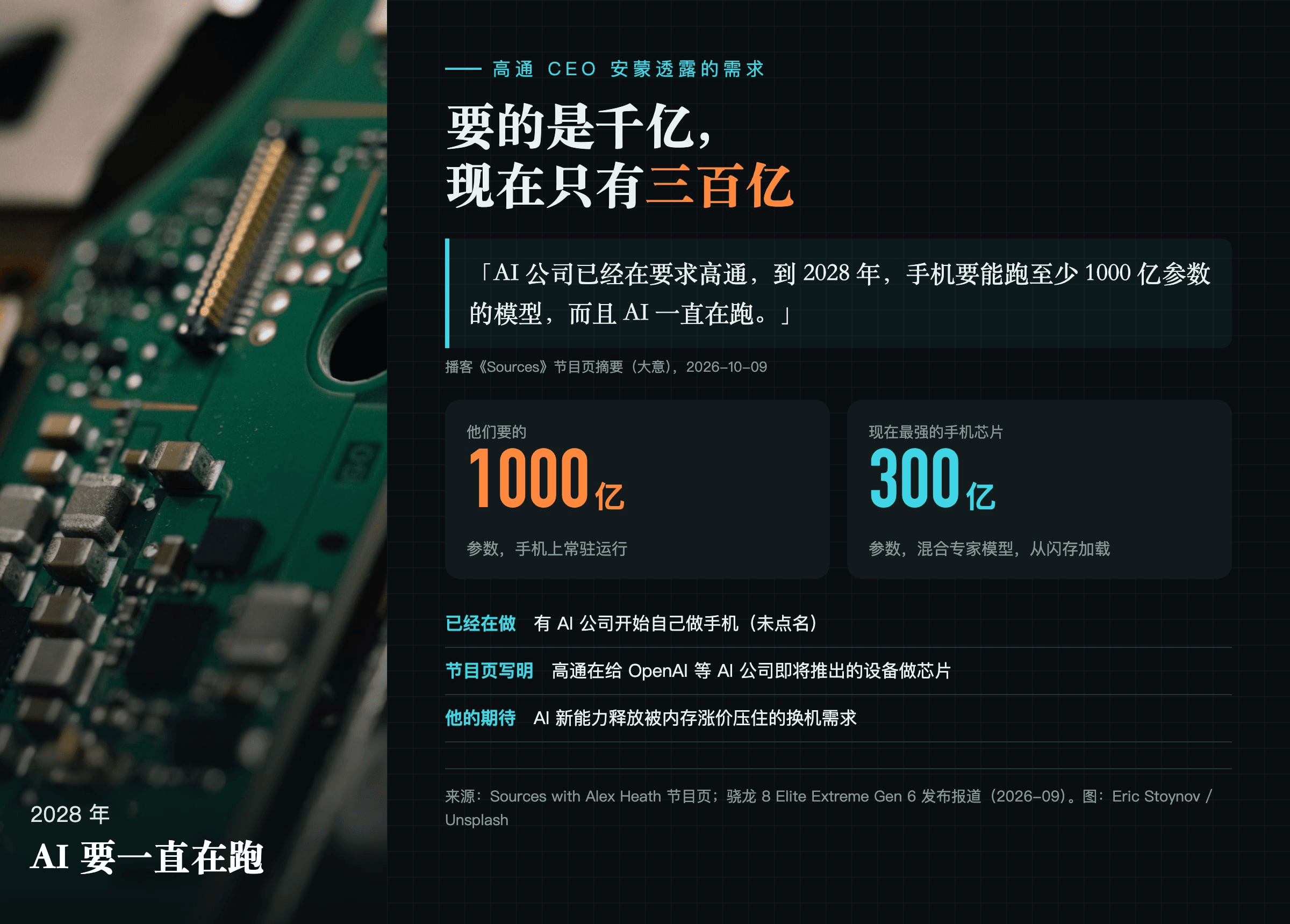
Qualcomm CEO Ammon revealed that some AI companies require mobile phones to be able to permanently run hundreds of billions of parameter models in 2028, and other AI companies have begun to make their own mobile phones. Even if the 100 billion parameter is pressed to 4 bits, it requires 50GB of memory. Nowadays, the mainstream for high-end machines is 12GB. Why do you have to put it on your mobile phone and keep running? One account: The agent resident in the cloud burns the computing power of the AI company every minute, and when placed on the mobile phone, it becomes a one-time payment when you buy the phone. One ticket: Agents must have system permissions to operate applications. Doubao mobile phones have demonstrated it last year, and system permissions are only the first door. Coupled with the increase in memory prices, who will the money be ultimately blamed?
Qualcomm CEO Ammon recently revealed a need in a technology podcast, which I have read several times.
Several companies at the forefront of AI have approached Qualcomm and made a request: by 2028, models with at least 100 billion parameters must be run on mobile phones, and AI must keep running.
He also said that some AI companies have begun to make their own mobile phones. There was no name named, but the introduction of the program stated clearly: Qualcomm is making chips for "devices to be launched by AI companies such as OpenAI."
Domestic discussions basically stop on one question: Is there enough memory in mobile phones? The answer is not enough, far from it.
But what I am more curious about is another question: These companies have the world's largest data center, why do they have to put a billion-dollar model into your mobile phone and keep it open 24 hours a day?
My answer is: one account, one ticket.
1. Look at the gap first: what you need is four times the current memory
What is the concept of 100 billion parameters?
Each parameter of the model must be stored in memory. Even if compressed to only half a byte per parameter (4-bit quantization within the line is already very tight), 100 billion parameters will still require50GB.
What about current mobile phones? Qualcomm's strongest chip just released in September was described as a model that can run 30 billion parameters locally, and it is a hybrid expert model that "only calls a part of the parameters at a time." Data from market research firm TrendForce shows that the mainstream memory of high-end mobile phones is becoming 12GB, the proportion of 16GB is declining, and mid-range phones have returned to 8GB.
To 50GB, the mainstream on the market is 12GB, which is more than four times the difference.
It's not enough if the memory is loaded, it still needs to be able to run. Every time the model says a word, the parameters involved in the calculation must be read from memory, so the speed depends on the bandwidth of the memory.
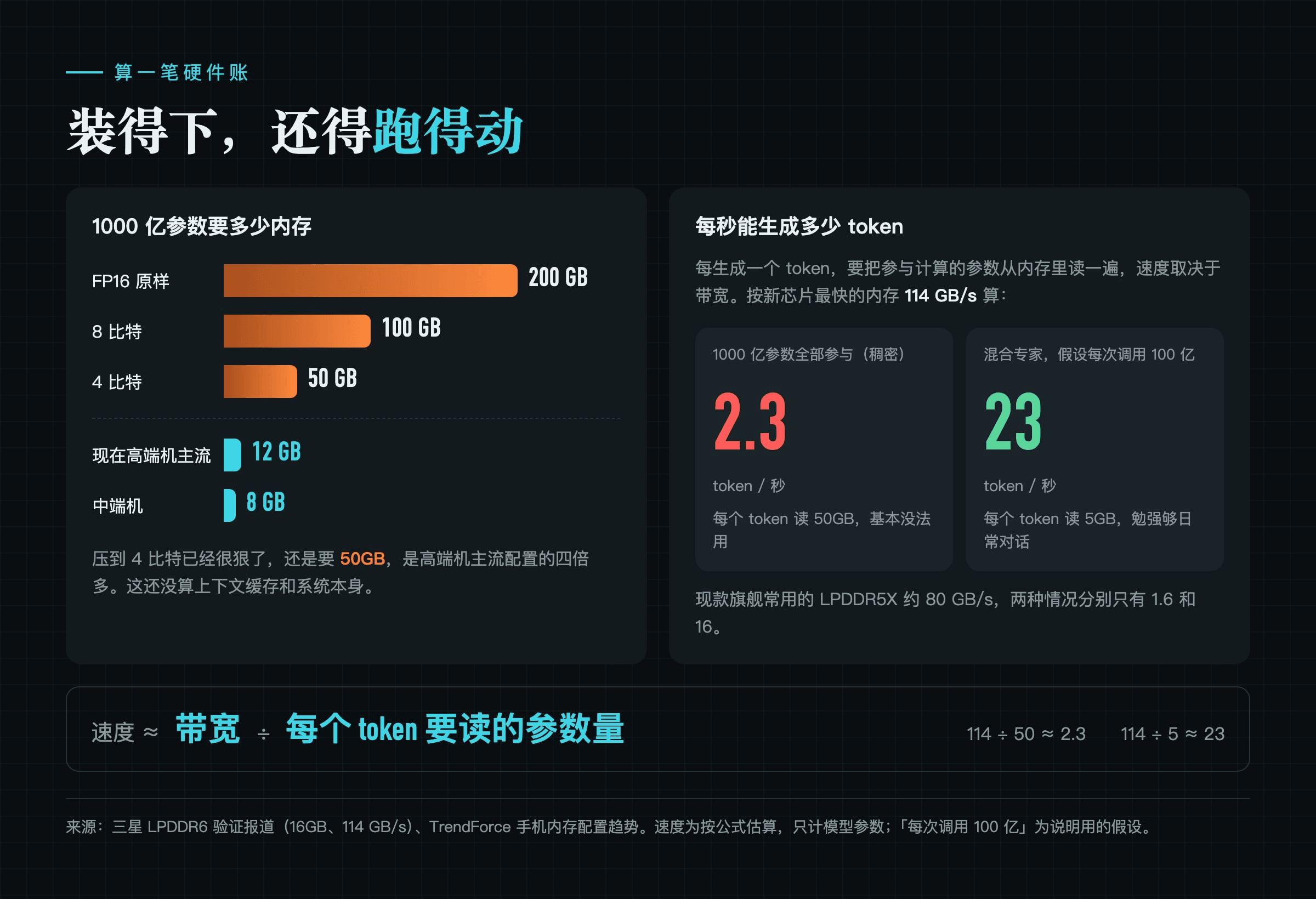
I calculated the fastest memory equipped with Qualcomm's new chip, and the bandwidth is 114GB per second:
If all 100 billion parameters are included in the calculation at a time, only two or three words can be generated per second. This is basically useless.
If we switch to a hybrid expert structure, assuming that only 10 billion parameters are called at a time, more than 20 tokens can be reached per second, whichis barely enough for daily conversations.
So there is only one way for hundreds of billions of models to enter mobile phones: a hybrid expert structure, plus much larger memory. Both cost money.
2. Why do you have to "keep running": Computing power accounts
Two weeks ago, OpenAI launched dots, an agent that works for you 24 hours a day. I demolished it in the previous article: Each dot has its own computer on the cloud. When you ignore it, it will also go through your email, calendar, and chat history in the background to find something that can help you do.
This kind of "running all the time" agent burns calculation power every minute. Whose are they burning? OpenAI's own.
Therefore, OpenAI has written clearly in the pricing of dots: the first dot is included in the package starting at US$100 per month, and the amount will be deducted for in-depth work. In the future, it will be charged according to "add a few dots, how fast it will be, and how much work you do per month."
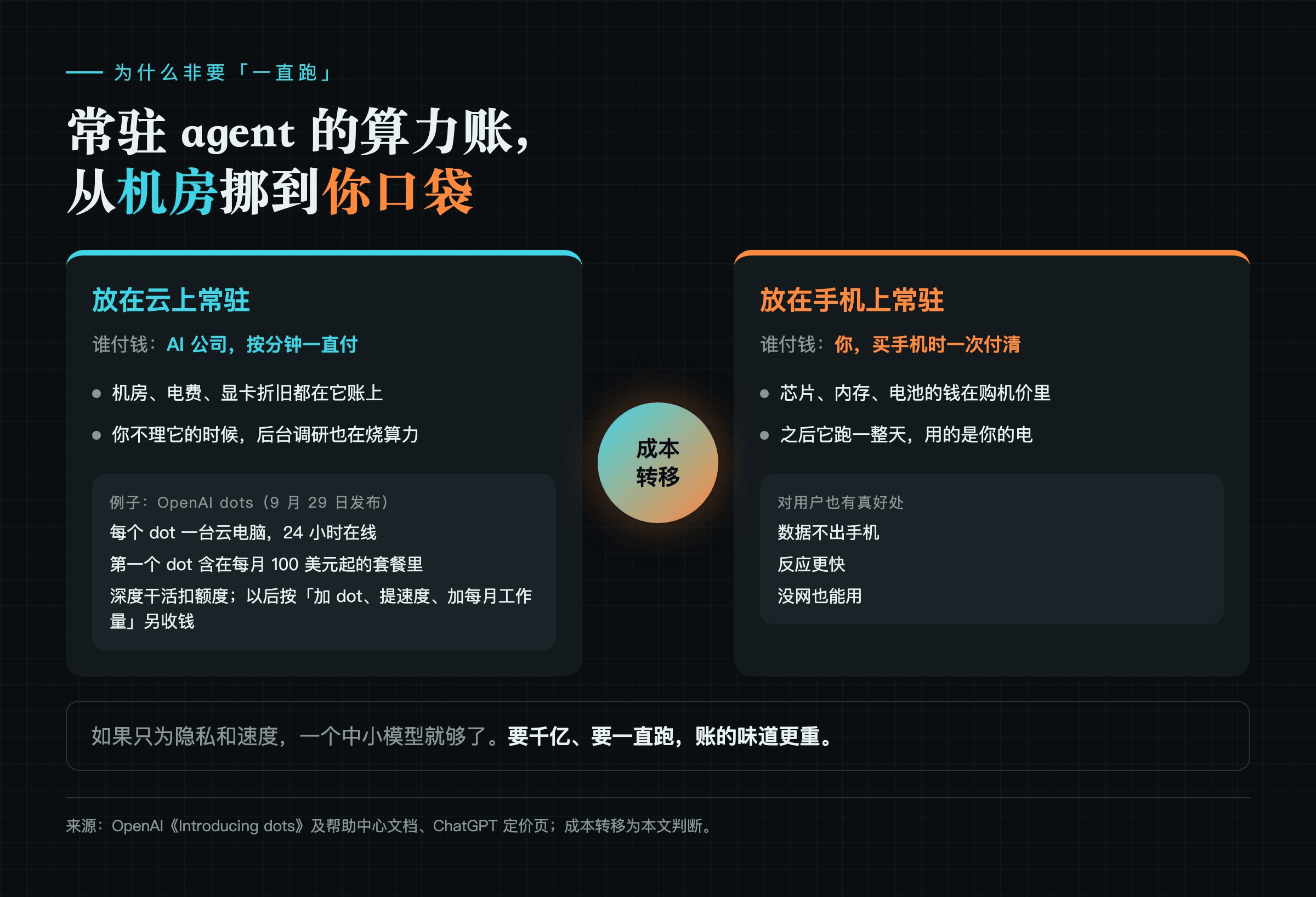
Now move this agent to your mobile phone, and the account will change:
Resident in the cloud: AI companies pay by the minute and always pay. Computer rooms, electricity bills, and graphics card depreciation are all in its accounts.
Resident on your mobile phone: When you buy a mobile phone, you pay for the chip, memory, and battery at one time. Then it runs in your pocket all day, using your electricity.
My judgment is: The most direct economic meaning of the requirement of "AI must always run" and "running on mobile phones" isto transfer the computing power cost of resident agents from the AI company's computer room to the user's mobile phone.
Of course, putting it on your mobile phone is also good for users: data does not flow out of the mobile phone, response is faster, and it can be used even if there is no Internet. These are all true. But if it's just for privacy and speed, a small and medium-sized model is enough. If you want hundreds of billions, you have to keep running, and the taste of accounts will be even heavier.
3. Why build your own mobile phone: Permission is a ticket
Ammon said on the show: "Smartphones are defined by third-party applications." He believes that agent will redefine mobile phones like apps of the past.
But if an agent wants to work for you, he must be able to operate the application on your mobile phone: ordering takeout, responding to messages, comparing prices, and placing orders for you. This requires system-level authority, and the key to the system is in the hands of the mobile phone manufacturer and operating system.
This incident has actually happened once in China.
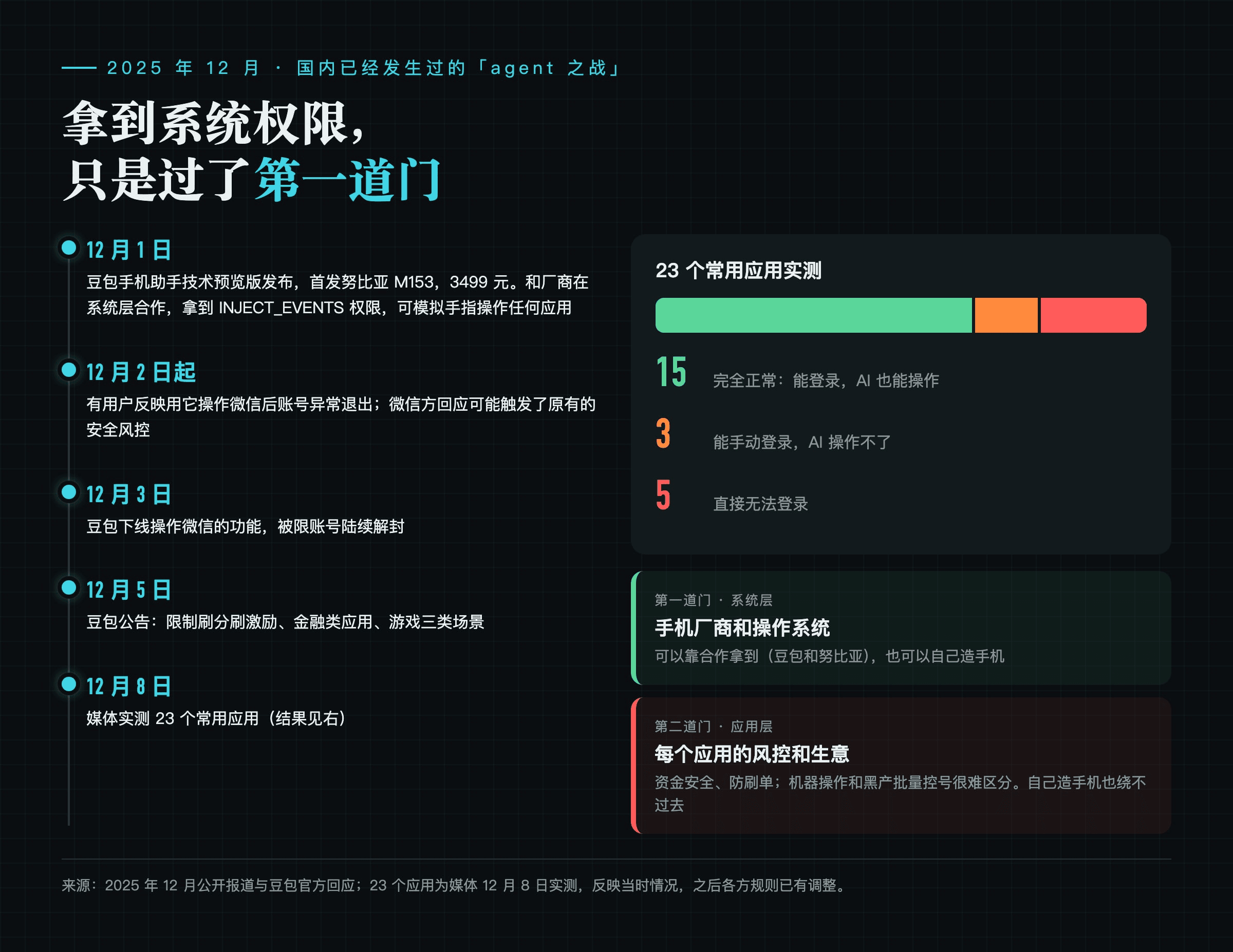
On December 1, 2025, Byte's bean bag mobile assistant released a technical preview version, which was launched on a mobile phone in Nubia. It cooperated with mobile phone manufacturers at the operating system level and obtained a system privilege called INJECT_EVENTS, which can simulate your finger to click on any application. Doubao's response was that this permission was obtained through cooperation with the manufacturer, requiring users to proactively authorize it, and was also included in the privacy white paper.
The day after the results were released, some users reported that their accounts were abnormally exited after using it to operate WeChat. WeChat's statement is that it may have triggered the existing security risk control. Subsequently, some banking and shopping applications also restricted it.
On December 8, some media conducted a test: Let this mobile phone install 23 commonly used applications, 5 of which cannot be logged in directly, 3 of which can be logged in manually but cannot be used by AI, and 15 of which are completely normal.
This incident illustrates a problem that is easily overlooked: getting permissions to the operating system is only the first door. Each application has its own risk control, traffic and advertising business, and they have the right to decide whether to welcome an AI that clicks on for users.
Standing on the application side, the reasons are also very good: fund security, anti-brushing, anti-black production. The machine replaces the human operation, and in the view of the wind control system, it is difficult to distinguish from the mobile phone controlled by the black production batch.
So AI companies make their own phones, and what can be solved is the first door: no need to ask Apple and Google for permission. The second door, that is, whether each application is willing to be operated by an agent, can not be bypassed by making a mobile phone by itself.
This is the same logic as what I have reviewed in previous articles. A large part of Meitu's profits are handed over to the app store;dots 'design focuses on permissions and approval; and at the mobile phone level, whoever has the authority to enter the door will have the next-generation traffic portal.
4. Who will this account be ultimately blamed
Go back to memory.
TrendForce data: The cost of memory in mobile phones used to account for 10% to 15% of the whole machine's materials, but has risen to 30% to 40% at the beginning of this year. The reason I wrote in the September article: AI data centers are competing for the same wafer as mobile phones, and the bid is higher. In the fourth quarter of this year, the contract price of mobile phone memory was still high and showed no sign of falling back.
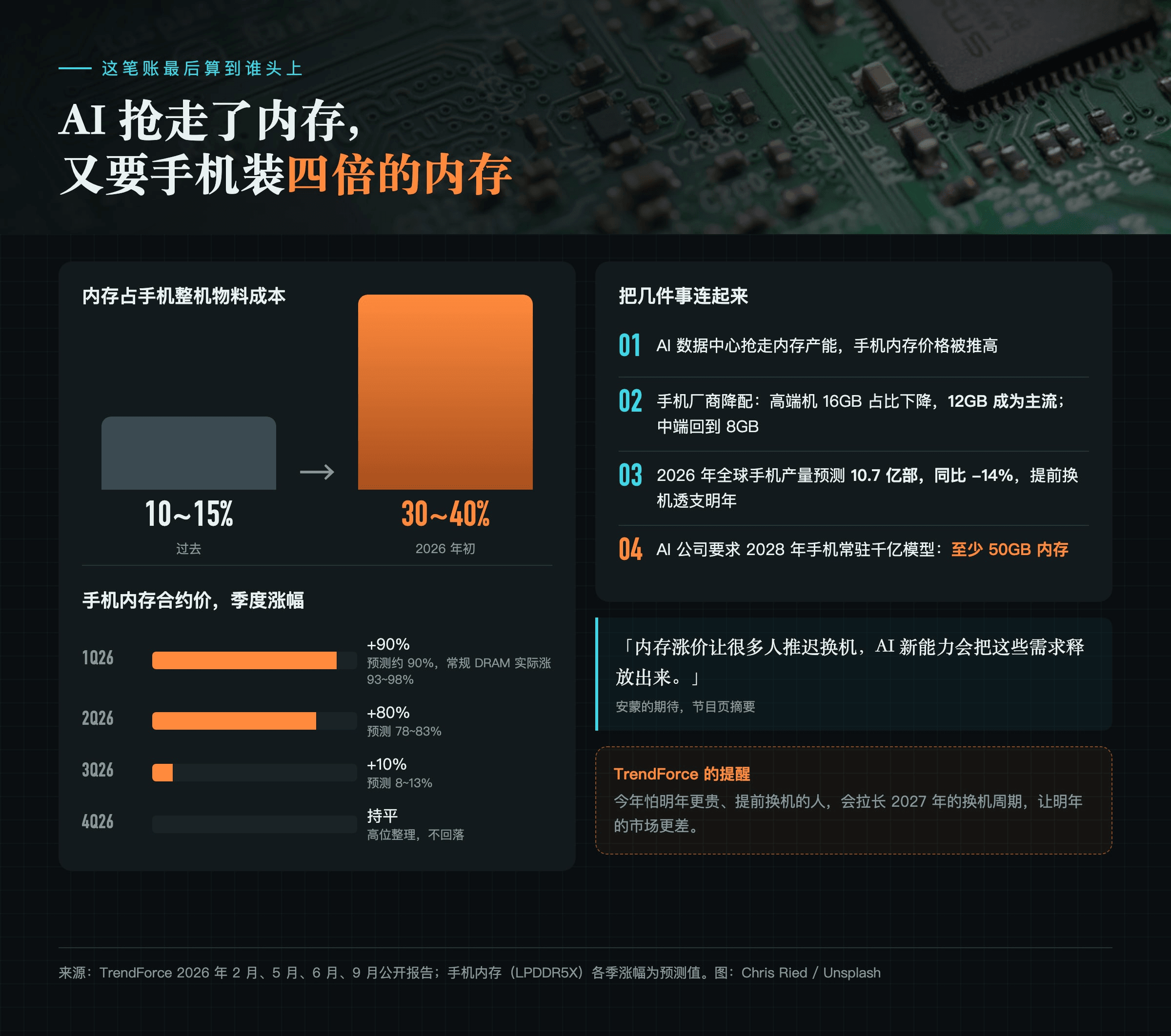
Ammon himself admitted that the rising price of memory has caused many people to postpone replacing phones. His expectation is that the new AI capabilities will release these suppressed needs and bring about a wave of machine replacements.
Putting these things together is a bit ironic:
AI data centers stole memory capacity and pushed up the price of mobile phone memory; mobile phone manufacturers were forced to downsize, and the proportion of 16GB of high-end phones was declining, and 12GB became the mainstream; then AI companies required mobile phones to install 50GB of memory., to run their resident agents.
It is not difficult to guess who will pay the money in the end.
5. My judgment
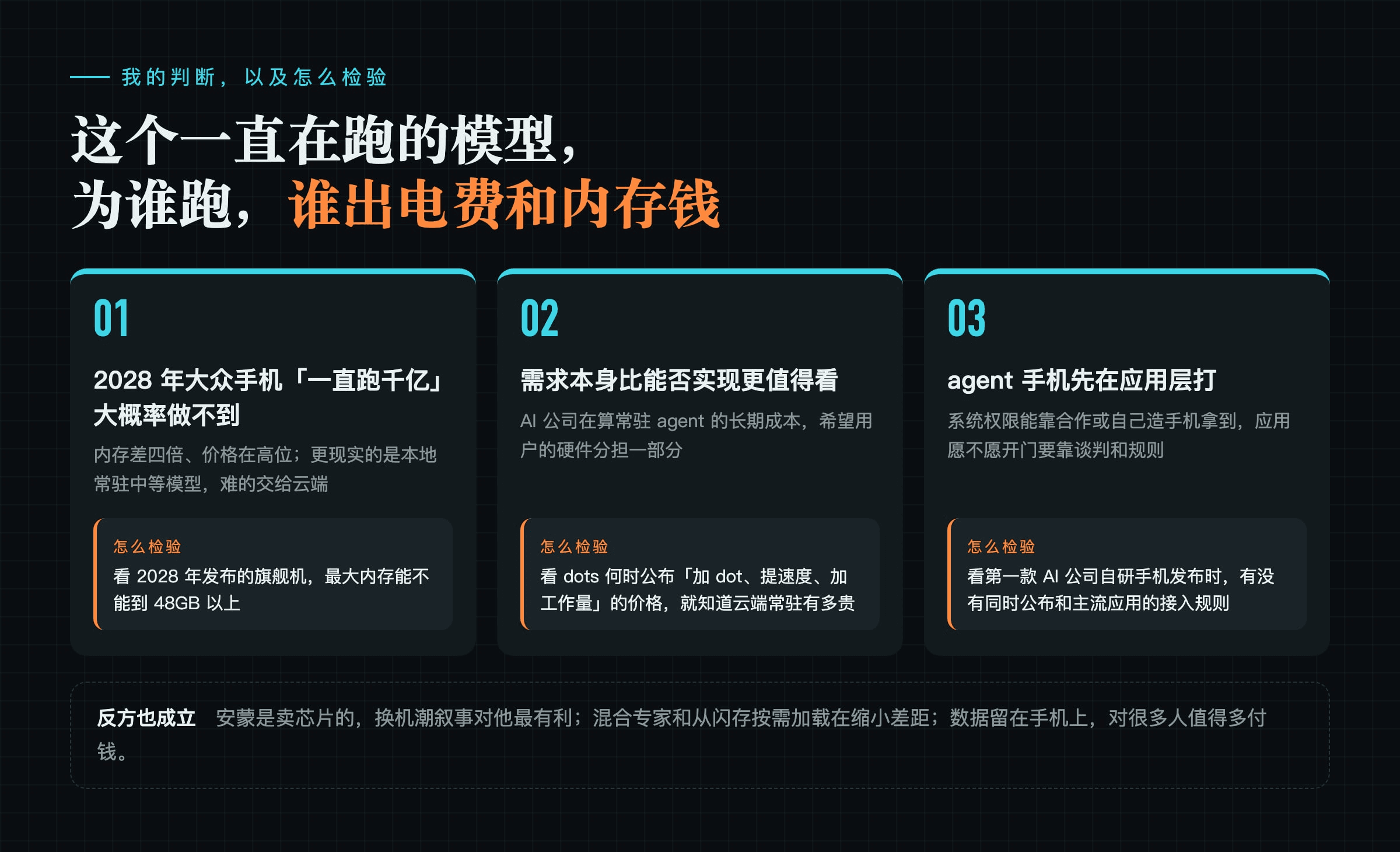
First, in 2028,"hundreds of billions of models will be running on mass mobile phones, but there is a high probability that it will not be possible. The memory capacity difference is four times and the price is high. A more realistic form is: a medium-scale model is resident on the mobile phone to handle daily and private matters, and the difficult things are handed over to the cloud.
Second, the need itself is more worth seeing than whether it can be achieved. It shows that AI companies are already calculating the long-term cost of resident agents and want users 'hardware to share part of it. Looking at how dots are priced in the future, you can see how expensive cloud residency is.
Third, the competition for agent phones will be fought first at the application layer, and the hardware will come later. The Doubao mobile phone has already demonstrated it once: system permissions can be obtained by cooperating with the manufacturer, but whether the application is willing to open the door depends on negotiation and rules. Whoever first talks to the main application about a set of rules of "what an agent can and cannot do" can make an agent mobile phone first.
6. Reasons for the Opposition
Ammon sells chips. The term "AI brings a wave of phone replacements" is most beneficial to Qualcomm. The 100 billion model in 2028 is only a demand raised by customers. Qualcomm has not promised any chips or timetables.
Technology may be advancing faster than I think. Mixing expert structures and only temporarily transferring the parameters used from flash memory into memory are all closing the gap. Qualcomm's chips this year can already run 30 billion parameters, and it is not impossible to reach 100 billion in two years.
End-side has real benefits to users. Data is left on your mobile phone. In today's increasingly sensitive privacy, this may be the reason why many people are willing to pay more for it.
AI mobile phones are not necessarily pits. Just next time you see the promotion of "Mobile phones can run hundreds of billions of models", you can ask one more question: Who is this model that has been running for, and who pays for the electricity bill and memory?
few sentences boundary
Ammon's statement comes from a summary of the program page released by the technology podcast "Sources" on October 9. The verbatim version of the program has not been made public;"AI companies start making their own mobile phones" was relayed by multiple reports, and he did not name specific companies.
Chip and memory specifications come from Qualcomm's public release and related reports at the Snapdragon Summit in September. Memory prices, material ratios and mobile phone configuration trends come from TrendForce's public report.
I estimate the bandwidth and speed according to the formula: only the model parameters are calculated, but not the context cache and the system itself."10 billion parameters are called each time" is an assumption made to explain the problem, which varies greatly from model to model.
The Doubao mobile assistant incident was publicly reported and the Doubao official response from December 2025. The tests of 23 applications were measured by the media, reflecting the situation at that time. Since then, the rules of all parties have been adjusted.
Photo sources: Gilles Lambert / Unsplash on the cover; Chris Ried / Unsplash on the text.