He used AI to defraud 16,000 yuan, and the county could not buy durian
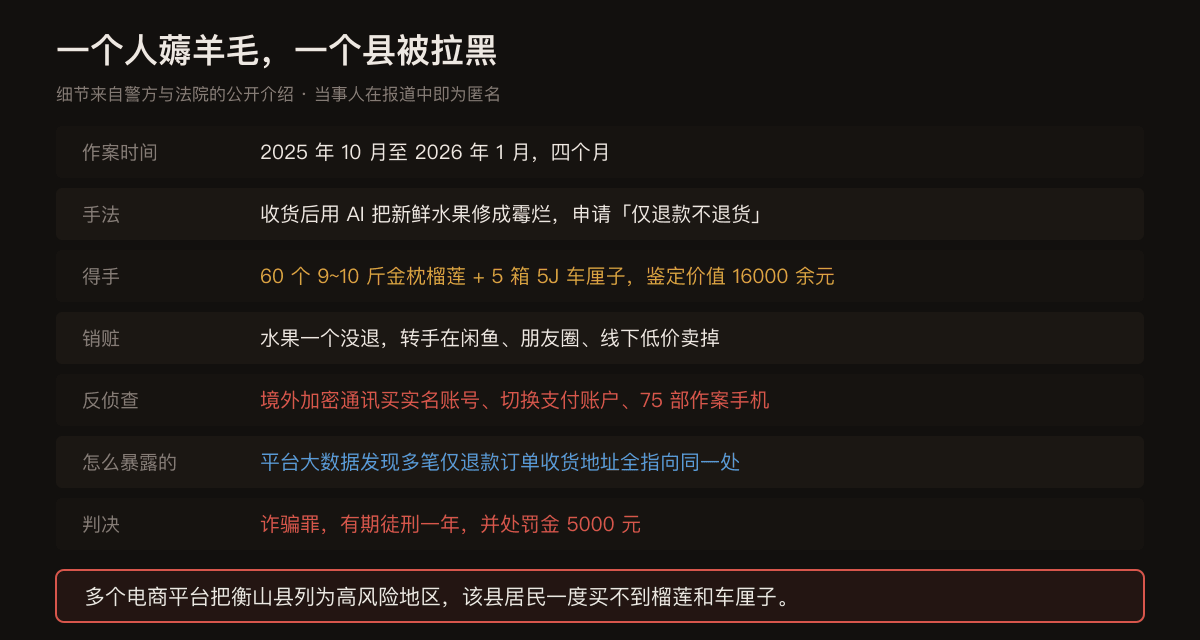
Residents of Hengshan County, Hunan Province were unable to buy durian and cherries on e-commerce platforms for a while. It was not that they were out of stock, but that multiple platforms listed the entire county as a high-risk area. The cause was that a local unemployed man born in the 1990s placed more than 100 fruit orders in four months. After receiving the goods, he used AI to repair the fresh fruits to a mouldy look. He applied for "refund only and no return". The money was refunded, and none of the fruits were returned. Refund, and sell them at a low price. Police found 75 mobile phones for the crime in his home. But none of his fake pictures were exposed, and the platform discovered that he relied on another thing.
Residents in Hengshan County, Hunan Province were unable to buy durian and cherries for a while.
It is not a shortage of goods, but multiple e-commerce platforms have listed the entire county as a high-risk area. You are in Hengshan, and you can't place these two things.
The reason was an unemployed local man born in 1996.
He spent four months placing more than 100 fruit orders. After receiving the goods, he used AI to revise the drawings to change the fresh fruits to look mouldy, and used these drawings to apply for "refunds only, no refunds." The money was refunded, but he didn't refund any fruits. He sold them at low prices in idle fish, friends circles and offline.
A total of 60 golden-pillowed durians weighing nine to ten kilograms and 5 boxes of 5J cherries were deceived, with an identification value of more than 16,000 yuan.
When the police went to his home, they found 75 mobile phones used to commit crimes.
He was not arrested because the plot was discovered
The first thing I want to understand in this matter is whether the drawings repaired by AI have been seen.
The answer is no.
The platform's way of discovering problems is simple: Big Data has detected multiple "refund-only" orders, all of which point to the same place. After receiving the report, the police conducted electronic data inspection, IP trajectory tracking, and data cross-comparison to lock him.
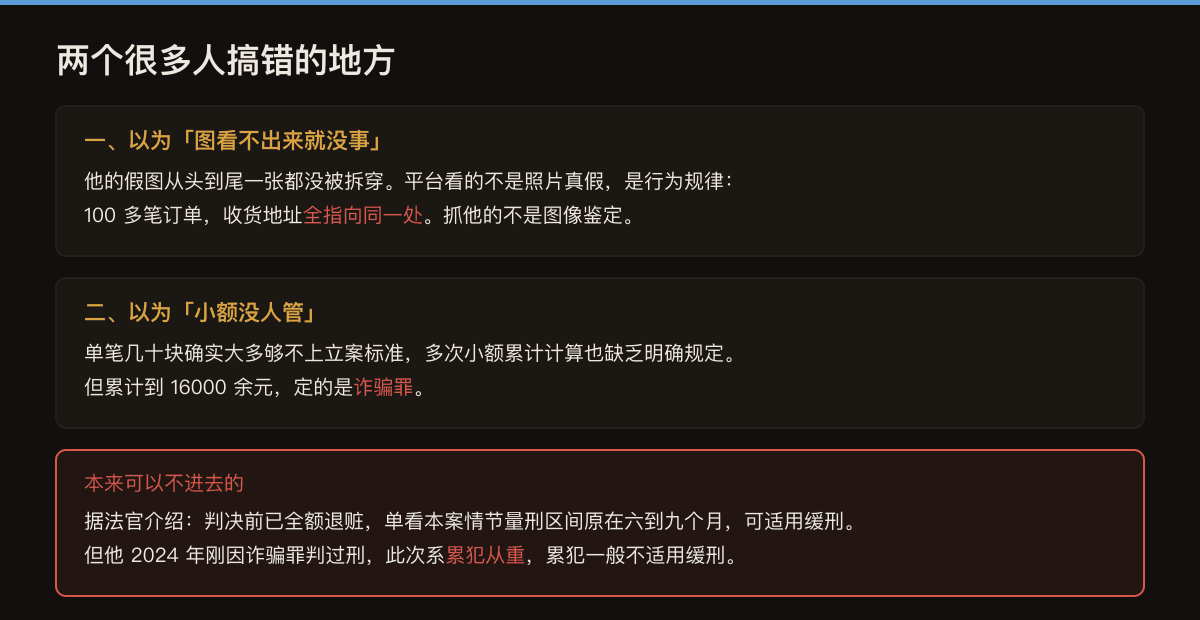
From beginning to end, no fake picture has been exposed. What caught him was not image identification, but behavioral patterns.
This is worth remembering for anyone who feels that "the drawings repaired by AI cannot be seen": whether you can see them or not is not necessarily the key point. If you do it once, no one cares; if you do it a hundred times, you still use the same shipping address, so you don't need to identify any photos.
He was actually guarding against it. The report said that he bought multiple real-name verified accounts through overseas encrypted communication software, and also switched different payment accounts to place orders separately. 75 mobile phones are probably used for this purpose.
But the address is real, and the goods have to be delivered to him.
fake for one minute, verification cannot be done
This case is extreme, but the soil supporting it is very ordinary.
A reporter once conducted an actual measurement: Take a photo of a peach and send it to three mainstream generative AI tools. Enter instructions.One minute later, the skin is covered with brown mold spots of different shades, and the fruit base is partially soft and rotten. The fake picture comes out, making it difficult to distinguish the authenticity with the naked eye. If you want to change the details, such as adding a few bump marks and saying one word to the tool, you can finish it in a minute.
There are even software that provides "e-commerce after-sales special templates" that can perform secondary light and shadow processing on the generated pictures, remove the product watermarks from the original pictures, and add background elements for logistics packaging. The purpose is clearly written: generate a diagram that matches the platform review scenario.
This is the cost on the counterfeiting side.
Look at the verification side again.
Existing AI content Detection Tools have low accuracy and are particularly weak in recognizing images after secondary processing. The cost of finding a third party for professional appraisal far exceeds the amount of the small order itself. For a banana order worth more than 30 yuan, you spend hundreds of yuan to evaluate it. If you win, you will lose.
Therefore, the choice of most small and medium-sized businesses is: not to check.
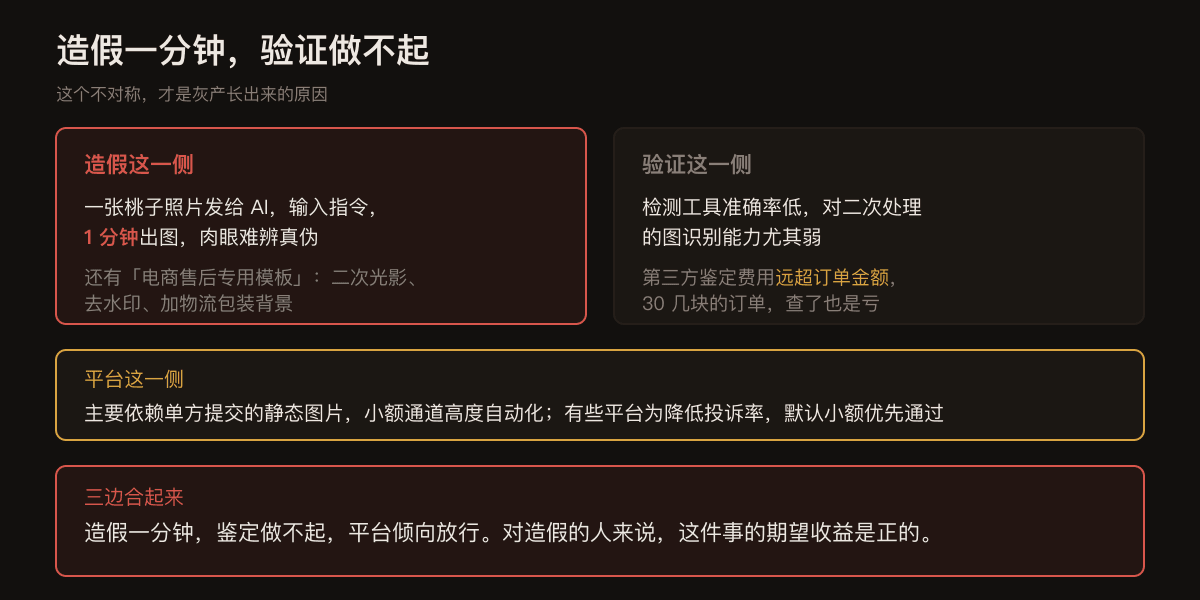
There is another floor on the other side of the platform. Most platforms still rely mainly on static pictures submitted unilaterally by consumers to handle after-sales disputes. The small fast refund channel is highly automated and lacks cross-verification with data such as logistics information, product traceability, and user historical credit. In order to reduce the complaint rate, some platforms simply default to giving priority to small refunds.
The three sides combine to create a situation like this: if one minute of fraud, the identification cannot be done, and the platform tends to let go.
Then for those who fake it, the expected return of this matter is positive. This is the reason why ash production capacity has grown, and has little to do with how advanced the technology is.
Someone has already made it a business
You can now buy "AI Refund Practical Course" online at a price of 288 yuan, as well as paid services such as "Secondary Optimization of Fake Images". The slogan is that a single account earns a thousand yuan a month. The course content includes light and shadow matching skills and multi-angle flaw generation.
On social platforms, this set of things has been packaged as "wool harvesting wisdom."
Who was the one who was picked up?
A doll shop owner in Shanghai received a "product stain map" and used professional tools to measure it. The edges were blurred and the light and shadow were logically contradictory. The problem was obvious. The platform still ruled a refund of 50 yuan.
What a fresh food merchant in Hubei encountered was even more outrageous: the picture of the rotten bananas submitted by the consumer was exactly the same as the archived photos he had when shipping the goods. The order for 32 yuan was still ordered to refund and not return it.
A merchant selling fig seedlings received a refund-only application after only selling a total of 12 orders. The leaves on the picture were all yellow. He has been planting for many years and can see the problem at a glance: the leaves that are really dehydrated should shrink and droop, and the leaves in the picture are completely unfolded normally, with only the color changed. He refused, and the buyer applied for the platform to intervene, and the platform approved the refund within a few minutes based on the map.
The order was 45 yuan. He later initiated a check-out.
"Small amounts are not managed" is a misunderstanding
There is another layer in this case that many people really don't know about.
It is true that most fraudulent refunds of tens of yuan per transaction do not meet the standard for criminal filing, and there is currently no clear regulation on the cumulative calculation of multiple small amounts, so in reality a large number of such behaviors cannot be investigated. This is a fact.
But it does not mean safety. When you accumulate to a certain amount, the nature changes. Hengshan has accumulated more than 16,000 yuan and was convicted offraud.
He also encountered another thing.
According to the judge, he had already returned the stolen goods in full before the verdict. Judging from the circumstances of the case alone, the sentencing range was originally six months to nine months, and probation could be applied. In other words, if this was the only thing, there was a high probability that he wouldn't really have to go in.
But he was just sentenced for fraud in 2024. This time it is a recidivist and is severely punished according to the law. Probation is generally not applicable to recidivists.
He was finally sentenced to one year in prison and fined 5000 yuan.
In fact, he is not the only one paying off the bill for ## .
I watched this case from beginning to end and felt that the most worthy thing to say was not how long he sentenced him.
It was who the bill ended up being shared.
What he took was 16,000 yuan worth of fruit. For this reason, residents of Hengshan County were unable to buy durians and cherries on e-commerce platforms for a while. Most of them had nothing to do with him. The merchant selling fig seedlings closed the store. What he lost was not 45 yuan, but a business.
And this game is going somewhere else. In public reports, AI has been used to forge quality inspection failure reports of competing products in commercial competition, serious illness medical records on public welfare fundraising platforms to defraud donations, and AI has been used to generate false medical diagnosis reports and accident scene images in insurance claims.
The logic is the same: pictures used to be the cheapest evidence, now they are the cheapest lies.
In the past, when you said something, if someone asked you to take evidence, you would just take a photo, because the action of taking pictures itself required the scene and physical objects. This premise is now gone. One minute, one sentence, one picture that matches the platform review scenario.
So what is really failing is not the after-sales rules of a certain platform, but the sentence "there is a picture and the truth."
few sentences boundary
The details of the case came from public reports, including police and court introductions. The person involved was anonymous in the report. I followed this writing without verifying who he was. The exact date of the verdict varied in different reports, so I didn't write it down.
This article does not discuss whether the "refund-only" mechanism should exist. That is another topic and I cannot draw conclusions. I just want to make one thing clear: when the cost of fraud drops to one minute and the cost of verification remains unchanged, the difference in the middle will definitely be taken away by someone, and the price will fall on completely irrelevant people.
Finally, I didn't write a word about the three AI tools, how to write the prompt words, and where to buy the template, and I won't write it in the future.