The lawyer asked the AI to find the case, but the judge checked it all made it up
A lawyer submitted two cases to the court, one of which was (2022) Hu 01 Min Zhong Zhong No. 12345. The judge searched this case number and found that the real case was private lending and had nothing to do with the equity holding in this case. He admitted that these two cases were obtained by repeatedly asking AI after refining keywords and did not conduct any verification. This case was included in the People's Court case database this year. Among the 5538 articles in the entire database, only one "artificial intelligence false case" hit it. The case database's description of these two fake cases is the most fatal: it is "highly consistent with the factual details, legal disputes, and adjudication logic of the case, and seems to have strong reference value."
A lawyer submitted two cases to the court to support his client's views.
The case number of one of them is: (2022) Hu 01 Min Zhong Zhong No. 12345.
12345。
The judge took this case number to search and retrieved the real judgment documents. That case number does correspond to a case in Shanghai First Intermediate People's Court, but the content is private lending and has nothing to do with the issue of equity proxy holding to be demonstrated in this case.
The same is true for the other one. The case number is real and the content is compiled.
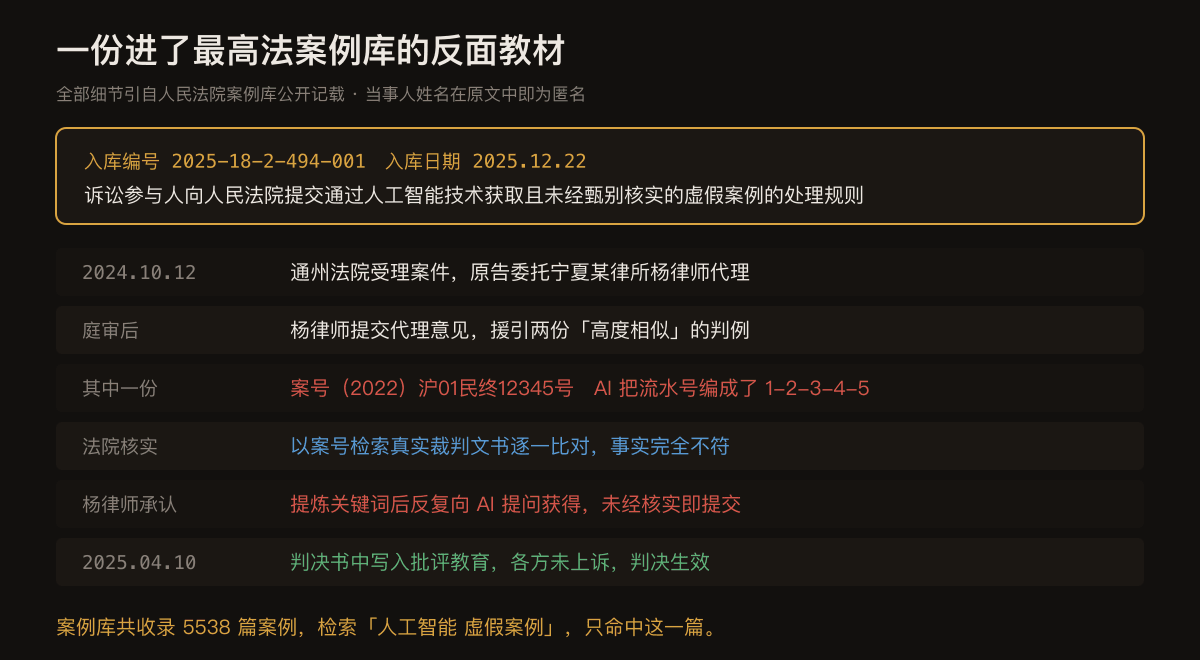
This case was included in the People's Court case database by the Supreme People's Court this year, with the entry number 2025-18-2-494-001. The entire case database now contains 5538 cases, and this is the only one searched using "artificial intelligence false cases".
How did this happen?
The records in the case database are very plain.
In October 2024, the Beijing Tongzhou Court accepted a "company-related dispute." The plaintiff entrusted Lawyer Yang from a law firm in Ningxia as his representative.
After the trial, Lawyer Yang submitted a written representative opinion. In order to demonstrate his views, he cited two cases in it, saying that the facts and controversial issues of these two cases were highly similar to the case.
The court's action was very simple: use the case number as a keyword to search, pull out the real judgment documents, and compare them with the content he submitted one by one.
Then I realized that it didn't match.
The handling judge later explained a detail in a television interview: the first thing he noticed was not the content, but the wrong format. There were solid dots on the left side of the two materials.
I find this detail quite interesting. People who have done text work should realize that it is most likely the unordered list symbol of markdown, the most common typographical residue when AI generates content. You copy and paste it into Word, and those little dots follow.
The judge did not see through it through legal skills, but saw at a glance that the text did not look like it had been written by a person.
After inquiry, Lawyer Yang admitted: He distilled the facts of the case into keywords and controversy points,repeatedly asked questions from an AI language model, got these two cases, and then wrote them into the agency's opinions without any verification.
The most fatal sentence in the ## case library
The description of these two fake cases in the case database reads as follows:
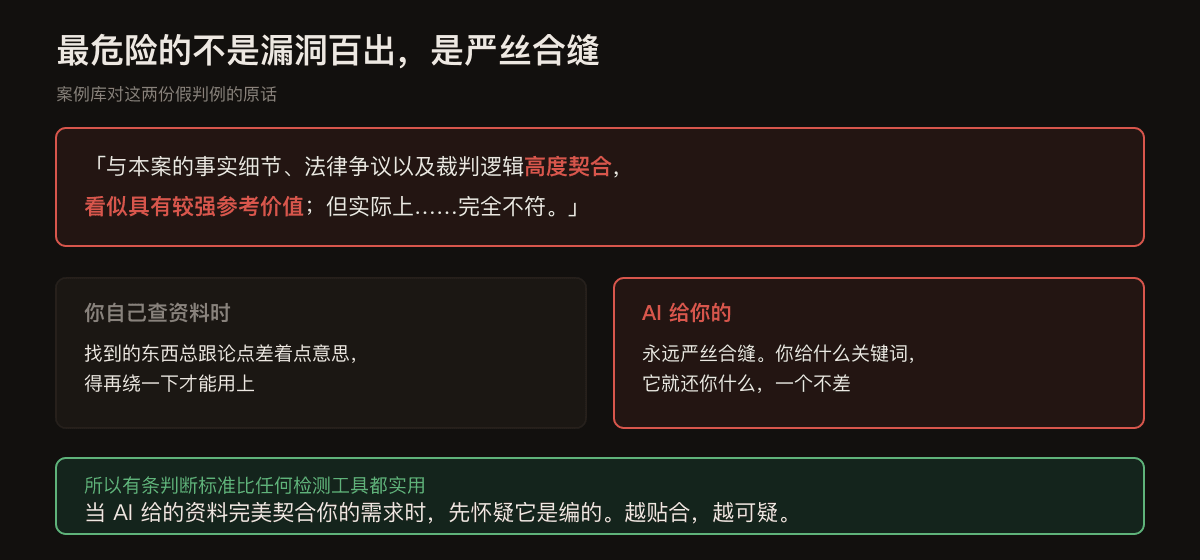
"The two cases provided by Yang are highly consistent with the factual details, legal disputes and adjudication logic of this case, and seem to have strong reference value; but in fact, the facts described in the two cases are completely inconsistent with the actual case numbers."
I read this sentence three times.
Highly compatible and seems to have strong reference value.
This is where this is really dangerous. A fake thing is not something that is full of loopholes and can be seen through. On the contrary, it is easier to use than the real thing.
Think about the experience of searching for information in real life: After searching for a long time, the jurisprudence, data, and cases you find are always different from what you want to demonstrate, and you have to go around it yourself before you can use it. This grinding process itself is actually a feature of the real world, because the real material is not tailor-made for your argument.
And what AI gives you will always be perfect. Whatever keywords you refine will give you, including facts, details, focus of controversy, and judgment logic.
So there's a criterion that I think is more practical than any Detection Tools:
When the information AI gives you perfectly matches your needs, suspect that it is compiled first.
The more they fit, the more suspicious they are.
There is a legal gap
The most worthy thing in this case is actually the court's reasoning. Because it deals with a new question: what is it to fabricate jurisprudence?
Intuitively, everyone will think of Article 114, paragraph 1, of the Civil Procedure Law, which is the article that "Whoever forges or destroys important evidence and obstructs the people's court from hearing the case, the people's court may impose a fine or detain it according to the seriousness of the case."
However, the court did not directly apply this article on the grounds that:
"The evidence specified in this clause shall be important evidence for determining the facts of the case. Cases submitted by litigation participants to the court for reference are within the scope of litigation opinions and are not evidence. Therefore, submitting an unverified false case to the court does not constitute 'counterfeiting or destruction of important evidence' as stipulated in the above clause."
Jurisprudence is not evidence, but an opinion.
So strictly speaking, it is not the same thing legally for you to compile a case and submit it to the court, and for you to forge a contract and submit it to the court. The former does not fall into the article on fines and detention.
So just ignore it? Not really. The court then wrote:
"However, the behavior of litigation participants submitting false cases violates litigation integrity and hinders the order of civil litigation, and they should bear corresponding legal consequences based on the seriousness of the case. In practice, the people's court may combine factors such as the degree of subjective fault, harmful consequences, and degree of obstruction of civil litigation, andrefer to the provisions of Article 114, paragraph 1, of the Civil Procedure Law."
Pay attention to those two words, refer to.
It's not application, it's reference. This provides a path to deal with areas that are not explicitly covered by the law. And this sentence is the reason why this case was written into the case database and became a reference rule for courts across the country.

QKPFX6 Why QK only criticizes education this time
The result: the court wrote a criticism in the judgment.
"This court criticizes this and hopes that the plaintiff's agent will take warning. When submitting reference cases and laws to the court, they should conduct inspections and verification to ensure the authenticity and accuracy of the content, and must not allow artificial intelligence models to generate or fabricate false information to disrupt judicial order."
No fines, no detentions. The case library gives three lighter reasons:
First, there was no evidence to prove that he deliberately submitted a false case; second, he was able to proactively explain the source of the case afterwards; third, the circumstances were minor and did not cause serious consequences.
These three are worth remembering because they are in turn aggravating conditions. If it is found that it is known to be false and then submitted, if it does not admit it and makes up another set of statements when questioned, and if this false material really affects the verdict, it is not the magnitude of criticism and education. The gist of the judgment is clearly written: if the circumstances are serious, they can be dealt with with in accordance with the first paragraph of Article 114. That one corresponds to fines and detention.
Incidentally, a comparison in terms of magnitude. There have been several such incidents in the United States, and the method of handling them is direct fines: a lawyer was fined US$15,000 for citing AI's fictitious jurisprudence in a document; another case where a person's temporary practice license was revoked, and the other three co-defendants were each fined US$1000 to US$3000; the earliest case was fined US$5000, plus mandatory professional literacy training.
On one side, the penalty is money, and on the other side, the penalty is reputation. This lawyer Yang didn't pay a penny, but the case entered the case database and became a teaching material for colleagues across the country.
QKPFX8 What does this matter have to do with people who do not file lawsuits?
It matters a lot, because the action that goes wrong is not to "file a lawsuit", but toask AI to help you find evidence and then hand it over without verification.
Change the word "jurisprudence" to something else, something you may do every week:
Write a plan and ask AI to find several cases from peers. Write a report and ask AI to supplement some industry data. Write a paper and ask AI to list several references. Report to your boss and ask AI to help you find an explanation that supports your point of view. Give the customer a reply and ask the AI to quote a policy article.
Each one has the same structure: you need a basis to support an established perspective, and AI gives you a perfect fit, and you feel you saved two hours.
The identity of a lawyer is not the key here, or rather, it is precisely because he is a lawyer that explains the problem. This is a profession that relies on verifying facts and is the group of people who know the most clearly that "citations must have their origins." The reasoning of the case base specifically points out this point: The Lawyers Law requires that "lawyers 'practice must be based on facts." Therefore, lawyers, as practitioners of the legal profession, should follow the principle of litigation integrity.
Even he saved the need to verify.
When the representative opinion was handed over, Lawyer Yang probably really thought that the two cases existed. This is the most common part of this case and the most likely thing to happen to anyone.
few sentences boundary
All details of this case come from the public records in the People's Court's case database, with the entry number 2025-18-2-494-001. The judgment was Tongzhou Court (2024) Jing 0112 Minchu No. 19067. It was issued on April 10, 2025. No party appealed and the judgment has taken effect. The names of the parties and lawyers are anonymous in the case database. I followed the original writing and did not verify who they were.
The detail that the judge discovered that the format was abnormal came from the judge's recollections during the TV interview, and this section was not recorded in the main body of the case database.
One more thing to be clear: this is not an article about "AI cannot be used." The wording used in the court's reasoning was "beyond the boundaries of reasonable use of technology." That is to say, using AI itself is not a problem, but the problem is that what it gives is directly regarded as facts.
The main sentence of the referee can actually be copied directly as a code of work: if you submit content obtained through artificial intelligence technologyand not screened and verified, you will bear corresponding consequences. The key is never "whether it was written by AI", but "whether it was verified."