The data center has not yet been built, and American residents have begun to pay for its electricity bills
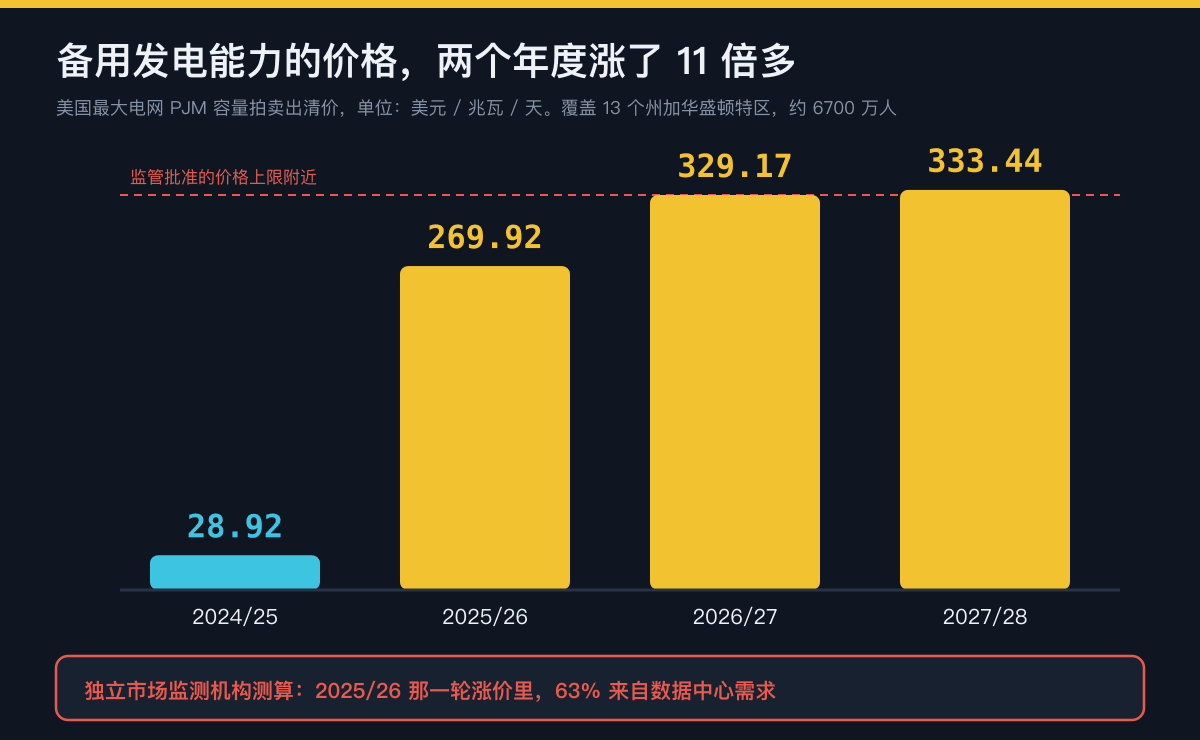
PJM, the largest power grid in the United States, holds an annual auction to buy reserve generation capacity on call during peak times. This price has increased from US$28.92 per megawatt per day in 2024/25 to US$329.17 in 2026/27, hitting the price ceiling and increasing more than 11 times. Independent monitoring agencies estimate that 63% of one round of price increases came from data centers. What's more critical is the mechanism: capacity is purchased in advance according to forecasts, and forecasts are also taken into account for the planned data center. Fees are added to all users 'bills when the auction is cleared. Projects will be postponed or even cancelled later, and the money will not be refunded. 97% of the new peak load in 2027/28 comes from the data center, and the last two auctions did not buy enough for the first time. Residents in some areas pay $16 to $18 more per month. On the other hand, Texas has also built data centers on a large scale, but electricity prices are basically stable: the results depend on the rules. What states are doing is shifting this cost back to data centers.
The largest power grid in the United States is called PJM, covering 13 states plus Washington, D.C., and approximately 67 million people use its electricity.
This power grid holds an auction every year to buy "reserve power generation capacity", which is different from the electricity used in ordinary times. The price is calculated per megawatt per day.
In 2024/25, this price is $28.92. By 2026/27, it will be US$329.17, hitting a regulatory approved price cap.
It has increased more than 11 times.
According to estimates by independent market monitoring organizations, 63% of one round of price increasescame from the electricity demand of data centers.
What was even more surprising was another thing: Part of the money was paid for data centers that had not yet been built. Even if it is not built in the end, the residents will still have to bear the cost.
This article will explain clearly how this money was calculated all the way to ordinary people.
1. What is the power grid buying?
First, we need to explain clearly what this auction is for.
Electricity is different from other commodities. It cannot be stored and must be distributed at any time. There are always a few hottest or coldest periods of the year, when electricity consumption across the entire network reaches its highest point. The power grid must ensure that there is enough generating capacity at that moment, otherwise power cuts will be imposed.
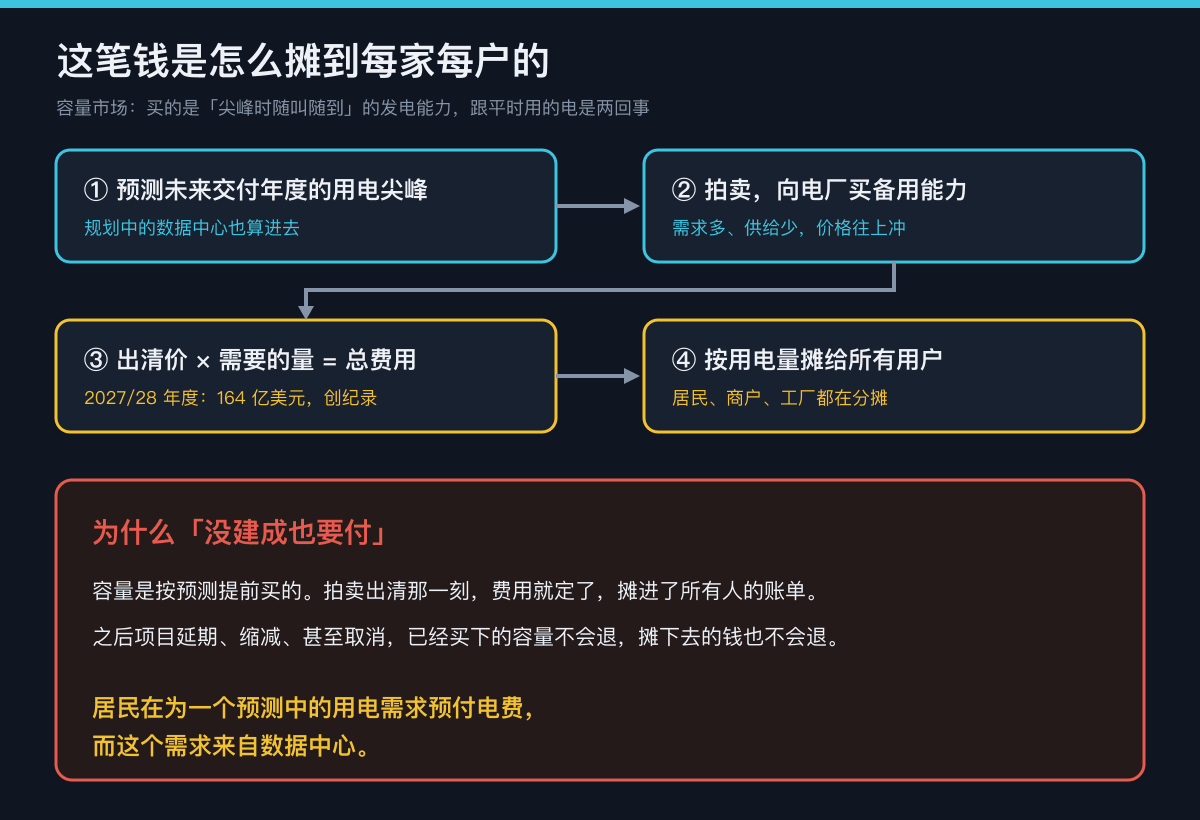
So PJM's approach is to predict in advance how high the peak will be in a certain year in the future, and then buy power plants the ability to be "on call" through auction. This is called the capacity market.
After the auction was cleared, the money wasspread to the bills of all users of the power grid based on electricity consumption, and no one paid it alone. Residents, merchants, and factories are all sharing the share.
There was nothing wrong with this mechanism. The problem lies in the "prediction" step.
2. The extra piece in the forecast
The data center is a large consumer of electricity, and its electricity consumption curve is very flat, with full load 24 hours a day. The electricity consumption of a large AI data center can be equivalent to that of a medium-sized city.
So PJM included a large number of planned data centers when making future load forecasts.
In the 2027/28 forecast, peak loads are approximately 5,250 megawatts higher than the previous year, of which nearly 5,100 megawatts come from data centers. Almost all the new parts are them.
Demand is going to rise, but supply cannot keep up. PJM's own judgment is that the new data center load is about 5 to 7 gigawatts per year, and before 2032, only 2 to 3 gigawatts of new power generation capacity can be added every year.
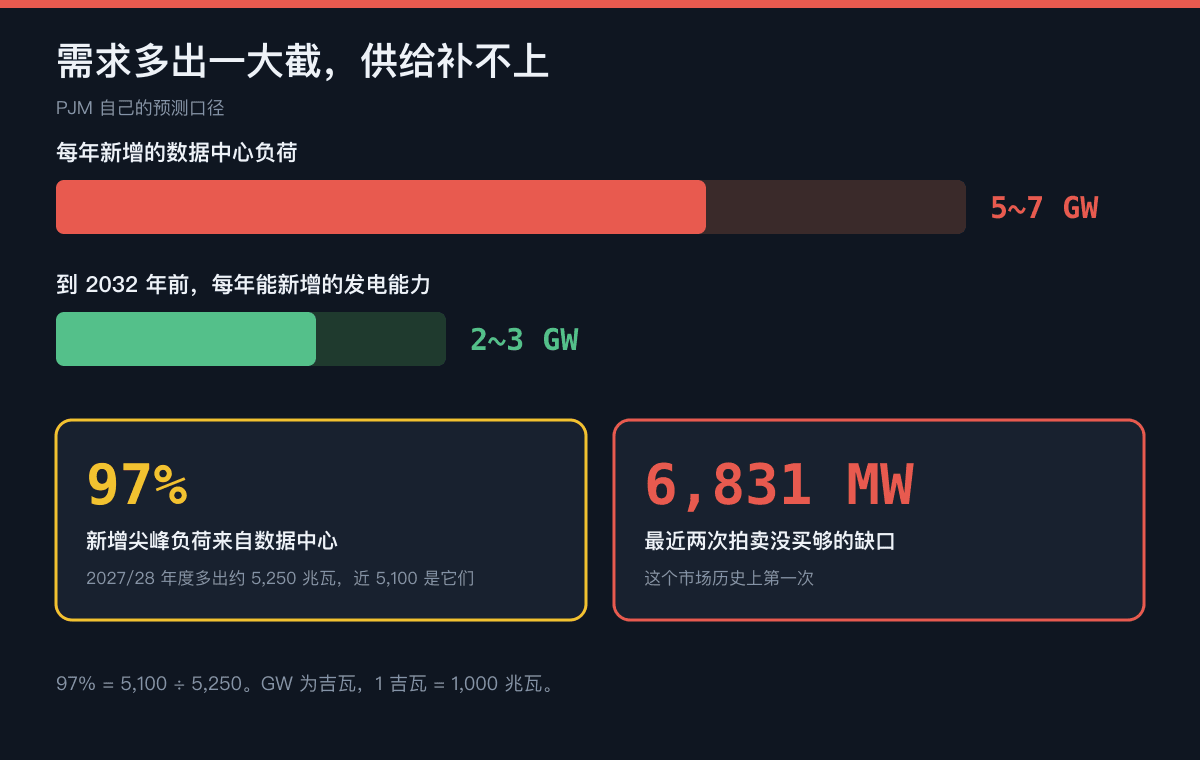
If there is a lot more demand and supply cannot make up for it, the auction price will naturally rise. For the first timein the last two auctions, there was not enough purchase, and reliability requirements were missing by 6,831 MW, which has never occurred in the history of this market. Prices have also hit upper limits in a row.
Total capacity expenses in 2027/28 reached a record high ofUS$16.4 billion.
3. Why "I have to pay even if it is not built"
This is the most critical part of the whole thing.
Capacity ispurchased in advance according to forecasts. At the moment of the auction, the grid was based on the prediction that "so many data centers would come in the future" and then spent money to buy the spare capacity.
The money was settled when the auction was cleared and was spread into everyone's bills for that delivery year.
If a data center project is postponed, reduced, or even cancelled later, the capacity already purchased will not be refunded, and the expenses already apportioned will not be refunded.
So the accurate statement is: Residents are prepaying for electricity bills for a predicted electricity demand, and this demand comes from the data center.
I think this is the structural issue of this matter. Of course, the data center itself pays its own electricity bill, but the part of the cost of "spare capacity" it drives up is distributed to everyone on the entire network according to existing rules. The demand it brings is paid by everyone together.
4. How much does it cost to each household?
These figures come from different institutions and have different opinions. Let's take a rough look:
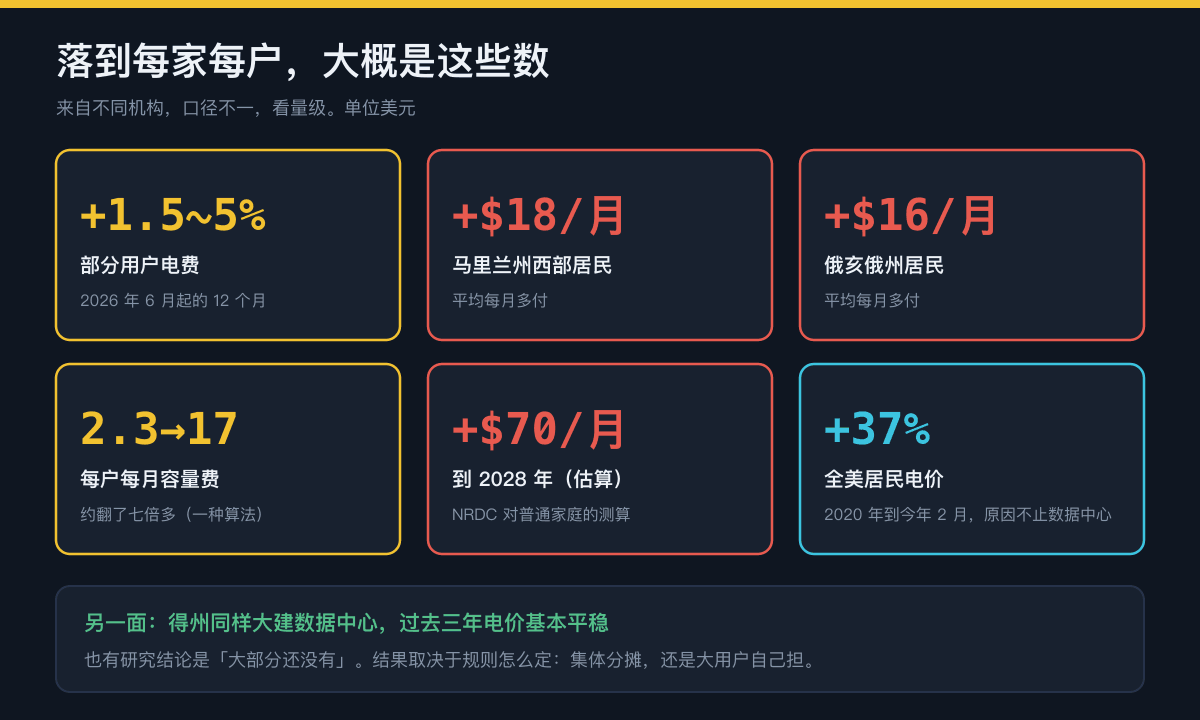
In the 12 months from June 2026, electricity bills for some PJM users are expected to increase by 1.5% to 5%. By region, residents in western Maryland pay an average of about $18 more per month and Ohio about $16 more per month.
One algorithm is that themonthly capacity fee per household has increased from approximately US$2.30 in 2024/25 to approximately US$17 in the last three years, an increase of more than sevenfold.
Environmental group NRDC estimates are even more pessimistic: by 2028, the monthly electricity bill of an average household in this area will be about $70 higher than before the price increase.
Looking at the United States, according to data from the U.S. Energy Information Administration, residential electricity prices rose from 12.76 cents per kilowatt-hour in 2020 to 17.44 cents in February this year,an increase of about 37%. Of course, this is not all due to the data center.
There is also another group that is easily ignored: factories. According to reports, the increase in electricity bills in factories far exceeds that of ordinary households. For electricity-intensive manufacturing, this is a real cost.
5. On the other hand: Some people say,"It's not that far yet"
This matter is controversial, and evidence from the opposing side must also be put forward.
Texas is also building a large data center, but electricity prices have remained stable in the past three years. Based on this, some reports believe that the root cause of the problem lies in specific market design and policies, not in the AI industry itself.
A New Jersey policy research institute concluded that data centers are driving up electricity bills "mostly not yet."
PJM's own attribution is also multi-factor: tightening supply, rising demand, changes in market rules, and reduced capacity quotes for power plants are all at play. Consulting firm Bain also warned that investment in local power grids and overall inflation, which have nothing to do with data centers, are also pushing up electricity bills.
My understanding is that these statements are not contradictory. The Texas example just shows that the results depend on how the rules are set. If the same data center is put together collectively in the capacity market, and if it is put together in another set of rules and is borne by large users themselves, the result of falling on residents 'bills can be completely different.
6. States have begun to change rules
Because of this, states 'reactions are almost all pointing in the same direction: shifting the cost from "everyone" and back to the data center itself.

Oregon became the first state to create a separate electricity price category for data centers, and large users and residents no longer use the same set of prices.
Virginia has a bill that would shift power distribution and capacity costs from residents to data centers. Virginia has one of the densest data centers in the United States.
At least six states have put forward proposals to suspend construction, and seven are seeking to eliminate or limit tax breaks for data centers.
At the federal level, the White House pushed a group of technology companies to sign a power user protection pledge and asked them to fund new power plants in the PJM jurisdiction. The meaning is clear: you will build the power plant yourself for the electricity demand you bring.
Last
The formation mechanism of domestic residential electricity prices is different. It is set by the government. The transmission chain of this capacity auction does not directly exist, so this article only talks about the United States.
But the truth it explains is universal.
A few days ago, I wrote about why the price of memory increased: AI data centers are competing for the same wafer as mobile phones. The power grid is the other side of the same story: AI is grabbing the wafer and also grabbing the backup capacity of the power grid. Ordinary people do not necessarily use AI, but they will pay part of the money for its expansion in the form of price increases.
When a new technology expands, who ultimately falls on the cost is often determined by rules that few people pay attention to. This time, it was an auction that had been completed long ago and few people paid attention to it.
few sentences boundary
The capacity clearing price, insufficient reliability demand at auction, and total capacity costs are derived from the PJM auction results and the report from the Energy Research Institute;"more than 11 times" is calculated by dividing 329.17 by 28.92.
"63% comes from data centers" comes from PJM's independent market monitor, targeting the 2025/26 auction round. Load forecast and new supply figures come from PJM's forecast caliber.
The monthly overpayment by residents in various places, NRDC calculations, and changes in capacity fees per household are estimates by different institutions, with different standards. Residential electricity prices across the United States come from the U.S. Energy Information Administration. There are multiple reasons for the increase and cannot be all attributed to data centers.
Some data such as wholesale electricity prices are the reporting standards. This article does not involve the evaluation of electricity price policies in any region.