AI companies burn money. At the current rate, when will they burn it out?
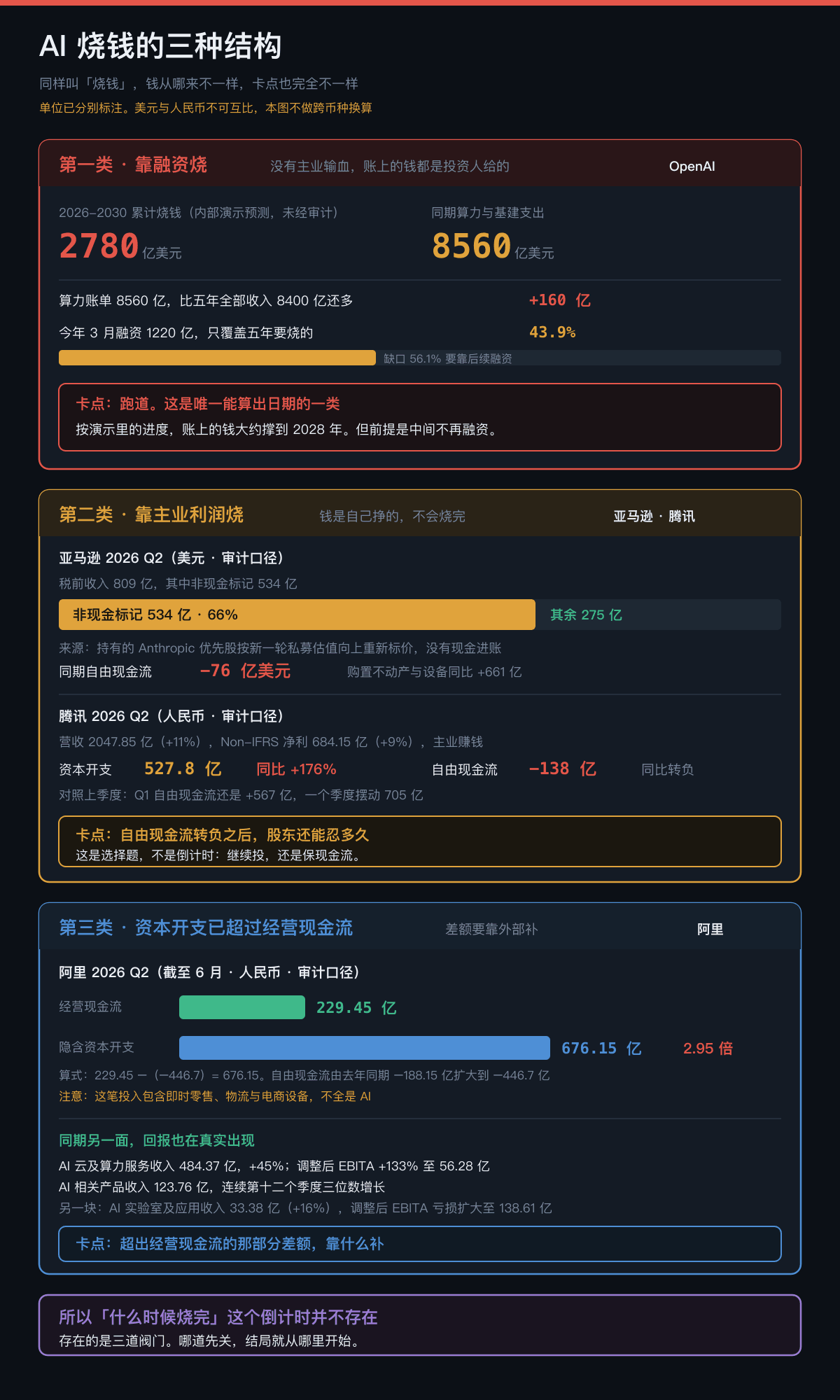
How long can AI companies continue to burn? This question must be classified first before answering, because "burn-out" is only true for one category. The first category relies on financing, represented by OpenAI: an internal demonstration in July showed that it is expected to burn US$278 billion and spend US$856 billion in computing power from 2026 to 2030, which is 16 billion more than the total revenue in five years. The 122 billion yuan raised in March only covers 43.9%, and will be spent in 2028 as scheduled. But the most counter-intuitive thing is that computing power expenditure rose from 600 billion yuan in February to 856 billion yuan, and the forecast for burning money dropped from 305 billion yuan to 278 billion yuan. Because most of the construction was funded by partners, the cost was shifted from the model company's statements to the supplier's balance sheet. The second category relies on the profits of the main business and will not be burned out, but other signals will appear on the accounts: Amazon's net profit of US$62.6 billion in a single quarter was non-cash marked by 53.4 billion, and the net outflow of free cash flow during the same period was 7.6 billion; Tencent Capital Expenditure increased by 176% year-on-year, with negative free cash flow. The third category of capital expenditure has exceeded operating cash flow. Ali's single-quarter operating cash flow was 22.945 billion yuan, and implied capital expenditure was 67.615 billion yuan, nearly triple. At the end of the article, four criteria are given that are more useful than headline numbers.
This question can be seen everywhere now: AI companies are burning money so much, how long can they continue to burn at the current rate?
I reviewed the accounts I could find in my hand and found that this question had to be classified before I could answer it.
Because the matter of "burning out" is only established for one type of company.
The other two types will not be burned out at all, and their trouble lies elsewhere.
Category 1: Relying on financing, this type can calculate the runway
The representative is a pure model company like OpenAI. It has no main business blood transfusion, and all the money on the account is given by investors.
Let me explain the point first: The following set of numbers is from aninternal company demonstrationin July, prepared for a computing power transaction, and was made public after being obtained by the media. This is a prediction, not a fact that has happened, and it has not been audited.
In this demonstration, OpenAI is expected to burn a totalof US$278 billion in cash from 2026 to 2030, and computing power and infrastructure expenditures during the same period are approximatelyUS$856 billion, making it its largest single expenditure.
Two comparisons are worth remembering:
1. The computing power is US$856 billion, and the cumulative revenue for the same period is approximately US$840 billion. Its five-year computing power bill is 16 billion more than its entire income in the past five years.
Second, it raised US$122 billion in March this year, covering only 43.9% of what it will burn in the past five years. According to the progress in the demonstration, the money will be spent in 2028.
So for this type of company, there is an answer to the title question: the money on the account will last until 2028 at the current pace.
But don't rush to memorize this conclusion yet, because the following set of numbers complicates it.
's most counterintuitive set of numbers
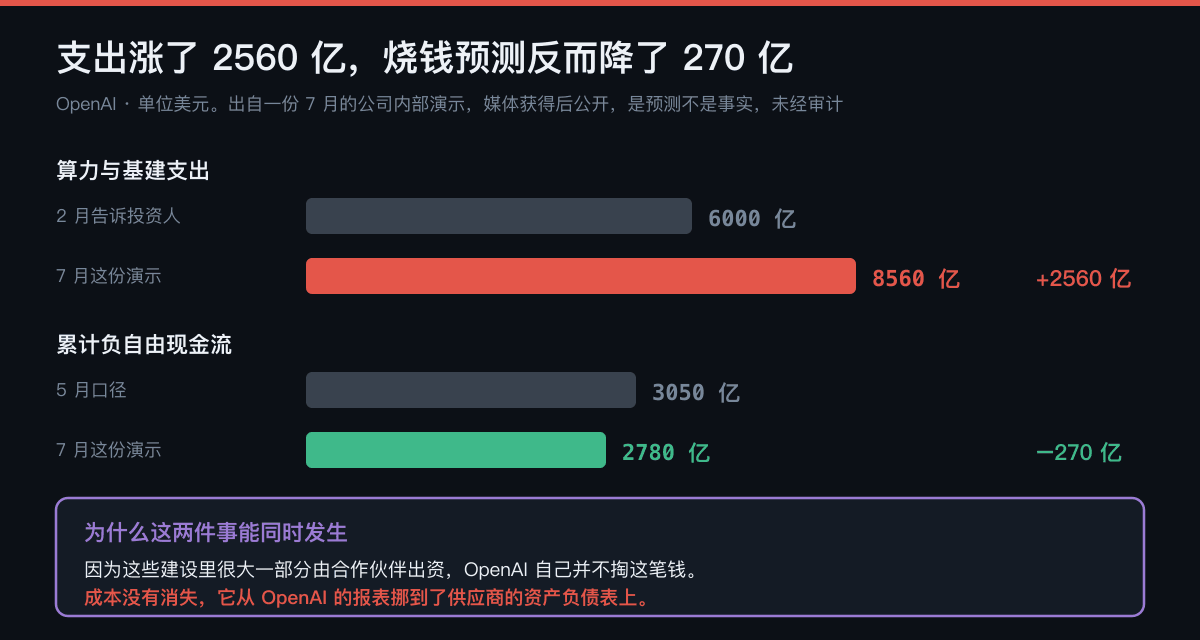
In February this year, OpenAI told investors that computing spending was approximately US$600 billion. By July, this demonstration had become 856 billion yuan, up 256 billion yuan.
During the same period, the forecast of burning money dropped from 305 billion yuan in May to 278 billion yuan in July, a decrease of 27 billion yuan.
Expenditure has increased by more than 200 billion yuan, but less money has been burned.
How is that possible?
The reason given in the report is straightforward: a large part of these constructions are funded by partners, and OpenAI itself does not pay for the money. Therefore, 856 billion yuan in computing power can coexist with 278 billion yuan in burning money.
This is my most direct judgment after reading it:
Costs have not disappeared, they have just moved from OpenAI's reports to suppliers 'balance sheets.
Someone has to pay for building a data center. The part that OpenAI burns less corresponds to the more debt borne by cloud vendors and infrastructure companies. The risk was not reduced,and it stayed in a different place.
Therefore, the headline "OpenAI wants to burn 278 billion yuan" should be read in reverse: this figure is lower than the previous edition, precisely because the risks have been transferred.
This can also explain one thing: the tension in the industry often first spreads from the companies that build computer rooms for model companies, but the model companies themselves learn about it later.
Why Category 1 accounts are the most difficult to read
There is another more troublesome thing: in this type of company, money moves in one circle.
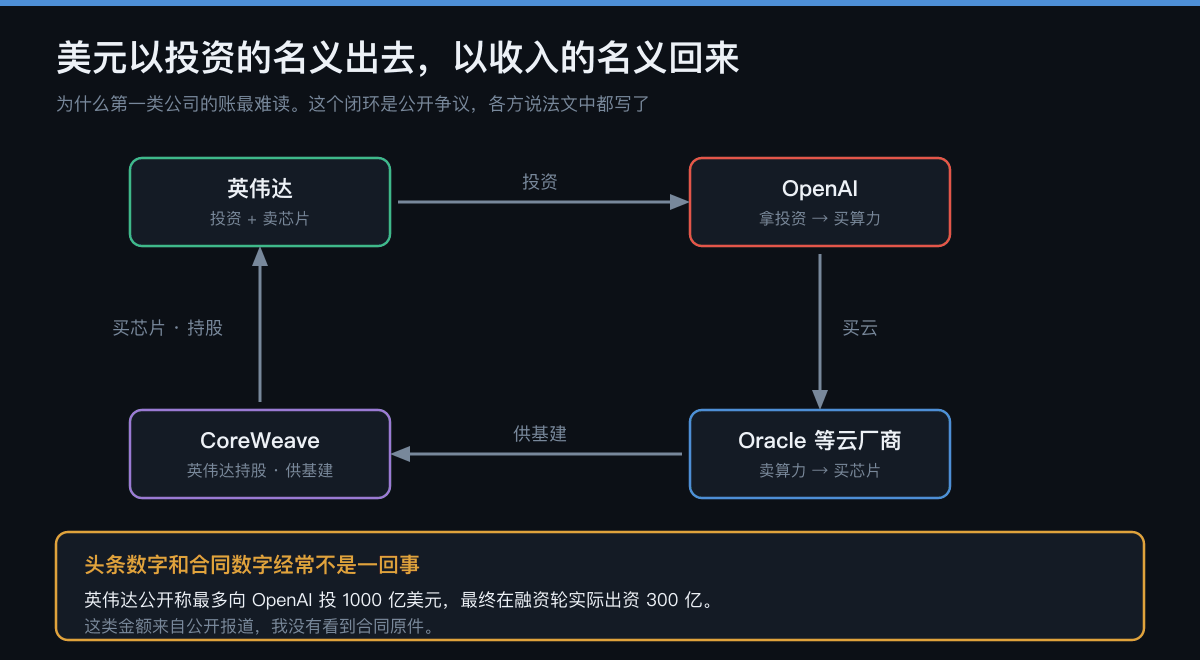
There is a rather concise summary of the Harvard negotiation research project: NVIDIA invests in OpenAI, OpenAI buys cloud computing from Oracle, Oracle buys chips from NVIDIA, and NVIDIA holds shares in CoreWeave, which provides infrastructure for OpenAI.
The dollar leaves a company's balance sheet in the name of "investment" and returns to its income statement in the name of "income." After the same amount of money went around, the valuation of every company in the ring increased.
A very useful reminder by the way: the numbers on the headlines and the numbers on the contracts are often different. Nvidia once publicly stated that it would invest up to US$100 billion in OpenAI, but in the end, the actual investment in the financing round was US$30 billion. The arrangement between OpenAI and AMD is: OpenAI promises to purchase 6GW of AMD chips (approximately US$90 billion), and AMD grants OpenAI 160 million warrants. Purchasing commitments and equity are packaged in the same transaction.
To be fair here, the opposing party's reasons are valid.
Making AI is indeed extremely expensive, and the most advanced chips are indeed scarce. In this market, companies rarely just place orders and wait for delivery. They often use long-term procurement commitments coupled with financing to lock up supply. This practice has a serious name, called supplier financing, andit has indeed built a real capital-intensive industry in history.
Anthropic's Amodi gave a fairly solid explanation: one party has capital and motivation because they are selling chips; the other party is quite sure that they will have income in the future, but they don't have 50 billion yuan in hand right now. Huang Renxun responded more directly, saying that the term "circulation" was ridiculous.
I think D.A. Davidson's Gil Luria summary is the most fair: there are healthy parts and unhealthy parts of this ecology.
The trouble is that you can't tell which part is which from the headline numbers.
Category 2: Burn it by relying on the profits of the main business, this category will not be burned out
Representatives are companies such as Amazon and Tencent that have main businesses. They will not "burn" because they earn the money themselves. But another signal will appear on the account.
Let's look at Amazon first. This group has the strongest audit caliber.
Its net profit for the second quarter of this yearwas US$62.647 billion, more than triple the same period last year. It seems that AI has made it a fortune.
However, when opening the statement submitted to the China Securities Regulatory Commission, 53.4 billion of the pre-tax income of 80.9 billion yuan was hung under "non-operating pre-tax other income." The source statement stated that it mainly came from investment in Anthropic. 534 divided by 809 equals 66%.
How did this 53.4 billion come about? Amazon holds Anthropic's non-voting preferred stock, and Anthropic's new round of financing valuation rose, so itre-priced its stake upwardsat the new price.
There was not a penny of cash coming in.
You can understand it as: your neighbor's house sold for a high price, so you revalued your house at this price, adding millions more to the book. I didn't get the money, but the account said you made it. Moreover, this price was negotiated by several institutions in the private equity round, and the open market did not participate in the matchmaking.
Here's where the real money is spent: In the same quarter, Amazon'sfree cash flow was a net outflow of $7.6 billion, as spending on real estate and equipment increased by 66.1 billion year-on-year. The income tax generated for the valuation increase in the other six months was 15.9 billion yuan, andthis tax had to be paid in real terms.
The most profitable amount on the book was not received, and the money actually spent was quite a lot.
To be clear, this does not mean that its main business is not good. On the contrary, operating profit was US$27.461 billion, up 43% year-on-year. AWS's growth rate of 37% was the fastest in 18 quarters, and AWS's profit margin was 39.4%. The main business is very solid. The only problem is that if you look at the headline figure of 62.6 billion, you will think that the growth is three times as strong as it is now.
Looking at Tencent again, it is the same category, but the signal is more direct.
In the second quarter of this year, Tencent's revenue was 204.785 billion yuan, a year-on-year increase of 11%, and Non-IFRS net profit was 68.415 billion yuan, a year-on-year increase of 9%. The main business is making money.
However, capital expenditure was 52.78 billion yuan, a year-on-year increase of 176%. Free cash flow was − 13.8 billion yuan, turning negative year-on-year.
Compare with the previous quarter: Q1's free cash flow was still positive at 56.7 billion yuan, and capital expenditure was 31.9 billion yuan. Between one quarter, free cash flow fluctuated by 70.5 billion yuan.
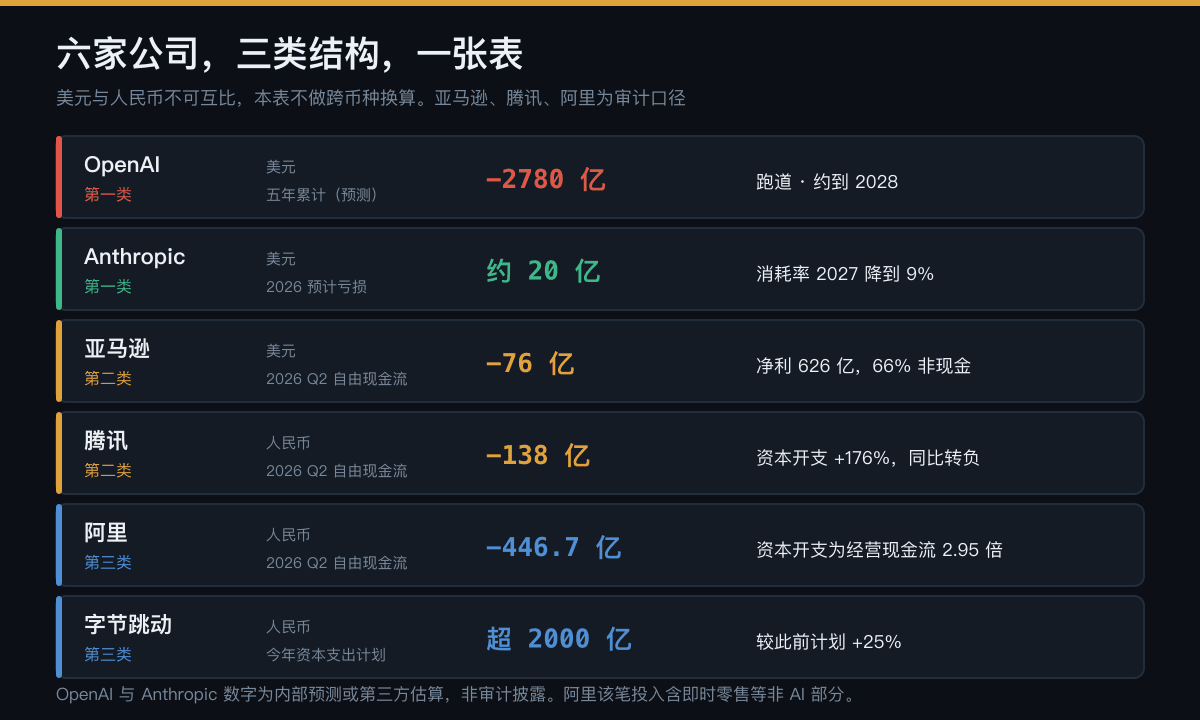
Therefore, the constraint of the second type of company is not the runway,but how long shareholders can endure after negative free cash flow. This is a multiple choice question, not a countdown: continue investing or maintain cash flow.
Category 3: Capital expenditures have exceeded operating cash flow
The representative of this category is Ali.
In the second quarter of this year (as of June), Ali's operating cash flow was22.945 billion yuan, a year-on-year increase of 11%. Thefree cash flow expanded from a net outflow of 18.815 billion yuan in the same period last year to a net outflow of 44.67 billion yuan.
If the two numbers are reduced, the implied capital expenditure is approximately67.615 billion yuan.
Divided by 676.15 by 229.45 is 2.95 times. The money invested this quarter was close to three times its operating cash flow.
One point must be made here, otherwise it will be misleading: this investment includes instant retail, not all AI. In Ali's own perspective, capital expenditures are related to cloud business, e-commerce equipment purchase, data center construction, logistics and direct sales facilities. Therefore, all of the 67.6 billion yuan cannot be counted on AI.
The other side is also a fact, which must also be put forward: Alibaba's AI cloud and computing power services revenue was 48.437 billion yuan, a year-on-year increase of 45%, and adjusted EBITA increased by 133% to 5.628 billion yuan; AI-related product revenue was 12.376 billion yuan, which has been triple-digit growth for the twelfth consecutive quarter. The return on this business is real.
At the same time, the other thing is also a fact: the revenue of the AI laboratory and application sector was 3.338 billion yuan, an increase of 16%, and the adjusted EBITA loss expanded to 13.861 billion yuan. The main reason was the increase in investment in AI capabilities and reasoning costs.
The money making is accelerating, and the money burning is also accelerating. Two things are happening at the same time.
Therefore, the third type of constraint is neither a runway nor a negative shift,but how to make up for the difference in excess of operating cash flow. Either external financing or slow down.
Incidentally, ByteDance also said that capital expenditure this year is expected to exceed 200 billion yuan, an increase of 25% from previous plans.
There is one thing worth saying alone
The accounts of these domestic companies are easier to read than those in the United States.
Alibaba and Tencent are listed companies. Operating cash flow, capital expenditure, and free cash flow are disclosed quarterly. Anyone can check it, and the figures are audited.
The ones that burn the most money in the United States are unlisted. The outside world wants to know how much OpenAI burns, so they can only wait for an internal demonstration to be obtained by the media. The 278 billion you are seeing now is essentially a document that was not intended to be shown to you.
This is a difference in company form, not who is stronger. But for people who want to read accounts carefully,the former is much friendlier.
The ## curve is branching, and the saying "AI companies are losing money" is too rough
One more thing: Putting all AI companies in the same sentence is not accurate.
According to current public forecasts and third-party estimates (this part is mostly estimates, not audit figures, and needs to be discounted): OpenAI's cash consumption rate will remain at around 57% of revenue in 2026 and 2027;Anthropic expects to drop to one-third of revenue in 2026 and 9% in 2027. Anthropic's gross profit margin has improved from approximately −94% in 2024 to an estimated 44% to 60% in 2026; the cost of computing power per dollar of revenue has dropped from US$0.71 in Q1 to US$0.56 in Q2, a decrease of 21%.
They are also burning money, one is collecting down, and the other remains unchanged.
So the next time you see that "AI companies are losing money", it is worth asking one more question: Are the losses narrowing or expanding, and in which direction is the gross profit margin going. These two questions are much more useful than absolute losses.
Back to the title: When will it finish burning?
To be honest, this question is wrong.
No family will really burn the money to the bottom, because before then, they will reach the next sum. The outcome is determined by the following three things, which have little to do with how much is left in the account, and correspond to the above three categories:
The first category depends on whether the financing window is still open. It is calculated that the money on the account will last until 2028, but this figure is based on the premise that "there will be no more financing in the middle", and this premise is almost certainly not true. So what we really need to focus on is whether we can get financing in the next round and at what price we can get financing.
The second category is to see how long shareholders can endure after negative free cash flow. Neither Amazon nor Tencent will be short of money, but capital expenditures will be asked at the earnings conference. It's a matter of patience.
The third category is to see how to make up for the difference in excess of operating cash flow. Continue external financing or lower the pace.
Therefore, the countdown to "when it will be burned out" does not exist. There are three valves. The one that closes first will begin.
finally gives four criteria
If you want to judge the financial integrity of an AI company, the following four items are more useful than the headline numbers. Establish any company you see, both at home and abroad.
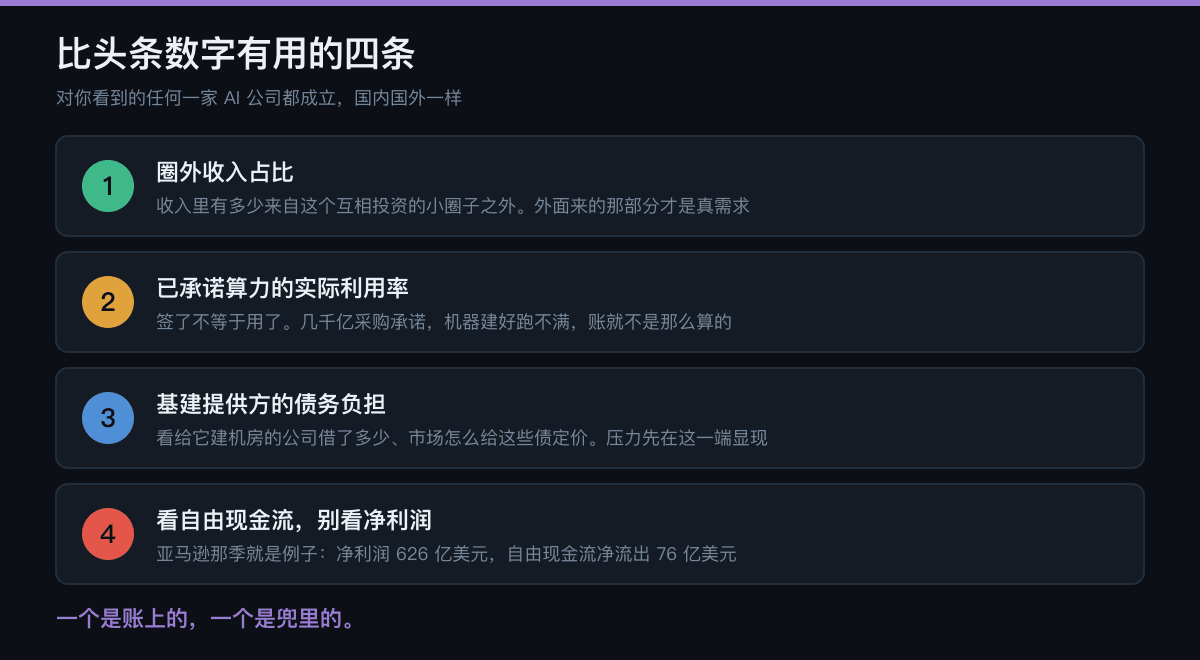
First, the proportion of income outside the circle. How much of its income comes from outside this small circle of mutual investment. The part that comes from outside is the real need.
Second, the actual utilization rate of computing power has been promised. Signing does not mean using it. With hundreds of billions of yuan in procurement promises, if the machine is not satisfied with being built and running, the bill will not be settled like that.
Third, the debt burden of infrastructure providers. See how much money the company that built it borrowed and how the market priced these bonds. According to the previous logic,pressure will appear at this end first.
Fourth, look at free cash flow, not net profit. Amazon's quarter was a ready-made example: net income of $62.6 billion and a net outflow of free cash flow of $7.6 billion. One is in the account and the other is in the pocket.
I am not writing this article to say that AI is a bubble, and I cannot give this judgment. But one thing is certain: The industry's current numbers need to be read more carefully than usual.
The investor is also the supplier, and the customer is also the invested company. The purchase commitment and equity are packaged in one contract, and valuation changes are directly included in the income statement. Under this structure, the words "how much you earn" and "how much you burn" cannot be understood literally.
Every time you see a big number, ask first: Did the money come from outside the circle or did it go around the circle?
few sentences boundary
Units are not mixed. The numbers for Amazon and OpenAI are in US dollars, and the numbers for Tencent and Ali are in RMB. Everything is marked in the text. I haven't done any cross-currency multiples.
Amazon's figures are based on its Securities and Futures Commission filings and official earnings release for the second quarter of 2026, including a description of the nature of the 53.4 billion yuan in non-operating earnings. Audit caliber.
The figures for Tencent and Alibaba are based on the public financial reports of the two companies for the second quarter of 2026. Audit caliber. Ariana 67.615 billion yuan was calculated backwards by me using "operating cash flow minus free cash flow". The formula is written in the main text and you can check it yourself; it includes non-AI inputs such as instant retail, which has been stated in the main text.
The OpenAI group came from an internal company demonstration in July, which was obtained by the media and made public. It is an internal forecast, not a fact that has occurred, and is not audited. The 600 billion yuan in February and the 305 billion yuan in May are historical versions under this caliber.
Anthropic's consumption rate, gross profit margin, and unit computing power cost are mostly estimated by third parties and are not disclosed by company audits.
The specific amount of the revolving transaction (100 billion yuan changed to 30 billion yuan, 6GW and 160 million warrants, etc.) comes from public reports, and I have not seen the original contract.
The three-point method is my own summary, not anyone's official framework. This article does not constitute an investment judgment on any company.