$3000 for a book, but the AI company is actually not paying for training
In July this year, a U.S. court finally approved a $1.5 billion settlement: an AI company compensated the author and publisher of the book for more than 480,000 works, with an average of about $3000 per book, which is 4 times the legal minimum compensation of $750. Many people read it as "AI book training will have to be paid for from now on," but the other half of the verdict said exactly the opposite: the judge divided the company's work into three things, training with books is considered reasonable use, and buying paper books is also considered reasonable use to scan them into an electronic version, but only downloading at least 7 million books from pirated libraries to build a permanent library is not counted. The 1.5 billion class action lawsuit only targets piracy. Ranked according to "one book", the cheapest is to buy a book legally and scan it. The legal compensation is 750, the settlement is 3000, and the formal authorization is US$5000 for three years. What licensing fees really buy is clean sources, boundaries of use and continuous supply.
On July 20 this year, a federal court in the United States finally approved a$1.5 billion settlement.
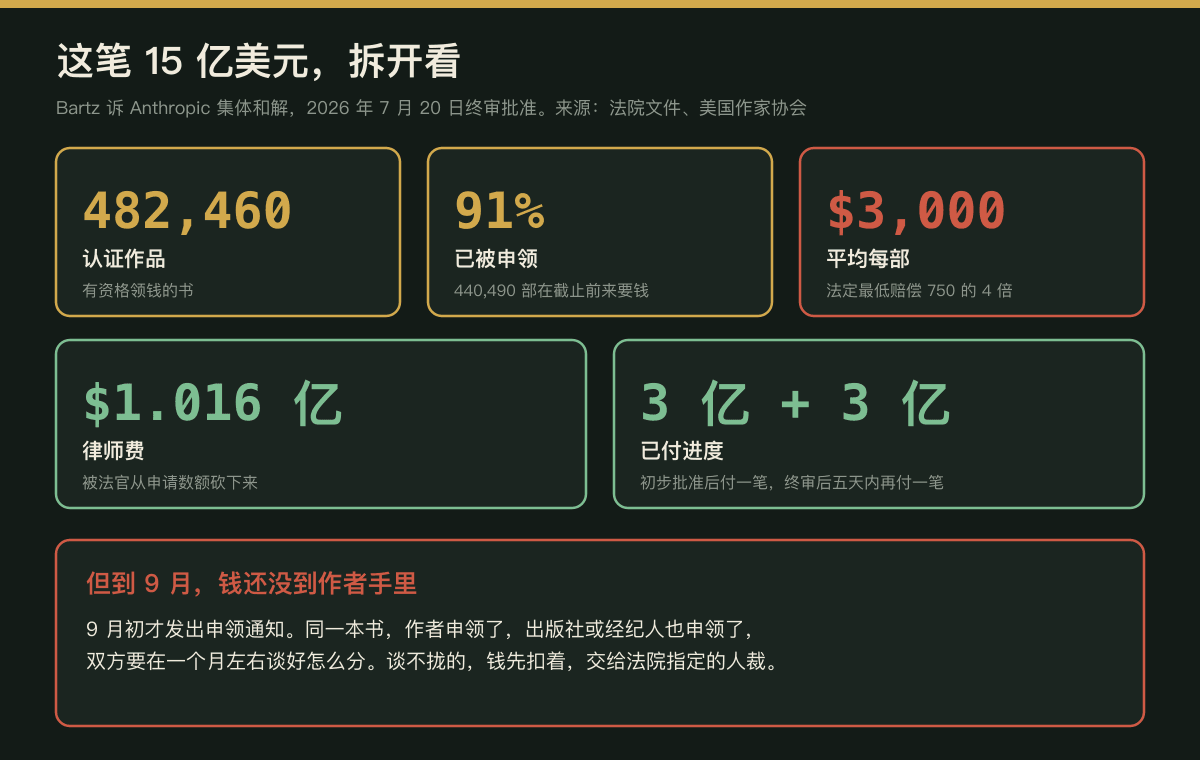
An AI company paid compensation to the author and publisher of the book. There are more than 480,000 certified works, with an average ofabout US$3,000 per piece. The court specifically calculated in the approval document: This is aboutfour times the legal minimum compensation of $750 forordinary infringement.
Many reports interpret it as a signal: AI takes books to train and has to pay for it from now on.
I went through the verdict and found that it was read exactly the opposite way.
This 1.5 billion yuan is not a loss for training.
1. Look at the money itself first
The settlement target was Anthropic, the company that made Claude. The case is called Bartz v. Anthropic. It was initially approved a year ago and finally approved by the judge who took over it in July this year. It turned out that the judge had retired.
Several numbers:
There are 482,460 certified works, and as of March 30 this year, 440,490 have been applied for, or more than 91%. Almost all qualified books came for money.
Lawyers 'fees were cut to about $101.6 million by judges. The company has already paid 300 million yuan in advance and will pay another 300 million yuan within five days after the final review.
But the money has not yet reached the author. The application notice was only issued in early September. A common card point is: for the same book, the author has applied for it, and the publishing house or agent has also applied for it. The two parties have to discuss how to divide it in about a month. If there is no agreement, the money will be withheld first and handed over to a person designated by the court for adjudication.
2. The other half of the judgment is rarely mentioned
The settlement was preceded by a June 2025 verdict. That verdict is the key.
The judge divided what the company did to the book into three cases, ruling one by one:
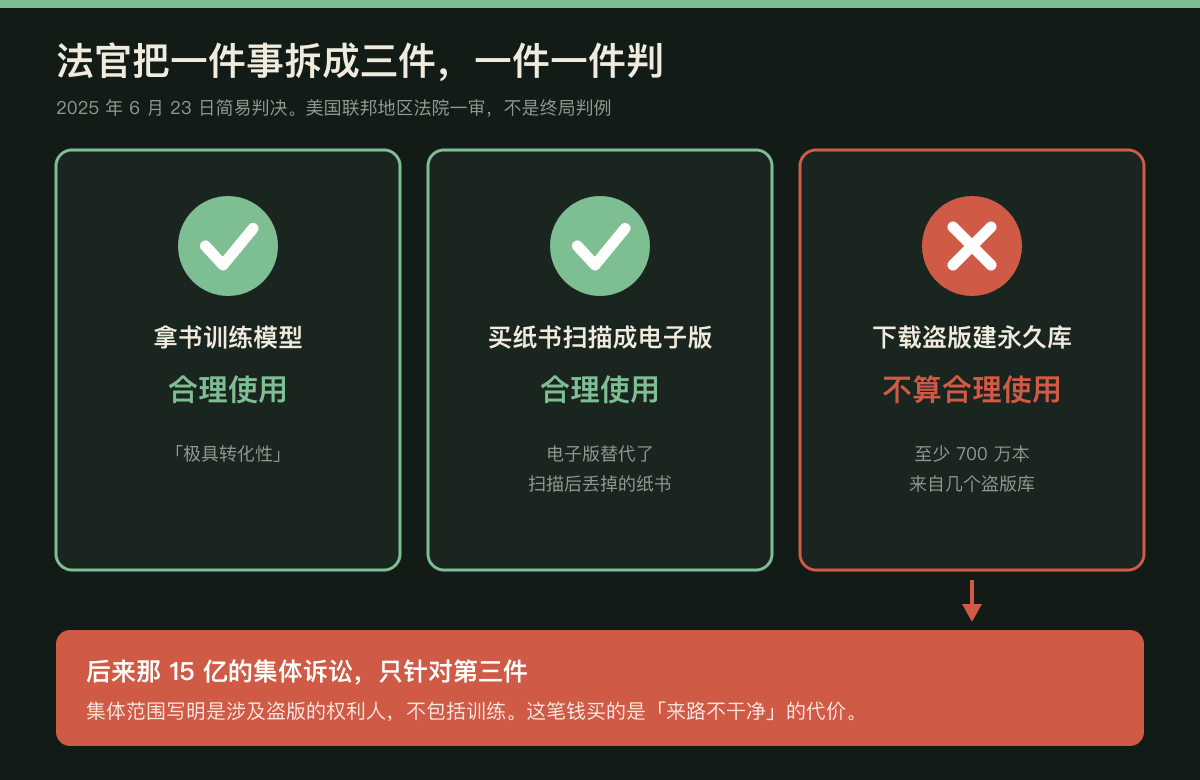
The first one is to train the model with books. The sentence is fair use. The judge's words were "extremely transformative."
The second one is to remove and bind the purchased paper book, cut the pages, and scan it into an electronic version. It is also used reasonably, on the grounds that the electronic version replaces the paper book that was lost after scanning, essentially changing the storage method. This company has really done this before, buying millions of paper books in batches.
Third, download books from pirated websites and save them in a permanent library. This case is not considered fair use and enters the trial process. The judge found it downloaded at least 7 million copies from several pirated libraries.
Later, the 1.5 billion class action lawsuit only filed against the third case. The scope of the collective is clearly written: the group of rights holders involved in piracy does not include training.
So the real meaning of this money is: the price of dirty origin.
As for the training itself, according to this ruling, legally purchased books are used for training and currently there is no need to pay separately in the United States.
I want to add two fair words. This is a first-instance judgment of the District Court, not a final case law of the Supreme Court; and training in fair use of this determination is strictly speaking only valid for the three signed plaintiffs. Two days later, another judge in Meta's case also concluded that training was "highly transformative," but both judges said that with a set of economic evidence, the conclusions might be different. Cases like the New York Times v. OpenAI are also ongoing.
3. How much does it cost to buy normally?
Since you have to pay for the stolen book, what is the price for buying the authorization honestly?
Among the public transactions, the one that best matches the unit of "One Book" is HarperCollins and Microsoft's:
Each book is US$5,000, with the author and the publisher each receiving 2,500. The author has to voluntarily agree. The conditions are also written in detail: only for non-fiction categories, theauthorization is only for three years, and it must be deactivated when it expires; the model output cannot exceed 200 words in a row, or exceed 5% of the book.
Ranking several prices according to "one book" will lead to a counter-intuitive ladder:
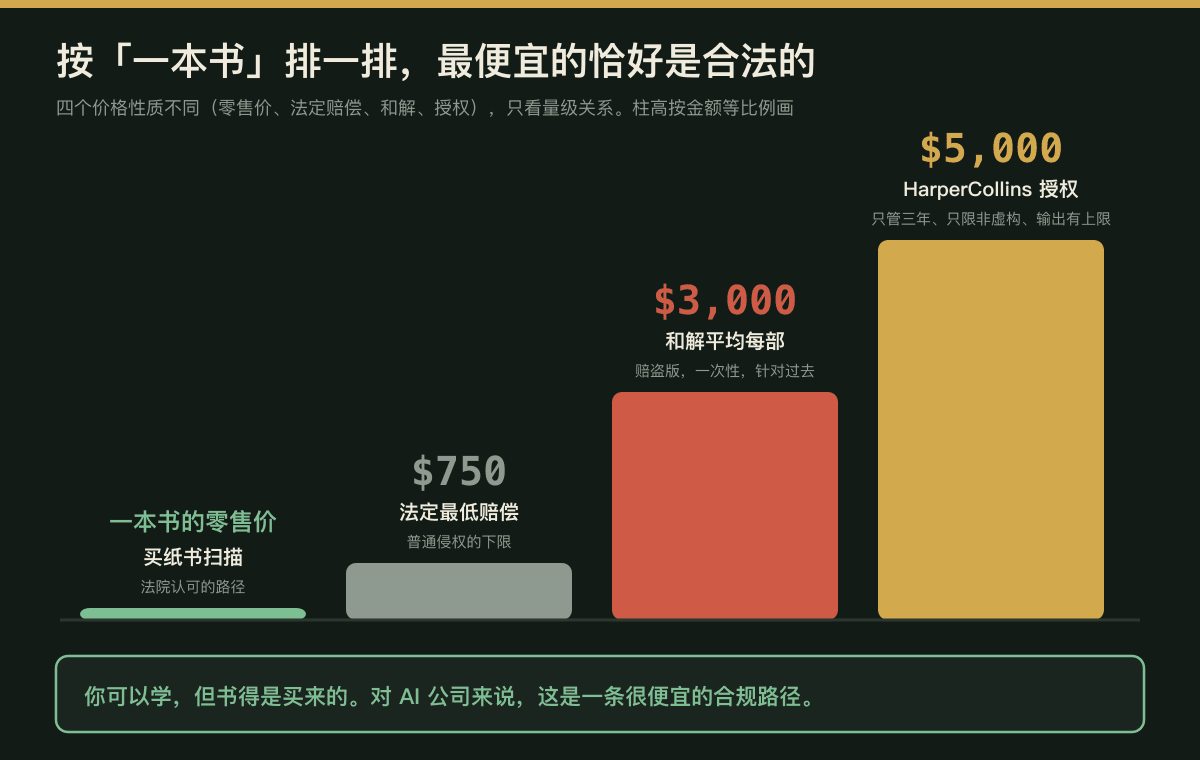
Legal purchase of a paper book to scan costs the retail price of a book. Legal minimum damages for ordinary infringement,$750. The settlement averaged about $3,000 per unit. Formal authorization,$5,000, and only for three years.
The cheapest road happens to be the road approved by the court.
4. What exactly does the money buy in the authorized transaction?
This is the point that I think is most worth thinking about.
If legal book training has been recognized as fair use, why would Microsoft spend $5,000 to sign a license?
My understanding is that the authorization fee never buys the matter of "being learned once", but buys three other things.
The first is the clean way to come. With a signed authorization, you don't have to worry about being chased down to court in the future. The 1.5 billion yuan above is the price for dirty sources.
The second is the boundary of use. The three-year term, limit to non-fiction, and limit to 200 words output are beneficial to both parties: the publisher knows that the book will not be spat out as it is, and the buyer knows which step he can use it.
The third is continuous supply. This one is most obvious in platform-based transactions.
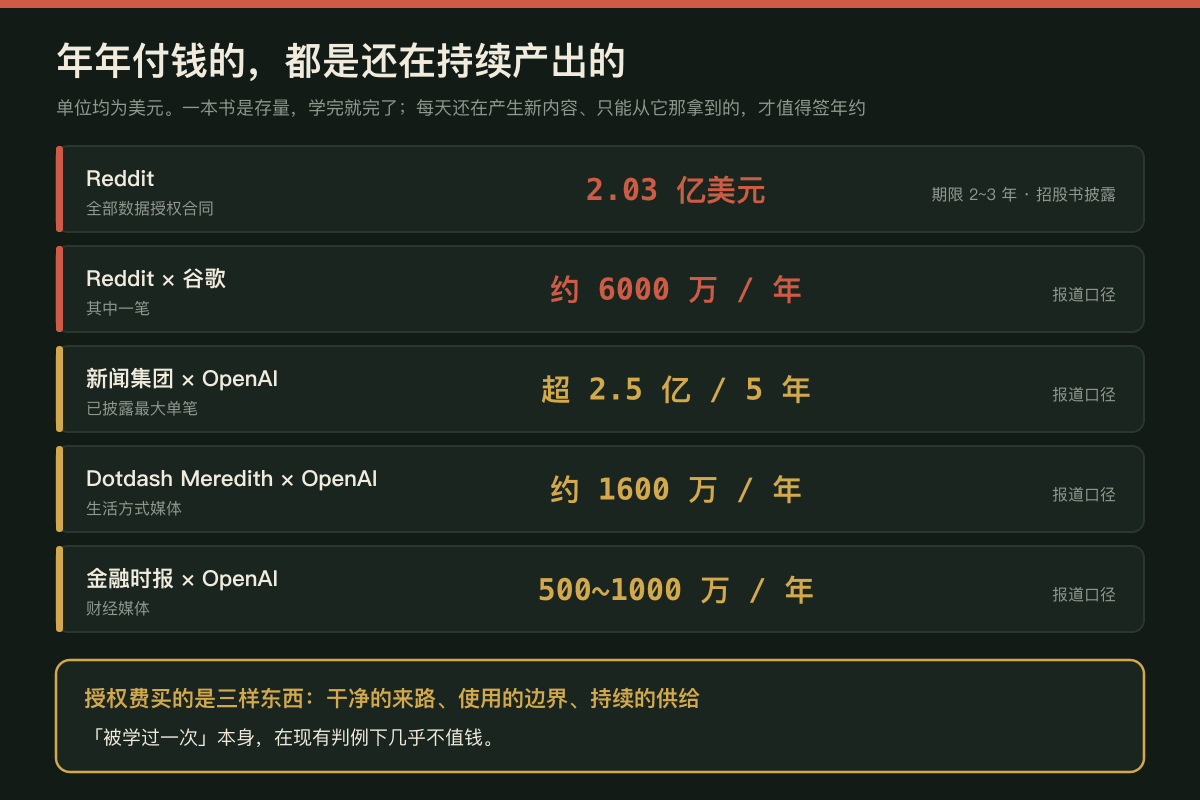
Reddit disclosed in its prospectus that its data authorization contract totaled $203 million and lasted for two to three years. According to reports, the amount from Google and Google is approximately US$60 million per year. News Corporation and OpenAI signed more than US$250 million in five years,making it the largest single transaction ever disclosed.
A book is a stock. Buy it once and you will be finished after learning it. But Reddit is still generating new real-life conversations every day, and News Corporation is still producing new reports every day. What AI companies are willing to pay every year is something that can only be continuously obtained from it.
The voices of the opposition should also be raised. The head of a news organization said that if it is included by search engines, it is equivalent to training. The actual value of the data is zero, and the only option is to completely disappear from the search results. This is a very serious statement, but what it points to is the above logic: the bargaining power of existing, public, and accessible content is very weak.
5. What does it mean for people who write?
These are all cases and transactions in the United States. Domestic rules are still being formed, so I will not make judgments. But the pricing logic is the same.
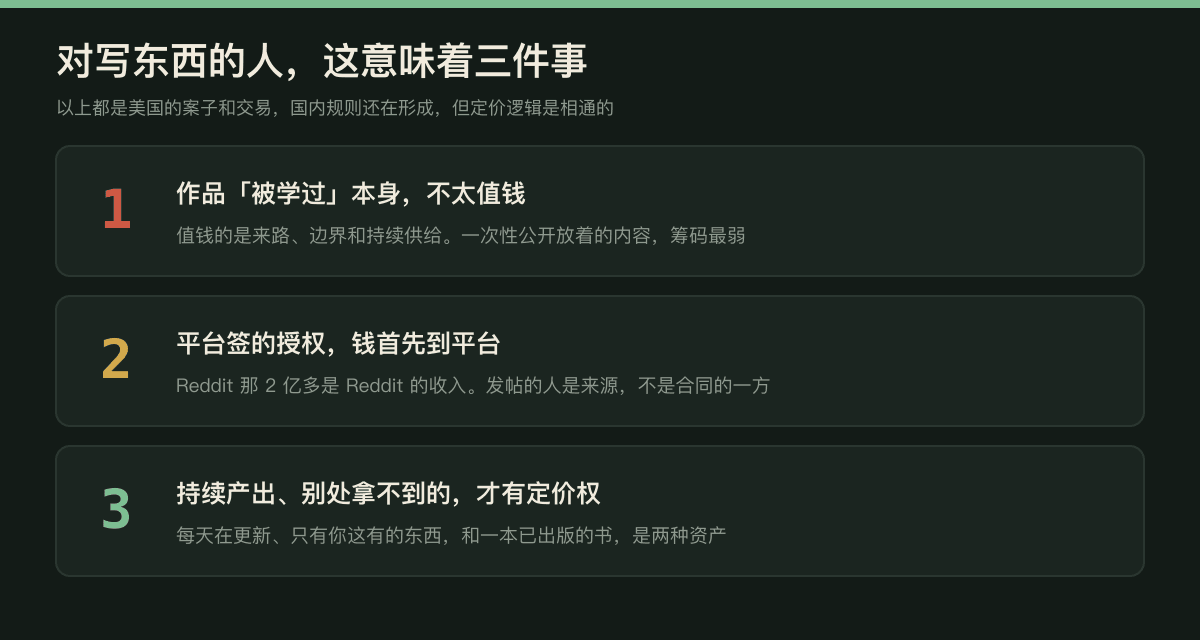
First, the "learned" work itself is not very valuable under existing jurisprudence. What is valuable is the origin, borders and continuous supply. If your thing is just one-off content that is publicly available, its bargaining chips are the weakest.
Second, for the authorization signed by the platform, the money goes to the platform first. Reddit's more than 200 million yuan is Reddit's revenue. The person posting is the source of the content, but not a party to the contract.
Third, only content that continues to be produced and cannot be obtained elsewhere has pricing power. A thing that is updated every day and only you have here, and a published book are two assets in the eyes of AI companies.
Last
The figure of $1.5 billion is too large, so large that it can easily be read as "AI will have to pay for learning from now on."
But when you open the verdict, it talks about something simpler: you can learn, but the book has to be bought.
For AI companies, this actually draws a very cheap compliance path. For people who write, the real question changes: Is it enough for others to take away from me once, or is it something that I have to keep coming back to find me.
few sentences boundary
The settlement amount, the amount per unit, the number of certifications and claims, legal fees, payment progress, from court documents and public information such as the Writers Guild of America. As of September, the money jointly claimed by the author and the publishing house is still under negotiation and distribution.
The content of the separate judgment of the three matters comes from the summary judgment of June 23, 2025. This is a first-instance judgment of the U.S. District Court, not a final case. The determination that training is fair use is only directly effective for the three signed plaintiffs, and similar cases are still ongoing.
HarperCollins 'authorization terms come from public statements by the publisher and the Writers Association;Reddit's US$203 million comes from its prospectus, and Google's approximately US$60 million per year, and News Corporation and OpenAI's more than US$250 million over five years.
The price ladder is a comparison I make based on "one book". The four prices are different in nature (retail price, statutory compensation, settlement, authorization) and are only used to illustrate the relationship between magnitude and magnitude. This document does not constitute a legal opinion.