AI is starting to borrow money: tech giants will issue bonds this year as fast as twice as much as last year
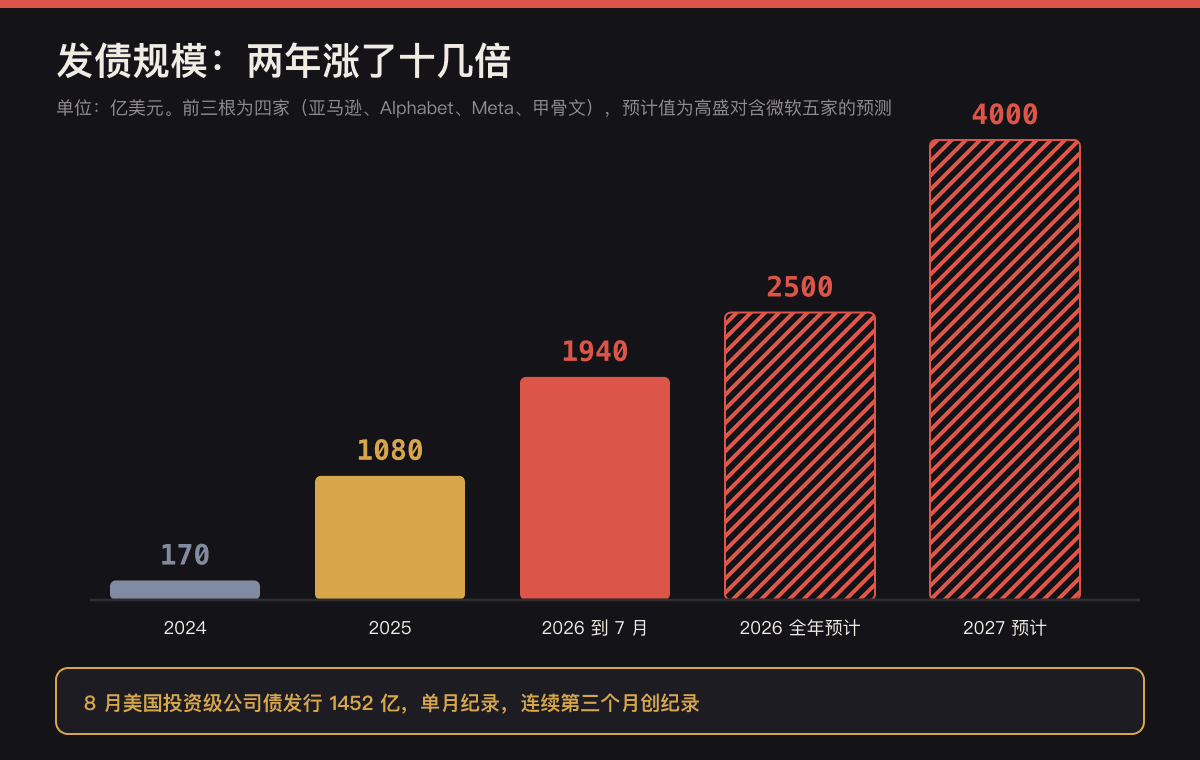
Three things came together this week: banks began distributing a $60 billion financing for Anthropic to buy chips, SpaceX was raising $40 billion to buy Nvidia chips, of which 30 billion were investment-grade bonds, and Bloomberg reported that technology giants were turning to borrowing to raise money for AI. Amazon, Alphabet, Meta, and Oracle issued bonds, which will be approximately US$17 billion in 2024, approximately US$108 billion in 2025, and approximately US$194 billion by July this year. The reason is that spending is faster than earning: since the second quarter, total capital expenditures exceed operating cash flow, and Bank of America predicts that the free cash flow of these companies will change from about positive 180 billion yuan in 2025 to about negative 64 billion yuan this year. There are three accounts here: the nature of money has changed, and interest rates have begun to be linked to AI; debts borrowed for a maximum of 30 years or even 100 years, and cards purchased for two years; risks have been pushed from model companies to suppliers, and then to banks and bond investors. The market is already repricing: the subscription multiple has dropped from 5 times to less than 2 times, and the spread is widening.
This week, three things came together.
On October 5, Bank of America, Citigroup, and Morgan Stanley began distributing aUS$60 billion financing to investors to buy chips for Anthropic.
On October 6, according to the Financial Times, SpaceX would raiseUS$40 billion to buy Nvidia's chips, of which about 10 billion would be bank loans and30 billion would be investment-grade bonds.
On October 7, a Bloomberg report put these things together: Several of the world's largest technology companies are borrowing money in the bond market, issuing additional shares, and raising money for AI infrastructure. The report said that this was a turn for Silicon Valley companies that used to rely mainly on their own cash.
In a word: AI has begun to borrow money.
1. How much did you borrow
Look at the numbers first. According to data quoted by Reuters, bonds issued by Amazon, Alphabet, Meta and Oracle:
In 2024, approximately US$17 billion. In 2025, it will be approximately US$108 billion, an increase of more than five times. In 2026, it will be approximately US$194 billion by July.
This year is not over yet, but it is already 1.8 times that of last year. Including Microsoft, the five companies will be approximately 220 billion by August 10. Goldman Sachs 'forecast is that these five companies will be about 250 billion yuan for the whole of this year and about 400 billion yuan next year.
The entire U.S. corporate bond market has been boosted. In August this year, the issuance of investment-grade corporate bonds in the United States was US$145.2 billion, setting a monthly record and the third consecutive month of record issuance. There were a total of 9 large orders exceeding US$20 billion this year, 7 of which came from these companies.
2. Why borrow it
These companies are the most profitable companies in the world and have a lot of cash on their accounts. Why do they still need to borrow?
Because you spend it faster than you earn it.
After Google, Amazon, Microsoft, and Meta's second-quarter earnings reports, capital expenditure guidance for 2026 adds up to $745 billion.
Investment bank Raymond James's judgment is that by the second quarter of 2026, the combined capital expenditures of these companies have begun to exceed operating cash flow, and free cash flow has become negative. Alphabet's free cash flow in the second quarter was minus $5.9 billion.
Bank of America postponed this matter for a few years:
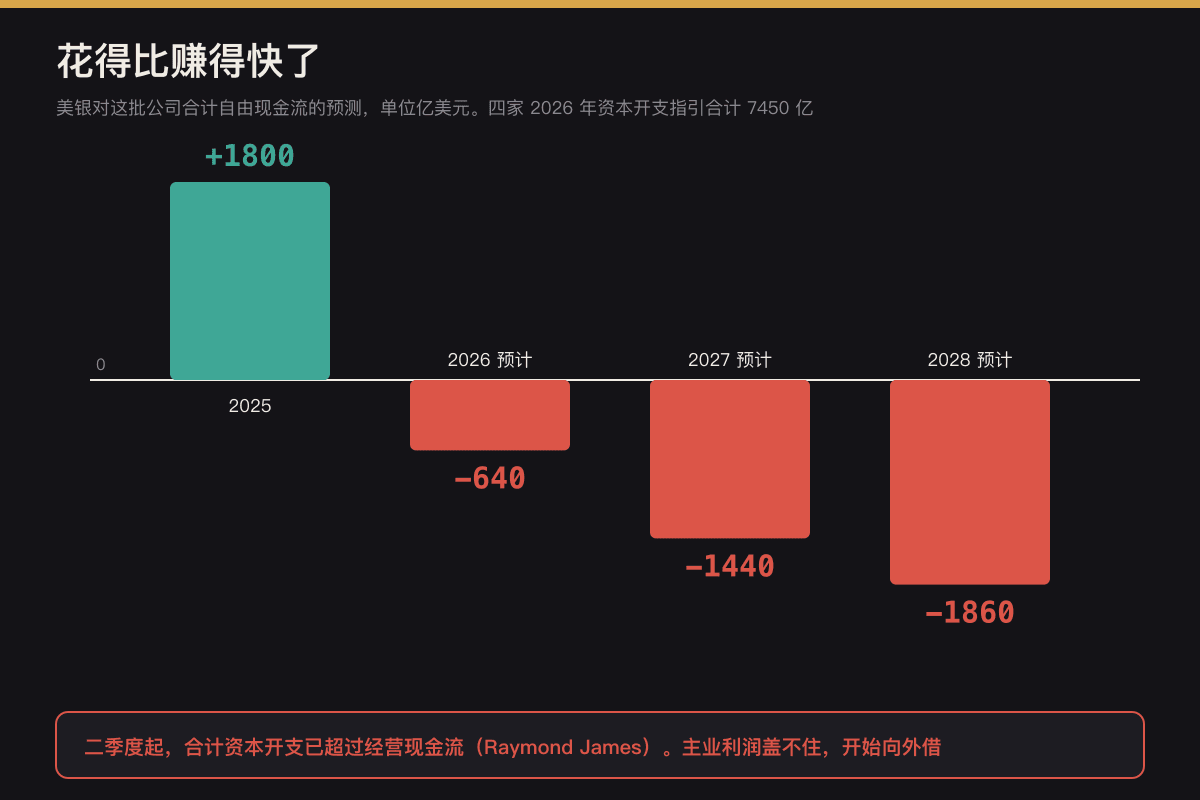
The free cash flow of these companies will be approximately positive US$180 billion in 2025, and is expected to turn into negative US$64 billion in 2026, negative US$144 billion in 2027, and negative US$186 billion in 2028.
Within one year, it swung from positive 180 billion to negative 64 billion, swinging by more than 240 billion.
A few weeks ago, I wrote an article dividing AI companies 'burning money into three categories. The second category is "burning by the profits of the main business." For Amazon and Tencent, the money is earned by themselves and will not be burned out. The third category is "investment has exceeded operating cash flow, and the difference must be made up by external sources."
What has happened this week is that category 2 is sliding towards category 3. The profits of the main business could no longer be covered and began to borrow from outside.
3. The first account: The nature of money has changed
Spending your own profits and spending borrowed money may seem to be spending money, but it is not the same thing.
If you spend profits and invest wrongly, shareholders will make less money. Borrowed money has interest and a maturity date, and must be repaid when the date comes.
So one variable that used to be less important is now important: interest rates.
When a company invests its own cash, the interest rate is higher and lower, which has little to do with the AI project itself. Once the money is borrowed, the annual interest is a real cost, and refinancing is needed when it matures. The return on investment must first exceed the interest rate before you can make money.
This is also why Qiaoshui recently said that the AI boom has entered a "more dangerous stage." One of the reasons is its increasing reliance on external capital.
And the market is already repricing this matter:
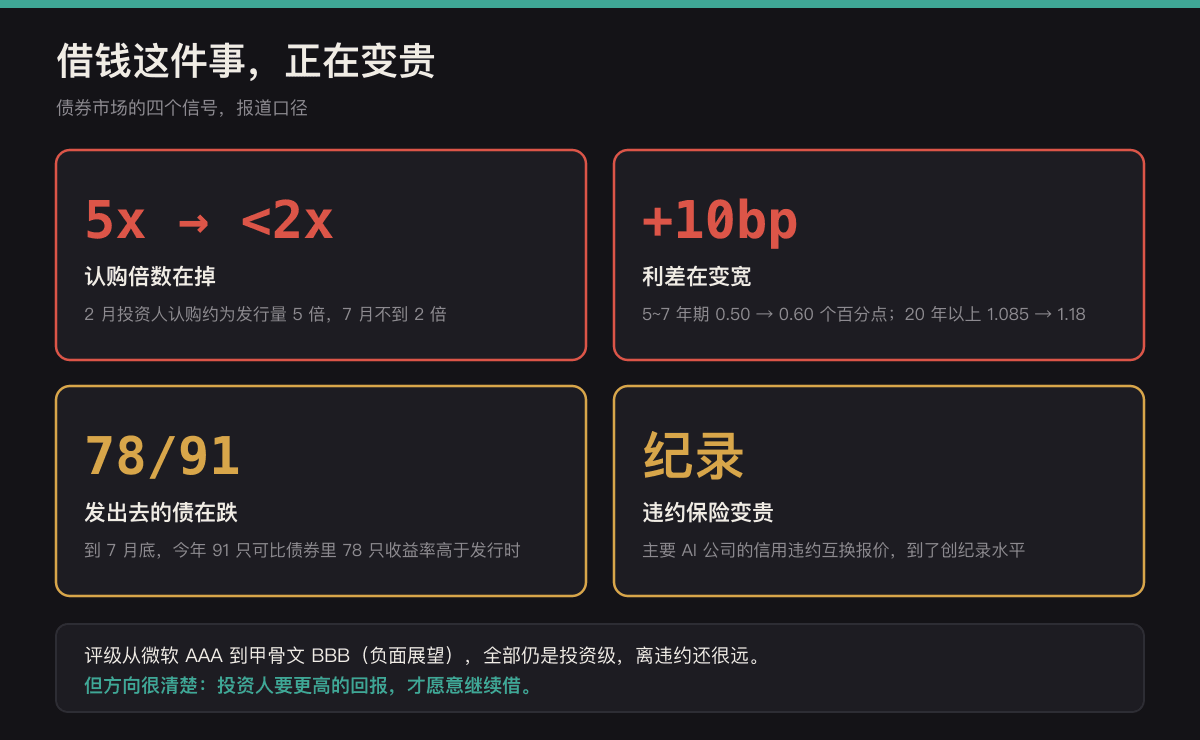
The subscription multiple is falling. In February this year, when these companies issued bonds, the subscription amount of investors was about five times the issuance amount; by July, it was less than twice.
The spread is widening. For bonds with 5 to 7 years, the spread rose from 0.5 percentage points to 0.6; for bonds with more than 20 years, it rose from 1.085 to 1.18. This means that investors demand higher returns before they are willing to lend them.
Debts issued are falling. By the end of July, 78 of the 91 bonds comparable this year had higher yields than when they were issued, that is, prices were lower than when they were issued.
Default insurance has become more expensive. Credit default swap quotes from major AI companies have reached record levels.
These companies are certainly far from default, with ratings ranging from Microsoft's AAA to Oracle's BBB, all investment grade. But the direction is clear: borrowing money is becoming more expensive.
4. Second account: Is the term correct
This is the place I think is most worth looking at.
Look at the maturity of several bonds: Nvidia's US$25 billion bond issued this year will last until 2056, which is 30 years. Amazon has a set of bonds with maturities ranging from 3 to 40 years. Alphabet even issued a 100-year sterling bond.
Look at what you bought again. According to calculations in the 9/23 article, Nvidia releases a new generation of architecture approximately every 18 to 24 months.
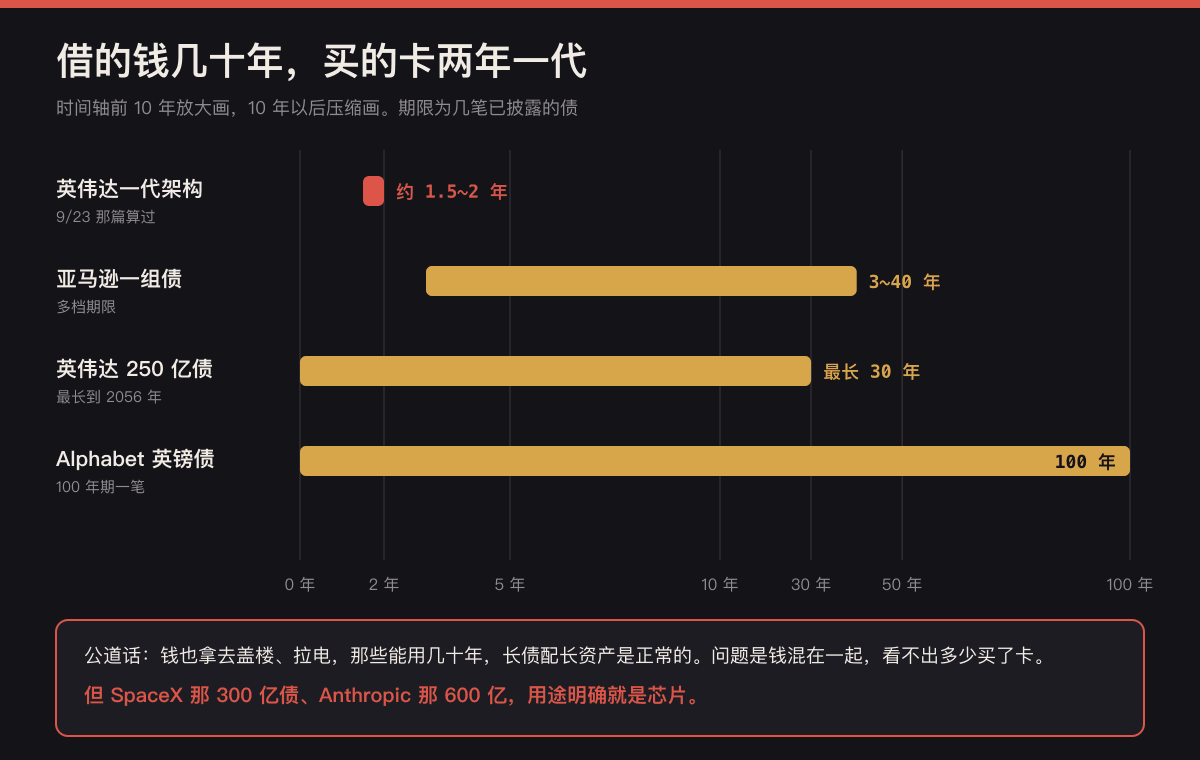
To be fair here: not all the borrowed money is for buying cards. Building data center buildings, pulling power lines, and building substations can last for decades. It is a normal financial arrangement to allocate long-term assets with long-term debt.
The problem is that money is mixed together. It is impossible to see from the outside how many of the hundreds of billions of borrowed money have been built to build buildings that will last for decades, and how many have purchased cards that will become obsolete after two years.
But two are clear: SpaceX's 30 billion debt is used to buy Nvidia's chips;Anthropic's 60 billion is also used to buy chips. These two transactions are to directly use debt to buy one of the fastest-changing assets.
The conclusion of the 9/23 article is that the depreciation life of graphics cards is a bet on future rent. Part of this bet now is borrowed money.
5. The third account: The risk is changed
As I wrote in the 9/22 article, OpenAI's money-burning forecast has become better because a large amount of construction has been funded by partners, and the risk has been shifted from the model company to the supplier's balance sheet.
What happened this week has been pushed in the same direction again.
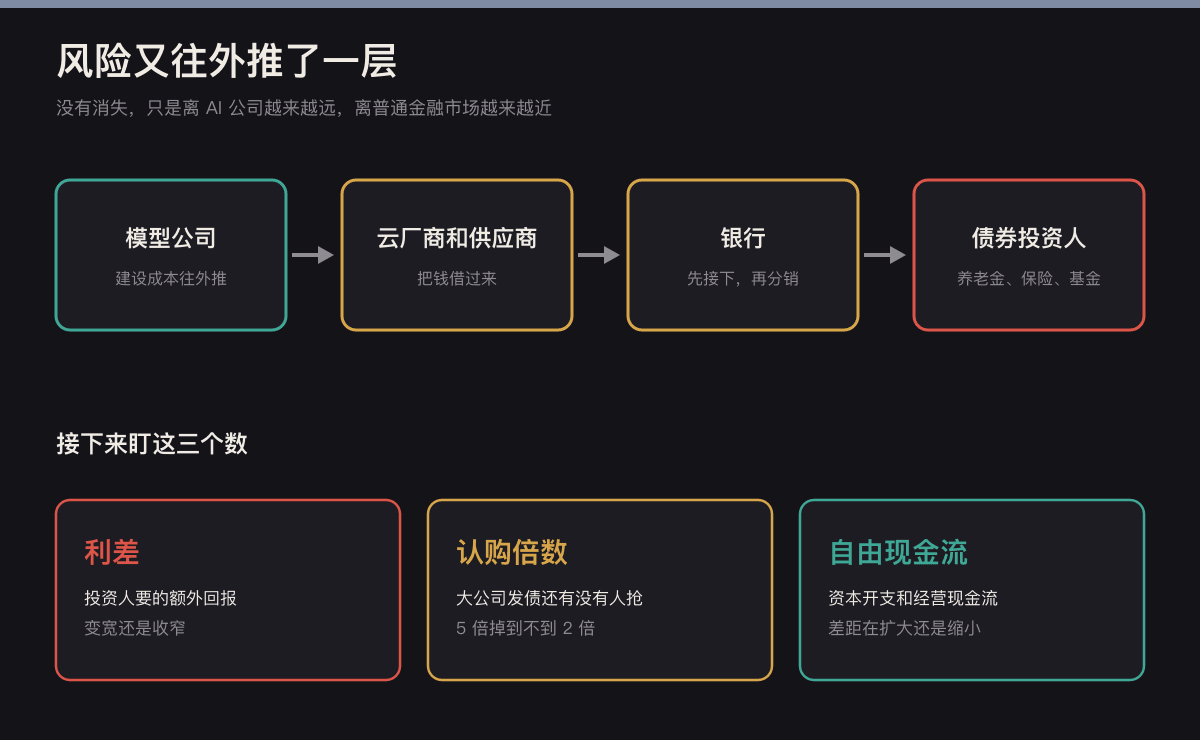
Model companies shift construction costs to cloud vendors and suppliers; cloud vendors and suppliers borrow money, putting the risk on banks and bond investors. The 60 billion sum is the most typical: the bank takes the money first and then distributes it to investors.
The risks have not disappeared, but they are getting farther and farther away from AI companies and closer to ordinary financial markets. Pensions, insurance funds, and bond funds are all major buyers of investment-grade corporate bonds.
6. The other way around
I don't want to write this article as "the bubble is about to burst." I can't give this judgment, and there are also very hard reasons for opposing it.
These companies have really good credit, cash on their books and investment grade ratings. Borrowing money is probably the rational financial choice: interest costs are lower than expected returns, while keeping cash on hand for other uses.
It has historically been the norm for heavy asset industries to borrow money for construction. Telecommunications, railways, and electricity were all built this way.
Not every debt is given to AI. For example, Salesforce issued 25 billion yuan in bonds to buy back shares.
So borrowing money in itself is not a problem. The question is what the borrowed money bought and whether it can be earned back before it is paid back.
7. What to Focus on Next
If you want to track where this matter is going, three numbers are more useful than any headline:
Spread. The extra returns that investors demand are widening or narrowing. This is the market's most direct offer for risk.
Subscription multiple. Is there anyone rushing to buy bonds issued by large companies? Falling from 5 times to less than 2 times is already a signal.
Free cash flow. Each quarterly financial report comes out to see whether the gap between capital expenditures and operating cash flow is widening or narrowing.
Last
In the past two years, when everyone discussed AI money, they mainly discussed valuation and financing: who raised how much and how much the valuation increased.
At the beginning of the week, the object of discussion changed to debt. Valuations can go up or down, and debts have to be repaid.
For the first time, the expansion of AI has borrowed money from others on a large scale. From this moment on, its accounts are not just the accounts of the technology company itself.
few sentences boundary
Data on bond issuance scale, capital expenditure guidance, free cash flow forecast, subscription multiples, interest spreads, bond yields and CDS come from Reuters, Bloomberg, Financial Times, etc. reports on data from LSEG, BNP Paribas, Goldman Sachs, Bank of America, Raymond James, Sage Advisory and other institutions. The number of companies and deadlines are different from different sources, and the numbers vary. The guidelines have been stated in the article.
SpaceX's fundraising and Anthropic's 60 billion financing are reported, and the specific terms and deadlines have not been fully disclosed.
Bank of America's free cash flow numbers are predictions, not results that have occurred. This article does not constitute investment advice and does not make a judgment on the credit of any company.