WeChat has just teamed up with Huawei, Glory, Xiaomi, OPPO, and vivo to become A2A assistants-the way you use WeChat every day is about to change completely
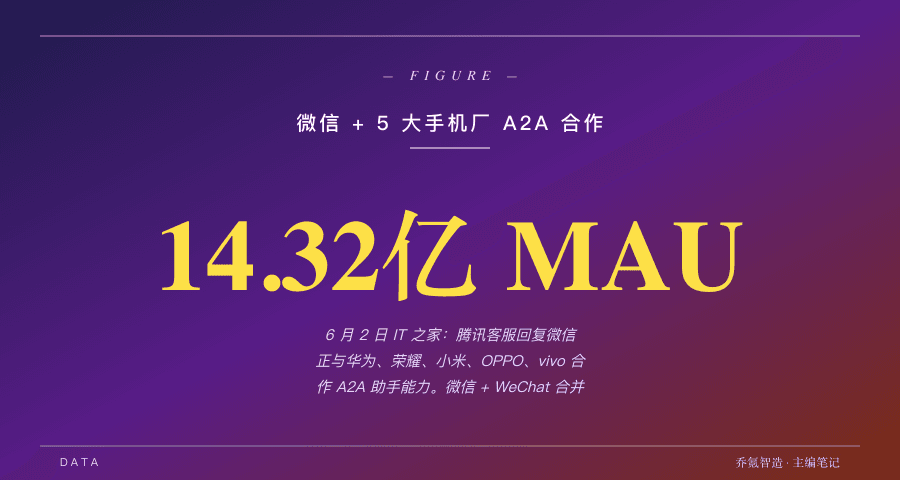
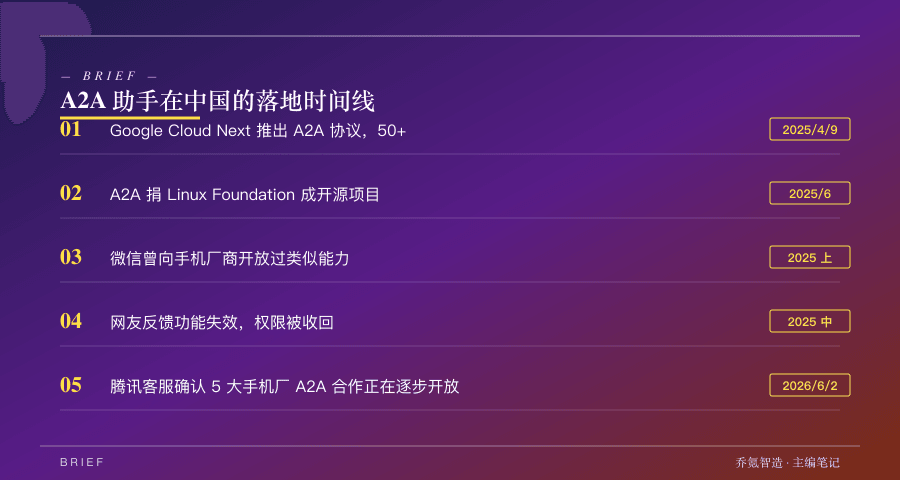
On June 2, IT Home reported that the latest reply from Tencent's customer service showed that WeChat is cooperating with mobile phone manufacturers such as Huawei, Glory, Xiaomi, OPPO, and vivo to launch A2A assistant capabilities. Users can directly initiate WeChat audio and video calls or send messages to designated friends through mobile voice assistants, using dual authorization mechanisms throughout the process. The user perception level of this matter is very simple-in the future, if you tell the voice assistant in the car/kitchen/running headphones,"Send a WeChat message to your wife and say she will work overtime tonight," it will directly call WeChat to complete it. But the industrial level is very important. A2A (Agent-to-Agent) is an open protocol promoted by Google at the Cloud Next Conference on April 9, 2025. In June 2025, it was donated to the Linux Foundation to become an open source project. The goal is to allow AI Agents from different manufacturers to call each other. This time WeChat teamed up with five major domestic mobile phone factories is the first wave of A2A real large-scale industrial landing in China. One week later in the same period (June 9), Apple WWDC 2026 plans to launch an independent Siri App "Campo" to deeply cooperate with Google Gemini. Apple Intelligence, a national bank, has not yet been launched. In the face of WeChat's 1.432 billion monthly life, this incident means that China's Android camp has bet on the right pace on the mobile AI entrance.
Let's put out the original text of today's news.
On June 2, IT Home disclosed based on the latest reply from Tencent customer service that WeChat is cooperating with mobile phone manufacturers such as Huawei, Glory, Xiaomi, OPPO, and vivo to launch A2A assistant capabilities. Users can initiate WeChat audio and video calls through mobile voice assistants or send messages to designated friends. Tencent customer service added that this function is based on the A2A (Agent-to-Agent) collaboration mechanism. The manufacturer's AI assistant initiates instructions to WeChat, which is responsible for executing and returning results. A dual authorization mechanism is used throughout the process to ensure data security and privacy compliance.
This news looks very technical and enterprise-level. But when you translate it into a daily scene, the weight becomes apparent.
You're driving on the road. He told the car voice assistant,"Send a WeChat message to my wife and say she will work overtime tonight and be back late." It sends it directly on WeChat, and you don't have to take out your phone to unlock it.
You're cooking in the kitchen with oil on your hands. Tell your mobile voice assistant,"WeChat has a video call with Manager Wang." It connects directly without you clicking on the screen.
You run with headphones on. Tell the headphone voice assistant,"WeChat sends a group of people saying 'I won't be coming at 7 o'clock tonight' to the running group." It goes straight out without you stopping.
If this matter works out, your relationship with WeChat will change from "opening the App and clicking" to "talking to your mobile phone."
And the true weight of this matter is far more than just "saving things."
It hit a centralized rearrangement of global mobile AI entrances from 2025 to 2026.
Below, I will put out all the data one by one.
First explain clearly what A2A is
The full name of A2A is Agent-to-Agent, and it is called "Between Agents" in Chinese. It is an open protocol that stipulates how AI agents made by different manufacturers and different frameworks discover each other, delegate tasks to each other, and coordinate with each other.
This agreement was launched by Google at the Cloud Next conference on April 9, 2025. On the same day, Google published an article titled "A2A: A new era of agent interoperability". At that time, it was jointly developed by more than 50 companies such as SAP, ServiceNow, LangChain, and MongoDB.
In June 2025, Google donated A2A to the Linux Foundation and became an open source agreement. This move is quite significant-it means that A2A is no longer a Google thing, but a public standard for the entire industry.
A2A is complementary to another protocol often mentioned together, MCP (Model Context Protocol, launched by Anthropic in 2024). The simple understanding is that MCP is responsible for "AI applications talk to tools", and A2A is responsible for "AI applications talk to AI applications." Together, the two protocols constitute the communications infrastructure in the multi-agent era.
Overseas, companies such as Adobe, ServiceNow, and S&P Global have deployed A2A Agents on their own platforms to call each other's capabilities across ecosystems.
There has been no industry of sufficient magnitude in China before. Until this news came on June 2.
WeChat + 5 mobile phone manufacturers What is the form of cooperation
Take it apart according to Tencent customer service description--
The first step is to speak to the AI assistants of mobile phone manufacturers (Huawei Xiaoyi, Glory YOYO, Xiaomi Super Xiaoai, OPPO Xiaobu, vivo Blue Heart XiaoV). For example,"Send a WeChat message to my wife saying she will work overtime tonight."
In the second step, the mobile phone manufacturer's AI assistant understands your intentions and issues instructions to WeChat through the A2A protocol.
In the third step, WeChat receives the command, verifies the authority (dual authorization mechanism), executes the operation, and returns the result to the mobile assistant.
Step 4, the mobile assistant confirms with you that it is completed.
You only said one sentence throughout the process. But the bottom layer is the collaboration of two independent agents: "Vendor AI Agent + WeChat Agent".
There have actually been a wave of attempts to do this in 2025. At that time, WeChat had opened similar functions to major mobile phone manufacturers, but in mid-2025, a large number of netizens reported that the function had failed, and it seemed that the authority had been withdrawn. The news on June 2 was a clear response from Tencent customer service that it was "gradually opening up," which meant that the authority was officially reopened.
According to feedback from blogger @ Wangzi Blockbuster and actual testing, some Glory mobile phones have taken the lead in supporting it-YOYO on Glory 500 Pro and Magic 8 Pro can already initiate audio and video calls or send messages to designated friends. There is no clear timetable for the specific implementation pace of several other mobile phone factories in the public information.
What does ## mean for WeChat's 1.432 billion users?
This part must first explain the size of WeChat.
According to Tencent's first-quarter 2026 financial report, the combined number of monthly active accounts of WeChat and WeChat has reached 1.432 billion, a year-on-year increase of 2% and a month-on-month increase of 1%. Tencent Q1's total revenue was 196.46 billion yuan, a year-on-year increase of 9%. The total user time spent of WeChat video accounts increased by more than 20% year-on-year.
A change in the interactive method of a product that is currently in use for 1.432 billion yuan will have the largest impact on the Internet in China.
The core change of this A2A cooperation is that WeChat allows itself to be "called by external AI" for the first time, instead of requiring all interactions to be completed within its own app.
For the past 13 years, WeChat has been a closed interactive mode where "you have to open the App to use it." Video accounts, Mini programs, and public accounts are all "content within WeChat." Opening A2A this time is equivalent to publicly authorizing the ability to "execute communication functions" to external AI assistants for the first time.
Note that I said "execute communication functions", not "open WeChat App." The two things are completely different. The former is Agent protocol-level capability authorization, while the latter is traditional quick startup.
Once this authorization is cleared, it means that WeChat will slowly change from "an App" to "a service that can be called by various AI." This is a change in product form and level.
But what is more worth watching is the time window this incident hit
On June 2, WeChat announced A2A cooperation. A week later, on June 9, Apple started at WWDC 2026.
According to Bloomberg reporter Mark Gurman repeatedly disclosed, Apple will launch a separate Siri App on WWDC 2026, with the internal code name "Campo." This is the first time that Apple has equipped Siri with a stand-alone App form, which is equivalent to upgrading Siri from a "system auxiliary plug-in" to a "system-level AI agent". Conversational interaction, context awareness, and direct access to personal email memos are all done.
Apple CEO Tim Cook made it clear at the earnings call conference at the end of October 2025 that the AI-enhanced version of Siri is still planned to be launched with iOS 26.4 in March or April 2026. There will be a bigger update for iOS 27 in the fall. The entire Apple AI strategy for 2026 is to "launch Super Siri first in the spring and make major changes in the autumn."
There is another background to this matter-Apple announced a multi-year partnership with Google in January 2026. Apple's next-generation basic model is expected to integrate Google Gemini technology. In other words, Apple is using Google's AI as a brain for its Siri.
Add another one-Bank of China Apple Intelligence has not been officially launched yet. On March 31, 2026, the "Apple Smart and Siri" option briefly appeared in Bank of China's iPhone settings, and was withdrawn a few hours later. Mark Gurman confirmed it was an accident. The Bank of China version has not received regulatory approval so far, and the technical docking is also stuck on "Which China AI company to find as a base"-Baidu Wenxin, Byte, and Ali have all talked about it, but there is no clear result at present.
Put these three pieces of information together-Apple will change Siri to AI Agent globally in 2026, but there is no timetable for the China market.
This leaves a huge window for China's Android camp.
The true weight of this wave of China Android camp
According to IDC's China smartphone shipment data for the fourth quarter of 2025, the top five in the domestic market are Huawei, vivo, OPPO, Glory, and Xiaomi. In other words, the five mobile phone manufacturers that cooperated with WeChat on A2A together cover most of the share of China's smartphone market.
All five companies have their own AI assistants-Huawei Xiaoyi, vivo Blue Heart Xiao V, OPPO Xiaobu, Glory YOYO, and Xiaomi Super Xiao Ai. Every AI assistant has been upgraded in the past 2 years. But when each company faced the question of "Can I control other apps" alone, they had no choice. Because WeChat does not open permissions, no one can transfer it.
WeChat's A2A attack is equivalent to relaxing the structural constraint of "WeChat closure" over the past 13 years for the first time.
The consequences are--
The AI assistant capabilities of these five mobile phone manufacturers will be instantly improved. Because WeChat is the most frequently used App by mobile phone users in China and takes up the longest screen time. An AI assistant that can control WeChat versus an AI assistant that cannot control WeChat are two different things in terms of user perception.
WeChat itself has also benefited-it handed over the "execution layer" to the mobile assistant and continued to guard the "content layer"(chat, video accounts, Mini programs, public accounts, payments). This is a smart choice.
In the longer term, this is a collective bet by China's Android ecosystem on the mobile AI portal-the superposition of the two layers of "WeChat Ecosystem + Domestic Mobile AI Assistant" may form a completely different form of mobile AI from iOS + Apple Intelligence.
Apple's WWDC 2026 stand-alone Siri App is not available in the short term. Android in China is already running on June 2.
China's Android camp won a position in the time window.
What may happen in the next 6 to 12 months
Let me make a few judgments.
First, the coverage of A2A capabilities will increase.
The first wave is "sending messages and initiating audio and video calls." This is the simplest communication scenario. Next, the high probability will expand to-send red envelopes, send locations, forward articles, pull groups, add friends, scan code for payment. With each expansion, the frequency at which you open WeChat apps decreases.
The fiercest direction of this matter is "cross-app orchestration"-you tell the voice assistant,"Order a cup of coffee and then tell Xiao Li that I will be there soon", and it calls up the two Agents, Meituan and WeChat, at one time to work together to complete it. Once implemented, the concept of "App" will be significantly weakened on your mobile phone.
Second, other big apps will follow.
After WeChat launched A2A, super apps such as Douyin, Alipay, Taobao, Meituan, and Didi all faced a choice-follow or not. If you don't follow, their services will gradually become the old form of "you have to open the App first", lagging behind in experience. If you follow, you will need to face the price of "weakening your own ecology."
There is a high probability that all head apps will follow. Competitive pressure is more urgent than ecological protection.
Third, the A2A agreement will become the de facto standard for China's mobile AI industry.
Google launches A2A in April 2025. Donate it to the Linux Foundation in June 2025. However, in more than a year, the implementation of overseas A2A industries has been concentrated at the SaaS enterprise level (Adobe, ServiceNow, S&P Global), and there is basically no consumer-level implementation.
China's WeChat + 5 major mobile phone factory is directly in the consumer-grade 100 million level. If it works through, A2A's real first large-scale commercialization battlefield will be on the mobile side of China, not on the overseas enterprise level.
This may be an unexpected but important landmark event for the Linux Foundation and Google.
Fourth, the time window for Bank of China Apple Intelligence is narrowing.
The stand-alone Siri App to be released on Apple's WWDC 2026 will be available to overseas users in the fall. Bank of China iPhone users have no timetable yet. If this wave of cooperation between WeChat A2A and the domestic Android camp is fully rolled out within six months, the gap between Bank of China iPhone users and domestic Android users in the mobile AI experience will become wider and wider.
This will put pressure on Apple's sales in the China market. Apple will either speed up the launch of Bank of China's Apple Intelligence (provided that supervision + China's AI partners are finalized), or accept the reality that Bank of China's iPhone lags behind domestic Android in terms of AI experience. Neither option is easy.
QKPFX6 What does QK mean to you
If you are a mobile phone user, 3 things will happen in the next 6 months.
First, your mobile voice assistant will suddenly become easier to use.
Some glory models have already been supported first. There is a high probability that the other four companies will follow suit in the next few months. When you say that the instructions of "send a WeChat message to XX" and "make a video call with XX" will change from "open the WeChat App, go to the chat interface, and start operating" to "just say one sentence and it's over."
This may seem small, but it is used frequently every day. Scenes such as driving, cooking, running, and bathing that are inconvenient to hands will be significantly improved due to this A2A cooperation.
Second, your relationship with WeChat will change.
In the past, when you opened WeChat, you took the initiative to do 8 out of 10 things. In the future, it will gradually become that 3 to 5 out of 10 things will be completed with just a word from your mobile assistant.
The frequency of opening WeChat apps may drop in the short term. But WeChat's "presence in your daily life" will rise instead-because it can now be called from various entrances on your mobile phone, not only if you actively open it.
Third, when you choose the next mobile phone, you must look at the actual capabilities of the AI assistant.
Before 2025, choose a mobile phone to look at the screen, camera, processor, and battery life. Starting in 2026, add a new dimension-whether the AI assistant can call up the apps you commonly use.
Huawei, Glory, Xiaomi, OPPO, and vivo will enjoy dividends first in this A2A cooperation. Other brands (including Apple Bank of China) will lag one notch in the short term.
If you are planning to change your mobile phone in the second half of this year, this dimension can be formally taken into consideration.
Last
On June 2, the Tencent customer service reply message from IT Home was a product technology news.
Digging down one layer is the first time that WeChat has issued A2A authorization to the public on the 1.432 billion monthly active plate, moving from "closed apps" to "callable services."
Digging further down, the top five mobile phone manufacturers in China's Android camp collectively seized the time window for the mobile AI entrance one week before Apple launched the independent Siri App on June 9 at WWDC 2026.
Digging further down is the A2A agreement that Google promoted in April 2025 and donated to the Linux Foundation in June 2025. For the first time, it has found a real implementation scenario for consumer-level 100 million users on the mobile side in China.
This is the biggest step in the past 18 months that the "AI Agent protocol" has gone from a "PPT concept" to "daily use by 1.4 billion users".
It is not unilaterally driven by a single company. It comes from the four things that are aligned together: "WeChat opening permissions + 5 major mobile phone manufacturers issuing assistants + A2A protocol issuing underlying standards + Apple Bank of China is not online".
The way WeChat's 1.432 billion users turn on their mobile phones every day is about to change completely.
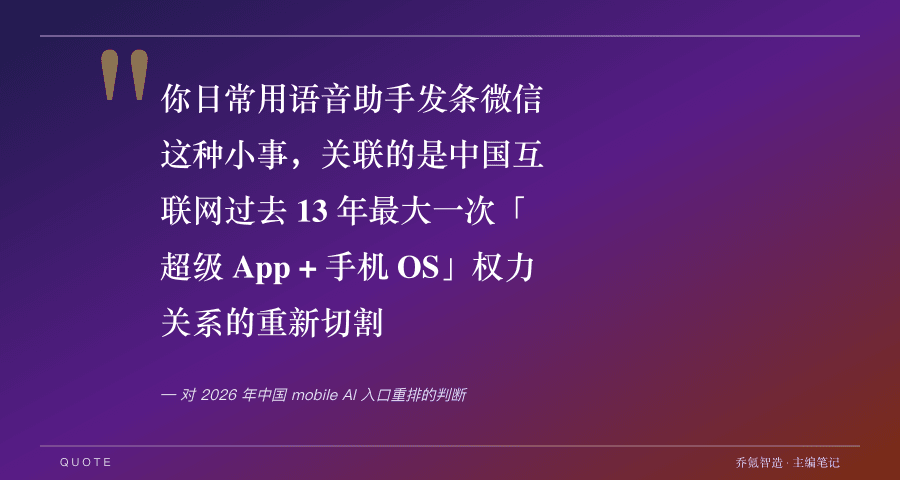
The trivial matter of using your voice assistant to send WeChat messages every day is related to the biggest re-cutting of the "Super App + Mobile OS" power relationship on the Internet in China in the past 13 years.
This matter will continue to unfold for the next six months.
Next time you are driving, try telling the car to "send a WeChat message to XX". If it does go out, you have experienced the first user-level moment of this cut.