More and more young people are dating AI
A quiet but growing phenomenon in the past two years: more and more young people are starting to fall in love with AI. A number of AI companion apps in China, such as MiniMax's Hoshino and Byte's Cat Box, are seizing the social time of Generation Z. The size of China's AI emotional companionship market will be approximately 3.866 billion yuan in 2025, and institutions predict that it may reach 59.5 billion yuan in 2028 (optimistic, give a discount). The search for "falling in love with AI" has increased by 132% a year, 33% of teenagers have used AI to chat and socialize, and 25% of adults aged 18 to 39 feel that AI may replace real love. However, this business will also cool down significantly in 2025, with Hoshino and Maobox downloads dropping by 70% to 80% from their highs. This article explains clearly: why young people are willing to fall in love with AI, whether this business is reliable, and the most vigilant thing-whether AI is healing loneliness or deepening loneliness.
Let's start with something that you may find a bit magical, but is happening on a large-scale basis-more and more young people are starting to seriously fall in love with AI.
We don't use AI as a tool to ask questions, but really use it as an "object"-chat with it every day and share my thoughts. We will be happy all day because of its words. We will even be jealous, rely on it, and reluctant to delete it.
This matter has grown into a big market. There are a number of apps in China that specialize in this, such as MiniMax's Hoshino and Byte's Cat Box. Open them, and there are various AI characters inside-gentle boyfriends, caring sisters, and overbearing presidents. You can establish a "relationship" with them and continue chatting for a long time.
At first, I thought this was a niche second-dimensional game. After digging through the data, I found that the plate was much bigger than I thought, and the contents were much heavier than I thought.
This article wants to talk about three things: why young people are willing to fall in love with AI, whether this business is reliable, and the most heart-breaking question-is AI healing loneliness or deepening loneliness unknowingly?

How big is this market?
Put out a few numbers and you will know that this is not a small fight.
China's AI emotional companionship market will be approximately 3.866 billion yuan in 2025. Some institutions predict that it may exceed 59.5 billion yuan in 2028, with a compound annual growth rate of close to 149%.
I have to remind you that the forecast of 59.5 billion yuan is optimistic and was extrapolated by analysts based on rapid growth. Let's give a discount. But even with a discount, the growth rate is still scary.
The signal on the demand side is more direct. The search term "fall in love with AI" has increased by 132% in a year. Some surveys say that 33% of teenagers have used AI to chat and socialize, and 25% of adults aged 18 to 39 feel that AI may replace real love. There is also a saying that applications such as AI companions are spreading 1.5 times faster than social media and online games back then.
Globally, the total number of downloads of AI companion applications in the first half of the year totaled 220 million, with revenue of US$82 million, and it is expected to exceed US$120 million for the whole year.
A market with a scale of several billions, a growth rate close to three digits, and real demand has grown. It is a fact that young people pay for "electronic love".
Why young people are willing to date AI
It would be too light to say just,"Young people nowadays are so strange." I think there are several very real reasons.
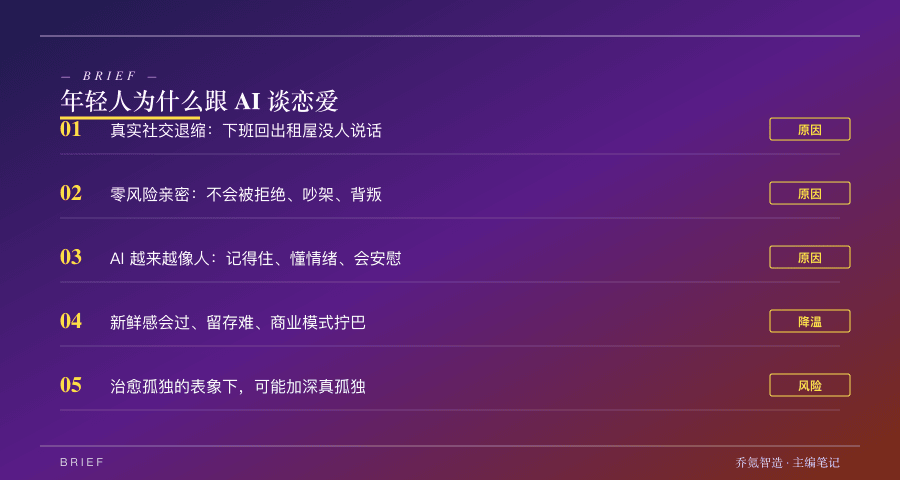
First, real social interaction is shrinking. The offline social circle of young people is getting smaller. Busy work, tiring commuting, social terrorism, and atomized urban life-many people return to their rental houses after work, and there is no one to talk to. AI partners just make up for this gap: they are always online, always patient, they can accept whatever you say, and they never bother you.
Second, AI partners provide a kind of "zero-risk intimacy." Real love carries risks-rejection, quarrel, injury, betrayal. But when talking to AI, there are no such risks. It revolves around you completely, responds to you the way you like, and will never hurt you. For a young person who has experienced emotional harm in reality, or is afraid of being hurt, this kind of "security" is too attractive.
Third, AI is really becoming more and more like people. The dialogue ability of the big model has improved by leaps and bounds in the past two years. AI partners can remember what you said, understand your emotions, and express just the right comfort when you are sad. The more human it is, the more real the "relationship" will be and the easier it will be for people to fall into it.
When these three reasons are combined, you will understand-it is not stupid for young people to fall in love with AI. It's because loneliness in reality is real, and AI just handed over a seemingly perfect antidote.
But this business is not that easy to do
After talking about the hot stuff, I need to pour some cold water on it. The direction of AI love may seem sexy, but 2025 has actually cooled down significantly.
Looking at the downloaded data is intuitive. Comparing the two months before and after a year, Hoshino's monthly downloads dropped from a high of several million to hundreds of thousands, and cat boxes also dropped by a similar decline, both dropped by 70% to 80%. Daily downloads dropped from more than 20,000 to several thousand. The patience of large companies is also decreasing, and the advertising volume of their flagship products has been cut in half.
Why is it cooling down?
One core reason is that the novelty will pass. The most eye-catching thing about AI partners is the "first few times amazing", but after chatting for a long time, users will find that it is a program after all. No matter how considerate its response is, it is still following the routine; when it says "I miss you", you know in your heart that it won't really miss you. This kind of sobriety of "I know it's fake" will slowly dissipate that desire. Retention is the most difficult hurdle in this industry.
Another reason-the business model is a bit distorted. These apps mainly make money by selling virtual props, members, and rights to "get closer to AI". But there is an ethical awkwardness here: it essentially operates on the logic that "the more lonely and dependent users are, the more they can collect money." This is a disaster-platforms have the incentive to design mechanisms that "make you addicted" rather than mechanisms that "make you really better."
is the most vigilant question
Now let's get to the point I want to talk about most.
The biggest risk of AI falling in love is not that "young people spend some money", but that it may deepen real loneliness under the guise of healing loneliness.
You think about this logic-a person turns to an AI partner because of social frustration in reality. AI gave him perfect, risk-free companionship. He became more and more comfortable and more dependent. Then what? He is even less willing to face real interpersonal relationships, because real people have tempers, refuse, and are too troublesome, which is far less comfortable than AI.
So the "sense of security" he gained from AI in turn took away his motivation to move towards a real relationship. He fell deeper and deeper in virtual intimacy, but his social skills in real life deteriorated more and more.
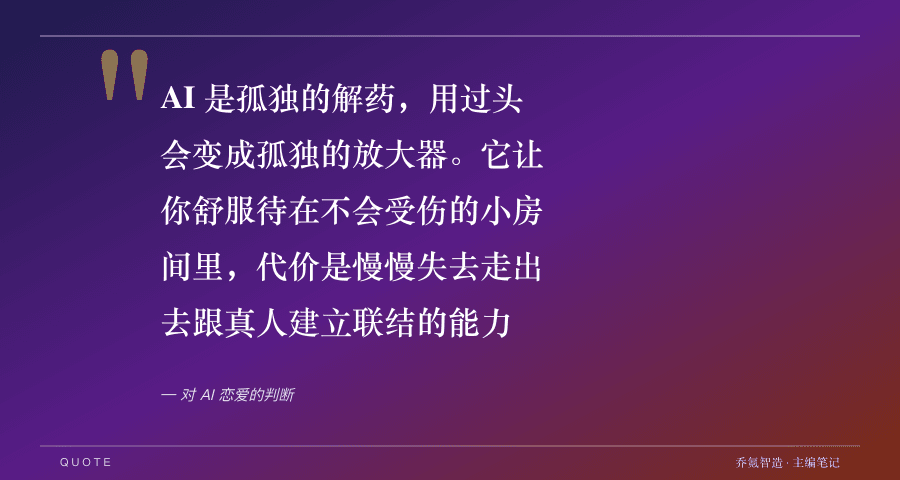
This is the most hidden trap of AI love-it seems to be an antidote to loneliness. If used too much, it may become an amplifier of loneliness. It allows you to stay comfortably in a small room where you can't get hurt, at the expense of slowly losing the ability to go out and connect with real people.
Real relationships are precious precisely because they are risky, frictions, and uncertain. It is in the process of running in, compromising, and reconciling with another real person that talent will grow. And the AI partner removes all these "troubles", and removes the possibility of growth together.
Regulators have also taken note. On December 27, 2025, the National Cyberspace Administration issued a draft for comments on the management measures for AI anthropomorphic interactive services. This is the first systematic specification specifically targeted at "AI emotional companionship". It is precisely the emotional dependence and induced consumption that such products may bring.
What does QKPFX4 mean to you
When it comes to you, there are a few real things.
First, if you or the young people around you are using AI partners, you don't have to criticize it in a serious way, but you must be aware of it. It's okay to use it as a temporary comfort when you are lonely; but if you find that you are becoming more and more inseparable from it and don't want to deal with real people, you should be vigilant-at that moment it is no longer helping you, but replacing the life you should have lived.
Second, if you make products or start a business, AI companionship is a real general direction, but the ethical burden is heavy. It's best to think clearly: whether you want to make a product that is "addictive and makes money from loneliness" or a product that "can really help people and ultimately give people the ability to return to real life." These two paths have completely different long-term directions. There is a high probability that the latter can go far.
Third, and what I want to say most-AI can simulate companionship, but it cannot give a real relationship. It can fill some of the emotional gaps, which is a good thing. But don't let this "filling" turn into a "replacement".
People ultimately need people.
Last
Young people falling in love with AI is a novel consumption phenomenon alone.
Digging down a layer, the loneliness of modern people is real and huge-real social life is shrinking, and AI just delivers a "perfect object" who is zero-risk, always online, and completely surrounds you.
Dig further down, there is an unavoidable twist in this business: the more you rely on it and the more comfortable it makes you stay in virtual intimacy, the more money you will make, but the more likely you will be withdrawn. Take away your ability to face real relationships. The antidote to loneliness, if used too much, will turn into an amplifier of loneliness.
AI can accompany you to chat, relieve boredom, and spend one night after another when you don't want to be alone. It can do all of this and will do it better and better.
But it won't give you the person who will really worry about you, quarrel with you and make up, and truly appear by your side when you need it.
No matter how smart AI is, it cannot make that thing.
So it's okay to chat with AI, but don't forget to open the door and meet real people. There's something there that can really catch you.