The most difficult hurdle for robots is not in the brain or the body
Recently, robot videos have been on the screen again-somersaults, folding clothes, pouring coffee, and screwing bottle caps. At the same time, the Ministry of Industry and Information Technology and the State-owned Assets Supervision and Administration Commission issued a document that this year they will promote the transition of humanoid robots from the "laboratory model" to the "factory model", and will be put on duty by the end of the year, forming a level of 10,000. It sounds like the robot is about to enter the factory to work soon. But if you really go to the factory and take a look, the story is completely different. I reviewed the latest developments and found that the most difficult hurdle in front of the robot is neither in the body nor in the brain. This article is peeled off layer by layer: the first layer, the body (dexterous hands, feet) is already enough, and being able to do cool movements does not mean being able to work; the second layer, what has really changed in the past two years is the "brain"--VLA model, brain-cerebellum division of labor, world model, simulation training, and the first time the robot learned to adapt; the third layer, and the most difficult level, is the two least sexy words-reliability: Let it work steadily for thousands of hours without making mistakes. The best result of the BMW factory was only over 1,000 hours, and the industry standard was 50,000 hours. No company completely passed the continuous operation test. Finally, we talked about where this wave of China is strong, where it is stuck, and how ordinary people should think.
Recently, I have seen many videos of robots-somersaults, somersaults, folding clothes, pouring you a cup of coffee, and fingers so flexible that they can twist the bottle cap. The comment area was full of "The future is here."
At about the same time, the Ministry of Industry and Information Technology and the State-owned Assets Supervision and Administration Commission jointly issued a document saying that this year we will promote the switch of humanoid robots from "laboratory mode" to "factory mode"-stop performing in test fields with constant temperature and humidity, go to workshops and warehouses. Work in real scenarios such as work, and at the end of the year, verification and regular work will be completed in a number of scenarios to form a landing capability of 10,000 units.
It sounds like robots are about to enter the factory on a large scale soon.
But if you really go to the factory and take a look, you will find that the story is very different from the one in the video. Can robots work at all? What is the difficulty? I checked through the latest developments and found something quite counterintuitive--
The most difficult hurdle in front of a robot is neither in its body nor in its brain.

I'll talk layer by layer.
Level 1: Do you think the difficulty lies in your body? My body is already sufficient
Remove one of the most common misunderstandings first.
Many people look at the robot and stare at its body-whether it can somersaults, whether its fingers are flexible enough, and whether it can run fast. It seems that the more dazzling the body, the stronger the robot will be.
But this area of the body has actually improved rapidly over the years and is no longer the most stuck area. Dexterous hands can twist bottle caps, feet can climb stairs, force control can hold eggs without crushing them-there are already many "movements" that hardware can do.
The problem is that being able to do a cool move and being able to work are two different things.
A robot that can somersaults may not be able to securely install a part in the right position a thousand times on the production line. Performance requires one surprise, and work requires one right every time. If you ask it to fold a piece of clothing beautifully, and replace it with something that it has never seen and wrinkled, it may be silly.
So the body has never been the most difficult place. What has really undergone a qualitative change in the past two years is another thing-its brain.
Level 2: What has really changed is the robot's "brain"
This is the layer I want to clarify with you most, because robots have "begun to behave" in the past two years, and the root lies here.
Why were robots in the past stupid? Because its "seeing" and "moving" are separated. The image seen by the camera requires the engineer to write a lot of rules, telling it one by one to "move like this when you see this." As soon as the scene changes, the rules become invalid, and it immediately catches them blind.
In the past two years, the robot has been replaced with a new set of brains. I'll break it up into several "organs" and show you.

The first organ is called VLA.
The full name is the "vision-language-action" model. Bottom line: It integrates the three things of "understanding the picture + understanding your words + calculating how to move your hands and feet" into one model.
This means that for the first time, robots can "watch and adapt to situations" like humans, rather than memorizing rules. If you tell it,"Put the sweet potatoes on the table into the air fryer," it can see, understand, and plan its own actions-even if it has never been specially taught this specific task.

This is not blowing. Google's Gemini Robotics and Physical Intelligence, which specializes in basic models, have both pushed VLA far this year. The new model of Physical Intelligence in April can already combine bits and pieces of small skills learned to do new tasks that have not been taught-the above "roasting sweet potatoes in an air fryer" is a true demonstration of it. Nvidia has open-source such models. Domestic efforts are also being made. Zhiyuan and Ant have come up with their own VLA. Ant is still trained based on 20,000 hours of real robot data and is completely open source.
How hot is it in this direction? At this year's top AI conference ICLR, VLA-related submissions have increased 18 times a year.
The second organ is the division of labor of "brain + cerebellum".
Just like people: the brain is responsible for slowly thinking clearly "what I want to do and take a few steps", and the cerebellum is responsible for quickly and subconsciously executing the movements. Robots are now divided into this way-a slow system does high-level planning, and a fast system does high-frequency motion control. Think and do, each performs its own duties.
The third organ is the "world model".
This is more cutting-edge. Simply put, it is to let the robot preview in its mind-it has an internal understanding of how the physical world moves. It can first imagine "will the cup fall if I push it like this" and then decide to move it. Domestic Zhiyuan has made an action world model, but Zhiyuan Research Institute has simply shifted its main direction from a big language model to a world model.
But this road is still early. The person in charge of Zhiyuan said very honestly: The world model has not reached the "GPT moment" yet, because data is too short, which is the core sticking point .
Finally, there is a change in the training method, called Sim2 Real.
A robot cannot try and error billions of times in the real world-too expensive, too slow, and dangerous. So everyone asked it to practice in the virtual world (simulation) first, and then moved its "brain" to the real machine when it was mature. Cheap, safe and fast.
With this "new brain" together, the robot truly "started to work" for the first time. Seeing this, you may think: Isn't that good, the difficulty is over?
don't rush.
Level 3: The most difficult level is the two most inconspicuous words-reliability
That's what I really want to say.
It's really not difficult to get a robot to do it once, demos are flying all over the place. The difficulty is to make it work continuously, stably and error-free for thousands of hours.
To give you the best achievement disclosed so far in the entire industry: BMW used two Figure robots in a factory in the United States to run for more than 1,200 hours, transported 90,000 sheet metal parts, and participated in the production of 30,000 cars. This is the most beautiful number you can come up with.
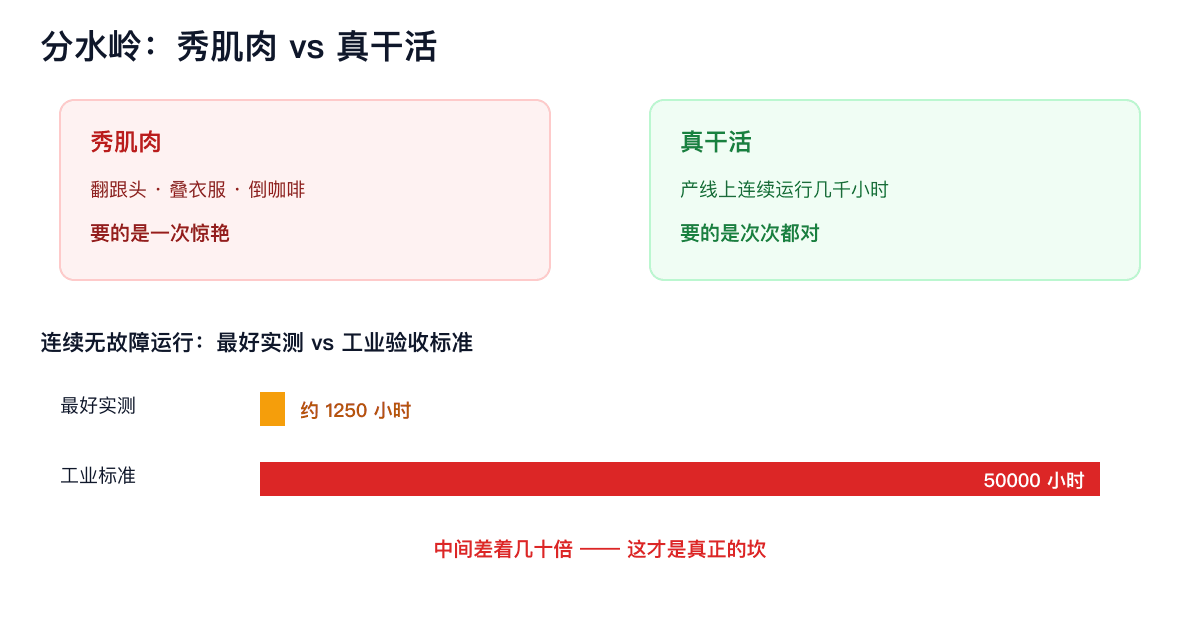
But do you know what the standard is for an automobile factory to accept a piece of equipment? The average trouble-free operation exceeds 50,000 hours. The best measurement took only more than a thousand hours, with a difference of tens of times.
The sobriest person in the industry said it bluntly: Customers don't care about how amazing your demos are. What they ask is-can you run in my factory for three or six months? Can we really reduce costs? Can I be willing to buy another batch? So far, no company has completely passed this test.
So the watershed of this industry is already clear: on one side, the "show muscles" that are constantly being renovated at the exhibition-folding clothes, pouring coffee, and somersaults; on the other side, the "working type" that has been working hard for thousands of hours on the production line. The question has changed from "can you do it" to "can you do it well and how long can you do it?"
It's sexy once. Only by being right every time and never falling off the chain can it be valuable. And this level is precisely the simplest and least sexy one-reliability.
, where does China stand?
Back to ourselves. This round, China is in the first echelon, and it is a bit stronger-not just fighting for how much a single robot can fight, but also fighting for a complete set of infrastructure to "let robots learn to work."

The open source VLA model, the open source simulation training platform, nearly 30 training grounds for real-life scenarios, and a number of cases where you actually run in factories-for example, in some factories, the robot handling station has been expanded from one to four. The number of materials that can be moved has increased from four to more than 20 types, and there has been no material dumping so far. This approach of "full industrial chain + many landing scenarios + quick accumulation of real data" is an advantage for China.
The stuck points are also very real, just like the rest of the world: data is still too scarce, and no one has yet overcome the challenge of reliability. Whether an advantage can be transformed into a solid lead depends on who does a solid job of "continuous and stable work" first.
What should ordinary people think of this wave
Falling to you, a few honest words.
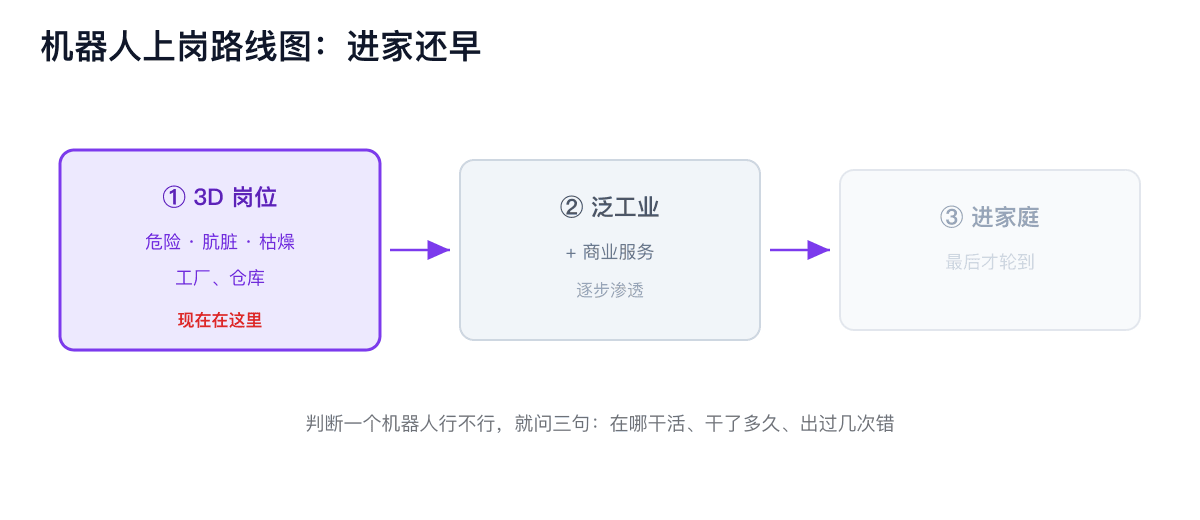
Don't be somersaulted in the video. To judge whether a robot is working or not, three questions are asked: where is it working, how long has it been working, and how many mistakes have it made. Only those who can answer these three questions are true; those who can only post performance videos will be put aside for now.
It's still early to get home. There is a clear path for robots to take up their jobs-first doing "dangerous, dirty, and boring" tasks (factories, warehouses) that people don't like to do, then going to broader industrial and commercial services, and finally entering families. Don't expect to have a robot nanny at home next year.
If you want to join the game , the window of opportunity is no longer "making another cool Demo"-that road is too crowded and worthless. What is really valuable is the least sexy things: reliability engineering (allowing it to run continuously, with low failure rates, and being able to connect to the factory system), the accumulation of real operation data, and the closed-loop of a specific scenario. Whoever does these hard work solidly will be able to accept the next 10,000-level orders.
Last
In terms of robots, the most eye-catching thing is the body, and the most sought after thing is the brain. But what really catches everyone is the two simplest words: reliability.
There are already many robots that can somersault. There are few people who can work a full shift in a row without making mistakes, and still make customers willing to buy another batch.
Whoever first overcomes the hurdle of "continuous and stable work" will truly transform the robot from a performer to a labor force.
2026 is likely to be the beginning of this hurdle being overcome.