Apple's new Siri is here, but Bank of China doesn't need it
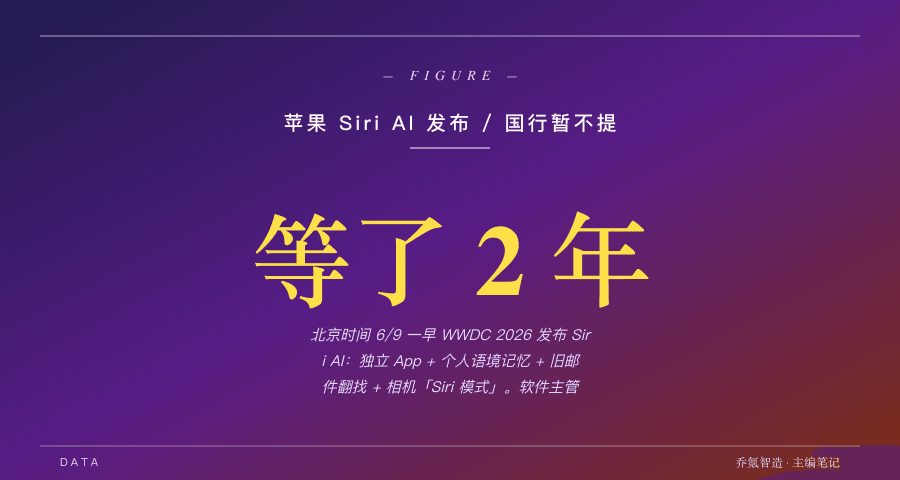
In the early morning of June 9, Beijing time, Apple's WWDC 2026 was completed. The AI version of Siri, which had been waiting for two years, was officially unveiled-a stand-alone App that can remember conversations, pull out hotel confirmation numbers from old emails, and a camera that can read the picture."Siri mode". However, software director Craig said something at the end of the press conference that made domestic users feel cold: Due to the need to cooperate with relevant requirements to advance work in the mainland of China, Siri AI will not be provided for the time being and will be launched in English first. This article clarifies three things: what is the strength of the new Siri, why Bank of China can't use it for the time being, and this gap actually leaves a home opportunity for domestic models to enter the iPhone. The background data is all real-Apple's AI is deeply customized with Google Gemini (according to Bloomberg reports, about 1.2 trillion parameters, about US$1 billion per year), and the Bank of China plan has long been discussing localization with Alibaba and Baidu. Undertaking.
On the morning of June 9, Beijing time, Apple's WWDC 2026 keynote speech ended.
This press conference has been awaited for a long time. Because Apple announced the AI version of Siri two years ago, it repeatedly skipped votes, so that everyone almost didn't believe it. This time it is officially implemented.
But for domestic iPhone users, the mood after watching the press conference is a bit complicated-it is really good, but unfortunately it has nothing to do with you for the time being.
Software director Craig said something at the end of the conference: In the mainland of China, Siri AI and other new Apple smart features need to be promoted in accordance with relevant requirements, so they are not available for the time being. The new Siri will be launched in English first and will gradually support more languages later.
In a word-Bank of China users can only watch the fun for the time being.
In this article, I want to explain three things clearly: what is the strength of the new Siri, why Bank of China cannot be used for the time being, and the reversal that many people ignore in this matter-this gap may be a home opportunity for a domestic model to enter the iPhone.
first said what has been upgraded to the new Siri
The name change of Siri this time is very telling-it is directly called "Siri AI." This is a complete brain replacement, not a minor repair.
A few really useful changes--
First, it can remember the context. In the past, Siri answered every question you asked, and the next sentence it would forget what you just said. The new Siri can remember the entire conversation, and you can keep asking questions, just like chatting with ChatGPT or Doubao.
Second, it can turn through your own things. Apple has given it an ability called "personal context"-you can ask it to pull up the deeply buried hotel confirmation number from your old email from months ago; you can ask it to pull up photos from your last trip. It can understand the scattered information on your mobile phone and help you find it.
Third, it has a separate app. Siri used to be a voice assistant that came out with a click, but now it has its own app that can review historical conversations and results, and can also sync between iPhone, iPad, Mac, Apple Watch, and Vision Pro via iCloud.
Fourth, the camera has "eyes". The iPhone camera has added a new "Siri mode". If you point the lens at a dish, it can estimate nutritional information; if you point it at an object, it can understand and give you a useful response. You can even use Apple Cash to share bills with friends.
If you connect these four changes, you will find that what Apple wants to do is to transform Siri from a "voice assistant that can understand simple instructions" to an "AI assistant that can see, remember, and do things."
This direction is right. The problem is that the Bank of China cannot use it.
Why can't I use it for that country trip?
This is the most clear part of this article. Because many people think that Apple is lazy or deliberately discriminates against the China market, but in fact it is not. The real reason is a specific technical bottleneck.
This time, the brain of the new Siri is in deep cooperation with Google.
Apple announced earlier this year that the basic model for the next generation of Apple Intelligence was customized in cooperation with Google and its Gemini model. According to Bloomberg reporter Mark Gurman and others, this is a specially customized Gemini model with about 1.2 trillion parameters, and Apple gives Google about $1 billion a year for this.
For a company that has always regarded "self-developed chips and end-side processing" as its core selling point, turning to Google's model is itself a big conceptual turn-it is equivalent to publicly admitting that its model cannot afford this for the time being. scene.
But that's the problem-this plan, with Google Gemini at its core, will not work in China.
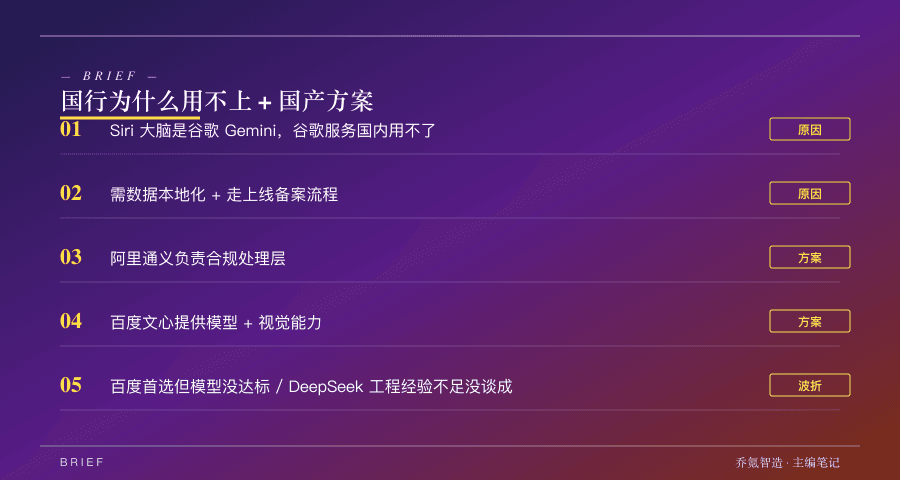
The reason is straightforward: Google's services are not available in China. Siri, who runs on the Google Cloud and relies on Gemini as its brain, cannot move into the China market as it is. In addition, China has its own online process for such AI services, requiring data localization and filing. So it is impossible for Apple to directly copy the American version.
Apple must come up with a separate plan for the China market.
The plan prepared by Apple for China is a domestic model
That's the most interesting part of this.
Apple can't use Google in China, so who will be its Siri brain? The answer is-domestic large model.
According to the information currently disclosed, Apple has designed a combination plan of "domestic models + local compliance" for Bank of China: the end side is still a small model developed by Apple, but the content is handed over to China companies to undertake it. The specific division of labor is roughly-Alibaba is responsible for adjusting Apple's AI model on iPhone, iPad, and Mac and doing a layer of content compliance processing that users do not perceive; Baidu is responsible for providing model capabilities for functions such as Siri and visual intelligence; cloud processing is handed over to Guizhou, which is already operating iCloud, the national bank.
To put it bluntly, in the United States, Google is the brain of Siri. In China, this role should be played by domestic models.
But the process was not smooth at all.
Apple's earliest choice was Baidu. As a result, Baidu's model failed to meet Apple's standards. Apple had to re-evaluate and compare Tencent, Byte, Ali, and DeepSeek. I also talked to DeepSeek, but DeepSeek did not have enough experience in project implementation and post-maintenance, and the negotiation was ultimately not concluded.
There was another incident on March 31 this year-Apple's AI function once briefly appeared on some domestic iPhones for a few hours. Suddenly, there was a new entry in the settings menu without any announcement, and it was quickly removed. Gurman said it was a mistake and had not yet received permission to go online.
Some domestic users took actual measurements in those hours and found that this set of BOC AI was in a "mix and match" state-sometimes the language processing is Baidu Wenxin, sometimes it is another model, and the content compliance processing is Ali Tongyi, the experience is relatively fragmented, and netizens complained that "it doesn't feel like AI intelligence, but like Huaqiangbei assembly machine."
This detail actually shows that Apple's Bank of China AI plan has not yet been fully implemented. When multiple domestic models are put together and then stacked for compliance processing, the engineering complexity is very high and the running-in takes time. This is also why at this WWDC, the official can only say that "it will not be provided yet."
Apple's real situation in China
Stretch the timeline, Apple Intelligence has gone quite a long way to enter China.
Released in June 2024, launched in stages in the United States in October 2024, and launched to EU users in April 2025. Only the China market has been delayed and has not yet officially implemented in June 2026.
And Apple's pressure in China is very high. Greater China is Apple's second-largest market, but revenue fell 11% in the fourth quarter of 2024, the third consecutive year of decline. At the same time, more and more China consumers are turning to local brands such as Huawei and Xiaomi.
For Apple, AI is an important card for it to regain the China market. Now this card has been delayed. Overseas users have already used it, and Bank of China users are still waiting. This gap will make some users who were originally waiting and watching more inclined to choose domestic mobile phones with mature AI functions.
Therefore, on the surface, the fact that "Bank of China cannot use Siri AI" is a pity for domestic users, but on a deeper note, it is a real problem for Apple in the China market.
But conversely, this is a home opportunity for domestic AI
Speaking of this, I want to talk about an angle that many people ignore.
Apple cannot use Google in China, and its self-research is not strong enough for the time being, which means that the AI brain of the iPhone, the world's largest high-end mobile phone platform, in the China market must be filled in by domestic models.
This is a rare home opportunity for domestic AI.
Think about this picture-iPhones in other parts of the world use Google Gemini for AI; in China alone, the iPhone's AI capabilities rely on Ali Tongyi, Baidu Wenxin, or other domestic models in the future to support it. This is equivalent to a domestic model getting access to hundreds of millions of iPhones.
The value of this entrance is very great. On the one hand, there is a huge number of calls and brand endorsements-being able to become the AI base for the national version of the iPhone is itself one of the highest certifications for the capabilities of a domestic model. On the other hand, this will also force domestic models to continue to strengthen their engineering stability and compliance capabilities, because Apple's standards are very high, and Baidu was re-weighed because it failed to meet the standards for the first time.
To put it more broadly, this incident is a lateral confirmation of the progress of domestic AI in recent years-a few years ago, no one would have thought that the iPhone's AI capabilities in China would rely on domestic models. Now this has become a reality. The domestic model has changed from a "chaser" to a specific market of China, an object that Apple cannot avoid and must cooperate with.
This is a node worth remembering.
QKPFX5 What does QK mean to you
When it comes to you, there are a few practical things--
First, if you use a Bank of China iPhone, don't count on the new Siri in the short term. The official said that it would not be provided for the time being "and did not give a clear timetable. Combined with the pace of procrastination in the past two years, we are optimistic that we will have to wait until the domestic model solutions are completely run-in and the online process is completed. This time may be a few months, or it may be longer.
Second, if you are struggling to change your phone, this is a factor to consider. The AI of the overseas version of the iPhone is already available, but the National Bank version is still waiting; while the AI functions of the domestic Android flagship (Huawei, Xiaomi, OPPO, vivo) have become quite mature in the past two years, and are tailor-made for the China scenario. If you value the AI experience particularly, this gap is real.
Third, if you pay attention to the domestic AI industry, keep an eye on who will win the iPhone National Bank AI next. Alibaba and Baidu are currently the main contractors, but Apple's standards have been changing. Who will ultimately pay for and how to divide the labor will be a very important signal in the competition landscape of domestic large-scale models.
Last
Apple's AI version of Siri was released but Bank of China is temporarily unavailable. Looking at it alone is a pity for domestic users.
Digging down a notch is that Apple's bet on Google's Gemini solution will not work in China. It must build a separate solution for the China market with a domestic model as the core, and this plan is still in progress.
Digging further down is the iPhone, the world's largest high-end platform. For the first time, the AI brain in the China market must be handed over to domestic models-something unimaginable a few years ago.
Apple's regret is precisely an opportunity for domestic AI.
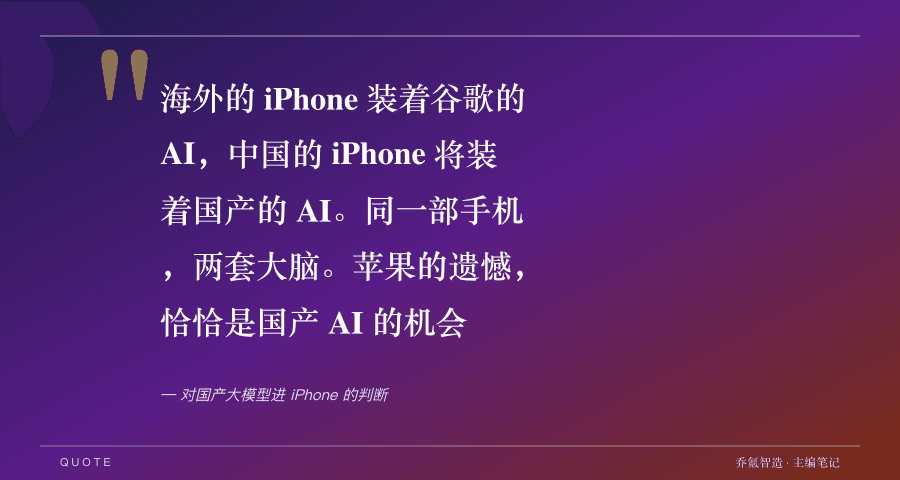
Overseas iPhones will be equipped with Google's AI, and China's iPhones will be equipped with domestic AI. One mobile phone, two sets of brains.
What is separated between is not only a regulatory process, but also the distance that domestic models have actually caught up in recent years.
No one can tell when the new Siri national tour will be available now.
But on the day it officially landed, the Chinese it spoke was likely driven by a brain made by a China company.
This event itself is quite worth looking forward to.