AI writes quickly and starts paying off debts three months later
A developer said online that no one on the team can control the projects the company has built using AI "atmosphere programming". Another person was even more ruthless: After being amazed by AI for two years, he read the complete code base line by line one day. After reading it, he only said,"This piece of junk must not be online" and then went back to write. This is not an exception-the industry named this hurdle, Spaghetti Point, and it will be around the third month: you add a new feature, and the three places you have done before will collapse. This article explains what is happening: AI makes writing code as fast as magic, but speed is never the bottleneck,"understanding" is. What piled up quickly was a black box that no one could read and no one dared to touch-the founder couldn't understand his own App, so if it broke down, he would go back and ask the AI. The AI would paste it again. After fifty iterations, the code became Fifty uninformed decisions stacked together. Hard data, out-of-control mechanisms, it is estimated that more than 8,000 startups will spend US$50,000 to US$500,000 on "rescue" by mid-2026, and the solution that China developers and big manufacturers have given-humans set the direction, AI executes, and writing the architecture and specifications into files that AI automatically loads every time. My judgment: Maintenance is something you think about the first day, not something you can make up for after three months.
Let's start with two scenes that are happening.
A developer said online: The company used AI to "atmosphere programming" to build projects that no one could control on the team. The other person was even more ruthless-he was amazed by AI for two years, handing over complex tasks all the way to models. One day, he read the complete code base line by line, and only said after reading it: "This piece of shit must never be online." Then turn off the AI and go back to writing.
This is not an exception. The industry has already named this hurdle.
honeymoon, and the hurdle called "pasta tipping point"
Let's make this trend clear first. In early 2025, Karpathy proposed vibe coding-atmospheric programming, which focuses on "forgetting the existence of code and writing programs by talking to AI." How popular is it? "Atmosphere Programming" has been directly included in the dictionary's word of the year. Especially sweet for entrepreneurs: product managers no longer have to wait for engineers to schedule, and they work as a team. Four positions are compressed into one, and four salaries are compressed into one subscription fee.
The first week, it was like magic. You describe a function, AI writes it, and the screen really moves.
Then, in about the third month, magic began to pay off its debts. The industry calls this hurdle Spaghetti Point, which is the critical point of pasta: If you add the next function, three places that have been done well and run well before will inexplicably collapse. (This "three months" is a rule observed by many people, not an exact constant, but more and more people are bumping into it.)
debt is generated by energy
This is not a feeling, it is data. Someone analyzed the evolution of 211 million lines of code, and the conclusion is very straightforward:
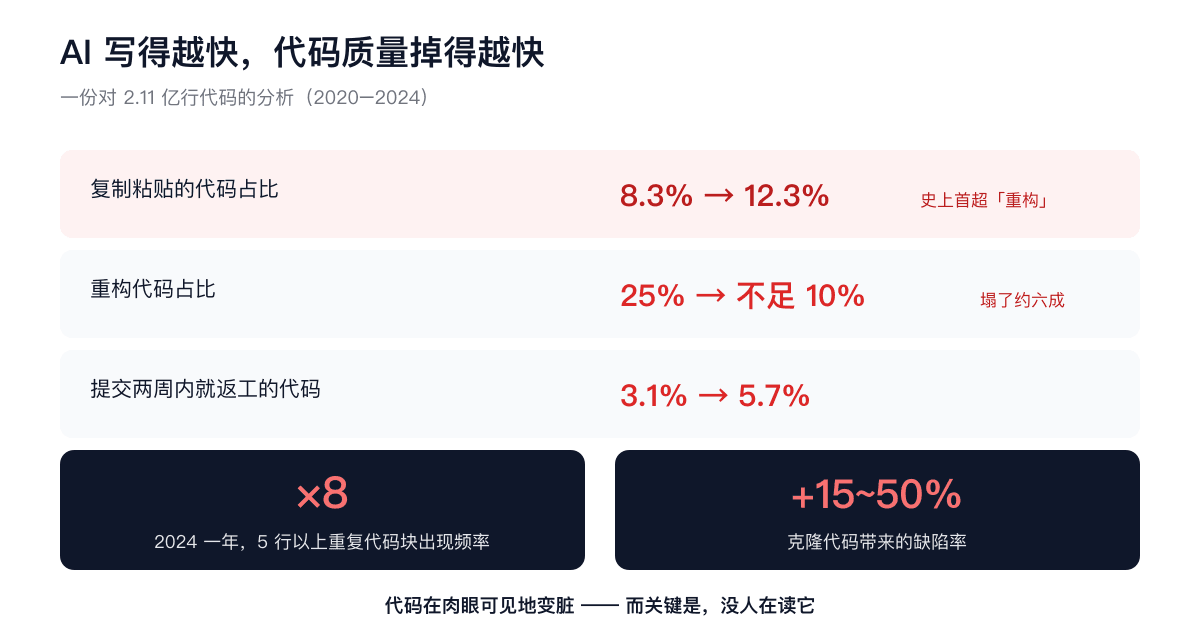
The proportion of copy-and-paste code increased from 8.3% to 12.3%-for the first time in history, copy-and-paste exceeded "refactoring." Refactoring, which is the matter of merging duplicate things into reusable modules, fell from 25% of the changes to less than 10%, a collapse of 60%. Code that needs to be reworked within two weeks of submission increased from 3.1% to 5.7%. In 2024 alone, the frequency of duplicate code blocks with more than five elements has increased eightfold.
Code is getting dirty at a rate visible to the naked eye. It doesn't matter where it is dirty, what matters is-- No one is reading it.
is out of control, not the code, but the "understanding"
It goes around the roots. Why did we use the most powerful tools and build a system that no one dares to touch?
Because AI only optimizes the prompt in front of you at a time. You ask it to add a login, and it writes the login properly, but it doesn't care how this login works with the rest of your entire system. Each function sheet looks reasonable, but when put together, the overall situation is chaotic-there are no module boundaries, no unified data model, and no general plan because no one has drawn it.
What's even worse is that it will snowball:
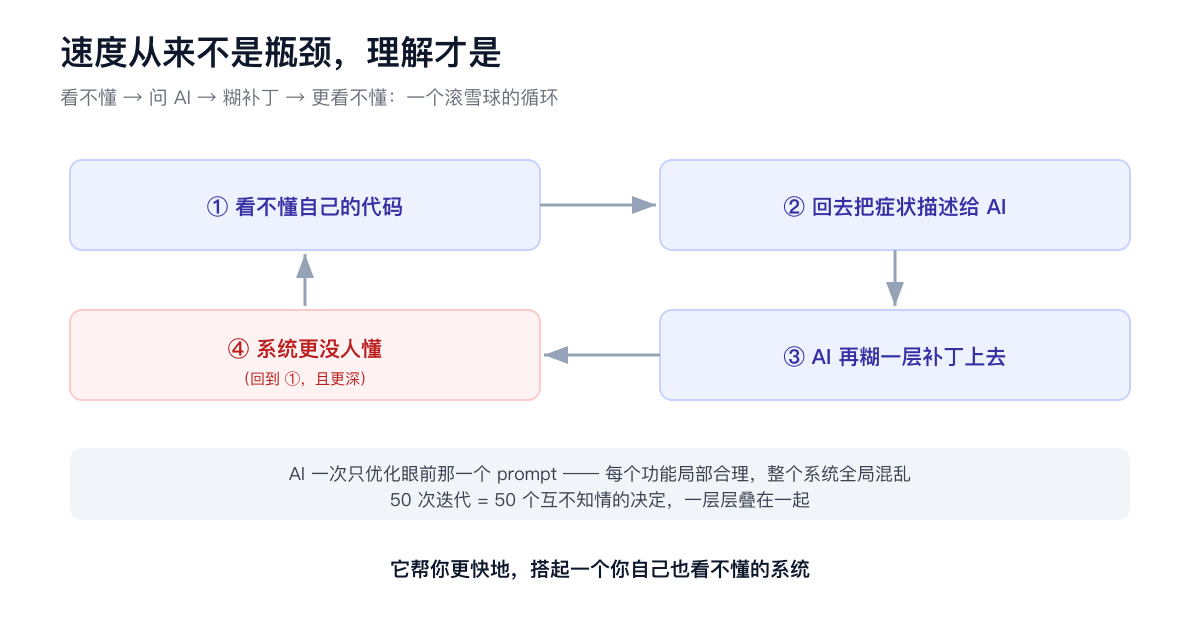
The founder couldn't understand the code of his app. When something broke down, he couldn't look at the code and find out the reason. He could only go back and describe the symptoms with the AI, and the AI would generate a patch to paste it. He couldn't tell whether the patch had really been repaired or whether a new mine had been buried. He would have to wait until the next mine exploded. After fifty such iterations, the structure of the code base is fifty uninformed decisions stacked one on top of another.
There is a very accurate saying: Vibe coding sometimes just helps you build a system faster than you can understand. Even Karpathy himself lamented that as a programmer, he had never felt that he had been so backward.
bill, due
This debt is not a virtual debt, it needs to be repaid with real money.
It is estimated that by mid-2026, more than 8,000 startups that use AI to quickly build products will need "partial reconstruction" or "rescue projects" to continue running. The price of cleaning up the mess is between 50,000 and 500,000 dollars-depending on how fragile the mess grows on the foundation. "Rescue Vibe coding code" has become a skill in job announcements, a new job that did not exist two years ago.
is a lesson that China entrepreneurs are in the middle
Nothing has been left behind in China. Statistics say that almost one-quarter of startups rely on AI to write code. There will only be more people with low code and making products without writing a line of code.
But the good news is that answers are emerging, and there is a saying that has been quoted repeatedly that I think is the key to the whole thing:
AI generation code is not a problem. Unstructured AI-generated code is the problem.
There are a few very practical ways to break it apart:
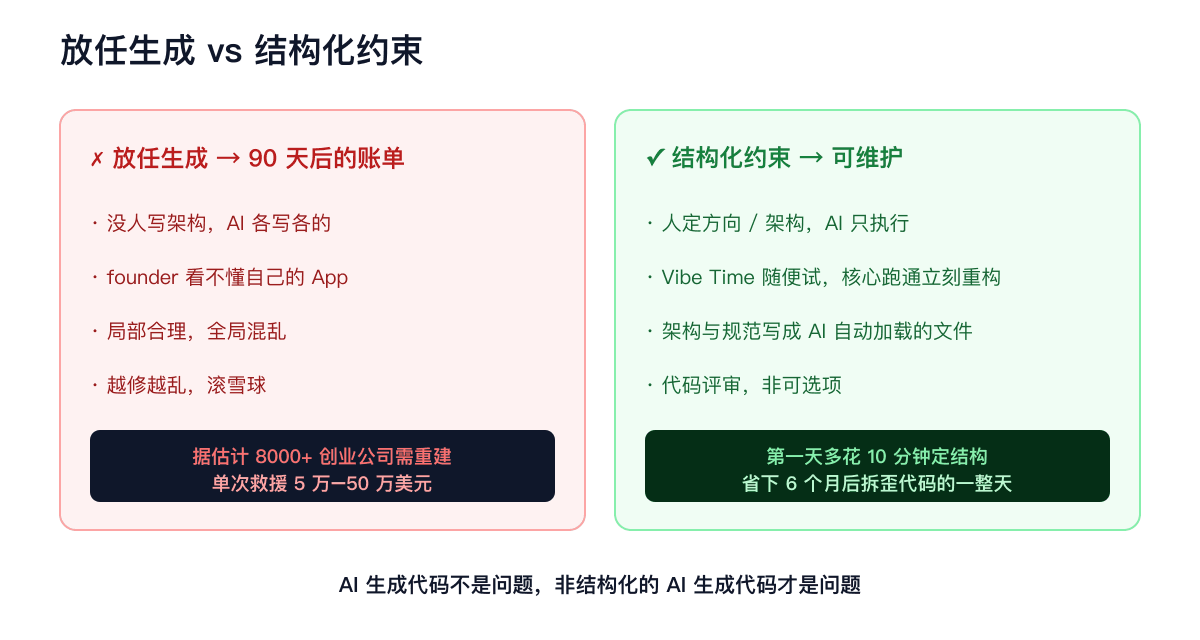
First, people are responsible for direction, and AI is responsible for implementation. Whether a function should be done, how to design the architecture, what debts are worth paying back-these are your job, and AI is not reliable on this; what you let it do is to realize what you have set.
Second, circle "write casually". A smart team will set aside a special period of Vibe Time, which will be tried and blurred at will; once the core logic is run out, it will immediately reconstitute and change the sketch to a regular army. Some teams even set up an experimental branch to program atmosphere, but to merge it back into the trunk, they must first go through strict cleaning.
Third, feed specifications to AI. Write the project's architecture, data structure, and code style into a file that is automatically loaded every time the AI starts, without you having to explain the background repeatedly-the number you are reading uses a CLAUDE.md. The cloud of some domestic major manufacturers has turned the software engineering specifications accumulated over the past decades into structured constraints that AI can read, verify, and execute, allowing developers to change from "people who write code" to "people who set specifications and command AI."
There is an account worth keeping in mind here: in traditional development, the cost of a change can be five or even hundreds of times that of the development period. You spend an extra ten minutes to define the structure clearly on the first day, and spending a whole day six months later tearing apart two sets of code that are already long and crooked. They are two completely different sums of money.
Last
Don't be afraid of AI writing code, it's so fast. But don't throw the entire steering wheel at it.
The core lesson of this atmosphere programming from 2025 to 2026 is actually very simple: Maintainability must be something you think about the first day, not something you can make up for in three months.
For those who can grasp the structure, control, and the bottom line of "I need to understand this", AI is ten times his leverage; and for those who hand over these things together, they will be waiting for him in front of him three months later., a bill of 50,000 to 500,000 dollars.
Whether this movement will end up as a dividend or a trap, the watershed lies between this idea.