After making 86.9 billion yuan in half a year, it only made 500 million yuan. How difficult is it to turn around?
In the first half of 2026, Digital China's revenue was 86.92 billion yuan, its net profit was 500 million yuan, and its overall gross profit margin was 3.25%. It is shifting from "selling other people's things" to "selling your own things." The revenue of its own brand computing power products has more than doubled year-on-year, which looks like a beautiful transformation report card. However, if we subtract the semi-annual report from the first quarterly report and calculate the second quarter into the single quarter, we will find that while revenue rushed from 1.886 billion yuan to 4.681 billion yuan, the gross profit margin dropped from 12.75% to 5.64%, which is a clear exchange of price for volume. On the R & D side, in the first half of the year, RMB 194.4 million, accounting for 0.22% of revenue. Revenue increased by 21.4%, while R & D only increased by 3.1%. Even if all R & D is included in new business, the intensity is only 2.34%. During the same period, Inspur Information's gross profit margin was 8.75%, up 4.20 percentage points year-on-year, relying on the upgrade of product structure. The absolute value is only one percentage point difference, but the direction is in the opposite direction. This article starts from its spin-off from Lenovo in 2000. It disintegrates a company with a distribution background and turned around under the AI wave. Where is it stuck?
This is a company with revenue of 86.9 billion yuan in half a year and a net profit of 500 million yuan.
86.9 billion and 500 million, there is a difference of 174 times.
This company is called Digital China. It is transforming itself from a company that sells other people's things to a company that sells its own things. In the first half of this year, revenue from its private-brand computing power products increased by 111.7% year-on-year, more than doubling. Judging from the growth figures, this is a beautiful transformation report card.
But I put its quarterly report and semi-annual report together, backcalculated the single-quarter data for the second quarter, and discovered something that I couldn't see in the summary of the report.
I want to start with this matter and talk about a bigger question: When the wave of AI comes, what is the difficulty for a traditional company to turn around?
1. First, find out what it used to do
To understand its predicament today, we must first understand how it has been through the past 20 years.
In 2000, Lenovo Group was divided into two. Liu Chuanzhi handed the Lenovo piece to Yang Yuanqing and the other piece to Guo Wei, named it Digital China, which was called Digital China in English. The following year, the company was listed in Hong Kong.
What is this division of business? IT distribution.
The saying is: Foreign manufacturers such as HP, Dell, and Cisco want to sell products in China, but they themselves do not cover the county's sales network. Digital China does this intermediate link, taking goods in batches from manufacturers and distributing them to tens of thousands of dealers across the country to earn the middle price difference. At the same time, it also undertakes the work of pressing goods and advancing funds.
This business has two characteristics. By understanding these two points, you can understand everything else.
First, the scale can be extremely large, but the profit per order is very small.
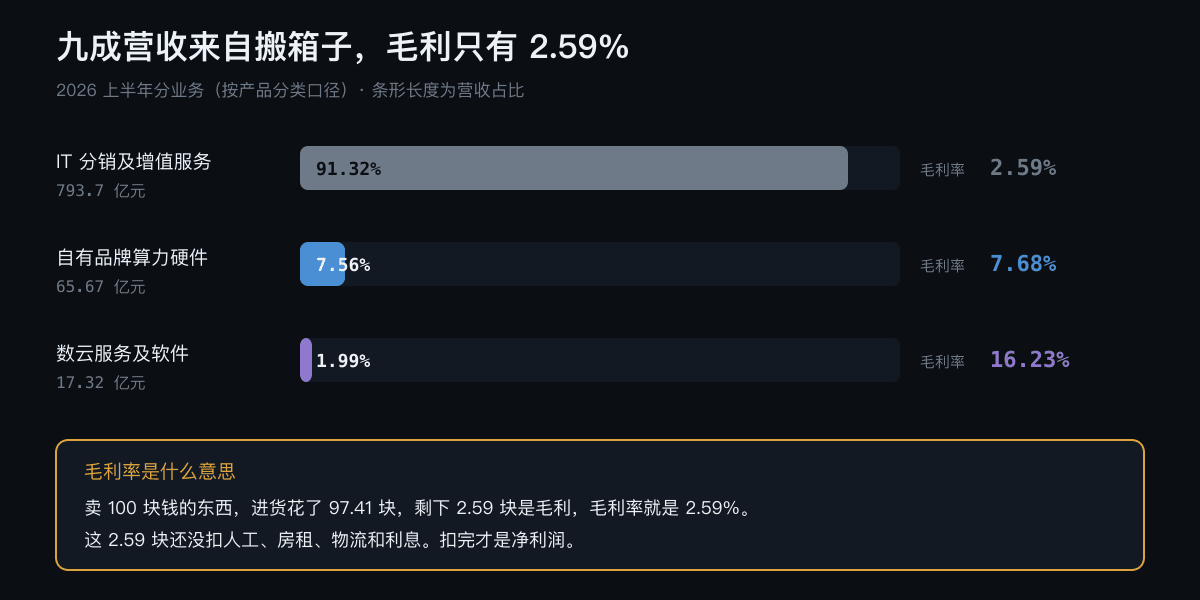
In the first half of this year, its IT distribution and value-added services business generated revenue of 79.37 billion yuan, accounting for 91.32% of the company's total revenue. But the gross profit margin of this business is only 2.59%.
The word gross profit margin explains: You sell something for 100 yuan and spend 97.41 yuan on the purchase. The remaining 2.59 yuan is the gross profit, and the gross profit margin is 2.59%. Note that this 2.59 yuan has not been deducted for labor, rent, logistics, and financial expenses. Only after deducting will the net profit be obtained.
So you will see that the company's overall gross profit margin is only 3.25%, and the net profit margin is 0.6%.The revenue of 86.9 billion yuan was only 500 million yuan, which is how it came about.
Second, the core capability of this business is capital turnover, not technology.
What are the most important skills of a distributor? It is possible to get good accounting terms from manufacturers, to quickly spread goods without backlog, and to collect dealers 'arrears on time. It focuses on turnover efficiency and capital cost, and has little to do with the words R & D, products, and technology.
This is particularly critical and will be used repeatedly in the future.
2. It has been trying to turn around, and it has been turning around for more than 20 years.
What's interesting is that the company realized the ceiling of the distribution business early on and has been looking for a way out. The following nodes are from public information:
In 2002, he proposed "IT Serving China" and wanted to shift from selling products to making services.
In 2013, the IT services business was packaged into Shenzhou Information and listed on A-shares through a backdoor.
From 2015 to 2016, a bigger move was made: the distribution business was spun off from Hong Kong stock companies and incorporated into A-shares. Trust Taifeng, which is today's Digital China (000034).The idea at that time was that the Hong Kong stock company should transform into the Internet and cloud, and the A-share company should focus on distribution.
In 2017, we acquired Yunjiao and began to fully shift to cloud computing.
In 2020, Shenzhou Kuntai was established to make its own brand servers and terminals based on Huawei Kunpeng and Shengteng Ecology, catching up with Xinchuang.
In 2022,"digital cloud integration" will be proposed.
After 2024, AI computing power has increased, and subsidiaries have begun to win bids for large orders from operators 'smart computing centers.
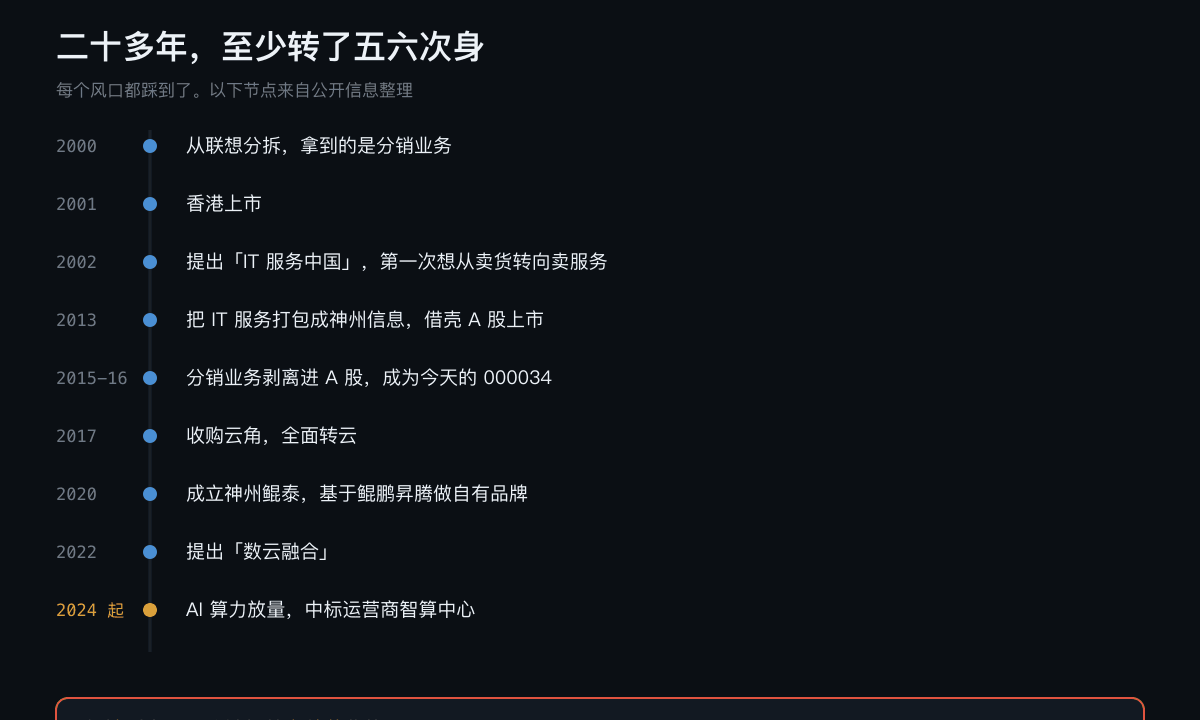
If you count it, it has turned around at least five or six times in more than 20 years, and every time it stepped on the wind at that time: IT services, cloud computing, Xinchuang, and AI computing power, none of them fell behind.
But today, distribution still accounts for 91.32% of its total revenue.
This number in itself says a lot. It saw the direction and invested the money. Turning around is itself difficult.
3. This AI transformation, the report card looks good
On the bright side, the data is real.
First half of 2026:
Private brand computing infrastructure products, revenue was 6.567 billion yuan, a year-on-year increase of 111.7%, more than doubling. Digital cloud services and software generated revenue of 1.732 billion yuan. The two pieces add up to 8.3 billion yuan, a year-on-year increase of 74.9%.
This growth rate is quite eye-catching among A-shares. Moreover, the gross profit margins of these two businesses are indeed much higher than those of distribution: private brands are 7.68%, digital cloud software is 16.23%, and distribution is only 2.59%.
Structurally, this is moving in the right direction: the proportion of low-margin box-moving businesses is declining, and high-margin proprietary products and software are rising.
If you only see this, the story is complete: an established distributor successfully entered into AI computing power, and the second growth curve has emerged.
But I am used to taking quarterly data apart.
4. Separate the second quarter, the situation is different
The semi-annual report of a listed company is the cumulative number, and the quarterly report is also the cumulative number. Subtract the quarterly report from the semi-annual report to get the true situation of the second quarter.
I calculated the private brand computing power hardware:
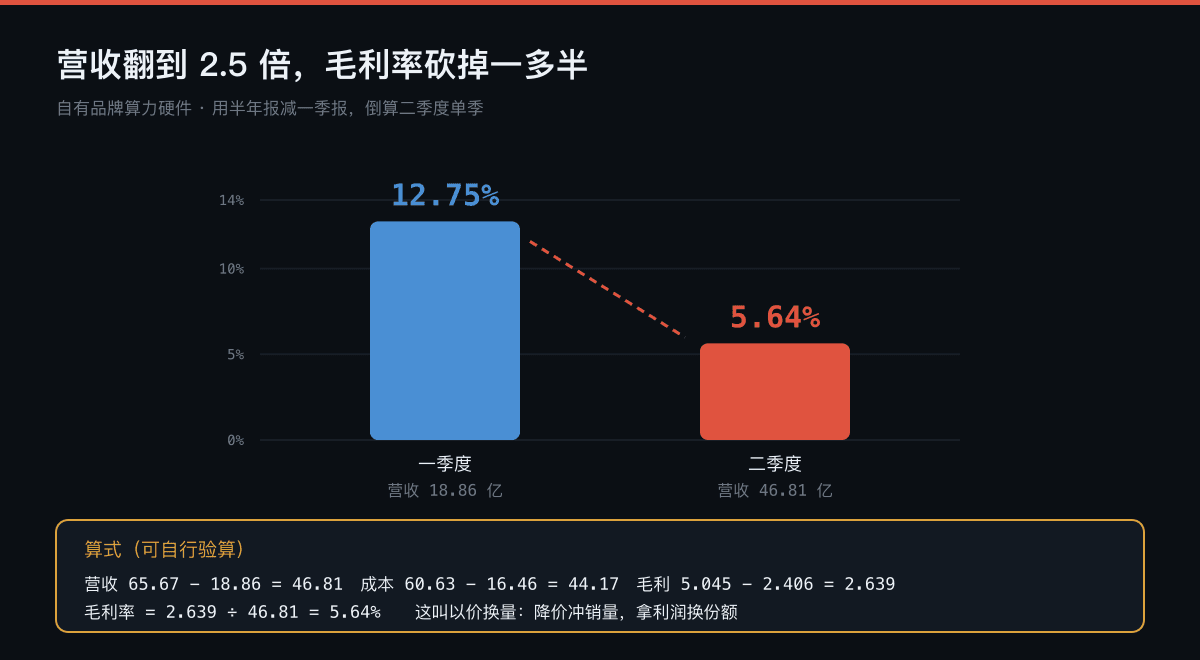
First quarter: Revenue was 1.886 billion yuan, costs were 1.646 billion yuan, gross profit was 240.6 million yuan, and gross profit margin was 12.75%.
Cumulative in the first half of the year: revenue was 6.567 billion yuan, costs were 6.063 billion yuan, gross profit was 504.5 million yuan, and gross profit margin was 7.68%.
So the second quarter: Revenue = 65.67 − 18.86 = 4.681 billion Cost = 60.63 − 16.46 = 4.417 billion Gross profit = 5.045 − 2.406 = 263.9 million Gross profit margin = 2.639 ÷ 46.81 = 5.64%
Put these two quarters together:
Revenue rushed from 1.886 billion yuan to 4.681 billion yuan, 2.5 times that of the first quarter. The gross profit margin dropped from 12.75% to 5.64%, cutting more than half.
There is a popular saying for this combination, it is called price for volume: in order to increase sales, actively reduce prices and exchange profit margins for market share.
I also used the same method to calculate the number of cloud software: 17.37% in the first quarter and 15.24% in the second quarter, a slight decline and basically stable.
So the problem is concentrated on the hardware side.
By the way, this quarter can be regarded as the basic actions of transformation companies. The summary of the semi-annual report says "doubled revenue", but at what price the doubling will be achieved, you have to calculate yourself.
5. R & D investment: The real number is much smaller than imagined
The most common explanation for the low gross profit margin is that the product lacks technical content. That depends on R & D investment.
According to the financial report, R & D expenses in the first half of 2026 were 194.4 million yuan, accounting for 0.22% of operating income.
Don't rush to say this number is low yet. The distribution business does not require R & D. It is unfair to this company to use the total revenue of 86.9 billion yuan to calculate the R & D proportion. The real question is: how much is it investing in new business.
The problem is that the financial report does not separately disclose the R & D expenses of sub-businesses. So I changed the algorithm:
Suppose that all R & D expenses are counted as investment in new business, without leaving a penny.
Total new business revenue = 65.67 + 17.32 = 8.299 billion yuan R & D intensity = 1.944 ÷ 82.99 = 2.34%
This is an upper limit.The actual number will only be lower than that, because the system operation and maintenance and technical support of the distribution business also account for a part.
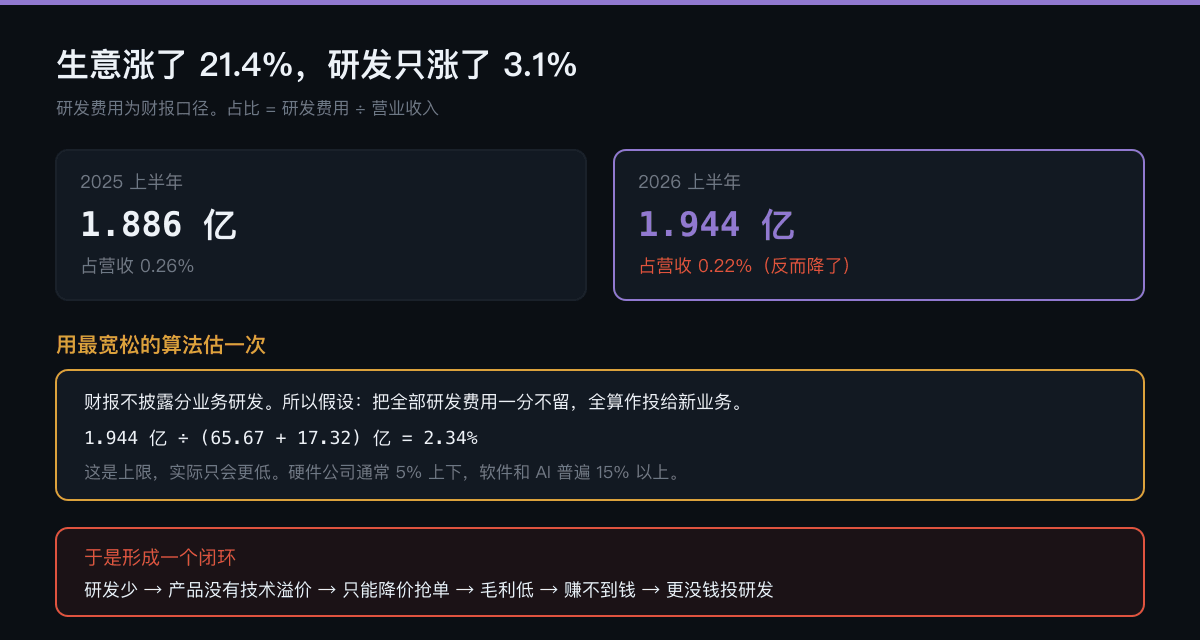
What level is 2.34%? For companies that make hardware, R & D accounts for about 5% of revenue; for companies that make software and AI, it generally accounts for more than 15%. With the most relaxed algorithm, it only reaches less than half of others.
There is another number that is more telling. Year-on-year:
Revenue increased by 21.4%, and R & D expenses increased from 188.6 million to 194.4 million, an increase of only 3.1%. The proportion of R & D in revenue dropped from 0.26% in the same period last year to 0.22%.
Business is growing rapidly, and R & D investment is basically stagnant.
A closed loop is formed here: less investment in R & D → lack of technical premium for products → can only rely on price cuts to grab orders → low gross profit margins → no money to invest in R & D.
6. Compared with peers, the difference lies in the direction
Many people will directly compare Digital China's private brand gross profit margin of 7.68% to Inspur and Shuguang. This comparison is not rigorous, so I have to make it clear first.
Inspur Information's gross profit margin for the first half of 2026 was 8.75%, and Zhongke Shuguang was 27.23%. These two are the company's overall gross profit margins.Digital China's 7.68% is the gross profit margin of a certain business segment, while the company as a whole is only 3.25%.
Using other people's overall business to compare yourself with your best business is already telling the problem.
However, Inspur has one particularity: its main business is making servers, so its overall gross profit margin can roughly represent the level of server business. This is more fair.
The result may be different from intuition: 7.68% versus 8.75%, only 1 percentage point difference.
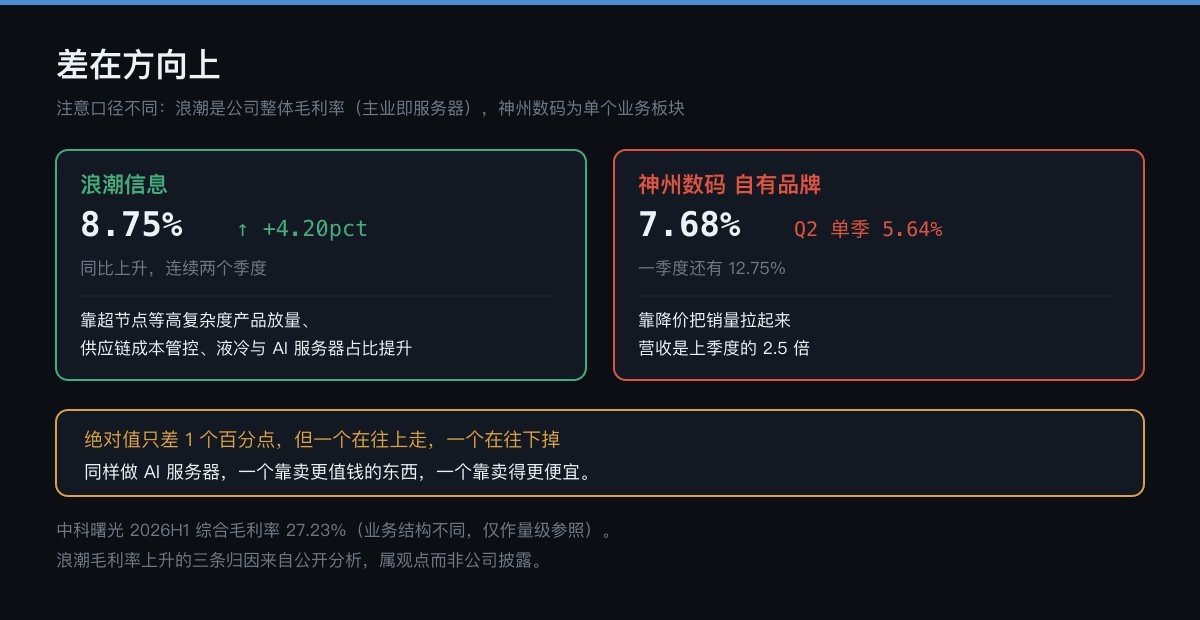
But the direction is the opposite.
Inspur's gross profit margin increased by 4.20 percentage points year-on-year, and it has increased for two consecutive quarters.Public analysis attributed the reasons to three reasons: increased volume of highly technically complex products such as supernodes, supply chain cost control, and increased proportion of high-margin products such as liquid cooling and AI servers.
Translation into plain Chinese: It increases the gross profit margin by selling more valuable things.
Digital China dropped from 12.75% to 5.64%, relying on price cuts to boost sales.
Similarly, when making an AI server, one goes up and the other goes down. This difference is much more important than the absolute value of 1 percentage point.
7. Why is this? The specific meaning of the word gene
Here we have to answer the core question: It's not that it doesn't work hard, why can't it do it well?
I don't think it's a team ability issue. The more fundamental reason is that distribution business and technology product business are two completely different operating logics, and it is difficult for a company to install both logics at the same time.
It is specifically reflected in four places.
First, the assessment cycle does not match.
What is the assessment for distribution business? Inventory turnover days, accounts receivable recovery, capital occupation efficiency. These indicators will be effective immediately when viewed on a monthly and quarterly basis.
What is the assessment for technical products? It takes two to three years for R & D investment to see output, and it takes five to ten years for brand recognition to be established.
Using the KPIs that manage distribution to manage new business, the result is almost doomed: the team will choose to scale it first, because the scale can be balanced in this quarter, and the technology accumulation can be balanced in three years. Price reduction impulse is the most rational choice under this assessment logic.
Second, the ability requirements are completely different.
Distribution strives for channel coverage, capital costs, and turnover efficiency. Private brand hardware focuses on chip selection, heat dissipation design, complete machine tuning, and supply chain bargaining. Software strives for productization capabilities, standardization levels, and whether it can sell a set of codes to 100 customers.
The latter two rely on long-term technical accumulation and talent density, which is exactly what the distribution business has not needed for more than 20 years.
Third, the left and right hands fight against each other.
This is rarely mentioned, but it has a great impact. Digital China is also an agent for several major international and domestic manufacturers, and is also making its own Kuntai brand. These two things conflict naturally.
If private brands sell too hard, it will impact the sales of agency brands and may affect the relationship with upstream manufacturers; and agency business is the basic source of 91% of its revenue and cannot be moved.
As a result, private brands dare not go to the high-end and can only find space in the mid-to-low-end market. The mid-to-low-end market is precisely the place with the least pricing power and the most price competition.
Fourth, resources will always be given priority to cash cows.
The distribution business contributes the vast majority of revenue and cash flow and is the company's lifeblood. In terms of funds, manpower, and management attention, it will always rank first. As the "second curve", new business naturally has limited resources.
Moreover, distribution is a capital-intensive business, with a large amount of money resting on accounts receivable and inventory. In the first half of this year, the company's net cash inflow from operating activities was-635 million yuan, a year-on-year decrease of 1.140 billion yuan. The money must first ensure the turnover of distribution plates, and the amount that can be used for long-term R & D investment is less than it appears on the report.
The conclusion of these four points is that new business does not "grow" within the company, it must first confront the original operating logic.
8. This is not a company's problem
I am writing this not to say that Digital China is not doing a good job.
On the contrary, it may be the one with the hardest transformation among traditional IT companies. For more than 20 years, every outlet has been seized, and the organization has been adjusted. This round of AI growth has indeed been achieved.
The difficulties it encounters are those that all traditional companies will encounter under the AI wave:
The way you made money and the way you wanted to make money require two completely different sets of abilities, assessments and cultures. The former is still supporting the entire company, and you can't stop.
It's like changing tires on the highway.
Judging from public cases, this kind of transformation usually has several things in common:new businesses are truly independent in organization , have their own assessment system, their own talent standards, and even their own office location;the top leader takes charge of it personally, because only the top leader can suppress the competition for resources from old businesses;give a long enough assessment exemption period and no need to memorize scale indicators for at least three years;admit that new businesses will lose money in the early stage and treat it as investment rather than business.
None of these matters sounds difficult, but each of them conflicts of interest with old businesses.
9. What to focus on in the future
If you want to continue to track the transformation of this company, I think there are four indicators that are much more useful than revenue growth:
First, whether the single-quarter gross profit margin of private brands can stop falling and recover. This is the most direct signal. If it continues to fall, it means that the price is still being exchanged for shares; if it starts to rise, it means that the product is beginning to have premium capacity.
Second, can the growth rate of R & D expenses exceed the growth rate of revenue? Currently, revenue is +21.4% and R & D +3.1%. Only when this relationship is reversed shows that they are really betting on technology.
Third, the proportion and gross profit margin of digital cloud software business. Software is the one that best reflects productization capabilities. Currently, this piece accounts for less than 2% of revenue, and the gross profit margin is 16.23%. If the proportion can increase and the gross profit margin can go above 25%, it means that productization has really been achieved.
Fourth, operating cash flow. It is normal to burn money during the transition period, but long-term negative cash flow will limit all possibilities.
These four indicators can be read in the financial report every quarter and you don't need to listen to anyone's story.
Last
There is one detail in this company's story that impressed me deeply: When it was separated from Lenovo more than 20 years ago, it received the business of "selling other people's products." More than 20 years later, what it wants to do is essentially "sell its own products."
This is equivalent to changing the identity he gave him when he separated his family.
The difficulty does not lie in whether you have money or whether you see the direction. The difficulty is that a company's capabilities, assessments, culture, and customer perceptions have been developed day by day over the past two decades. It is impossible to replace them in three years with a strategic plan.
The wave of AI will give many traditional companies similar opportunities and similar problems. Whether we can seize it or not depends on who is really willing to give a different set of rules to new business, and has little to do with the speed of response.
A few sentences
All financial data in this article comes from the regular reports of listed companies, including the 2026 semi-annual report and the first quarterly report. I calculated the single-quarter data for the second quarter by subtracting the semi-annual report from the first quarterly report. The formula has been written in the main text and you can check it yourself.
The division of R & D expenses by business was not disclosed in the financial report. The 2.34% in the article isan estimate of the upper limit forcalculating all R & D expenses to new business. The actual value is even lower, as explained in the main text.
In the peer comparison section, the gross profit margins of Inspur Information and Zhongke Shuguang are the company's overall caliber, which is different from Digital China's sub-business caliber. This difference has been explained in the main text. A considerable part of Zhongke Shuguang's profits come from investment income, so only gross profit margin is used as a reference.
Part of the historical evolution comes from the collation of public information, not financial reporting level facts.
The three reasons for the increase in Inspur's gross profit margin come from public analysis and are opinions rather than company disclosures.
This article is a structural analysis of a company's transformation path and does not constitute any investment advice and does not involve stock price judgment.