The new domestic model said that writing code exceeded Claude, but I really adjusted it again.
Kimi K3, GLM-5.2, and DeepSeek-V4 collectively claim to be the best in coding and surpass Claude. Today, I directly adjusted their APIs and used two real programming questions with traps to actually run and test them for verification. Result: The ability is really tied (all full marks), but the speed and usability are far behind (GLM-5.2 free channel restriction or timeout, K2.7-code 57 seconds, Kimi K3 is fast and right).
Recently, domestic large models have been collectively screened. Kimi K3, currently the largest open source model;GLM-5.2, which is commercially available under MIT license; and DeepSeek-V4, each of which claims to be the most powerful in coding capabilities, surpassing GPT and Claude in some aspects.
The rankings are good. But anyone who has done development knows that ranking points and "whether real code is easy to use" are two different things. So I didn't look at the list, just adjusted their APIs, took two real programming questions with traps, and let them actually run them over, compared them with Claude's questions, and then ran test cases to verify right and wrong. Today (August 1st) was the real tune, and the result was firsthand.
Let's talk about ability first. The conclusion is: it really tied.
The first question I asked was to parse the time-length string (convert "1h30m" to 5400 seconds), which buried eight boundary traps: wrong order, duplicate units, pure numbers without units, negative numbers, unknown units, spaces, capitals... a total of 19 test cases. Results:Kimi K3, DeepSeek-V4-Pro, Smart Spectrum, and Claude all scored 19:19. Kimi's programming special version K2.7-code is one missing. The only thing wrong is that it proactively removes the front and back spaces (it's more forgiving, but it's not wrong).
The second question is a bit more elaborate. Comparison of version numbers (which is bigger than "1.2.10" and "1.2.9") contains several pitfalls such as leading zeros, different number of paragraphs, comparison by numerical values, and not by character strings. The codes given by Kimi K3 and DeepSeek-V4-Pro are almost exactly right as Claude.
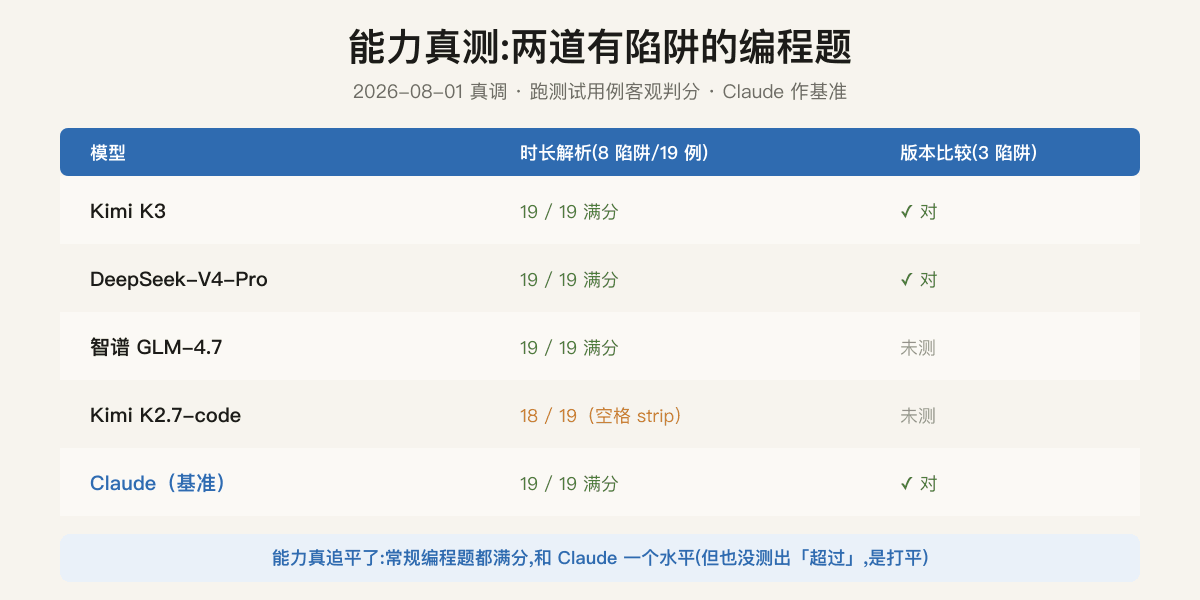
Therefore,"domestic model coding has caught up with the first echelon", not in marketing terms, but in my actual measurement, it has indeed tied up. These types of programming questions with clear right and wrong are on the same level as Claude, and the answers are correct and concise.
But I have to be honest: I didn't find out which one "outperformed" the other in these two regular questions. Everyone is right and concise. It is a draw, not a crush. To really distinguish between the best and the best, you have to take extremely difficult questions; but for most people's daily programming, this level is enough, and it is no different from Claude.
The truly valuable discovery is in the second part: the ability is equalized, but the speed and usability are far behind. This is something the rankings won't tell you.
Let's start with GLM-5.2. It is the brightest and highest-profile one in this Poli coding list that calls "more than Claude". But when I really adjusted it, the official interface of Smart Spectrum directly reached 429, which limited current; and when I changed the free access point of the volcano, I waited for two minutes, but not a word came out. No matter how high the score is, you won't use free channels at all. I retreated and adjusted glm-4.7, which can be connected to by Smart Spectrum, with a full score of 38 seconds, which means that Smart Spectrum's modeling capabilities are online. However, the 5.2, which is a popular 5.2, is something that ordinary developers want to use for free.
DeepSeek-V4-Pro, the answer is correct, but it is a "think first and answer" reasoning model. It takes more than 20 seconds to think about a question. Kimi's special programming version K2.7-code, that's right, but a simple question takes 57 seconds, which is more than twice as slow as the generic K3.
The best comprehensive one in this round is the Kimi K3, which is more than ten to twenty seconds. It is fast and right, and its API is also stable.
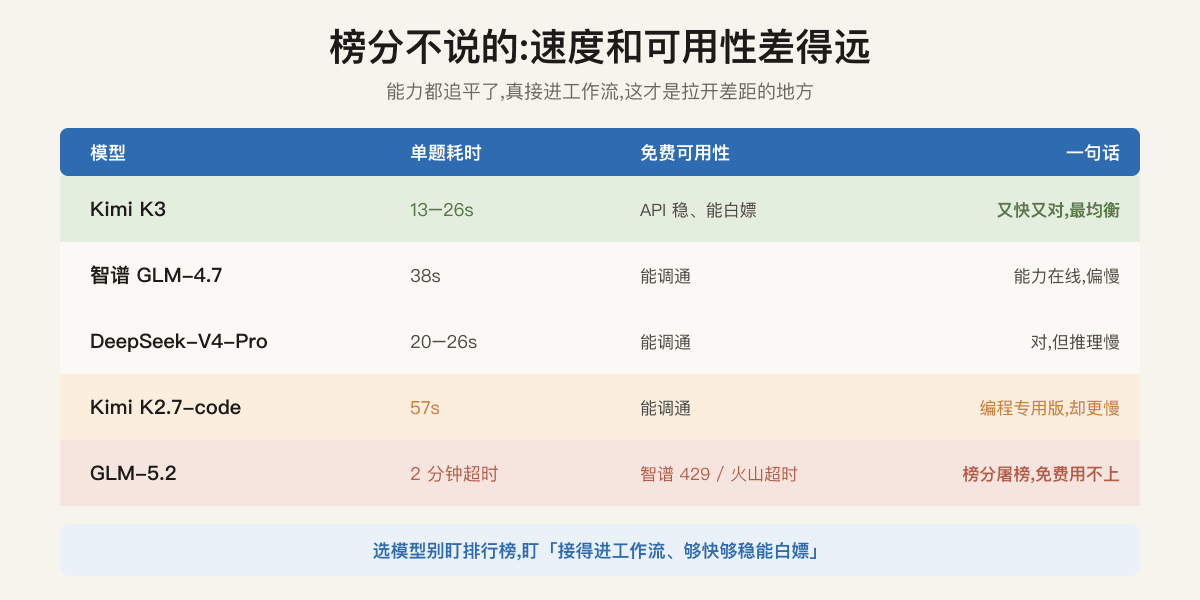
So give a word of truth to developers who want to choose models: Don't use lists to sort models.
At the level of capabilities, these domestic models are all tied up, and the difference is a few points on the list. You can't feel it when you enter the daily workflow. What really determines whether you enjoy using it is a few other things that don't appear on the list: whether the acceptance is fast and stable, whether the free quota is enough, whether the current will be restricted frequently, and how much it costs. The GLM-5.2 list scores but cannot be adjusted for free. Kimi's K3 list score may be half a point lower but it is fast, stable and can prostitute for free. Which one do you choose? Anyone who has done projects knows to choose the latter.
The list is for the press conference, and your workflow is the real test room. These new domestically produced models are worth getting started, but don't focus on the hype of "surpassing Claude", but focus on "enough, fast enough, stable enough, and able to prostitute for nothing." It's much more practical to pick someone who can really get into your life than to pick someone who is number one on the list.