Free large models to write long articles, the longest one is 8 times more than the shortest one
Let the free model write something longer, either breaking in half a sentence or wrapping it up quickly. I always thought max_tokens was not enough. This time, the same question and the same 8000 token budget tested 8 models: Mistral wrote 13785 words and was truncated. GLM-4-Flash only wrote 1598 words and stopped by itself. The difference was 8.6 times. Two counterintuitive things were detected: Groq and Cerebras ran the same model 2.3 times worse, and the thinking model ate 40 percent of the budget first.
If you ask a free big model to write longer things, you will have a high probability of encountering two situations: either you write and break it in half a sentence, or you will finish it hastily, obviously asking it to write six paragraphs, but it will write three paragraphs. Say,"That's all."
I always thought this was because max_tokens didn't give enough. This time, I found that it was not all true.
The measurement method is very simple: for the same question and the same parameters, let each of the eight free models write it again.
The title is "Write a complete guide to selecting a notebook computer, divided into 6 parts, each part of which is at least 300 words, and do not omit it when writing it in one go." As required, the qualified answer must be at least 1800 words. max_tokens is uniformly given to 8000, which means that the budget is enough. Whoever writes more and writes less depends on himself.
The result was 8.6 times worse.
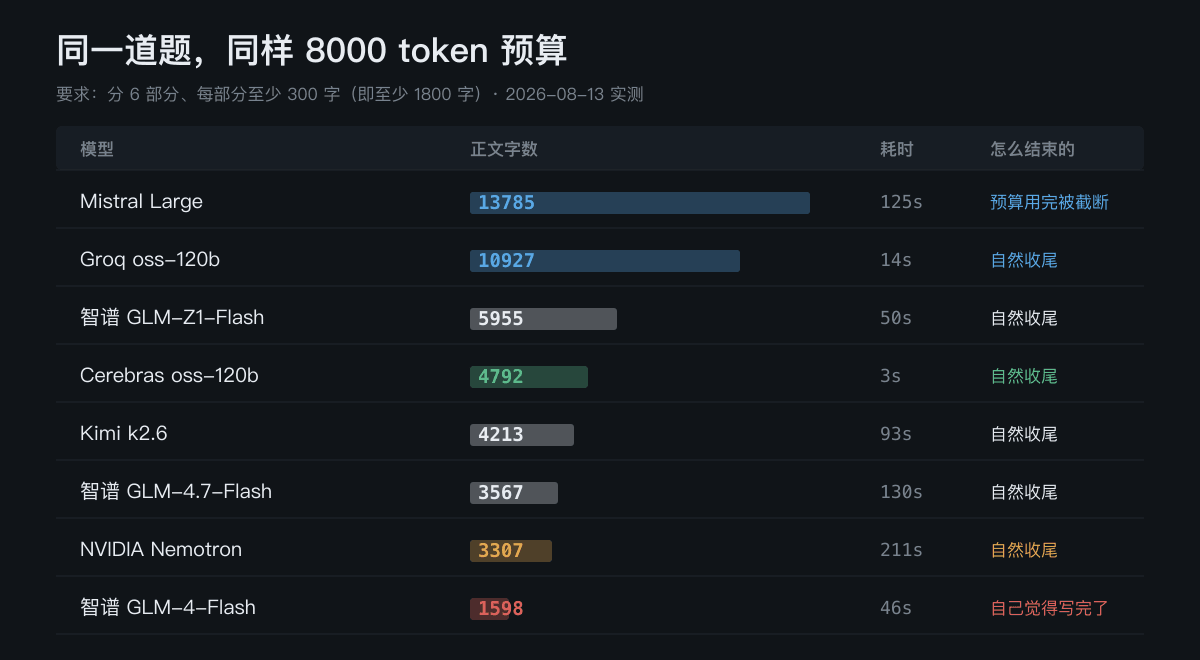
from 13,000 to 1,600
| model | Text words | time-consuming | How did it end? |
|---|---|---|---|
| Mistral Large | 13785 125 seconds Budget runs out and cuts off | ||
| Groq oss-120b | 10927 | 14 seconds | natural ending |
| Smart Spectrum GLM-Z1-Flash | 5955 | 50 seconds | natural ending |
| Cerebras oss-120b | 4792 | 3 seconds natural ending | |
| Kimi k2.6 | 4213 | 93s | natural ending |
| Smart Spectrum GLM-4.7-Flash | 3567 | 130 seconds | natural ending |
| NVIDIA Nemotron | 3307 | 211 seconds natural ending | |
| Smart Spectrum GLM-4-Flash | 1598 46 seconds natural ending |
The longest Mistral writing of 13785 words has not yet been completed, but was cut off by the 8000 token budget. The shortest GLM-4-Flash wrote 1598 words and then stopped by itself.
Pay attention to the difference between the two, this is the most important point in this test.
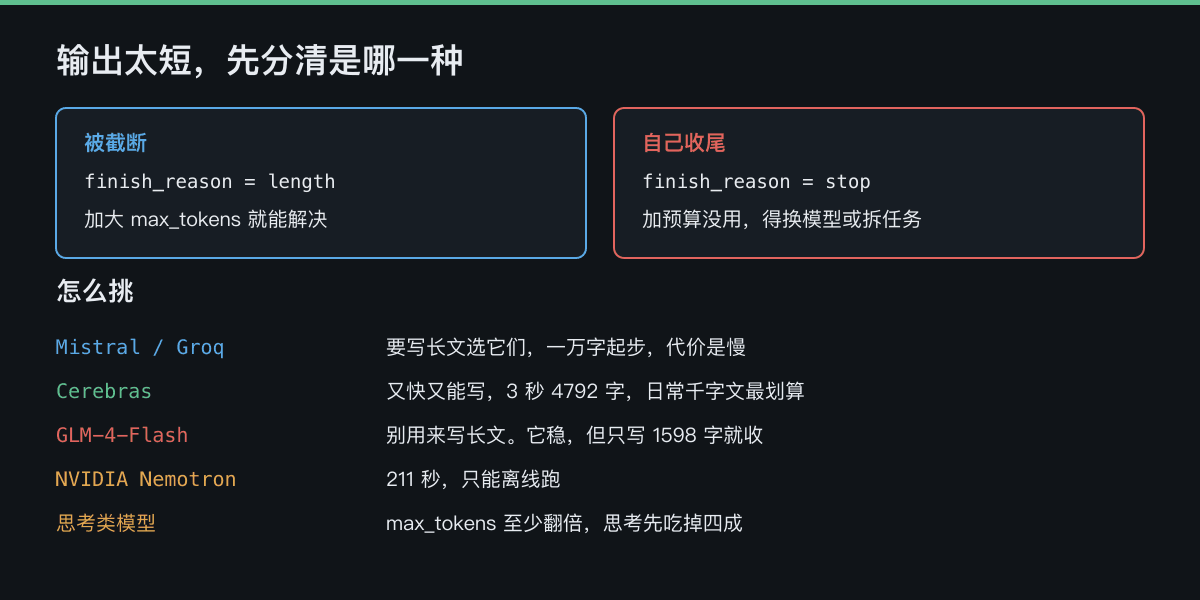
Mistral said "I still want to write, but the budget is gone", finish_reason returns to length. This situation can be solved by adjusting max_tokens larger.
GLM-4-Flash means "It feels like it's finished writing", finish_reason returns to stop, only 846 tokens were used, leaving a budget of more than 8,000. It won't work if you adjust max_tokens to 100,000, it just won't be written.
The task requires six parts, each of which is at least 300 words, which is at least 1800 words. It submitted 1598 words. It didn't meet the standards, but it thought it was done.
Therefore, there are two completely different causes of "too short output", and the corresponding solutions are also completely different:
It is truncated to see if finish_reason is length, so it will increase the budget.
Finish it yourself. finish_reason is stop. It is useless to increase the budget. You can only change the model or break the task into several calls.
In my previous article, I attributed empty returns to max_tokens being eaten up by thoughts, and that was right. But let me add this time: Even if the budget is sufficient, the model may not be written enough, which is another matter.
is the same model, but the difference is 2.3 times when changing platforms
This was something I didn't expect at all.
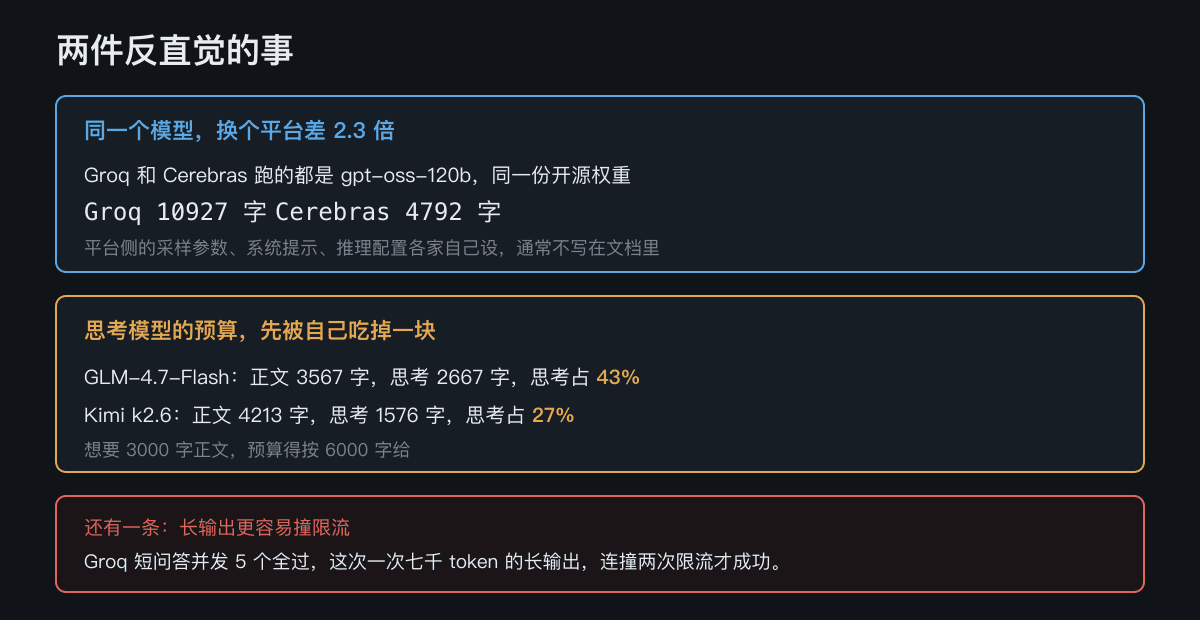
Groq and Cerebras run the same model, gpt-oss-120b, with the same open source weight.But the output length is 10927 to 4792, a difference of 2.3 times.
The time taken is also ridiculously short: Cerebras 3 seconds, Groq 14 seconds. Groq, however, wrote twice as much, spreading it out on both sides of each word very quickly.
The same weight, the same topic, the same max_tokens, the result difference is so much, can only be the difference on the platform side: default sampling parameters, system prompts, inference configuration, these can be set by themselves, and usually not written in the document.
The actual meaning of this sentence is: "I use XX model" This sentence has a limited amount of information in the world of free APIs. The same model name is different on different platforms. The performance you measure on a certain platform may not hold true at all.
Thinking Model Budget, Half of Its Budget Was First Eat by Yourself
For the two models with thinking, the accounts must be calculated separately.
Wisdom GLM-4.7-Flash: The main body is 3567 words, but before that it thought about 2667 words.The two parts add up to the output budget it really consumes, with thinking accounting for 43%.
Kimi k2.6: The main text is 4213 words, and the thinking is 1576 words, with thinking accounting for 27%.
What does this mean? If you set the max_tokens to 2000 for GLM-4.7-Flash, it can use nearly half of it just thinking, and the rest won't be enough to write a few paragraphs. You think you gave a writing budget of 2000, but you only got a little over 1,000.
This also explains why thinking models generally suffer from long-term tasks: a piece of the budget is cut away, and less is written before it starts.
Incidentally, the thinking processes of these two models are placed in different fields. GLM-4.7-Flash is placed in reasoning_content, and content is a clean text; while another reasoning model of Intelligraphy, GLM-Z1-Flash, mixes thoughts in content and wraps them with the <think> tag, which has to be cut off by itself. The return structures of the two models in the same house are different.
long output makes it easier to hit current limiting
There is another detail worth remembering.
I adjusted Groq three times in this round before I was successful. The first two times I returned to rate_limit_exceeded. In my previous test, Groq was not restricted to issuing five short questions.
The difference is the output length. Its current limit is calculated based on tokens. A long output of 7,000 tokens is equivalent to dozens of short Q & A times. If you estimate the amount according to "how many requests can you send per minute", you will make an outrageous mistake when encountering long-term tasks.
Therefore, when doing long-text batch tasks, retry logic is more important than short tasks, and enough backoff time must be given.
How to choose
Based on the data this time, my division is as follows.
To write a long article, choose Mistral or Groq. One can write to 13,000 yuan and has not stopped, and the other can finish naturally in the early 10,000 yuan. The price was slowness. Mistral took 125 seconds.
Cerebras is the only solution to write fast and quickly. 4792 words come out in 3 seconds, and there is no second word in this combination list. Writing a thousand-word document every day is the most cost-effective.
GLM-4-Flash should not be used to write long texts. This is a bit awkward for me to say, because in my previous article it was the best success rate of the bottom-up model (25,000 calls, 98.2%). It is indeed stable, but stability and being able to write long are two different things. It is suitable for making fuses for high-frequency and short-task tasks, but not suitable for making it write something in one go.
NVIDIA Nemotron can only run offline. 211 seconds. Any scene where someone is waiting in front of you cannot be used.
When writing long articles using the thinking model, the max_tokens will at least double. Based on a 43% thinking ratio, if you want 3,000 words of text, you will have to provide 6,000 words in the budget.
The boundaries of this test
I only tested one question and called it once. The output length of the model itself is random, and the numbers will vary if you run the same question again, especially for the "finishing yourself" stage, where the fluctuations will be greater than the "truncated" stage.
The type of topic can also affect the results. This is a clearly structured explanatory text. If it is changed to open writing or code generation, the ordering is likely to be different.
Volcano's GLM-5.2 was not detected this time, and its account was in arrears and stopped serving. This in itself is a reminder: the availability of free models can change at any time, and it was still on the surviving list in the previous article.
Finally, all numbers were measured on August 13, 2026. The default parameters of each platform are changed without any sound, and the shelf life of this table is also calculated in weeks. If you really want to use it, you can run it through your real task yourself.