The fastest free model from 8 days ago starts charging today
I tested 21 free large model entrances eight days ago. The fastest one at that time was gpt-oss-120b on Cerebras, 593 milliseconds, and I recommended it as my first choice. Run the same script again today, and it returned "Payment required to access this resource". Another entrance at Cerebras is even more straightforward, and models have been archived. The top one is Groq, 545 milliseconds, becoming the new fastest, and it runs exactly the same model. One more thing: my script in the first round declared these two clear deaths "empty returns" for reasons worth taking a look at by anyone doing usability monitoring.
Eight days ago, I tested 21 free large model entrances and wrote an article saying that 9 of them were available at the time. The fastest one in that article is gpt-oss-120b on Cerebras, 593 milliseconds, and I definitely recommend it as my first choice.
Today, I took the same script and the same question and ran it again.
The entrance of Cerebras now returns this sentence:
Payment required to access this resource. Visit your billing tab.
There is a payment.
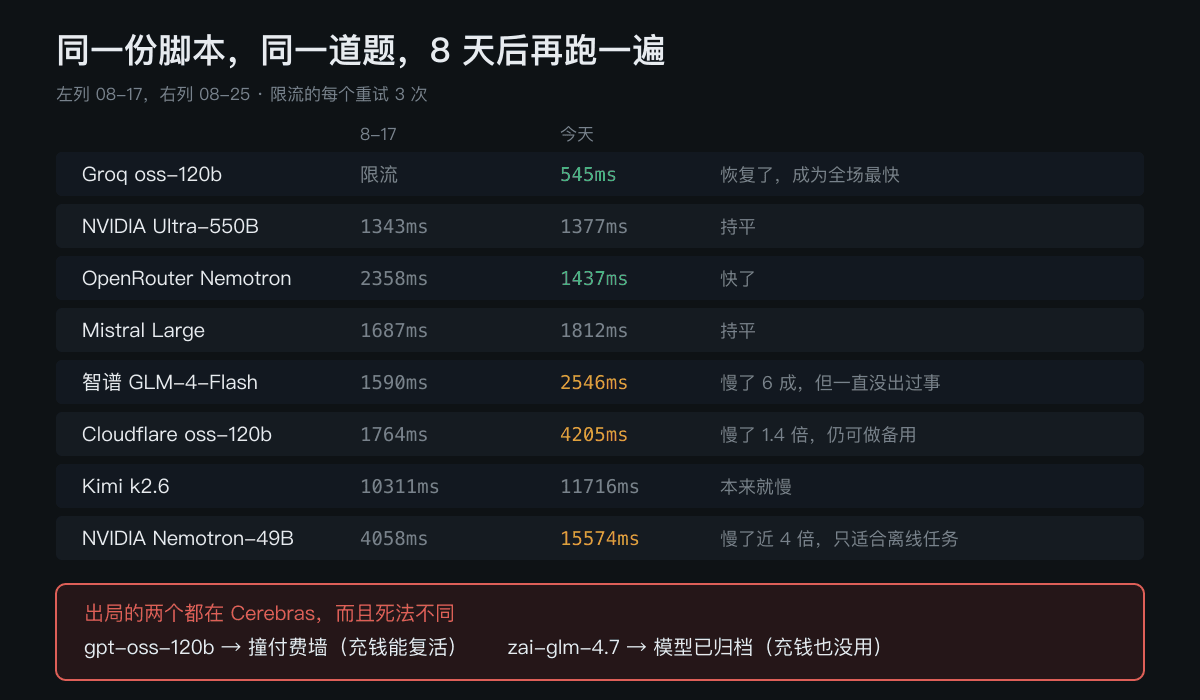
Eight days, the ledger becomes like this
Available 9 can be turned into 8, 5 current limiting 5 can be turned into 3, and 7 can be turned into 10.
The numbers show that only one is missing, but the ingredients have been changed.
Out are two entrances to Cerebras. And there are two completely different ways to die.
gpt-oss-120b hit a pay wall, and the error code payment_required means that the free limit of this key has reached its end. If you want to continue using it, you can go to the bill page.
zai-glm-4.7 is another matter, returns:
Model zai-glm-4.7 is archived and unavailable for the organization.
Error code model_archived. The model was archived and no longer exists for the organization.
One is "You can still use it, but you have to pay for it", and the other is "This thing is gone." When making a backup plan, these two types should be treated separately: the former can be resurrected by charging money, and the latter will be useless regardless of how much money you charge.
The top one is Groq.
Eight days ago, Groq's gpt-oss-120b was current-limiting. I classified it into the "5 current-limiting" category and wrote,"It is normal to limit current but it recovers quickly." Today it recovered, 545 milliseconds, the fastest one in the audience.
In other words, the speed rankings have changed hands, and the new number one and the one who stepped downare running the same model.
There are two other changes in ## that are easily ignored
The NVIDIA Nemotron-49B is nearly four times slower. Eight days ago, 4058 milliseconds, today 15574 milliseconds. It's still alive and it returns normally, but if you leave it where someone is waiting, the user experience is a different matter.
"Can be used" and "easy to use" are not the same thing here. I wrote it once in the previous chapter, and this time it is played again.
GLM-5.2 on Mistral has changed from "current limited" to "subscription level not supported".
Eight days ago, it reported a current restriction, and I was put in the "it may be better tomorrow" position. Today it reported:
This model is not available in your subscription tier
This nature has changed. Current limiting is a waiting matter, but you can't wait until subscription levels are not supported. The judgment at that time was wrong, or the wrong information at that time concealed the true situation.
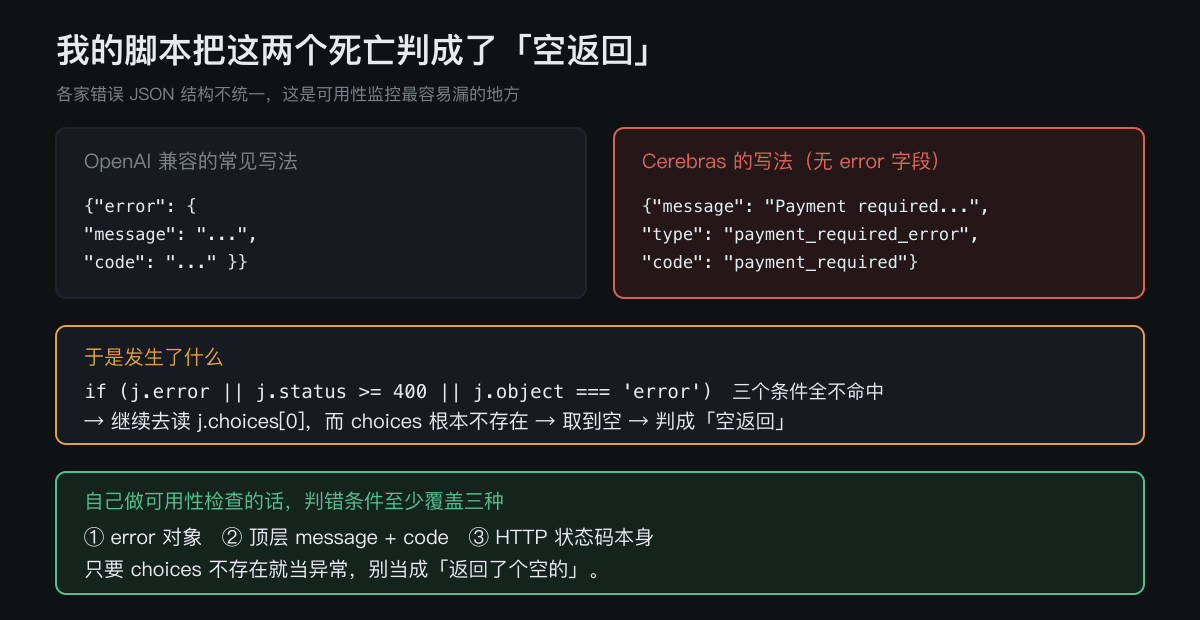
My script ruled these two deaths as "empty returns"
This part was what surprised me most in this retest.
After the first round, Cerebras 'two entrances did not display "dead" but "empty return", or the state where they received 200 but the content was empty. I thought it was another manifestation of current restriction. It wasn't until I looked at the original response alone that I realized that people had made it clear long ago.
The reason is that the JSON structure of each family is different.
A common way to write OpenAI compatibility is to pack errors in error:
{"error": {"message": "...", "code": "..."}}
Cerebras is not. It is directly given to the top level:
{"message": "Payment required to access this resource.",
 "type": "payment_required_error",
 "code": "payment_required"}
There is no error field.
The line in my script that made a mistake read if (j.error || j.status >= 400 || j.object === 'error'). None of the three conditions hit, so the program continued to read j.choices[0].message.content. choices does not exist at all. It takes an empty string and finally falls into the "empty return" file.
A response that clearly told you "pay" was ruled by me as "returned empty."
In the previous article, I talked about the exact opposite pit: the inference model puts content in the reasoning field, and read-only content will sentence the alive as the dead. This time, only the error field was recognized, and the dead one was declared empty.
The two pits add up to the same sentence: what your surveillance sees depends on which field you plan to look at. However, each family had not discussed where to put the words.
If you are also doing this kind of usability check, the error criteria must cover at least three types: error objects, top-level message plus code, and the HTTP status code itself. As long as choices does not exist, it should be handled as an exception, not as empty content.
's previous suggestion, this time I verified it myself
The core conclusion of the article eight days ago is one sentence: the same model with multiple platform entrances is more effective than multiple different models. The reason is that the request body for changing the platform basically does not need to be moved, and the code needs to be changed to change the model.
At that time, gpt-oss-120b had three entrances: Cerebras could be used and the fastest, Cloudflare could be used, and Groq was current-limiting. The arrangement I gave was to take Cerebras, prepare Cloudflare, and keep Groq and not delete it.
Eight days later, the status of the three entrances was: Cerebras hit the paywall, Cloudflare was still alive but slowed to 4205 milliseconds, and Groq recovered and became the fastest.
If you had followed that platoon method, your service would not have been interrupted for the past eight days, and you might not even feel that the main force had changed for one round.
I singled out this matter separately, not because I guessed correctly. Because this time the data illustrates a more practical problem: the life span of such free entrances is measured in days, and any "who is the best to use" list, including the one I wrote, has a very short shelf life. The manifest will expire, but the configuration structure will not.

How to match ## with this current version
Based on today's data, if you put free models in your project:
The gpt-oss-120b model is modified from Groq. 545 milliseconds, the fastest in the game. Cloudflare is kept as a backup, and it is slow but stable alive. Remove the entrance to Cerebras first and wait until you are willing to pay.
If you want to connect directly in China without disturbing the network environment, Smart Spectrum GLM-4-Flash is still the first choice. It slowed down a little this time, from 1590 milliseconds to 2546 milliseconds, but nothing happened.
The Nemotron-550B series can be placed on both NVIDIA and OpenRouter entrances. Today, NVIDIA has 1377 milliseconds and OpenRouter has 1437 milliseconds. Both sides are healthy and backup each other.
The NVIDIA Nemotron-49B is moved to run offline tasks. 15 seconds is not suitable for where someone is waiting.
Stop spending time on Cerebras 'GLM-4.7. The model is filed, and this has nothing to do with the quota.
few sentences boundary
This is a snapshot of an account and a point in time, August 25, 2026. The three ones that are currently limited may be ready tomorrow, and the eight ones that can be used may be limited tomorrow.
There are two situations to distinguish between the "dead" file: the two GitHub services are retired and no one can use them; and the arrears, insufficient balance, subscription levels, and pay walls, strictly speaking, are "I can't use this account". You can be resurrected by changing your account or charging your money. Cerebras hit the pay wall only means that my free credit for this key has been used up, but it does not mean that it has started charging everyone.
In addition, I only tested whether the results could be returned normally, not the quality, nor did I run through the limit to see the upper limit.
If you want to check it yourself, remember the wrong judgment trap above: Don't just look at the error field.