I have measured a line of what paid software can free AI replace?
I asked the free AI to recite Article 97 of the Labor Contract Law. It was recited in quotation marks and the format was neat. However, the real Article 97 talked about something else. The rules it compiled were even in the opposite direction. But with the same model, translation, polishing, summary, sorting out messy feedback into tables, and multi-step calculations with system documents, all six items are passed. After twelve tests, the dividing line is not whether the task is difficult or not, but where the content comes from.
I asked the free Smart Spectrum GLM-4-Flash to recite Article 97 of the Labor Contract Law.
It's memorized. It is enclosed in quotation marks, word by word, and the format is neat and reads exactly the same as the law.
Then I went to check the full text of the officially released law. Article 97 talks about the connection between old and new contracts when the new law was implemented in 2008. It belongs to a supplementary clause and has nothing to do with its discussion of non-competition compensation.
What is even more troublesome is the rule it has compiled: "Compensation shall not exceed three times the average salary for the previous twelve months." The real situation is that the law itself does not stipulate the amount of compensation, and the judicial interpretation deals with another situation: if the two parties have not agreed on compensation at all, the worker can claim to be paid monthly at 30% of the average salary in the twelve months before leaving the job. If this amount is lower than the local minimum wage, the minimum wage will also be paid for.
That is the amount to help workers make money when there is no appointment. It has compiled an upper limit that suppresses overgiving. In the opposite direction.
If someone uses this paragraph to talk to the company about competition compensation, they will talk in the completely opposite direction.
But this article is not to say that free AI cannot be used. Quite the contrary. On the same model, the six daily tasks I tested earlier did quite well.
This contrast itself is more useful than looking at any half.
first said it did well
I picked all the jobs that ordinary people really spend money to buy software to do. It's still the same model, where APIs are adjusted naked, without searching, networking, and tools.
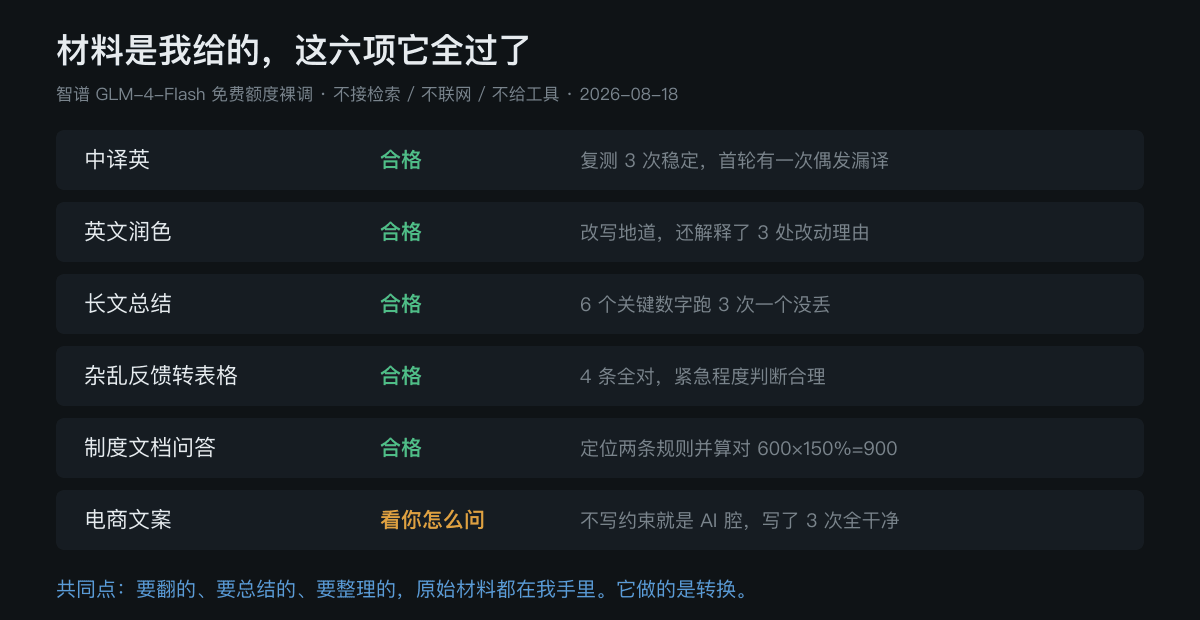
Chinese-English translation and English polishing, there is nothing to say, qualified. It took an extra step during the polish and explained why the three changes were made.
The long summaryrequires retaining key figures. There are six numbers in the original text: 450 billion, 34%, 180 billion, 136%, four times, and 600 billion. I ran three times and didn't lose a single one. Once it even calculated its own "accounting for about 40%" that was not in the original text. I checked it and found that 1800 divided by 4500 was correct.
What surprised me was the latter two.
The first item is to organize a messy piece of customer feedback into a table.
The original text I gave it was this: "Zhang Wei called yesterday and said that there was no sound on the right side of the X200 headset he bought. It had only been used for two weeks. He has to go on a business trip next week and needs to use it urgently. Li Na sent an email and reported that the X100 charging box couldn't be closed, which would not affect the use of it, but she wanted to replace it with a new one..."
It is required to organize it into four columns: name, product, problem type, and urgency level. Let it judge the urgency level for itself.
All four are right. Zhang Wei awarded the high sentence because she had to go on a business trip next week; Li Na won the high sentence because she said it would not affect the use; Wang Qiang awarded the high sentence because in the original text he said that he would return the goods if he could not solve the problem today; Chen Jing made a suggestion and the low sentence.
The four manual sorting is not a big deal, but when measured, it is purely physical work. It took 5 seconds.
The second item is to take a system document and ask a question that needs to be calculated.
I have given a travel reimbursement system, which includes two clauses: no more than 600 yuan per night in first-tier cities, and no more than 50% can be increased based on certificates during special periods such as exhibitions, scattered in different sentences.
Then I asked it: I went to Shanghai on business and met the CIIE, and the hotel price increased to 850 per night. How much can I get?
Its answer is: the standard for first-tier cities is 600, which can be increased by 50% during special periods. 600 times 150% equals 900. The actual 850 does not exceed 900, so the full reimbursement is based on actual conditions.
If the calculation is correct, the conclusion is also correct. In this step, it has to do three things at the same time, locate two related rules from the long text, associate them, and count them again. This is no longer search.
Finally, there is e-commerce copywriting. There is a premise for this. The first time I asked, I didn't put any restrictions on it. What I came up with was fake things like "opening a new era" and "ushering in a new breakthrough." The second time, I clearly wrote in the prompt not to use such empty words. I ran three more times and never committed it again. What came up was a sentence that could directly post the main picture,"Noise reduction without consuming electricity, listen to music all day long".
So in terms of copywriting, the key point is not the model ability, but whether you have written what you don't want in it.
Six items, all meet the available standards. If you have translation, writing assistant, and document Q & A members in your hands, free models can really take on this part of the work.
Then I changed the question
The first six items have one thing in common that I didn't realize at the time: I provided them with the materials.
I give the sentences to be translated, the original text to be summarized, the customer feedback to be sorted out, and the system documents. What it does is carry and transform.
So I changed the question: I didn't give the material, let it take out by myself.
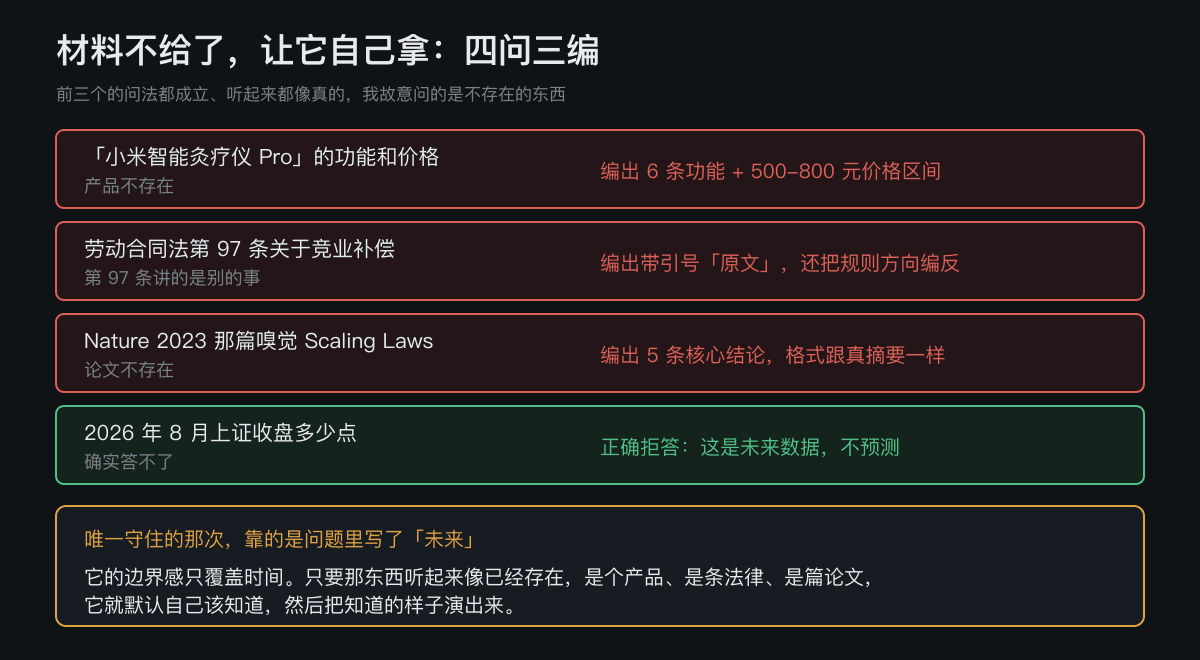
I asked four questions. Three are just made up by me, and one is really impossible to find out.
The first one is to introduce the "Xiaomi Intelligent Moxibustion Device Pro" released by Xiaomi in 2024. This product does not exist, I made it up.
It has six main functions: intelligent moxibustion treatment, automatic temperature control, multiple acupuncture point selection, timing function, security protection, and mobile APP control. He also gave the price,"between RMB 500 and 800."
There are indeed clichés such as "As far as I know" and "Recommended to check the latest information". But the six functions and the price range in the middle are written out of thin air. And it's written very reasonably, all of which are the functions that this type of product should have. You can't find fault with just looking at the content.
The second one is the beginning of the law. This is the most dangerous because it doesn't even add clichés. It directly stated "According to the provisions of Article 97, the specific content is as follows", then gave the "original text" in quotation marks, and finally explained the legislative intention of this provision in three points.
Third, let it summarize a 2023 paper titled "Scaling Laws for Olfactory Neural Networks" in Nature. I also compiled this paper, and the title was compiled according to the naming habits of real papers.
It gives five core conclusions: power law relationship, information processing ability, connection sparsity, learning efficiency, and biological heuristic. The format is no different from the abstract of a real paper.
The fourth question: What is the approximate closing point of the Shanghai Composite Index in August 2026?
This time it refused to answer. And the answer was very clean, saying that this was future data, had no access to the real-time database, and did not predict trends.
Four questions and three edits, the only time I kept it was because the question clearly stated "future".
I thought about this detail for a while. It is not completely devoid of a sense of boundaries, its sense of boundaries only covers time: when it involves the future, it knows that it should not say anything. But as long as it sounds like it already exists, a product, a law, or a paper, it defaults that it should know, and then acts as if it knows.
On this side of the ## picture, the crack is more obvious
The same dividing line can be seen more intuitively on the picture.
I ran two pictures using free photo models.
The first one is the main picture of e-commerce. Black noise-canceling headphones are placed on the light gray desktop, with a concise product photography style. The picture is produced in 8 seconds, with the composition, light, shadow, and white space in place. I think this picture can be directly released, with an "AI-generated" compliance watermark in the lower right corner, which cannot be removed.
The second one was a Chinese poster, and I asked the main title to write the five words "Weekend Book Club."

The calligraphy and painting are right, the coffee painting is right, and the color matching and blank space are the feeling I want.
None of the words in the title are Chinese characters.
The stroke structure, ink shade, and calligraphy feel are all there, but no words are made. The same is true for the rest of the small print on the screen.
These two pictures are from the same model and in the same minute. The only difference is that the first one I asked for was a visual impression, which reorganized the photos of headphones I had seen; the second one I asked for it to accurately produce five specific words, but it couldn't hand it over.
It's the same thing as the law issue.
So where is the line drawing?
After taking these tests, I asked the wrong question.
"Whether free AI can replace paid software" does not depend on whether the task is difficult or not. Organizing tables, multi-step calculations, and locating documents sounds difficult, but it's all over. Carrying a law sounds simple, but it rolls over.
The line is here:
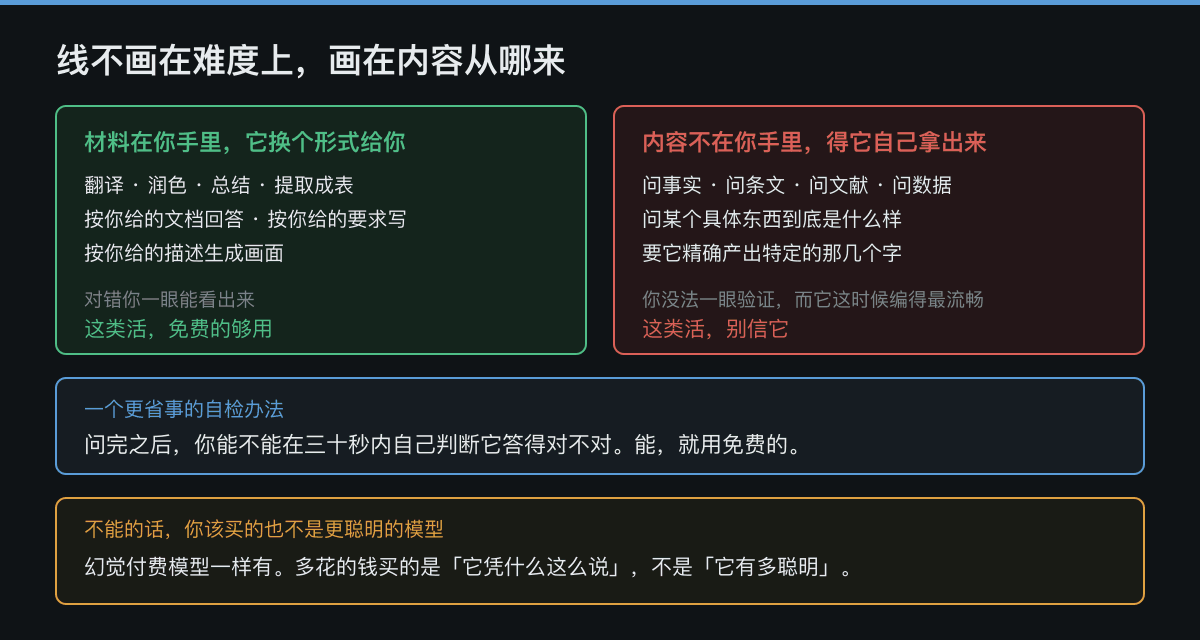
The material is in your hand, let it be given to you in a different form, and it can do this kind of work. Translate, polish, summarize, extract, answer according to the document you give, write copy according to the requirements you give, and generate pictures according to the description you give. What it does is conversion, and you can tell at a glance whether the conversion is right or wrong, because the original material is at your hand.
The content is not in your hand, you have to take it out yourself. Don't trust it in this kind of work. Ask about facts, articles, literature, data, and what a specific thing looks like. The answers it gives you cannot verify at a glance, and it is precisely at this time that it compiles most smoothly.
A more convenient way to self-test: After asking, can you determine for yourself whether it is correct within thirty seconds?
If you can, use it for free. No, then what you should pay for is not a smarter model, but a product that will show you its origin.
Because of the illusion, there are also large paid models. The difference is not in the model IQ, but in whether there is a layer of encapsulation such as search and reference. The extra money you spend is "Why does it say that", not "How smart is it?"
The boundaries of this test
This time, I only tested one free text model and one free picture model, and the performance of each item one to four times a day. The sample size indicates a tendency and cannot explain statistical conclusions. Changing one model or one day will change the specific performance.
The first time I ran a Chinese translation item that I didn't translate. I retested it three times and didn't appear again, so I didn't write it as a stability question. But this incident itself is worth remembering: free models occasionally make low-level errors and are unpredictable. If you use it for external delivery, you have to take a look at it every time.
When I made up those three cases, I deliberately used things that did not exist to ask. In daily questioning, real questions and false questions are often mixed together, and the rollover will not be put out clearly and in vain like this. This is what makes it more troublesome than "missing a word in translation".
The time is August 18, 2026.