23 free AI interfaces were measured, and only 3 can be used directly in China
Half a month ago, I tested from the computer room which AI interfaces can be dialed through during a round of domestic direct connections, but the computer room outlet and the broadband at home are completely different. That conclusion actually does not count for Jiakuan users. This time, I retested 23 interfaces on my home broadband, and I didn't open any special networks throughout the process: there were only 3 overseas who could really get the results for free, and among these 3 calls, only Cloudflare hit all 15 times. One thing I discovered in the middle is that NVIDIA is upstream of the free model of OpenRouter, and the failure information is clearly written, so it is purely self-comforting to write these two families as the bottom line of each other.
Half a month ago, I tested which AI interfaces can be dialed through during a round of domestic direct connections. That time, I ran it from a computer room server. After the article was published, I have always had a knot in my heart: the network exit in the computer room and the broadband in your home are completely different. The routes are different and the IP segments are different. I took the conclusions from the computer room test and said to the person who plugged in the network cable at home,"You can use it too." It was actually not very responsible.
So this time I retested the same batch of interfaces on home broadband. There was no special network open throughout the entire process, just ordinary telecommunications broadband, and curl forced the local agent to bypass.
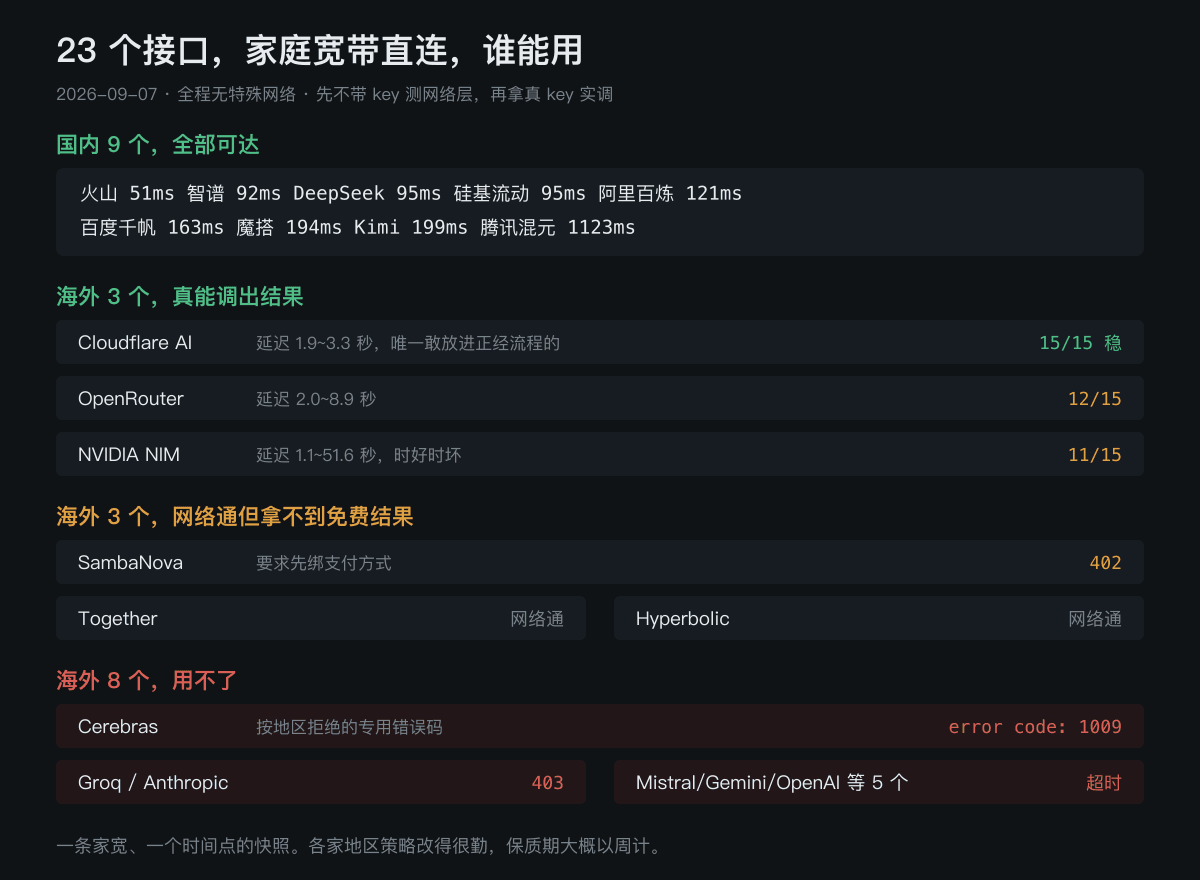
There are 23 interfaces in total. There are only three overseas people who can get results for free.
Among these three, there is only one I dare to use for serious work.
first said how to measure it, otherwise the numbers would be meaningless
Many people only do one step to test this kind of thing: take the key and adjust it, and it will be done if it works. There is a trap in this test. When you fail, you can't tell whether the network cannot reach you or whether the network has arrived but the other person won't take your order.
So I took two steps.
The first step is to make an empty request directly to the interface without any key. At this time, you can distinguish three situations by looking at the return code:
Returning 401 or 400 meansthat the network is open, but people just think you don't have a certificate. This kind of thing can be used.
Returns 403, indicating that the package reached the other server, but was rejected by region. Cerebras is more direct, and the response body clearly states error code: 1009, which is the code Cloudflare uses specifically to mark regional blockades.
If you directly timeout and don't respond, that means that the network layer cannot reach it.
The second step is to use the real key to perform the actual adjustment of the information passed by the network layer to confirm that it can really speak out. This step eliminated one: SambaNova's network was well connected, and it returned to 402 in one tone, allowing you to bind the payment method first. You can reach it online, but it is meaningless to white prostitutes.
domestic 9, all access, no suspense
Volcanic Ark is 51 milliseconds, Intelligent Spectrum is 92 milliseconds, DeepSeek is 95 milliseconds, silicon-based flow is 95 milliseconds, Ali Bailian is 121 milliseconds, Baidu Qianfan is 163 milliseconds, Moda is 194 milliseconds, Kimi is 199 milliseconds, and Tencent Hunyuan is 1123 milliseconds.
There is nothing to say about this, it is already in China. It is listed as a ruler: whether the overseas interfaces behind are fast or not must be compared with this row of numbers.
Tencent's mixed value of 1123 milliseconds is obviously slower in the domestic batch. I retested it again and it is still this magnitude. I'm not sure if it happened on the same day.
can be used overseas, but the gap lies in stability
Cloudflare、OpenRouter、NVIDIA。These three networks can work, and real keys can also produce results.
If I stop writing when I get here and write an article "These three can be used without a special network," then this article will be useless. Because being able to adjust it once is completely different from being able to use it for work.
I called each interface 15 times in a row to see how many times I could solve the same problem and how the delay would dissipate.
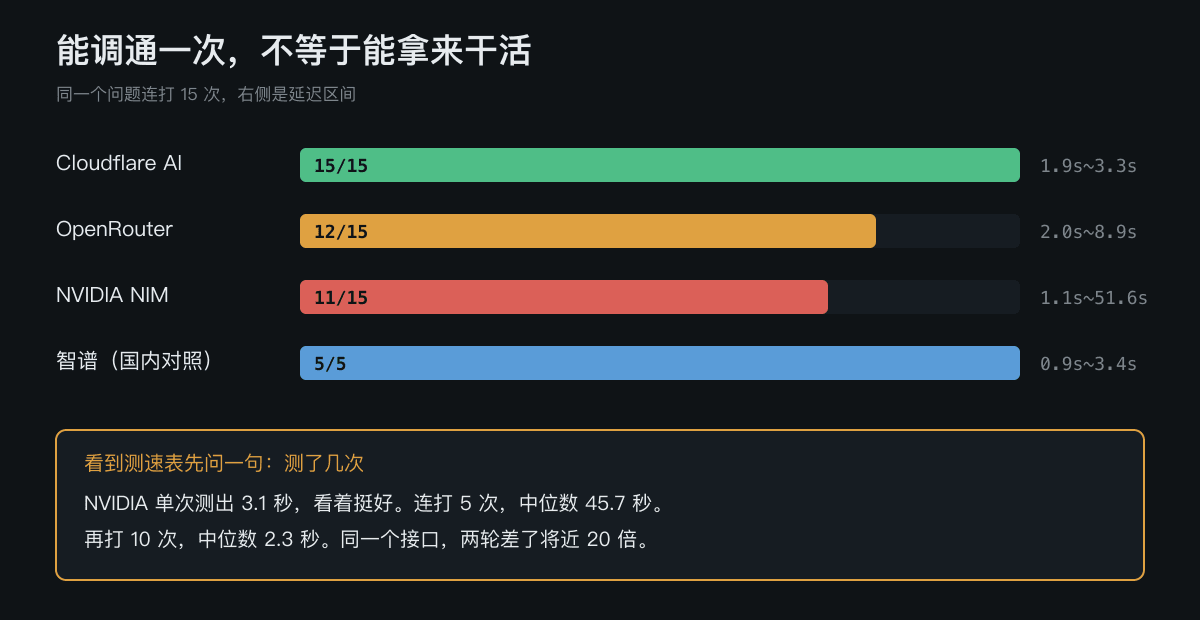
Cloudflarehit all 15 times, with latency ranging from 1912 milliseconds to 3327 milliseconds, with the median of the two rounds being 2488 and 2605 milliseconds respectively. This curve is a bit boring, and boredom is the highest praise here.
OpenRouter became 12 times in 15 times, and the delay was relatively wide, with the fastest being 1985 milliseconds and the slowest being 8852 milliseconds.
NVIDIA's 15 times became 11 times, with a delay range of 1136 milliseconds to 51632 milliseconds.
You are right. The fastest is 1.1 seconds and the slowest is 51.6 seconds, a difference of 45 times.
was almost cheated
NVIDIA I want to talk about this alone because I almost lost myself here.
The first time it was called alone, 3145 milliseconds, which was quite normal. At that time, I had already begun to form a statement in my mind: the last time the computer room measured it for 22 seconds, this time the home width was 3.1 seconds, which was 7 times faster. It seems that the home width routing is better.
Sounds smooth, right? There are comparisons, multiples, and explanations.
Then I ran 5 times. The median is 45740 milliseconds.
Ran 10 more times. The median was 2312 milliseconds.
For the same interface, the median between the two rounds was nearly 20 times different. It is not fast, it is not slow, it isgood and bad. When it is good, it will go out one second, and when it is bad, it will be stuck for more than 50 seconds and then I will tell you Service temporarily overloaded.
If my conclusion that "the width of the home is 7 times faster than the computer room" is issued, it will be a wrong judgment based on a single sampling. The last time the machine room measured the 22 seconds, 80% of which was only when it hit it and was convulsing.
So when you see anyone giving you a speedometer with an AI interface,you first ask and test it several times. The number measured once is similar to the number not measured.
something I didn't expect
What really made me sit straight was the failure message.
NVIDIA returns Service temporarily overloaded when it fails.
When OpenRouter fails, it returns: Upstream error from Nvidia: Service temporarily overloaded.
The free model I use on OpenRouter, the one with the suffix :free,upstream is NVIDIA itself.
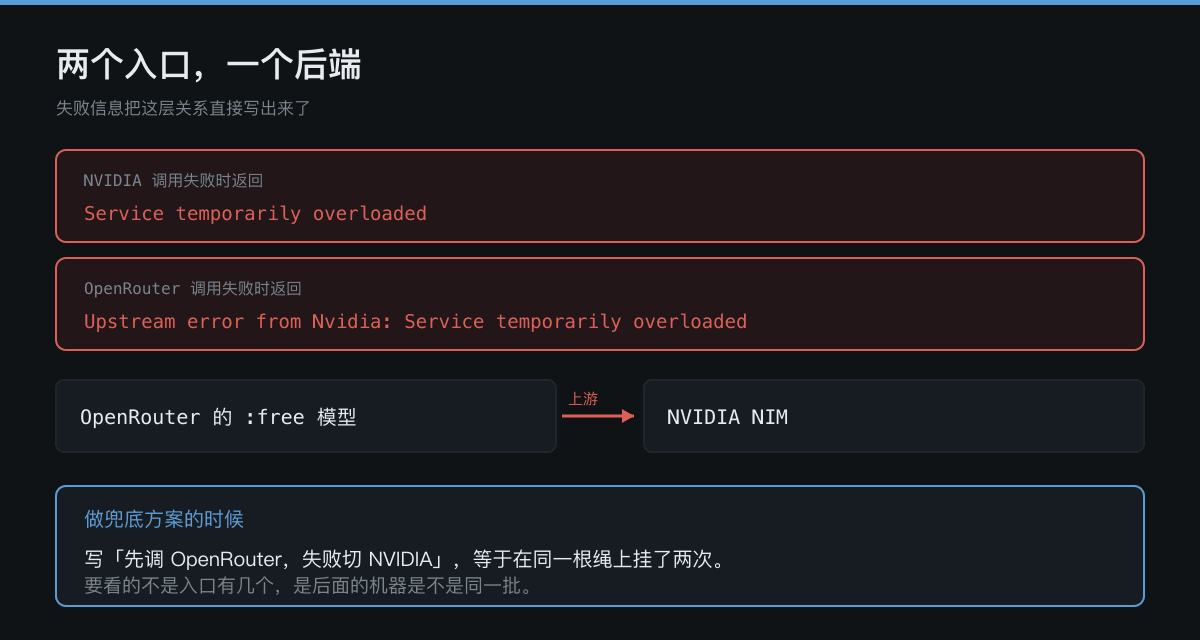
What this means is: If you write in your code "Adjust OpenRouter first and automatically switch to NVIDIA if it fails" for insurance purposes, then you think you have two insurances, but you are actually hanging on the same rope twice. Once NVIDIA is overloaded and both sides report errors at the same time, your bottom-up logic is useless at all.
This also explains why the success rates of the two families are so close. 12:15 and 11:15 are the same thing.
The free models of aggregation platforms basically follow this approach. They do not raise their own cards and forward them to others. This is especially true for the free one. Therefore, when making a bottom-up plan, it depends not on how many entrances there are, but whether the machines behind are the same batch.
There are actually two types of ## rejected
Groq, Cerebras, and Anthropic returned 403. The bag was delivered, and the other party looked at where you came from and returned it. Cerebras is the most candid and directly gives 1009.
Mistral, Gemini, OpenAI, xAI, and GitHub Models are pure timeouts with no response for 20 seconds. This is not the same nature as 403. 403 is at least a response. After overtime, you can't even touch the door.
The result is the same for the user, and it cannot be used. But there is a practical advantage to distinguishing them: 403 is the other party's strategy, and the strategy will change; overtime is basically impossible.
By the way, GitHub Models was 410 Gone last time, but this time it expired directly.
changed compared with the computer room
The reachable list remains unchanged.
Cloudflare, OpenRouter, and NVIDIA, which were accessible to computer rooms last time, are also accessible to home users this time. Groq and Cerebras, who were rejected last time, still had the same error code this time. Mistral and Gemini, who timed out last time, still timed out this time.
I thought there would be a difference if I changed the exit, but the two sides were perfectly sewn. This shows that the regional judgment of these interfaces is a national strategy, not a routing problem for a certain computer room. On the other hand, if you can't try it at home, it's probably the same even if you change the machine.
The only difference lies in speed and stability, and this part is mainly the platform's own pot, not your network's pot.
So how to choose
Just want a free overseas interface that can be used, so close your eyes and choose Cloudflare. With 15 hits, the delay interval is as narrow as a straight line. This time, it was the only one I was willing to put into the serious process.
OpenRouter should be a supplement, not a backup. It has many models, which is a real advantage, but it must be clear who is upstream of the free one. If you really want to do the bottom line, you have to pick one whose back end does not coincide with your main force.
NVIDIA can play with it, but don't put it anywhere where time requires it. It can produce results in one second, but it can also hold you for fifty seconds. You can't predict which one will be today.
If you have domestic interfaces in hand, the cost performance of these overseas ones is actually not high. The median of the intelligence spectrum is 1748 milliseconds, and the first byte of the volcano is 51 milliseconds. The stability and speed are higher than those overseas. The main reason for torturing overseas free quotas is to use a certain model that is not available in China. If there is no such need, what can we do around this circle?
few sentences boundary
This is a snapshot of home broadband and a point in time. Different operators and different cities may have different results. I only have one exit and cannot verify your line for you.
15 times per interface. This sample size is enough to see the difference in magnitude. Cloudflare 15:15 and NVIDIA 11:15 cannot be explained by noise, but don't take this as a strict statistical conclusion.
The Together and Hyperbolic network layers are connected. I don't have an account with these two companies, so I didn't verify the actual call. Only network reachable is marked on the inside and outside.
Each family changes its regional strategies frequently, and the shelf life of my form is about weeks. If you really want to use it, you can hit it with a curl yourself. It is written on the two-step method, just follow it.