A million-dollar injection of cancer drugs is being administered to 200,000
There is a domestic drug CAR-T for treating blood cancer. It costs 990,000 to 1.29 million yuan per injection. It is called a "medical luxury" and most families dare not even think about it. But recently, this million-dollar wall has begun to be cracked open: the approval price of a domestically produced CAR-T is set at about 200,000 yuan. From 1.29 million to 200,000, what happened in between? This is much more interesting than "discovering the conscience of a pharmaceutical company." It is expensive, but the root lies in the method-CAR-T is a specially customized injection for you: draw your own immune cells, send them to the factory for transformation and expansion, and then inject them back, one batch per person, purely manual, 4 to 6 weeks at a time, only a few hundred injections can be made a year. The key to price reduction is not to cut profits, but to turn "manual customization" into "industrial mass production": one is to make it by machines (fully automated unmanned + full-chain self-developed, with production capacity reaching 50 times), and the other is to change it to "spot"(using healthy donor cells for mass production and freezing in advance, and using them at any time). But don't rush to call for free cancer-spot prices are easy to reduce but difficult to improve, zero models have been approved so far, machine manufacturing still has to go through supervision, and the door to medical insurance has not yet been opened. The ice broke, but it didn't reach the shore. This article explains why life-saving medicines are expensive and why they start to fall.
Let me start with a number, which may make your heart sink: In China, there is a drug for treating blood cancer that costs 990,000 to 1.29 million yuan per injection.
It is called CAR-T and is one of the most promising anti-cancer therapies in recent years. For some lymphoma and leukemia patients, it can really "clear cancer cells with one injection." But this price makes most families dare not even think about it. It has a nickname-"Medical Luxury".
But recently, a hole in this million-dollar wall has begun to be smashed open. The approval price of a domestically produced CAR-T has been set at about 200,000 yuan.
From 1.29 million to 200,000, what happened in between? This matter is much more interesting than "discovering the conscience of a pharmaceutical company." I'll break it up with you.
First understand: Why is it so expensive?
Many people's first reaction is that pharmaceutical companies are evil. But the cost of CAR-T lies in its "creation method".
Ordinary medicine is a standard product made by tons in the factory. You and I eat the same batch. CAR-T is not. It is a specially customized injection given to you alone.
Here's the process: First extract your own immune cells (T cells), send them to the factory, use genetic technology to transform them into "soldiers" who can recognize and kill cancer cells, then expand them in large quantities, and finally inject them back into your body.
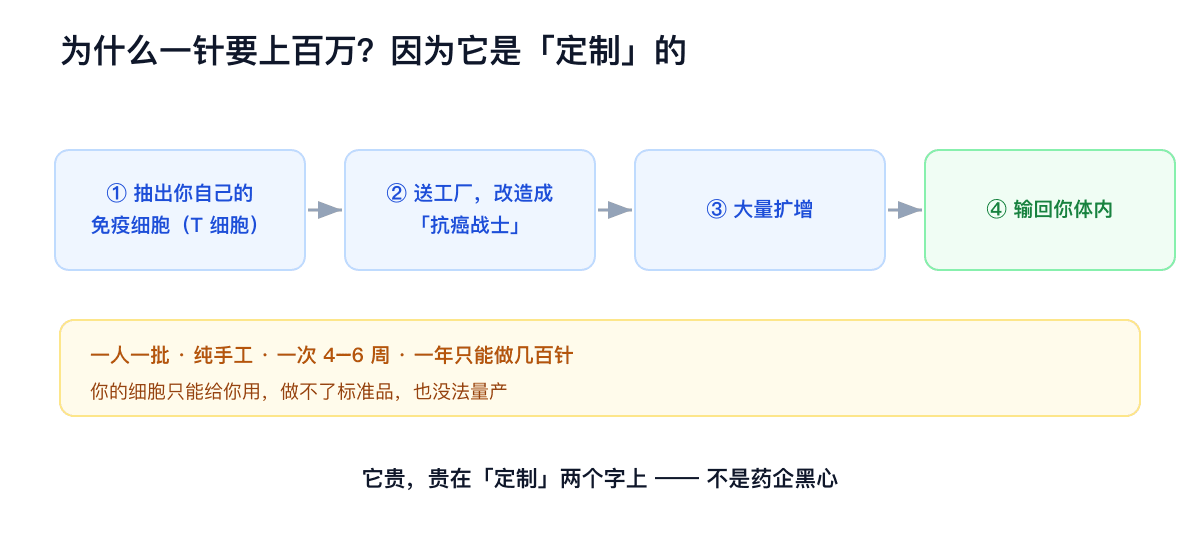
Do you understand? This is a manual customization process that is one person, one batch, one manual. Your cells can only be used for you. It takes 4 to 6 weeks to do it once, and it requires top-notch laboratories, equipment and people to watch the entire process. Under the traditional method, a company can only make hundreds of stitches a year.
The output is so low and it relies entirely on manual work, so the cost naturally cannot be suppressed. It is expensive, and it is expensive in the word "customization".
's key to price reduction, what is it
If you want to make it cheaper, you don't rely on cutting profits, but on turning "handmade customization" into "industrial mass production". There are two keys right now.
First one: Let machines make it, not man-made.
That domestic CAR-T with an offer price of 200,000 is going this way. This company has turned production into a fully automatic, fully closed, and unmanned system, self-developing everything from core equipment to the most basic raw materials and reagents-equivalent to building a "unmanned cell drug factory" without anyone guarding it. The result is that the production capacity is more than 50 times that of traditional methods, and a base can make thousands of stitches a year.
As the production capacity increases, the cost of a single needle will naturally decrease. This is the most practical way to reduce prices.
Second handle: Change from "customized" to "spot".
The more fundamental one is to change the idea: instead of using your own cells, switch to cells from a healthy donor, prepare them in batches and freeze them in advance, and take a needle and inject it at any time if anyone needs it. The industry calls this "spot type".
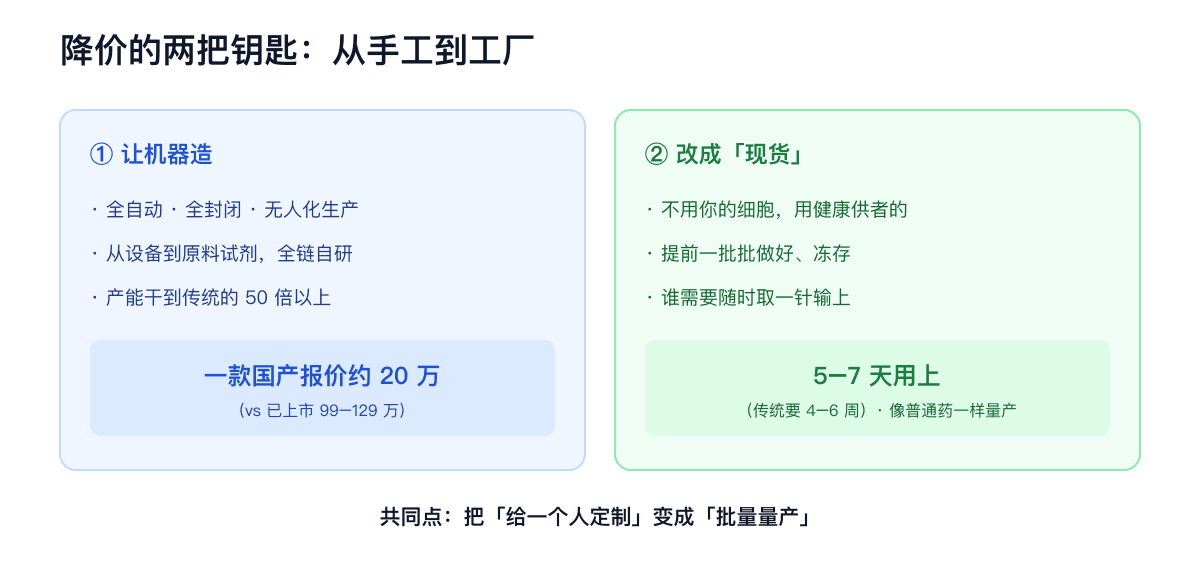
The benefits are straightforward: instead of waiting 4 to 6 weeks for your own cells to slowly develop, you can use them in 5 to 7 days-for patients whose disease progresses rapidly, these few weeks can be the difference between life and death. Moreover, it can be mass produced and cost diluted on a large scale like ordinary drugs.
But don't rush to shout "Cancer is free"
You may be a little excited to talk about this. I had to pull back-it was breaking the ice, but it was far from reaching the shore.
My consistent attitude when writing about this kind of thing is to say good news and make it clear. The following obstacles have not been overcome yet:
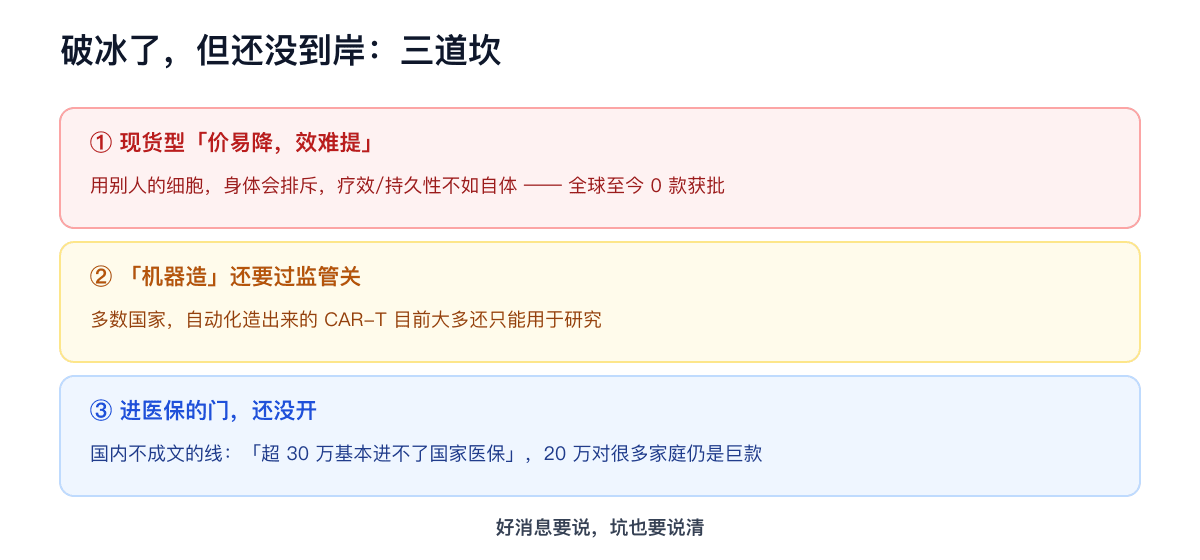
Spot type "The price is easy to drop, but the efficiency is difficult to improve". If you use other people's cells, your body will reject them, resulting in its efficacy and durability that are currently not as effective as using your own cells. The price can be lowered, but the effect is discounted-so far, no spot CAR-T has been officially approved for listing in the world .
"Machine-made" still has to go through supervision. Fully automated production sounds beautiful, but in most countries, most of the CAR-Ts made by machines can only be used for research. Whether large-scale approval can be used for medical treatment is still a matter of supervision.
The door to medical insurance has not yet been opened. There is an unwritten line in China: "More than 300,000 people will basically not be able to enter the national medical insurance." This means that even if it is reduced to 200,000, it will still be a huge sum for many families, and there is still a distance from being "affordable to everyone."
In the end
CAR-T, a million-dollar wall, is being smashed, but breaking a hole and tearing down the wall are two different things.
What I want to say more is the truth in this matter: Many life-saving cutting-edge technologies are prohibitively expensive on the first day, not because they shouldn't be cheap, but because they are still in the "manual" stage. What makes it go to ordinary people has never been a moral appeal, but to move it from a handicraft workshop to a factory that can be automated, standardized, and mass-produced-this is precisely what this era is best at.
This is true of diet pills, and so are cancer drugs. The romance of technology does not lie in its perfection at birth, but in its ability to turn the most expensive things into things that ordinary people can reach step by step.
This one is still on the way. But it did, and it started going down.
(The data in this article comes from public reports; the information related to diseases and treatments is for understanding only and does not constitute any medical advice. Please follow your doctor's advice for details.)