The first to abolish AI is not a novice, but a "skilled worker"
Have you ever had this feeling recently: you are working very hard, are familiar with the craft, and have been working for many years, but you suddenly feel that you are not worth so much-the offer cannot be improved or even suppressed, and the newcomers will catch up with you in a few days with AI. Years of hard work. This is not an illusion, but the structure underneath is changing. Everyone says that "AI replaces people", but this statement is too crude. What's really happening is: AI splits people into two ends and collapses the middle (Goldman Sachs calls it the "M-shaped economy", the IMF says the middle class has almost no light, and PwC billion job ads show that the labor force is split into "dual tracks"). Moreover, the first cut it made counter-intuitively fell on the "skilled worker"-because AI is best at producing "average levels", a novice with AI can equate with your years of proficiency in a few seconds, and your "proficiency premium" is wiped out. The other end of the price increase is not the general "excellence", but the level that AI cannot level out: judgment, depth of the field, integration, and responsibility. AI is not replacing people, but re-pricing people-clearing "proficiency" and labeling "judgment" at a high price. You have to know whether what you are selling is "proficiency" or "judgment".
Have you had this feeling recently--
He was obviously working hard and proficient in craftsmanship. After working for many years, he suddenly felt that he was not so valuable anymore. The work is still being done, but the price cannot be increased, and even is pushed down; the newcomers hold AI and can catch up with your years of hard work in a few days.
This is not an illusion, nor is it that you are not working hard enough. It's the structure underneath that is changing.
Everyone is saying,"AI will replace people." But this statement is too crude and useless. What is really happening is not "people are replaced by the whole", but something more precise and heart-breaking--
AI is splitting a person into two ends, causing the middle to collapse. Moreover, the knife it struck first might not be the person you thought it was.
Let's make it clear first: AI is not to level everyone, it is to pull everyone apart
Many people's first impression of AI is "universal benefit"-everyone can use powerful tools, and the level is leveled and raised.
The data says the opposite.
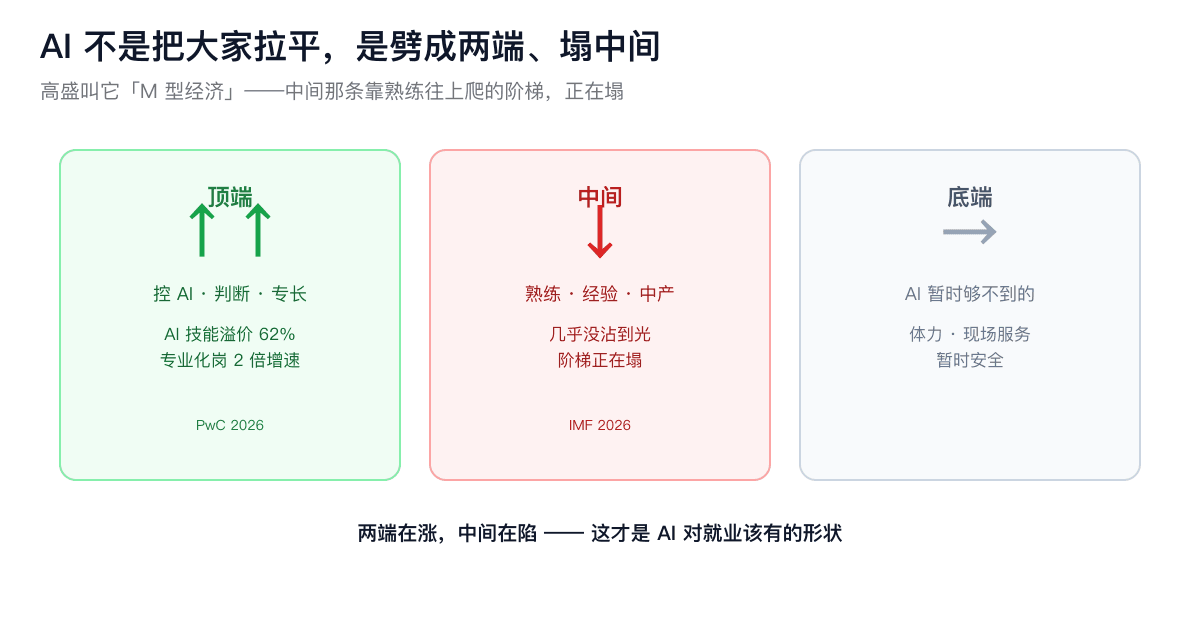
PricewaterhouseCoopers 'report in June this year, based on one billion job advertisements, made a clear judgment: the labor market is breaking into a "dual track." One track is "professional" positions-AI does regular work, so people's judgment and professionalism are more valuable, and such positions grow faster; the other track is positions where AI "lowers the threshold", non-professionals can also get started, so they become less and less valuable.
The International Monetary Fund's study at the beginning of the year put it more directly: AI has raised average wages, but the benefits are mainly given to both high-skilled and low-skilled people. Medium-skilled people have almost no exposure to the light, and the middle class is being squeezed out. Goldman Sachs simply gave it a name-"M-shaped economy": wealth gathers at the top (those who control AI) and at the bottom (physical services that AI is temporarily unable to reach), and the middle line that originally relied on "proficiency" to climb up is collapsing.
Both ends are rising and the middle is sinking. This is the shape AI should have for employment.
's counter-intuitive knife: The first to be priced at cabbage prices is a "skilled worker", not a novice
According to old experience, technological shocks always eliminate the lowest and least skilled ones first. This time it was reversed.
Think about this: What AI is best at is producing "average" things-ordinary copywriting, ordinary code, ordinary design, ordinary translation. Because it was originally trained by feeding a large amount of "average", it was born to be an efficient "average output machine."
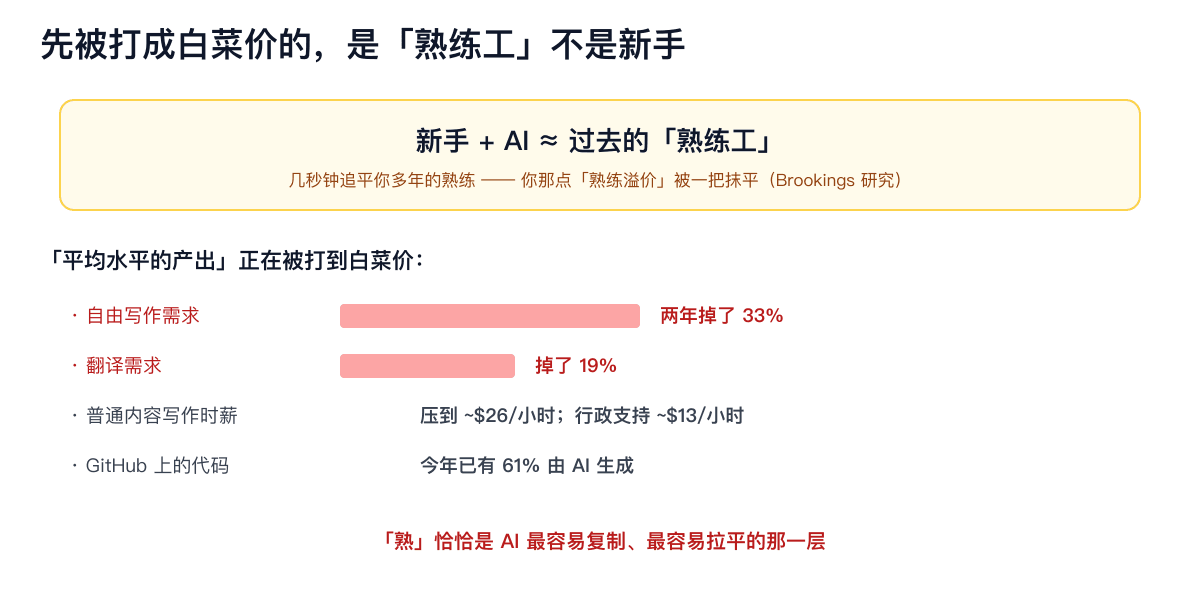
What does this mean? A novice, coupled with AI, can produce in a few seconds the "not bad" that used to take years of proficiency to deliver.
The consequences are severe. A Brookings study found that generative AI is "leveling off"-novices use AI and what they produce is close to masters, so customers are no longer willing to pay more for "high reputation" and "old qualifications." The "proficiency premium" that you are better than the novice is wiped out by AI.
Data also confirms that in the freelance market, demand for writing has dropped by more than 30% in two years, and 20% for translation; global hourly wages for general content writing have dropped to more than 20 yuan (US dollars), and administrative support has dropped to more than 10 yuan. On the code side, 60% of the code on GitHub this year is already generated by AI-the marginal value of a programmer who "writes fast and familiar" is shrinking.
You will understand when you understand this level: AI's first knife is not to cut people who "can't do it", but to cut people who "are familiar with it, but only familiar with it." Because the matter of "familiarity" is precisely the easiest thing for AI to copy and level out.
What is the increase in ## ? It's not the general "excellent", it's the layer that AI cannot level out
It's true that the other end is rising-but you have to explain clearly what is rising, otherwise it's chicken soup.
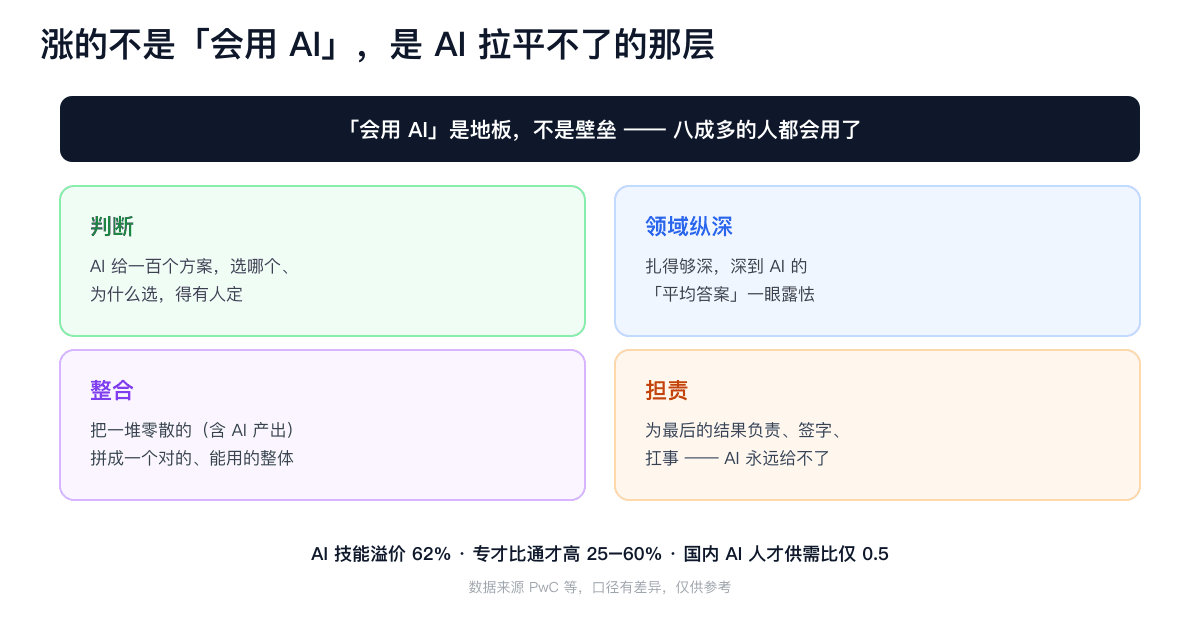
In the PricewaterhouseCoopers report, the salary premium for positions requiring AI skills reached 62%(it was 56% last year); professionals with in-depth field expertise were quoted 25% to 60% higher than generalists, and the gap was still widening. (This is also the case in China-the supply-demand ratio of AI talents is only 0.5, which is about equal to two positions competing for one person, and the median monthly salary of new graduates in large model algorithm positions reaches nearly 25,000.)
But note-- What is valuable is not the "ability to use AI" itself . Now more than 80% of people are using AI. They know how to use it for floors, not barriers. What is really increasing prices are the few things that AI cannot straighten out:
- Judgment : Know what to do and what is right-AI can give you a hundred plans, but which one to choose and why to choose must be decided.
- Depth of field : Deep enough in an industry, so deep that AI's "average answer" will show its timidity in front of you.
- Integration : Put a bunch of scattered things (including those produced by AI) into a correct and usable whole.
- Take responsibility : Be responsible for the final result, sign, and take responsibility-this AI will never be given to you.
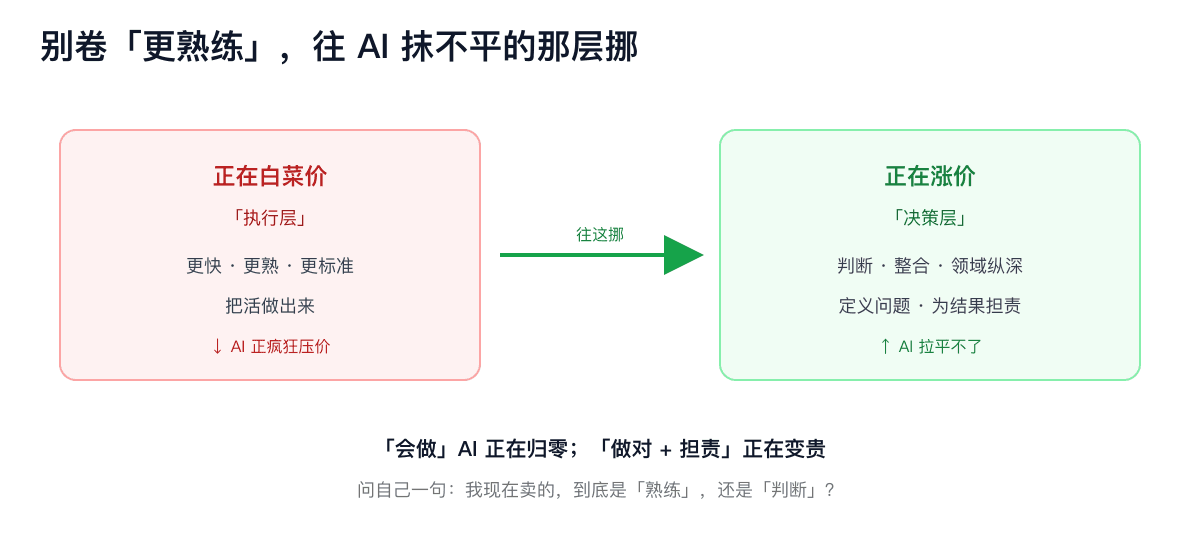
To put it bluntly, AI has turned "execution" and "proficiency" into fast-moving consumer goods, so what is valuable has shifted from "being able to do it and being familiar with it" to "knowing what to do, judging whether it is done right, and taking responsibility for the results."
A truth: Don't panic, this matter is still at the beginning
You have to be honest so you don't get scared.
As of today, in terms of total amount, AI has not caused large-scale unemployment-Anthropic, IMF, and Stanford reports all said that the overall employment gap is still small and insignificant. Change begins at the "margins": the youngest people (employment in highly exposed industries dropped by more than 10% between the ages of 22 and 25), and those jobs that are most likely to be replaced by AI.
In other words, sea levels have not risen yet, but the shore is already changing. This is not the end, it is a reshuffle-and the time to reshuffle is just when there is still time to move.
So where should you move?
Fall to specific:
Stop betting on "being more proficient". You desperately want to be faster, more familiar, and more standard than your peers-and this is the level where AI is frantically lowering prices. Proficiency is the strongest item compared with AI.
Move to the level where AI cannot level out. For the same job, spend less time on "doing the work"(let the AI do the first draft) and more time on "judging whether the work is done correctly, how to integrate it, and how to be responsible for the results." Transform yourself from an "executor" to a "person who defines problems and makes decisions."
Dive deep into a field. AI takes everything that is universal and average; the more vertical it is, the more it requires real experience and on-site judgment, the more AI cannot reach it. Depth is a rare barrier in this era that AI cannot erase.
Think of "being able to use AI" as the starting point, not the end point. Use AI to expand your production capacity tenfold, and then use the time saved to do things that only people can do.
Last
Back to the beginning of the feeling of "suddenly worthless".
It's not because you have regressed, it's because the ruler has changed. This round of AI is not simply "replacing people"-it is repricing people in : clearing "proficiency" and labeling "judgment" at a high price.
There are many people who can translate, but few can judge whether this paragraph should be translated this way and be responsible for the translation. There are many people who can write code, but few can think clearly about a complex system and bear the burden of its success or failure. People who can do "okay" are becoming free; people who can do "right" are becoming more expensive.
So stop asking "Will AI replace me?" A more useful question: Is what I am selling now "proficiency" or "judgment"? *
For the former, AI is reducing its price to zero. The latter is where you can really live in the next few years.