AI companies have suffered huge losses, but you are using it cheaper and cheaper
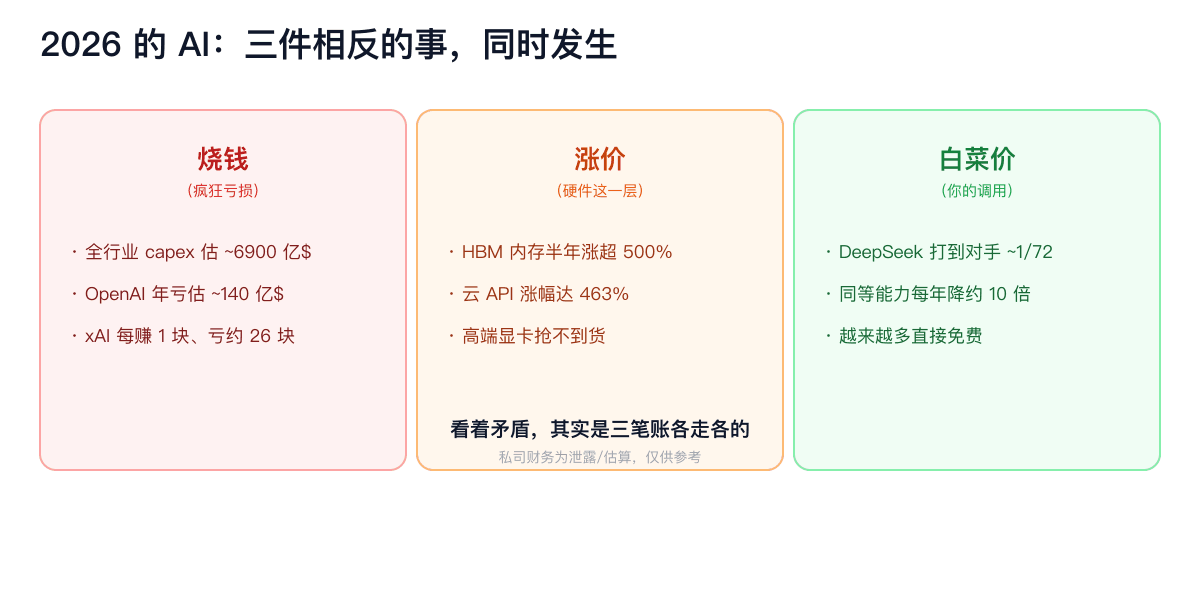
You may have noticed something weird: on the other hand, the news says that AI companies are burning money crazily and making huge losses (OpenAI is estimated to lose more than 10 billion US dollars a year, xAI earns about 26 yuan for every piece earned, and industry-wide capex estimates more than 600 billion), while the AI you use is getting cheaper and even free (DeepSeek reduces the equivalent ability to a few tenths of its opponents, and reduces its fixed ability by about 10 times every year). What is even more strange is that prices are still rising at the same time in the first half of 2026 (HBM rose by more than 500% in the first half of the year, and cloud API rose by 463%). Burning money, rising prices, and cabbage prices, three opposite things happen at the same time. This article clarifies it clearly: This is not one account, but three accounts-the training account is burning money (betting on tomorrow), the hardware account is increasing prices (selling shovels), and the reasoning account is the price of cabbage (engineering optimization + competition). Let me talk about two more counter-intuitive things: the bargain you enjoy is that "yesterday's intelligence" is being discounted, and the frontier is always expensive; and the Jevens Paradox-the cheaper, the more you spend (Uber burned out its full-year AI budget in four months). By understanding these three accounts, you will understand all the distortions in the AI industry in 2026: why prices are lowered after huge losses, prices are not allowed to survive, and the most stable ones may not be models.
You may have noticed something quite awkward.
On the one hand, the news says every day that AI companies are burning money crazily and making huge losses-OpenAI, which is doing ChatGPT, is estimated to lose more than 10 billion US dollars a year; Musk's xAI is even more exaggerated, and the figure is that for every dollar earned, it will cost about 26 yuan. The entire industry has spent more than US$600 billion on AI infrastructure this year.
On the other hand, your own feeling with AI is that it is getting cheaper and cheaper, and even more and more free. The domestically produced DeepSeek has cut prices permanently a while ago, bringing the price of the same ability to a few tenths of that of its opponent. Looking at it out, if AI reaches the same level, the price will drop by about ten times every year.
What's even weirder is yet to come: In the first half of 2026, the AI industry is actually increasing prices at the same time -Memory (HBM) has increased more than fivefold in half a year, high-end graphics cards cannot be obtained, and API prices of several cloud manufacturers have been adjusted upwards, and some increases have been exaggerated to more than four times.
Burn money, increase prices, cabbage prices. Three things in completely opposite directions occurred simultaneously in the same industry and during the same period of time.
What the hell is going on? How is the money calculated?
I went through this matter from the beginning and found that the key was only one sentence--
This is not one account at all, it is three accounts, each going its own way. ****
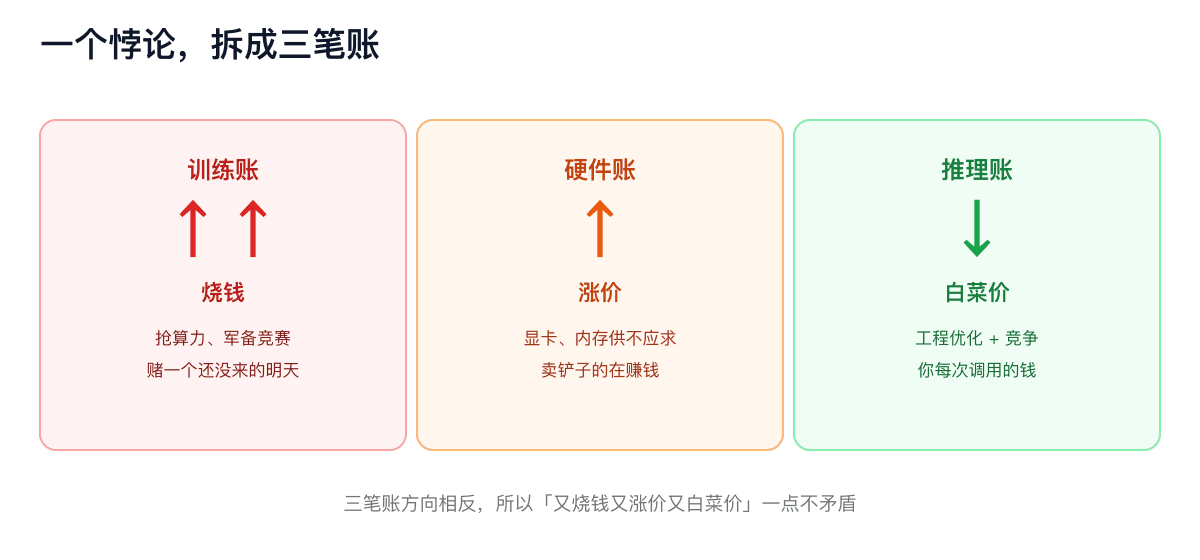
Take these three accounts apart and you will understand almost all the distortions in the AI industry in 2026.
's first account: Training, burning is to gamble tomorrow's money
Most of the astronomical figures burned by AI companies are not spent on "serving your question this time", but on training the next generation of models + competing for computing power.
This is an arms race. Whoever has the best model will win all, so no one dares to stop-desperately buying graphics cards, building data centers, hoarding computing power, betting on a future that has not yet arrived.
How scary is this money? It is estimated that the largest cloud giants alone will have a budget of more than US$400 billion in AI infrastructure this year. And it's getting hotter and hotter as it goes: There are leaked internal predictions that OpenAI's annual loss will rise from more than 10 billion yuan this year to more than 40 billion yuan in a few years.
What's worse is that this account cannot be hedged. Anthropic's CEO himself said a very honest thing (to the effect): There is no hedging method in the world when it comes to buying computing power-if you buy too much, the company will be dragged down if demand fails to keep up; if you buy too little, you will fall behind in the competition.
Therefore, the characteristics of the first account are: Gambling on the future, the more you gamble, the more you become more and more prosperous. It has almost nothing to do with how few cents you spent on AI this time.
Second Account: Hardware, the one who increased the price was selling shovels
The second account explains why the "price increase" is still in 2026.
The most reliable money in the gold rush has always been shovels. In this wave of AI, shovels are graphics cards and memory.
The demand is too strong, and the supply cannot keep up-high-end GPUs have not been available for a long time. The price of high-bandwidth memory (HBM) specifically used for AI has reportedly increased more than fivefold in half a year. Those who sell shovels (those who make chips and memory) are making huge profits, while those who buy shovels (cloud manufacturers, model companies) are severely raised.
So you will see that several cloud manufacturers have increased their prices for AI-related services, and some have increased their prices by more than four times; there are also large domestic model manufacturers that have increased their prices three times in a year.
Note that the price increase at this level is the price of computing power and hardware, not the price of terminal model calls. These two floors are in exactly the right direction.
third account: Reasoning, cabbage prices are real skills
Now we have reached the most critical and counter-intuitive point-how did the "getting cheaper and cheaper" you feel every day come about?
Let's first distinguish one thing: More than 90% of the cost of AI is actually not in training, but in reasoning-that is, the real computing power spent every time you ask and every time it answers. Training is one-time, reasoning is spent every time it is called, running for a lifetime.
The single cost at this level of reasoning has dropped structurally in the past two years. Relying on two things.
The first thing is engineering. In the past two years, the industry has spent a lot of time on "How to make model answers quickly and economically":
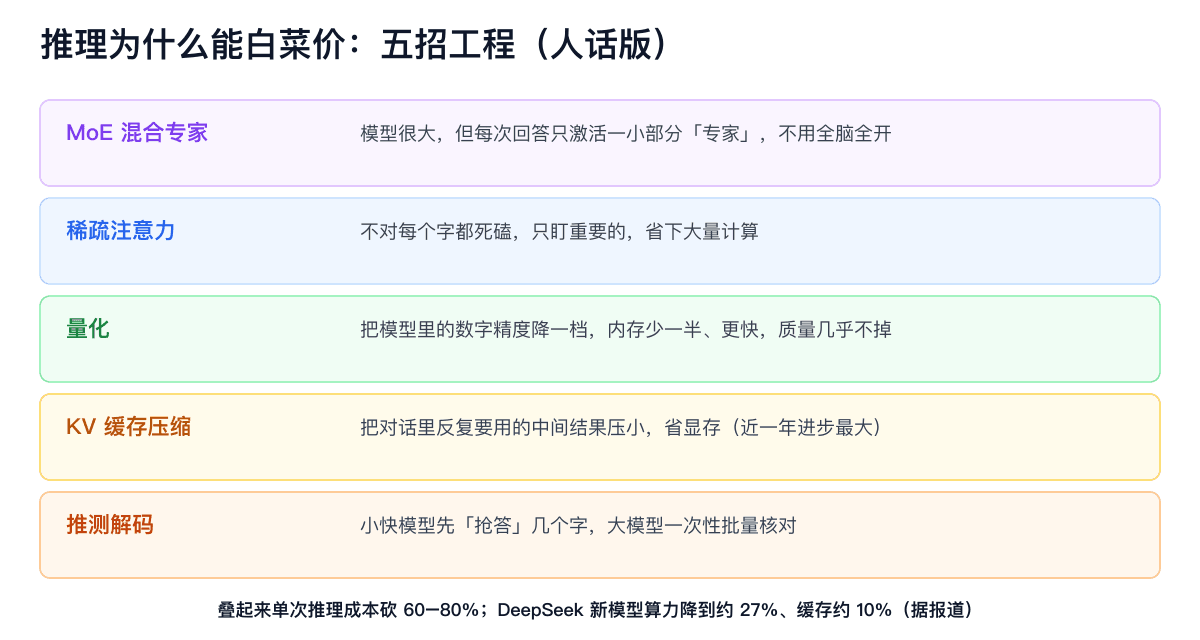
I will try my best to use people to say these tricks:
- MoE (Mixed Experts): The model is very large, but only a small number of "experts" are activated each time, so the entire brain does not have to be fully opened to save computing power.
- sparse attention : Don't let the model focus on every word, only focus on the important ones, saving a lot of calculations.
- Quantization : Reduce the precision of the numbers in the model (for example, from high precision to low precision), reduce the memory by half, the speed is faster, and the quality is almost unchanged.
- KV cache compression : Reduce the intermediate results that are repeatedly used in the conversation and save video memory-this area has made great progress from last year to this year.
- Speculative decoding : Use a small fast model to "rush" a few words first, and check the large model in batches at one time, saving the effort to hold back one word at a time.
When these moves are stacked together, the cost of a single reasoning can be reduced by 60 to 80%. The domestically produced DeepSeek is a typical example-it is reported that its new generation model has only 20% to 30% of the computing power and 10% of the cache power of the previous generation under extremely long contexts. It relies on a self-developed attention architecture (incidentally, domestic computing power is also used).
The second thing is competition. Open source models have collectively approached the first echelon this year-several open source model families have reached the level of top-level closed-source models within a few months of their release, but the price is more than ten times cheaper. This puts a hard top on everyone's offer: if you sell it too much, customers may as well run their own open source. DeepSeek took the lead in pushing prices to global lows, and Xiaomi also followed suit, and the price war broke out.
Engineering keeps costs down and competition squeezes out profits. If you clip both ends, the inferred price becomes the price of cabbage.
But there are two things you need to understand
Speaking of this, the "three accounts" have been solved: burning money is spent on training, increasing prices is due to hardware, and lowering cabbage prices is due to reasoning. There is no contradiction at all among the three floors.
But there are still two counter-intuitive things hidden in the price of cabbage. If you don't explain clearly, you will be led astray.
First: The discount you enjoy is the discount on "yesterday's smart". ****
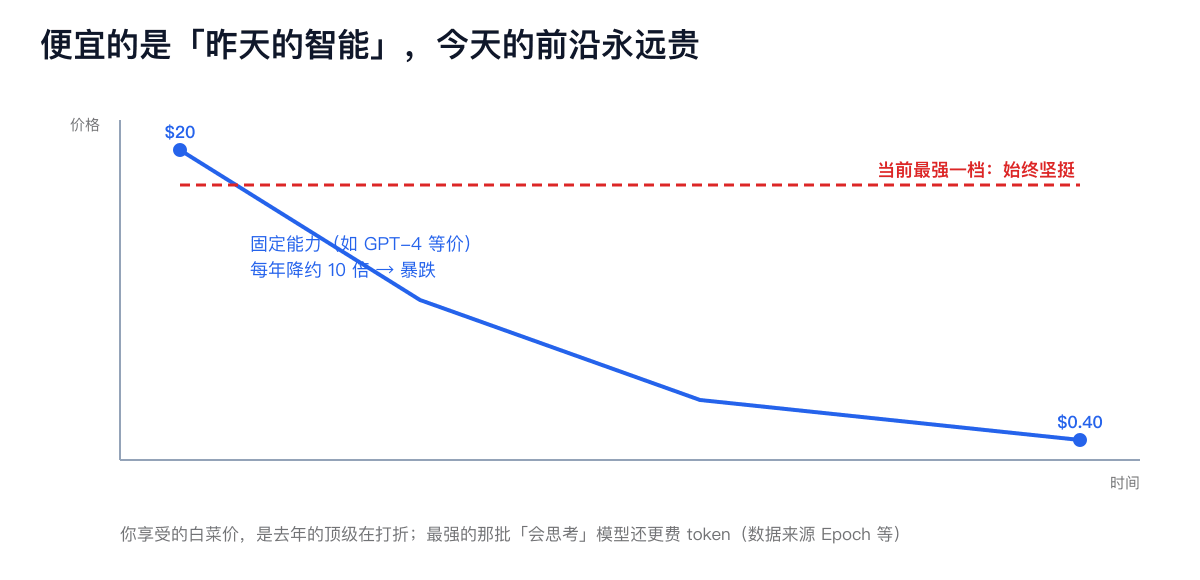
What plunged prices was the ability to "reach a certain fixed level." Last year's top models have become bargains this year-this part has indeed dropped tenfold every year. But the price of the "current strongest gear" has been very firm. Data from research institutions also confirms that the price of fixed capacity can drop dozens of times every year, but there is almost no drop in cutting-edge models.
Moreover, the strongest "thinking" reasoning models nowadays have to "think" in their minds before answering a question. These thoughts also burn tokens. So even if the unit price is dropping, if you really work with the strongest model, the bill will not be small.
Cheap things are always at the forefront of yesterday, and today's frontier will always be expensive. This is the iron law of this business.
Second: The cheaper it is, the more people spend. ****
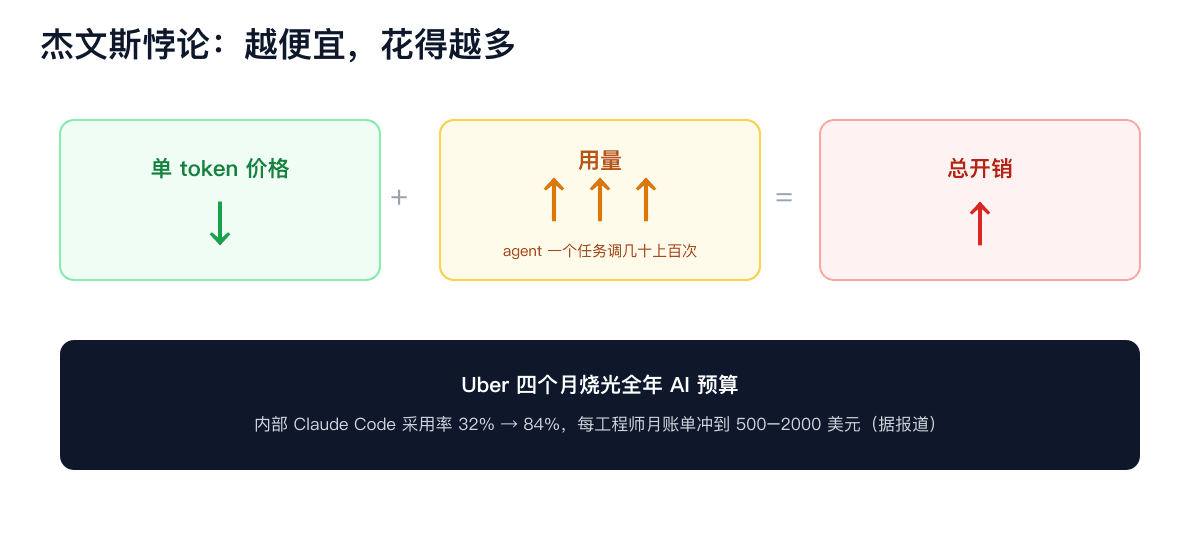
This is the famous "Jevons Paradox" in economics-the cheaper something is, the more it is used, and the total expenditure will rise instead of falling.
AI is vividly reflected here. Single token is cheap, but nowadays agents often call models dozens of hundreds of times when doing a job; long contexts and repeated self-checks will consume tokens twice. The result: Uber reportedly burned out its AI budget for the whole year in four months-because the number of people writing code internally shot from 30% to more than 80%, and the monthly API bill for each engineer rushed to hundreds and thousands of dollars.
So the "cabbage price" didn't really save anyone money, it just made the entire plate bigger. This is also the root cause of the strange phenomenon of model companies- The more customers there are, the more severe the losses : for every additional user and every additional call, it has to pay for real computing power costs.
So what does this mean to you
Stack the three accounts with these two things and implement them:
If you are someone who uses AI : Don't use the most expensive and strongest one at the beginning. Distinguish the gears-use cutting-edge models for top-notch reasoning tasks; use cheap gears for a large number of repetitive and simple tasks (even Google's CEO is urging major customers to use more cheap Flash files, saying it can save billions of dollars). Also, don't calculate by "how much money per token", calculate by "how much it costs in total to get something done"-the former is falling, the latter may be rising.
If you care where this business goes : Keep an eye on two things. The first is who can afford to burn money-they are also losing money. Some companies choose not to build their own data centers, but to rent computing power to keep the proportion of burning money low; some carry a large number of free users and cannot reduce the proportion of burning money. Those with light capital have a greater probability of survival. The second is where the price floor is-as long as the open source model can approach the forefront, the bottom of the price is "how much it will cost you to run an open source equivalent model yourself", and this bottom is still dropping by 30% to 50% every year. In other words, it will become increasingly difficult to make a lot of money by selling "universal model calls."
There is another bonus that is easily ignored : The significance of reasoning about cabbage prices is actually not to help you save money, but to unlock things that you couldn't afford before. In the past, a task tuned the model hundreds of times, fed hundreds of thousands of words of context, and asked it to self-test repeatedly-I didn't even dare to think about it because I couldn't afford it. I can afford it now. Opportunities lie in these applications that were "too expensive in the past but are now suddenly feasible."
Last
So stop worrying about "Is AI burning money or cabbage prices"-it is at the same time .
What burns is the money to bet on tomorrow, what increases is the price of the shovel sold in the middle, and what decreases is the price of the shovel sold to you today. Each of the three accounts goes in its own direction.
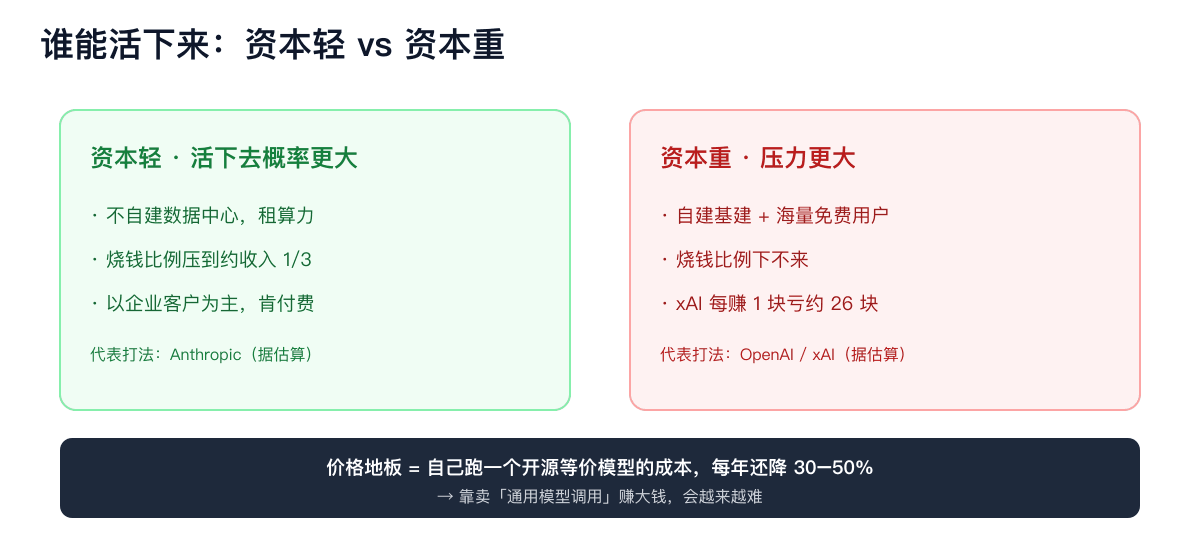
After understanding these three accounts, all the things that the AI industry looks at in 2026 will be smooth: why do we still have to cut prices for huge losses (if we don't cut prices on the reasoning account, we can't get customers if we don't cut prices), why can't we survive even if we cut prices (training accounts burn even harder), and why in this gold rush, the most reliable ones may not be those who dig gold (make models), but those who sell shovels (make chips and computing power).
Yesterday is cheaper, tomorrow is burning money. You and I are enjoying yesterday's discounts, while these companies are betting on a tomorrow that has not yet arrived.