AI Times volunteers, which major to choose will not be eliminated
The 2026 college entrance examination has just ended, and tens of millions of families have entered the volunteer season. The most anxious question for parents this year is what major should they choose for their children in the AI era so that they will not be eliminated by AI as soon as they graduate. The "Catalog of Undergraduate Majors in General Colleges and Universities (2026)" released by the Ministry of Education on April 28 gave a strong signal: 38 undergraduate majors were added at one time, and the proportion of majors adjustment in colleges and universities nationwide exceeded 10% for the first time, and the cumulative value exceeded 30%. The new focus is all on AI-related directions-embodied intelligence, brain-computer science and technology, commercial artificial intelligence, and biomanufacturing. Among them, specific intelligence has attracted the most attention. The Ministry of Education has used the "extraordinary setting mechanism" to support the opening of nine universities including Harbin Institute of Technology, Beihang University, Beijing University of Posts and Telecommunications, Shanghai Jiao Tong, and Zhejiang University. The average annual salary of industry recruitment is 333,800. But this article is not to advise you to close your eyes and pursue a new major. The core judgment is that no major can be done once and for all, and the logic of selecting a major should be changed from "selecting popular" to "selecting irreplaceable".
The 2026 college entrance examination has just ended. In the next week, tens of millions of families will have to make a decision that may affect their children's lives-to volunteer and choose a major.
One of the most frequently asked questions in the parent group this year is: AI is already like this, what major should I choose for my children so that they will not be eliminated by AI as soon as they graduate?
This anxiety is particularly real. In the past few years, people chose majors based on whether they were popular or not. Now there is a deeper layer of fear-the major that I think is popular now, will the child graduate four years later, have been killed by AI?
I reviewed this matter from three aspects: policy, data, and employment. Let's put the conclusion here first-the logic of choosing a major is really going to change this year. From the past "select hot spots" to "select irreplaceable".
Let's talk slowly next.

First look at an official signal: the professional catalog is undergoing major changes
The most authoritative indicator for selecting a major is the Ministry of Education's professional catalog. It's not the Internet celebrity who has the final say, nor is it the organization.
On April 28 this year, the Ministry of Education released the "Catalog of Undergraduate Majors in General Colleges and Universities (2026)". This catalog is very informative--
38 undergraduate majors were added at one time. The new version of the catalog covers 13 categories, 92 professional categories, and 883 majors. The most critical figure is that this year, the proportion of professional adjustment in colleges and universities across the country exceeded 10% for the first time.
What is the concept of 10%? This means that one-tenth of the professional landscape has become passive within a year. Looking at it further, during the "14th Five-Year Plan" period, 10,200 new undergraduate majors were allocated in colleges and universities across the country, and 12,200 were cancelled or suspended-more cancellations than new ones. The cumulative professional adjustment ratio over the past five years has exceeded 30%.
This string of numbers shows one thing-the university majors themselves are rapidly being rearranged by this wave of technological changes. You think that university majors are a stable structure that has remained unchanged for decades, but in fact, they are undergoing major changes every year, and since 2024, the Ministry of Education has changed the majors catalog to "updated annually."
The significance of this signal to parents is-stop looking at majors from the perspective of ten or twenty years ago. The cognition in your memory that "learning a certain major will earn money" may have expired.
has added 38 majors, focusing on AI-related
These 38 new majors are not evenly distributed. The Ministry of Education has focused on several directions around national strategies and industrial needs, and these directions are almost all related to AI.
The one that attracts the most attention is "embodied intelligence".
You may not have heard of this term, but it is actually "AI brain + machine body"-allowing AI not only to think on the screen, but to fit it into a robot that can understand the world, make decisions independently, and work in a real environment. It combines AI algorithms, mechanical engineering, biological motion principles and automated control. To put it bluntly, they are the people who build robots that can work.
The Ministry of Education attaches very little importance to this major-it has launched something called the "Extraordinary Setting Mechanism" to directly support nine universities including Harbin Institute of Technology, Beijing University of Aeronautics and Astronautics, Beijing University of Posts and Telecommunications, Shanghai Jiao Tong University, and Zhejiang University to open a unique intelligent major. Beijing Institute of Technology's personalized intelligence major was approved to recruit 120 students at one time.
Why so urgent? Because there is a shortage of people and the money is too much. According to industry data, the average annual salary of recruitment in the specific intelligence field reaches 333,800 yuan. This is a starting point that fresh graduates dare not even think about.
In addition to specific intelligence, new additions include brain-computer science and technology (opening up brain science, AI and information engineering to study how the brain and machine interact directly. Tianjin University and Harbin Institute of Technology took the lead in recruiting students), commercial artificial intelligence, biological manufacturing, digital finance, digital trade, agricultural robots.
If you add these names together, you will find a clear intention-the country is using the baton of professional catalogs to lead a large number of young people in the direction of "combining AI and physical industries."
But I have to pour cold water on it: Don't close your eyes and pursue a new major
Speaking of this, the first reaction of many parents is-that's easy to handle. Wouldn't it be enough to let their children pursue their own intelligence and AI majors?
It's not that simple. There are three pits here.
The first pit is that a new major means that there is no mature training system. In the first year of a major, teachers, courses, internships, and employment channels are all crossing the river by feeling the stones. The first batch of students were to some extent "guinea pigs". After graduating four years later, no one can guarantee the quality of training in this major.
In the second pit, hot spots will inevitably pile up, and pile up will inevitably turn cold. Today, everyone thinks that AI majors are good, and everyone is rushing forward. Four years later, this group of people graduated together, and the supply suddenly increased sharply. At that time,"bioengineering","environmental engineering" and "civil engineering" all turned from hot cakes to sinkholes-the problem was not the profession itself, but the swarm of people swarmed in to crush it.
The third pit, which is also the most fundamental one, is evolving too fast. The specific skills taught today may be mastered by AI itself four years later. If a major teaches "how to use a certain AI tool" and "how to write a certain code," its half-life may be shorter than four years.
Therefore,"closing your eyes to pursue AI majors" is not the answer.
What are the criteria for judgment?
I have thought about it myself that when selecting a major in the AI era, the core criterion should be changed from "whether this major is popular" to "whether it is difficult for AI to replace the abilities cultivated by this major."
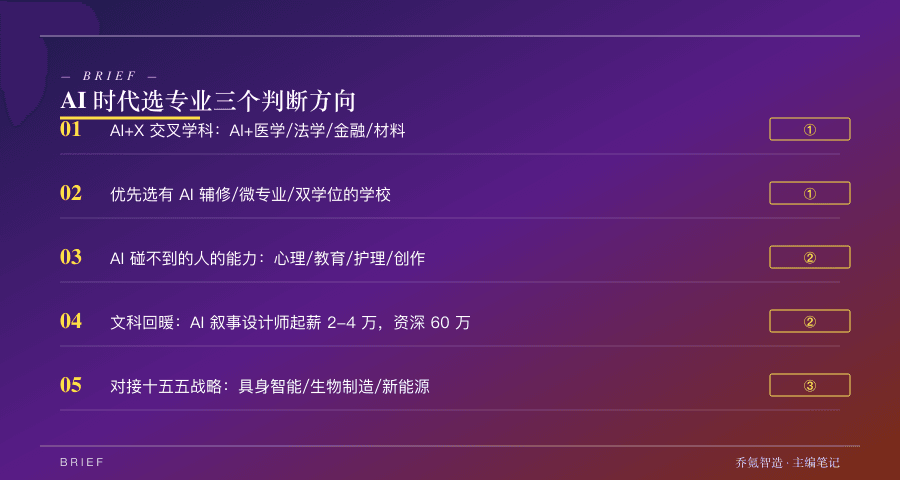
Following this standard, there are three types of professional directions worth focusing on.
The first category is "AI + X" interdisciplinary.
The most stable thing now is the intersection of AI and traditional majors. AI + medical imaging, AI + law, AI + finance, AI + materials. The reason is very simple-there are many people who specialize purely in AI, and there are many people who specialize purely in medicine and law, but very few people "understand both AI and a specific industry." AI itself cannot replace this kind of compound ability, because it requires AI capabilities to be applied to real problems in a specific field, and the judgment and experience in this process are human.
The advice is very specific-regardless of whether children study literature, science or medicine, priority should be given to schools that offer AI minor, micro-major, and dual degree. Let children have an AI tool in their hands in addition to their main majors.
The second category is "human capabilities" that AI cannot reach in the short term.
There are some abilities AI cannot really learn in the short term-complex interpersonal collaboration, cross-cultural communication, relationships that require long-term accumulation of trust, services that require the presence of a real body, and creations that require aesthetic and taste judgment. Psychology, education, high-end nursing, complex negotiation, and artistic creation may not seem high-tech, but they are precisely the most difficult tough bones of AI.
There is a particularly counter-intuitive phenomenon worth mentioning here-liberal arts students are quietly warming up in the AI era. According to media reports, at the spring 2026 job fair, leading technology companies opened a large number of high-paying positions for liberal arts students, such as "AI narrative designers","large model humanities trainers" and "AI ethics researchers". The starting salary is generally 20,000 to 40,000 yuan, and the annual salary of a senior can reach 600,000 yuan. Why? Because the stronger the AI model, the more people who understand humanities, narrative, and ethics need to "train" it and set its direction. Technical capabilities AI will increase by itself, but it depends on people to "adapt technology to people's value."
The third category is to align with the direction of the country's long-term strategy.
2026 is the beginning of the 15th Five-Year Plan. The new majors added by the Ministry of Education this time essentially tell you in advance "what the country will focus on development in the next ten years." Specific intelligence, biomanufacturing, new energy, deep earth science-these are the directions in which the country needs to invest long-term resources. Choosing these directions is equivalent to standing on the long-term increase in the industry, and the plate of employment will continue to grow.
By the way: Use AI to volunteer, be careful
There is also a new phenomenon this year-major factories are all volunteering for AI newspapers. Ali Quark, Tencent Yuanbao College Entrance Examination Pass, Baidu, and Byte Doubao all went to the AI volunteer filling tool. According to Ai Media Consulting, the entire college entrance examination volunteer filling market is estimated to have a scale of 1.09 billion. Now, the filling system without a large model has been regarded as a "backward product."
These tools are used for information integration and preliminary screening, and are indeed efficient. But don't believe it all.
There are several real pits-the same score is input into different AI platforms, and the recommendation results may be far different, because there is no official standard for "stability or instability", and each family takes its own photos. AI can also have illusions. There have been mistakes that deviate by hundreds of places in admission rankings, which is enough for a candidate to slip directly. In addition, AI's recommendation logic relies too much on score matching. The same plan will be pushed to a large number of candidates with similar scores. As a result, everyone will flock together in niche majors that only recruit one or two people, which will reduce the probability of admission.
Some education scholars have put it right-it must be irresponsible for any organization to claim that after connecting to AI, its volunteer ability is stronger than that of human planners.
AI reports volunteers, which can be used as an auxiliary reference, and is the only basis for decision-making. It is dangerous. Be sure to cross-check multiple platforms and combine official data with human judgment.
Last
Simply looking at it, it is a family's choice.
Digging down one level, the Ministry of Education is using the baton of professional catalogs to lead a generation of young people in the direction of "combining AI and physical industries"-38 new majors, with an adjustment ratio of more than 10%, and updated every year. This is the fastest rearrangement of the university's professional structure in decades.
Digging further down, it is the wave of technological changes in AI that are redefining "what capabilities are worth." What was valuable in the past was "mastering a certain professional skill", but what was valuable in the future was "the part of the ability that AI cannot replace"-cross-cutting, judgmental, aesthetic, and requiring the presence of real people.
So if I only give one sentence of advice, it's like this--
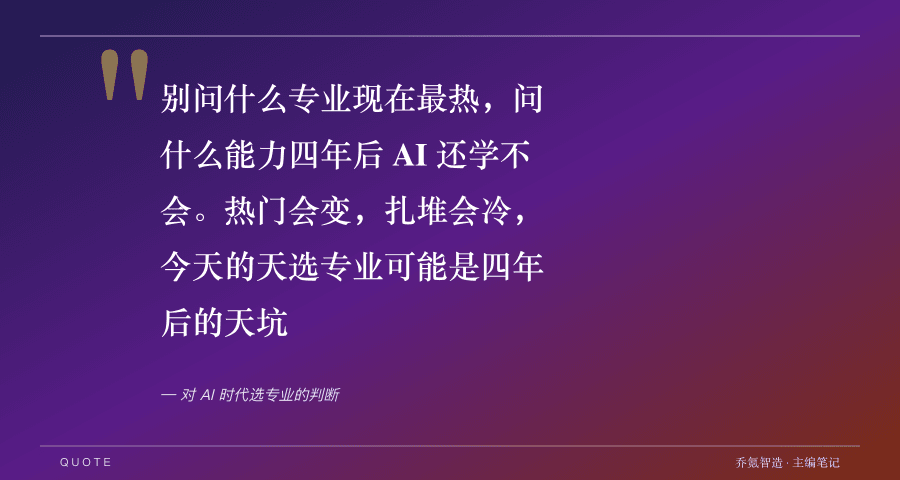
Don't ask "What major is the hottest now", ask "What ability will AI not be able to learn in four years?"
Popularity can change, and getting together will get cold. Today's Tianxuan major may be the Tiankeng four years later. However, the standard of "AI's ability to be difficult to replace" can survive this wave of technological changes and is relatively stable.
What you choose for your child should not be a professional name that "sounds very powerful now." It should be an ability that "will not be easily replaced after four or ten years."
This matter is more important than chasing any hot spots.