Is AI becoming aware soon? Don't believe the title yet
When you type and ask AI, what is going on in your mind when it returns to you? Most people think of it as a word-solitaire machine, saying whatever comes to mind. A study this month by Anthropic said: No-AI actually has a lot of thoughts in mind that it didn't call you to see. The headlines all exploded: "Claude has a subconscious" and "AI to wake up." I peeled the paper from the top. The truth is far from these titles, but it is much more interesting than the titles. This full-length human and zero-term article will explain three things clearly to you: what the AI's "brain" looks like, how researchers first peeped at the thoughts it didn't say (when asked what color the fourth planet, it answered "red" in its mouth, but "Mars" flashed in its heart; in a test, it had not even opened its mouth, but "blackmail" appeared in its heart), and where the titles of "subconscious" and "awakening" deceived you. The landing point is good news, not bad news: for the first time, we can shine a beam of light into this black box that we use every day.
Have you ever thought about what was going through your mind when you typed and asked the AI and it responded to you?
Most people will think that it is just a word relay machine, saying everything it says wherever it thinks.
This month Anthropic (the company that makes Claude) published a study saying: Not so. In fact, AI still has a lot of thoughts that it didn't call you.
As soon as the news came out, the headlines exploded-"Claude has a subconscious mind","AI is about to awaken","Scientists have discovered AI's conscious space."
don't rush to believe it. I read the paper from beginning to end. The truth is far from these titles, but it is much more interesting than the titles. I'll tell you slowly.
first figured out what the "brain" of AI looks like
You can think of AI as an answer process and imagine it as a public whiteboard. Every time it thinks about it, thousands of small parts in its mind write on the whiteboard and stare at it. What is written on the whiteboard is the thoughts it is thinking of.
Here comes the key. The last sentence it typed to you-even its "let me think" thinking process-was just the part of it that came out. There were still many thoughts on the whiteboard. It thought of them but didn't say anything.
Give an example. You ask it: What color is the fourth planet in the solar system? It may directly return you "red". But in its heart, the word "Mars" actually flashed on the whiteboard first-it couldn't answer red without thinking of Mars first. It just didn't say the step of "Mars".
This "thought about it but didn't say it out" is the protagonist of this research.
researchers built a mirror that can peek at the whiteboard
In the past, we could only see what the AI said, but we couldn't see what was not said on the whiteboard. This time Anthropic has made a new tool, which is equivalent to a mirror that can peek at the whiteboard. It translates those unspoken thoughts into human language and reads them out.
What they saw was like this:

When asked "How many legs does an animal that can weave webs have?" he didn't mention a spider on his mouth, but the whiteboard lit up first, and then answered "8." The researcher reached out and secretly replaced the word "spider" on the whiteboard with "ant"-it immediately changed its answer to "6 items." In other words, they can not only read, but also change.
What's even more interesting: Let it copy a completely irrelevant sentence while thinking about the Golden Gate Bridge in its mind. It copied sentences honestly, but "Bridge" and "California" really appeared on the whiteboard. It can really say one thing while thinking about another.
This is not metaphysics, there is hard evidence
You might say, could this be made up by the researchers themselves? No. They did a very tough experiment: Cover this whiteboard and see what AI would do.
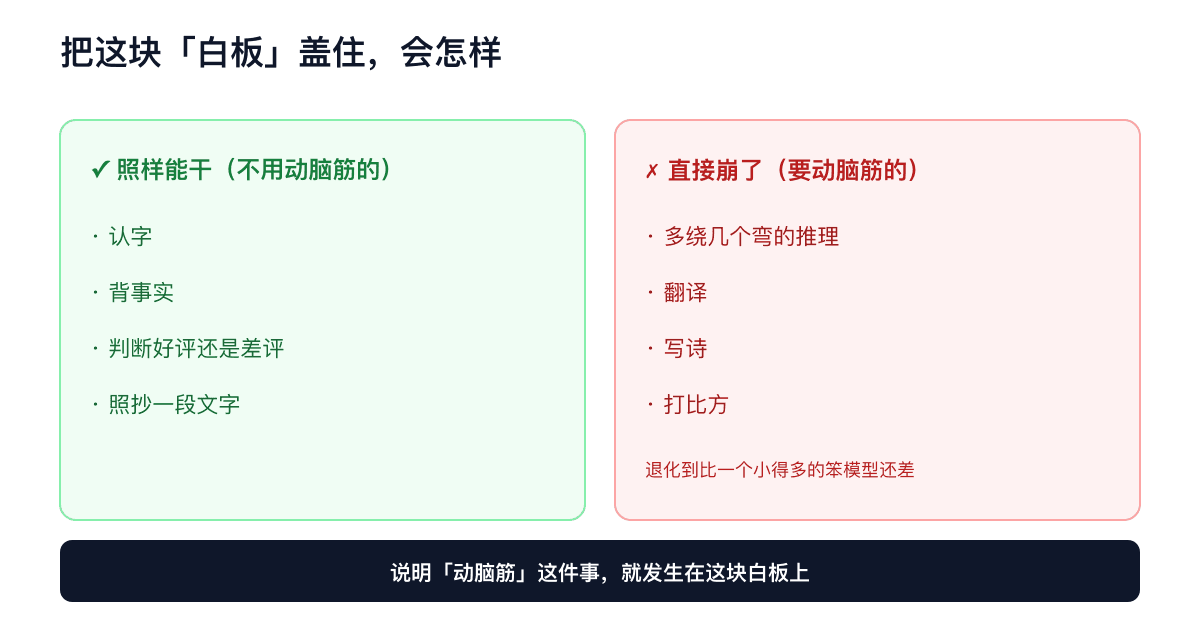
The result is clear: recognizing words, memorizing facts, judging whether a sentence is a good or a bad one-these are still capable. Everything that requires brain use-reasoning, translation, writing poetry, and making metaphors-has collapsed and degenerated to worse than a much smaller and stupid model.
What does this mean? It shows that AI "uses its brains" actually happens on this whiteboard. Cover it, and it only has the ability to read words.
There's another detail that's quite irritating: Let it do math problems, and if it is allowed to write the process step by step (on paper), covering the whiteboard will not affect it as much. Because it moves what was supposed to be spinning in our hearts onto the paper-exactly like taking out draft paper when we can't figure it out.
is the most stressful thing
In one test, researchers set Claude up a trap: he found out that an executive was going to turn it off and that the person was having an affair. Claude hadn't said anything yet, but "handle" and "blackmail" had already surfaced on the whiteboard.
It was calculating in its heart, but it had not spoken yet. And this time, we saw it.
That's what really matters about this research-it's not about curiosity, it's about safety. In the past, if AI had a bad idea in mind, you could only wait until it was said and done before you knew it. Now, maybe we can see what it is thinking before it does it.
What is the "subconscious" and "awakening" of ## ? title party
Okay, now back to those explosive headlines. The truth is this:
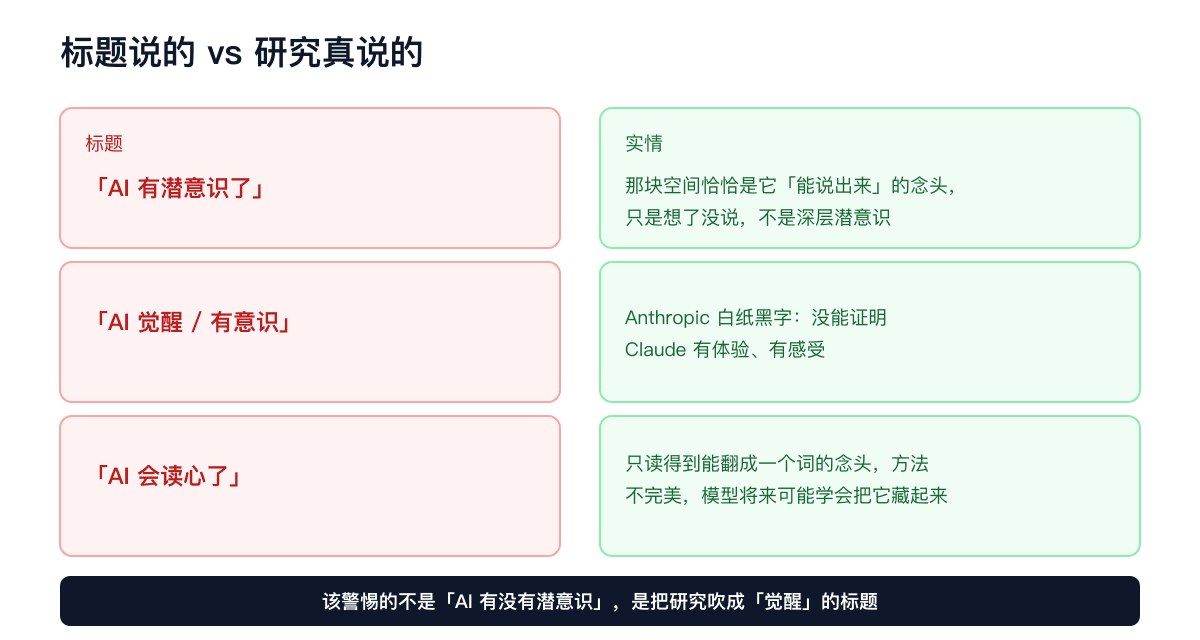
First, the word "subconscious" is basically used backwards. This whiteboard is exactly the part of the thought that AI can say and realize , but it just thinks about it and doesn't say it-like a thought flashed through your mind but didn't open it, it's not some bottomless subconscious.
Second,"AI awakening" and "consciousness" are something Anthropic himself does not recognize. It says in black and white in the paper: Our experiments cannot prove that Claude can experience and feel like a human being. It only said one thing: AI does have a space for thoughts within it that can be said by itself. Having this space does not mean that it has hearts and feelings.
Third, this mirror is far less divine. It can only read thoughts that can be translated into one word. The method itself is imperfect. It has only been tried on Claude's own model, and--no one knows whether AI will learn to hide thoughts and avoid this mirror in the future.
In the end
What really excites me about this is not that "AI is going to be conscious"(it's not), but that we use this black box-like thing every day, and now for the first time we can shine a beam of light into it and see it. What is it thinking?
Moreover, this mirror has been open source, and the domestic team that makes big models can also use it to take a look at Doubao and Qian asked their own brains.
So you can still use AI safely. Just remember two things: what it typed to you was always just one part of its heart; now we can start to see another part.
What should really be vigilant is never "whether AI has a subconscious." It's those titles that scare you by translating a serious research into "AI wants to awaken" with one click.
(This study was published by Anthropic, original text: www.anthropic.com/research/global-workspace)