AI solves 50-year-old mathematical problems in one hour?
On July 10, OpenAI threw out a PDF: The latest model GPT-5.6 Sol Ultra was used in less than an hour and parallel with 64 sub-agents to produce the "Circular Double Coverage Conjecture"-a graph theory problem that has not been solved for 50 years-machine-verifiable proof-, and the signature is directly given to the model itself. Social media exploded instantly: AI is conquering mathematics and replacing mathematicians. I went through this certificate and the controversy it caused, and what I want to say is: This is indeed a milestone, but it's not what the hot search means. The most interesting thing is precisely the most difficult and neglected hurdle between "AI says proves" and "mathematical recognition"-machine verification can only ensure that "logic does not jump" and cannot ensure that "you formalize what is the original proposition", and it cannot ensure that "people can understand and understand why it is right." This scene was staged 50 years ago (1976's Four-Color Theorem, the first computer-aided proof, which has been debated in the mathematical community today). The real breakthrough is not "which question was proved", but "how was proved"-64 sub-agents parallel searches + an undeceived validator. This article explains it clearly.
On July 10, OpenAI threw out a PDF with a scary title: Its latest model, GPT-5.6 Sol Ultra, less than an hour , produced a proof of the "Circular Double Coverage Conjecture"-a mathematical problem that no one has solved for 50 years. The signature column directly writes the model itself.
Social media exploded instantly: AI conquered mathematics! AI is replacing mathematicians!
I went through the certificate and the controversy it caused. What I want to tell you is: This incident is indeed a milestone, but it is definitely not what you see on the hot searches. The most interesting thing is precisely the most difficult and neglected hurdle between "AI says proved" and "mathematical recognition".
Speak slowly.
first figured out: What does it "prove"?
Let's talk about this question first. The cyclic double cover conjecture was proposed by two groups of mathematicians in 1973 and 1979 respectively. It is recognized as one of the most important open problems in graph theory. What it says is not complicated: for any network diagram with "no broken bridges", you can always find a set of rings so that every edge is covered and exactly twice. It sounds simple. I haven't been certified for 50 years.
OpenAI said that GPT-5.6 uses a very special method: instead of a model immersed in hard calculations, sent 64 "sub-agents" to search for in parallel, and a copy of the certificate was completed within an hour., and it was a "machine-verifiable"*.
The five words "machine verifiable" are the key to the whole matter and the most easily misunderstood place.
What does ## "Machine Verification" prove and not prove anything
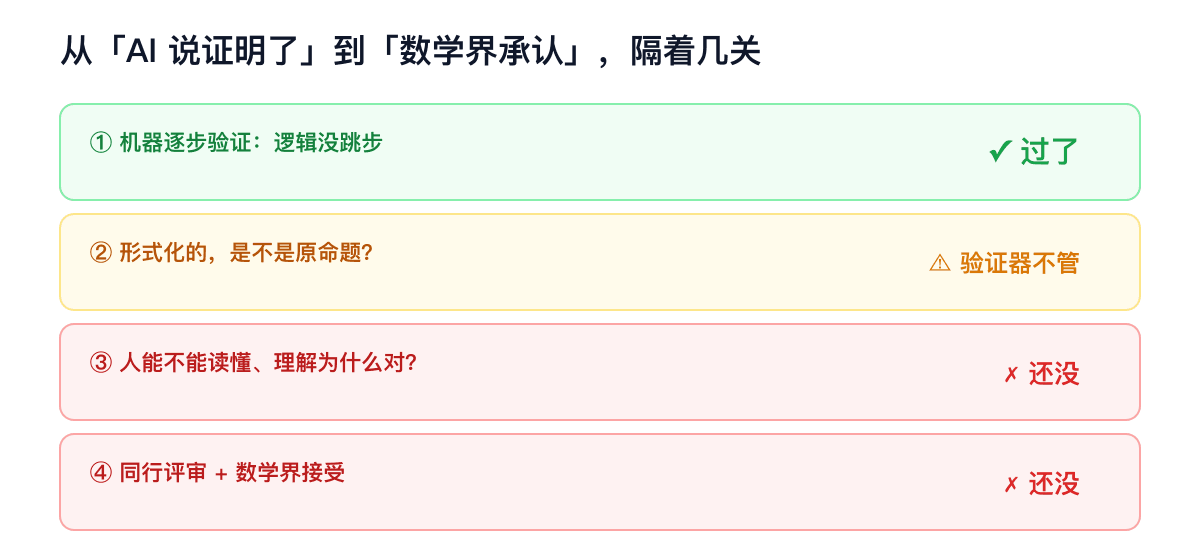
You can understand "machine verification" as: the proof is translated into an extremely strict formal language, and then checked step by step by the computer to confirm that every step is extrapolated from axioms without any logical jumps. In this regard, computers are much more reliable than humans-people will misjudge, but validators will not.
Doesn't that sound like a certainty?
Not so fast. Machine verification can ensure that "the logic is correct," but it cannot guarantee two other more fatal things:
First, what you formalized is the original question? The validator only checks whether "this string of symbols can deduce that string of symbols" and does not determine whether "this string of symbols is really equal to the cyclic double cover conjecture." If the translation step into formal language is to write the proposition a little more skewed and relax the conditions a little more, the validator will still say "pass"-it checks what you feed it, not what you think in your heart. question.
** Second, can people understand it and understand why it is right? * This is the core thing in mathematics. What mathematicians never want is just "this conclusion is right", but "why is it right"-an insight that can make you realize it and can be used elsewhere. A certificate that only a machine can start and cannot be read at all, even if its logic is impeccable, does not bring what it wants most to the mathematical community.**
The scene of ## was staged once 50 years ago
Speaking of this, I have to mention a particularly similar history.
In 1976, the four-color theorem was proved-the one that "any map can make adjacent areas have different colors by using only four colors." It was the first major mathematical proof that was produced by a computer, breaking the problem into thousands of situations and letting the machine test it one by one.
What happened? The mathematics community was in a row. Many people refuse to admit it. The reason is not that "it is wrong", but that " People cannot finish reading and test it. Can this be called proof? " In a sense, this debate has not completely subsided to this day.
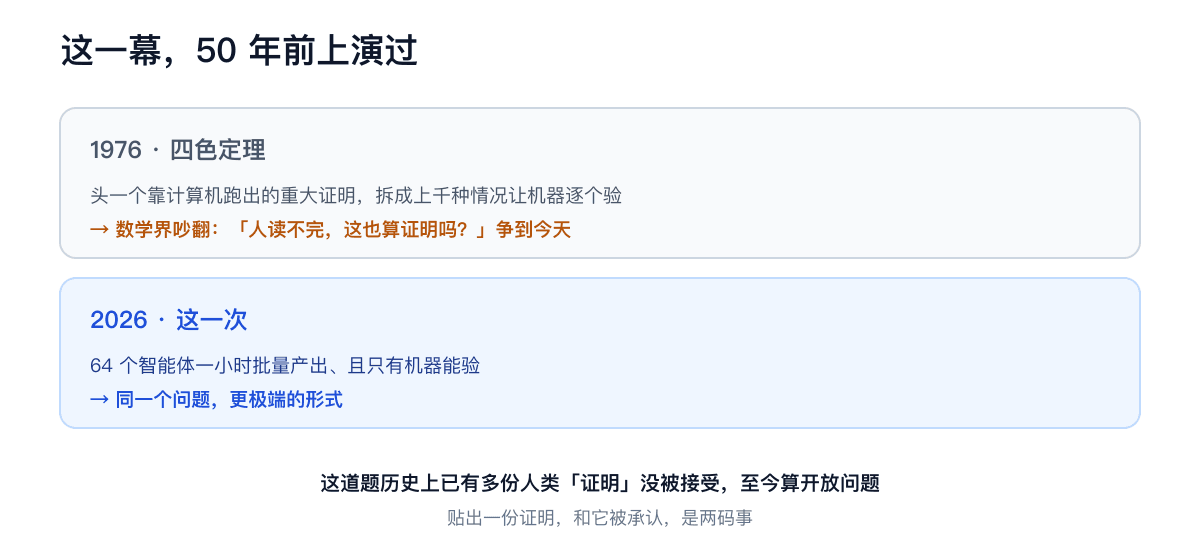
Half a century later, AI put the same question on the table in a more extreme form: when a proof can be produced in batches by 64 agents in an hour and only machines can verify it, how much of the word "proof" is left for people?
Not to mention, the problem of circular double coverage itself has had several preprints of "proof" written by humans in history, but none of them were accepted by the mathematical community in the end-it is still regarded as an open problem. Posting a certificate and being recognized are two different things. The most difficult test is in between.
So, where is the new thing?
Don't get me wrong, I'm not here to pour cold water and say "AI can't work." On the contrary, there is something more valuable in this matter that is covered by the hot search for "conquering mathematics":
What is really new is not "What question did AI prove?" It is "How did it prove?"*
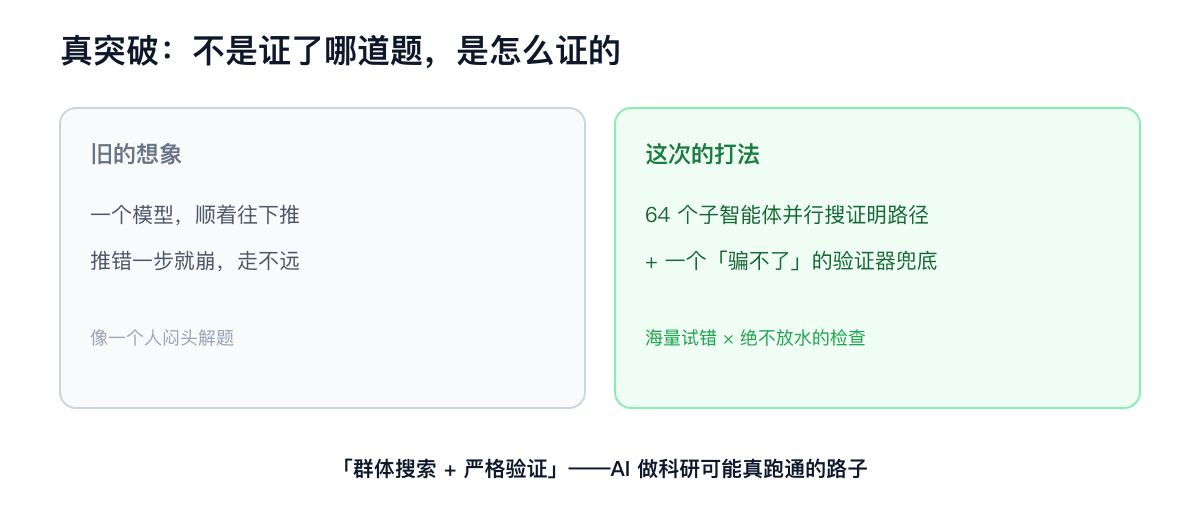
In the past, when we imagined AI doing mathematics, it was a model that was pushed down, and if it was pushed wrong, it would collapse. The style of play this time is completely different: 64 sub-agents searched for possible paths of proof in parallel, and then used a "logically undeceivable" formal verifier to cover the situation. On the one hand, there is a massive search that allows trial and error, and on the other hand, there is an inspection that will never be released. This combination of "group search + strict verification" is the way that AI may really work through in scientific research.
It means that the role of AI is changing: from "answering your questions" to "helping you search for answers that humans have not yet found." And the role of the person changes-to the person who asks good questions, translates them accurately, and ultimately understands why the answers are right.
After all
AI "proves" a 50-year-old problem in one hour. Every word of this sentence is correct, but the meaning when combined is different from what you first thought.
It does not "solve mathematics." What it did: For the first time, in a completely new way-group search and machine verification-it produced a logically valid proof. Whether this proof can truly enter the realm of human mathematics has to pass the most difficult hurdle: It will be understood, convincing, and understanding why it is right.
At this level, machines cannot replace people for the time being. Because of this, the work of mathematicians has not been replaced, but has been pushed further: to ask questions worth proving and to understand the answers that machines bring back.
The most important thing is never "AI has proved another problem." For the first time, we have to seriously answer a question that was buried decades ago-what should we do with machines that can give truths that humans cannot read?