Can I use free AI pictures at will? I opened it and looked
Can I just use the AI diagram generated for free? I adjusted the free cultural graphics interface once, and "AI Generation" was posted in the lower right corner of the graphics. I thought it was a free file treatment. When I opened the file, I found that there was an AIGC JSON lying in the metadata: the business license number of the generator and the serial number of this picture, not a single one was missing. It is still there when the watermark is cut, and it is still there when it is converted. This is not anyone who is stingy.
Can I just use the AI diagram generated for free?
I kept vague about this question until yesterday when I really went to take a look at what was in the picture.
Yesterday, I attached pictures to an article, but I was too lazy to draw it myself, so I directly called the free Wensheng picture interface.
The picture is out. I glanced at the returned address and froze for a moment:
maas-watermark-prod-new.cn-wlcb.ufileos.com
  /20260807193416eefdc669be4f4f4f_watermark.png
Watermark is written in the domain name, and watermark is also written in the file name suffix.
Open the picture and see that there is indeed a small piece with rounded corners on a gray background in the lower right corner, with two words in white: AI generated .
My first reaction was quite vulgar-it's free, if a watermark is normal, the paid version should be gone.
Then I took the picture down and peeled off the document itself. Only then did I discover that the visible watermark was the least important part of the matter.
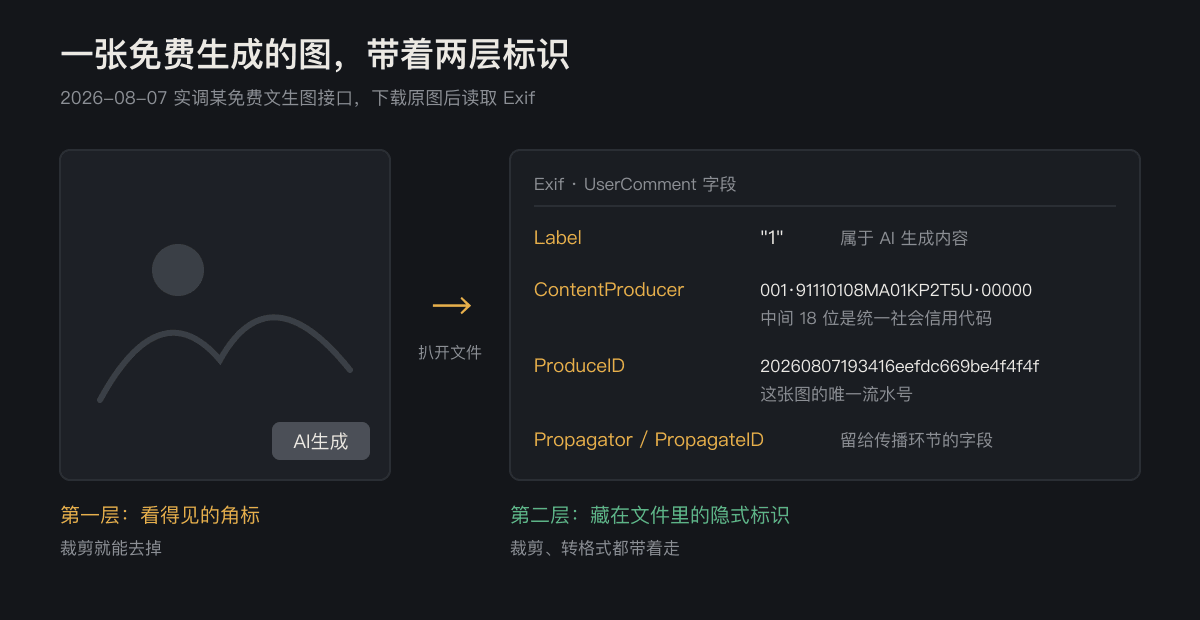
There is a JSON lying in the ## file
Reading the metadata of the picture (that is, the one in the file header that records the source, parameters, and shooting information, and the time and location in the photo of your phone are also stored here), there is a field called UserComment, which contains something like this:
{"AIGC":{
  "Label":"1",
  "ContentProducer":"001191110108MA01KP2T5U00000",
  "ProduceID":"20260807193416eefdc669be4f4f4f",
  "ContentPropagator":"001191110108MA01KP2T5U00000",
  "PropagateID":"20260807193416eefdc669be4f4f4f",
  "ReservedCode1":"64ee","ReservedCode2":"b057"}}
Remove one by one:
Label is 1, which means that this belongs to AI-generated synthetic content.
The 18 digits 91110108MA01KP2T5U in the middle of ContentProducer are a series of unified social credit codes, which is the number on the company's business license. The corresponding one is the company main body of Beijing Zhipu Huazhang. 110108 is the administrative division code of Haidian District, which matches its registered place.
ProduceID is the number of this picture, which is exactly the same as the string in the file name. In other words, this picture has its own serial number.
The last two Propagator / PropagateID are fields reserved for the dissemination process.
So when this orange cat illustration was shipped from the factory, the manufacturer wrote its business license number into the document together with the unique number of the picture.
I stared at the credit code for a while. It's not that I don't think it should be here, but I didn't expect it to be written so realistically.
What will happen if I cut the watermark?
This is what I want to know most. After all, when normal people see a watermark, their first thought is to cut it off.
I took this 1024×1024 picture to do three things, all of which ordinary people can really do:
The first is to cut off the bottom 124 pixels and cut off the entire watermark in the lower right corner; the second is to change the format and save it as PNG; and the third is to use tools to actively empty the metadata.
The result is this:
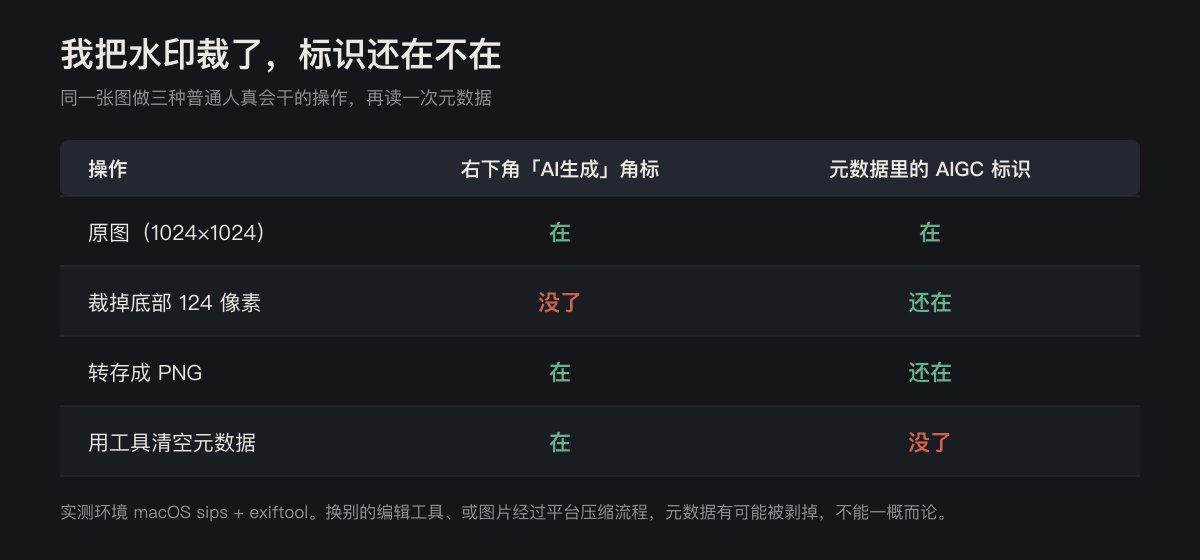
Cut and rewrite the pixels, transform the format and change the entire package, and the JSON still follows. Only the third type-specifically clearing metadata-is really gone.
I have to make the boundaries clear here, so that you won't follow my conclusions: I use sips that come with macOS. If you change it to other editing tools, or if the image goes through the compression process of some platforms, the metadata may be stripped. This cannot be generalized. But at least the intuition that "cut off the watermark and it will be clean" is wrong.
As for the third approach, its nature is completely different, so we will talk about it later.
This is not a stingy person
I originally thought it was a free benefit, but after checking it, I found that I was wrong.
In March 2025, the State Administration of Cyberspace Technology, the Ministry of Industry and Information Technology, the Ministry of Public Security, and the State Administration of Radio, Film and Television jointly issued the "Measures for Identification of Synthetic Content Generated by Artificial Intelligence", supporting a mandatory national standard GB45438 -2025, ** September 1, 2025 Effective . It has been almost a year now.*
The method divides logos into two categories. I think this division is the skeleton of the whole matter:
Explicit identification solves "what content is generated". It is the corner, text, and prompt that you can see at a glance, which requires that the content must be retained with it when downloading, copying, and exporting. The national standard also has size requirements for it. The height of the text on the picture must not be less than 5% of the shortest side of the picture.
Implicit identification solves "who generated it, who passed it on." The method is to write the name of the generator or production elements such as code and content number in the file metadata, and encourage the addition of digital watermarks.
The JSON section I found matched the second category accurately.
So that corner mark is not a platform stingy, but a legal action. Payment will not disappear because of this-Article 9 of the method leaves a clause: after the user clearly applies and the service provider clearly defines identification obligations and use responsibilities in the agreement, it can provide content without explicit identification. Note that this is transferring the responsibility to you, not wiping the logo clean. The hidden part remains.
Forty years ago, printers did this
This set of methods is not new at all.
In the mid-1980s, Xerox and Canon put one thing in color laser printers: on each printed paper, a layer of tiny yellow dots invisible to the naked eye, encoded the machine's serial number, and some also carry the printed date and time. It only becomes visible under a magnifying glass or under blue light. The original intention of doing this was to fear that color copiers would be used to forge banknotes.
This matter was never known to the public until 2004. In 2005, the Electronic Frontier Foundation (EFF, an American digital rights organization) solicited netizens to send printed samples, deciphered the dot matrix, and also released the analysis script. Later, it was discovered that this was not a quirk of individual models, but a common feature of almost the entire product line.
When I put these two things together, the common denominator is very clear: The output device writes down who it is in the product , and the user basically has no knowledge of it. The purpose is to prevent counterfeiting and keep traceability.
The differences are more interesting. Yellow dots are something that manufacturers have been doing for 40 years without telling anyone;AI content identification is something that is written in black and white into the national standard and requires you to explain it clearly in the user agreement. One is dark and the other is bright.
From this perspective, the current set of rules is actually more generous than the printer's. At least it tells you.
Why ## can only go this way
It is worth thinking more about this: Why did the supervision choose to "write the logo on the generator side" rather than "do the detection on the platform side?"
My opinion is that testing itself is not feasible.
To judge whether a picture was drawn by AI, we can also rely on finding flaws in the early days-the number of fingers is wrong, the text is blurred, and the relationship between light and shadow is awkward. However, each time the generative model is iterated, there are fewer of these flaws. Letting the detection model chase the generation model is to target something that is improving every day. It is inevitable that you will not be able to catch up, not because you don't have enough effort.
And there's a more troublesome place here: testing can only give probability, not source. At most, it will tell you that "87% of this picture looks like it was generated by AI" and cannot tell you who generated it or when. It can be traced back to this fact that it will never be possible to do just by looking at the pictures themselves.
So there is only one way left- The moment something is created, let the person who created it write his identity in it. Responsibility moves forward to the generation side, and the platform side is only responsible for reading and verification. This is the same idea as the food traceability code and the electronic drug supervision code: it is not expected to be tested on the supermarket shelves to find out where the meat came from, but requires it to carry a number when it comes out of the slaughterhouse.
After I figured this out, it wasn't surprising to write the string of credit codes into my cat chart. It's the slaughterhouse number.
is written regularly and read scribbled
The interesting part is here.
The generator executed it quite seriously-I randomly adjusted a free interface, and there was no shortage of explicit and implicit identifiers.
The communication end is another matter. According to public reports, on the first day of implementation of the new regulations, someone conducted actual measurements and transmitted AI-generated content to several mainstream content platforms. As a result, none of them were automatically recognized and marked with superscripts. Some platform parties responded that they could not verify the metadata information of the work. Currently, they mainly rely on their own technical testing to determine whether it is suspected of being AI generated, and their recognition capabilities are limited. In subsequent reviews, we can also see that the proactive declaration function entrances on many platforms are deeply hidden, and the omissions are concentrated in ultra-realistic portraits and comics.
So the real situation now is quite divided: Your picture is circulated online with a complete factory identity, but the receiving end is often not checked.
I don't think this window will last forever.
At the end of April 2026, the Central Cyberspace Administration of China deployed the special action of "Clearing Up and Rectification of AI Application Chaos." Among the seven key issues in the first phase, the fifth category is "insufficient implementation of generating synthetic content identification", which clearly points out Two things: The professor's tutorial information on removing AI logos and providing illegal "de-identification" tool services . The results of the first phase announced on July 6 included the disposal of more than 14,000 illegal AI products, the clearing of more than 6 million pieces of illegal and illegal information, the disposal of more than 26,000 accounts, and the removal of more than 1300 illegal AI products. In June of the same year, a "Special Zone for Reporting Chaos Related to AI Applications" was also opened.
Back to the third experiment I did earlier. Actively clearing metadata is technically a matter of command, but the method is very straightforward: no organization or individual may maliciously delete, tamper with, forge, or conceal logos, nor may they provide tools and services for others to do this.
I cleared it that time to verify whether the logo could be followed. There was just a cat map and I didn't send it anywhere. But this action itself is completely different from "cutting a picture"-the former is without a label, and the latter is tearing up the label. What is in between is not technical difficulty, but qualitative nature.
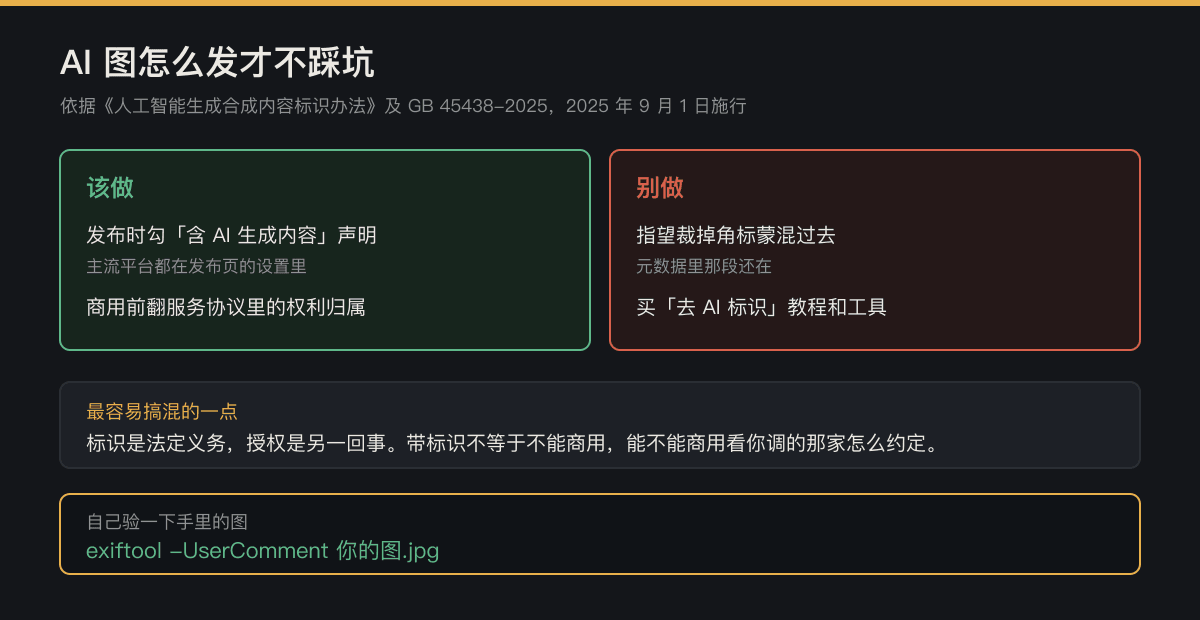
, so can you use it casually?
Back to the question at the beginning.
It can be used. There is no rule that says that you are not allowed to post pictures generated by free interfaces or make covers. But there are four things to know first, otherwise it will be easy to fall in the wrong place.
When posted, it will be marked as "AI Generation", not that the platform is targeting you. Platforms are required to verify metadata. If you read an implicit identifier, you have to add a prompt around the content; if you can't read it, you have to add it if you declare it yourself. This is its obligation, not its evaluation of you.
Don't expect tailoring to fool you. You can cut out the explicit corners, but the implicit sections are still lying in the file. The platform reads scribbled today does not mean that it will read scribbled tomorrow-the special action has put the implementation of the logo into the focus.
Don't buy "De-AI Logo" tutorials and tools. This is not a gray area. It is a named target for rectification, and the seller is already being dealt with. In order to save a corner to bear this, the account cannot be settled.
Correct movements are actually very convenient. When publishing, use the platform's own declaration function to check "Including AI-generated content". Most mainstream platforms now have this entry, which is in the settings on the release page. If you proactively declare it, the content will be distributed as usual; if you don't declare it, it may affect traffic.
If you use AI drawings for commercial purposes -shop, design outsourcing, take orders and produce drawings-there is one more thing to confirm: identification and authorization are two different things. Logo is a legal obligation and has nothing to do with whether you can use it; whether you can use it for commercial use depends on how the company you adjust stipulates the rights to generate content in the service agreement. Each family writes differently and will be revised. I can't generalize for you. Go and read it in the original text of the agreement before signing the contract, and don't listen to second-hand paraphrases.
, go and pick up your own pictures, too
In this article, I only really picked up a picture of one company, because the interface of this company can be directly adjusted. According to regulations, other companies have to write the same, but the specific writing and fields are incomplete. I have never measured them and cannot guarantee them.
Fortunately, you can test this yourself in a minute. Install exiftool, and then:
exiftool -UserComment 你的图.jpg
Or if you don't want to load anything, just:
strings 你的图.jpg | grep AIGC
Pull out and run the pictures you generated from each family before. See what is there, what is not there, and what is written. I guess you'll look at that credit code more often, like I did.
By the way, a practical measurement that has nothing to do with the main line: I sent 6 simultaneous picture generation requests, only 2 of which were successful, and the remaining 4 immediately returned 429, indicating that the account had reached the rate limit. You can use it for free, but don't expect to buy it in batches-this is related to the level of your account, and your situation may not be the same as mine.
Finally, I left a question that I haven't figured out yet.
Logo covers only "generation" and "synthesis". Then what kind of real photo I took, using AI to replace the sky, erase passers-by, and adjust the light again? By definition, this belongs to synthesis, and the mark is. But now, almost everyone uses one-click retouching pictures and eliminating passers-by in mobile phone albums every day. I haven't tested whether these pictures have left anything in the metadata or how to draw the standards.
This boundary may be closer to most people than the line of "AI drawing".