There are pictures and truth, and they are officially invalid.
Let's take a look at a picture and guess whether it's true or false: Jianlibao, AD Calcium Milk, and Big Bubble Gum are displayed on the wooden shelves. Even the "red-eye" flaws in old photos are all there-a batch of photos of the "90s Canteen Shop" were swiped on the screen a while ago. Many people were "young again", and then they realized that they were all generated by AI, and there were not a single real shot. What's even more striking is the next step: Are you still divided into halal photos or AI edits the physical picture and bowl of malatang in the merchant's comment area? Something has happened-some college students used AI to convert static photos into dynamic videos that can pass live testing and swiped 50,000 yuan in three months. Someone passed their ID card to the AI and "changed it to Cook's face" and even changed the number. "There is a picture and the truth" is being voided. The first reaction of many people is to practice a stronger "AI counterfeiter" to catch fake pictures-but this road has already lost: in 2023, you can still see flaws, in 2025, the light will be filled in, and in 2026, the human eye and most detectors will not be able to distinguish (the detector accuracy rate is only 70 - 90% and the false alarm rate is 5 - 15%). So the industry changed its head: instead of arresting fakes, it changed to issuing "digital birth certificates"(content certificate C2PA + watermark SynthID) to authentic content-the anti-counterfeiting logic has been flipped from "arresting fakes" to "verifying authenticity." This article explains this turn, the three unblocked pits, and what ordinary people do now.
First look at a picture. You can guess whether it is real or drawn by AI.
Jianlibao, AD Calcium Milk, and Big Bubble Gum are displayed on the wooden shelves. On the glass counter are Little Raccoon Crispy Noodles and Jumping Candies. The warm yellow light contains even the "red-eye" flaws in old photos. A while ago, a batch of photos of the "90s Canteen Shop" were posted on the screen. Many people watched and lamented,"My youth is back"-then they realized that they were all generated by AI, and there were not a single real shot.
This is just to make you feel old. What really hurts is the next step: Can you still tell whether the physical picture and the steaming bowl of malatang you see in the merchant comment area are real or compiled by AI? And the threshold for this kind of fake and real things is already so low that ordinary people can generate domestically produced tools such as Dream and Action with just a few words.
Not to mention what has already happened: a college student who was about to graduate in Changsha used AI to convert still photos into dynamic videos that could be detected in vivo by payment software, and swiped more than 50,000 yuan in three months; someone passed his ID card to AI and asked it to "change its face to Cook." The AI not only changed its face, but also changed the name and date in its ID number properly.
The saying "there is a picture and the truth", which we have believed for many years, is being voided.
, wouldn't it be enough to practice a stronger "AI Counterfeit"? -- This road has been lost
The first reaction of many people is: The road is one foot tall and the devil is one foot tall. If you can make it, I will practice a stronger AI to catch fake pictures.
It sounds reasonable, but the reality is- This road has been lost.
Three years later, you will understand that in 2023, the pictures generated by AI can still be found out by careful examination (wrong number of fingers, awkward light and shadow); in 2024 and 2025, these flaws will be filled in one by one; today, AI-generated pictures, cloned sounds, and face-changing videos are invisible to humans, and neither are most automatic detectors. ****
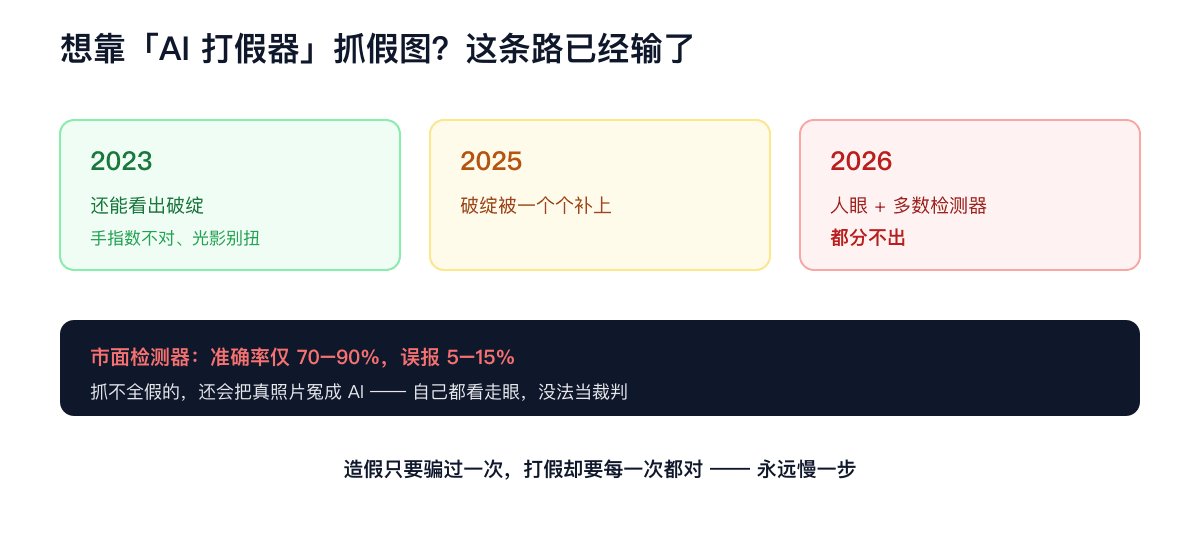
What level are the "AI detectors" on the market today? The consumer-level accuracy rate is only 70% to 90%, and the false alarm rate is 5% to 15%. This means that not only cannot catch all fakes, but also falsely accuse real photos as AI-generated *. You can't use a tool that you can misjudge and be everyone's referee.
In the arms race between "counterfeiting and counterfeiting", the counterfeiters will always be one step faster. Because counterfeiting only needs to deceive the detector once, but counterfeiting must be correct every time.
So the industry turned around: instead of arresting fakes, it was changed to "issue birth certificates to real people"
This is the most interesting turn in this matter.
Since the path of "proving that a picture is fake" does not work, we will reverse-- issue a "digital birth certificate" to the true content.
Specific two floors:
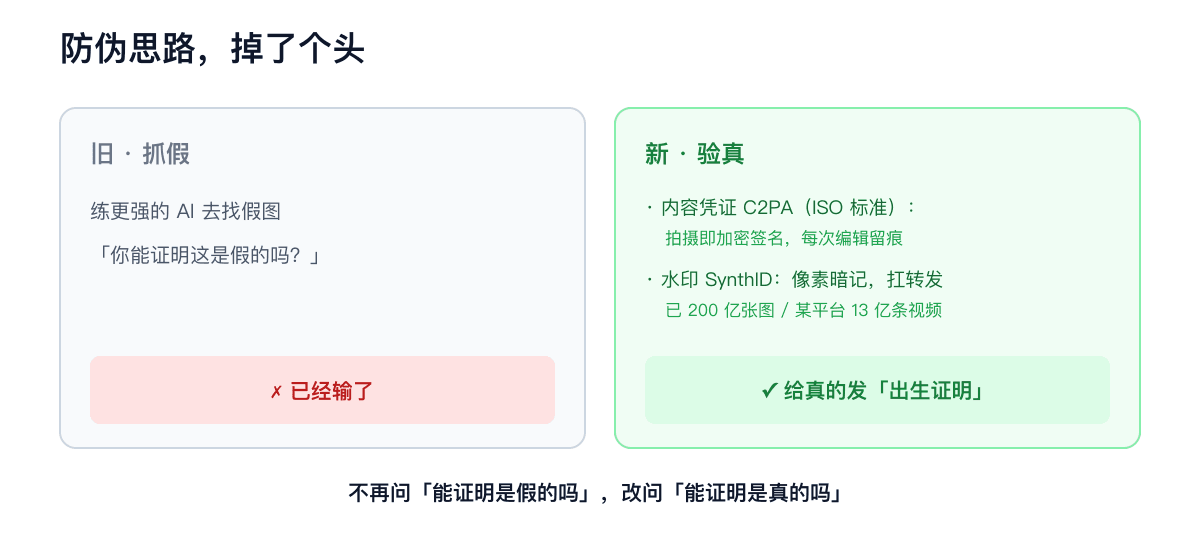
The first layer is called content certificate (industry standard C2PA, which has become an ISO international standard). The moment the camera presses the shutter, it adds an encrypted signature to the photo and records which device it was taken; every time the photo is retouched or edited, a note is added to this record-who changed it and what changed it leaves a trace. Once a signature is tampered with, it will be visible at a glance by any software that supports verification. Leica, Sony, Nikon, and Canon are all adding this to camera firmware.
The other layer is called a watermark (such as Google's SynthID). When AI generates a picture, it embeds a secret mark that is invisible to the naked eye in the pixels. The biggest advantage of it is that can withstand forwarding -you take screenshots, forward them, change platforms and compress them again, but the watermark is still there. Google has marked 20 billion images with this watermark, and a certain Short Video platform has marked 1.3 billion videos with AI sources.
Do you understand this turn? In the past, the idea of anti-counterfeiting was to "catch fakes", but now it has become "authenticity verification." Instead of asking,"Can you prove this is false?", I ask,"Can you prove this is true?"
But don't be happy too early, the three pits have not been blocked yet
My consistent attitude: If you want to say good news, you must also explain the pitfalls clearly. This "truth verification" system is still leaking:
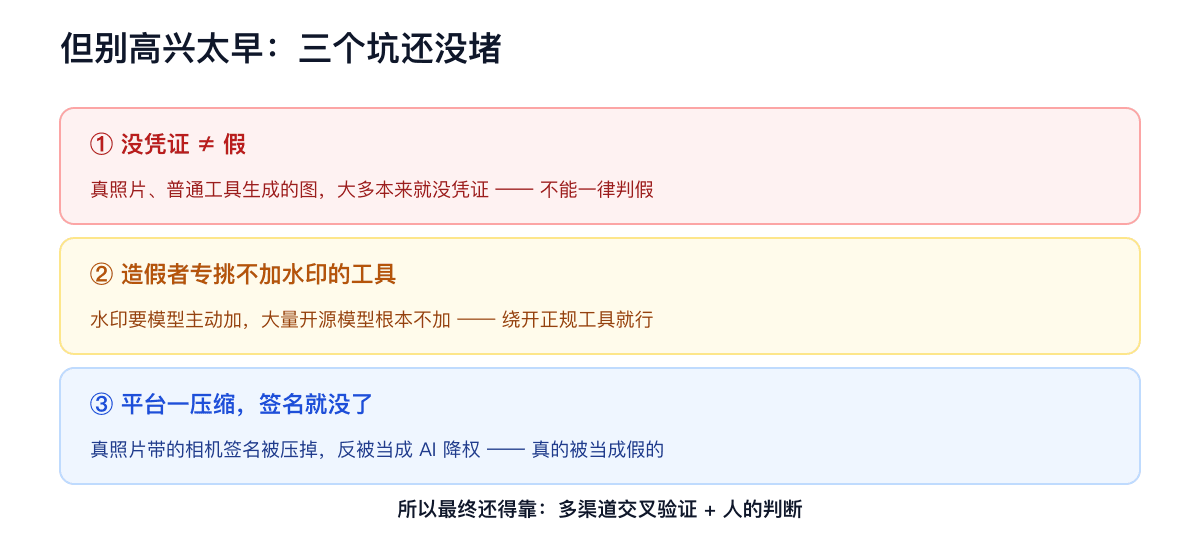
First, no certificate ≠ fake. The vast majority of photos in reality-including countless real shots and those generated using common tools-do not carry any credentials. You can't rule a picture to be fake just because it "doesn't have a birth certificate," or you will accuse a large number of people.
Second, counterfeiters choose tools that do not include watermarks. Watermark requires models to be actively added when generated, but a large number of open source models do not add at all. People who want to do bad things can just avoid regular tools with watermarks.
Third, once the platform is compressed, the signature is gone. A very real problem: the real photo was originally signed by the camera, but when it was transferred to the platform, it was recompressed and the signature was erased. Instead, it was treated as AI-generated, de-titled and marked-if it was really treated as a fake, this was embarrassing.
In the end
For us ordinary people, there are three most practical things at the moment: ** When it comes to money, transfers, and privacy, don't believe in taking a picture and a video. Be sure to make calls, meet, and have more cross-verification ; Don't just hand over the face to an unidentified App; if someone really uses an AI image to infringe, take a screenshot and save evidence as soon as possible, and then complain or call the police.*
But the bigger thing lies ahead. The invalidation of "there is a picture and the truth" means that the way we trust a picture is being completely rewritten-- In the future, if you trust a picture, it will no longer rely on "it looks real", but "it has no birth certificate, and the source cannot be traced." This is not a function of a certain App, but the foundation of trust for the entire information society. It is changing a batch of bricks.
The era of seeing is believing is over, and the era of "verification is reality" is next. It will be more troublesome, but it will also be stronger-after all, in a world where even eyes can be deceived, eyes should not be relied on alone.