AI designed weight loss pills, there are still a few levels away from you
A company in Hangzhou has designed an oral weight-loss drug using AI. It recently became the first AI-designed drug in China to enter Phase III clinical trials. If it goes smoothly, it may be launched by the end of 2028. There is no need to say much about the popularity of diet drugs in the past two years, so when they heard that "diet drugs designed by AI will be on the market soon," many people's first reaction was: AI will subvert the industry of drug-making. I have pulled through the global data, and what I want to say is actually the reverse-AI makes drugs, it is really fast (this drug takes 8 months to lock in the molecule, 4.5 years to reach Phase III, and traditionally it takes 7 - 9 years); but "design quickly" and "medicine can be made" are two different things. From 2019 to now, about 175 AI-designed drugs around the world have been tested in humans, and none have been approved by the FDA. The most difficult thing is never design, but in clinical practice. 2026 is the year when a batch of AI drugs will hit the Phase III hurdle. The most important milestone is not financing or design speed. It is whether any model has passed the last hurdle and is actually put on the shelves. This weight-loss drug put everyone in the examination room first.
Let me start with something that may surprise you a little.
A company in Hangzhou designed an oral weight-loss drug using AI, and recently became the first AI-designed drug in China to reach Phase III clinical trials. Phase III is the last and most difficult level before a new drug is launched. If everything goes well, you may be able to buy it by the end of 2028.
Diet pills have been popular for more than two years, so I don't need to say more. So when they heard that "diet drugs designed by AI are coming on the market soon," many people's first reaction was: AI is really going to subvert the industry of drug-making.
I checked the global data, and what I want to tell you is actually the reverse.
AI makes medicine, fast is really fast
Give AI justice first. It is indeed surprisingly fast in "designing drugs".
With this diet pill, the team synthesized more than 80 new molecules in 8 months and locked on the one they wanted to push forward. From the project establishment to the entry into Phase III, it took about four and a half years and spent about US$23 million.
What is this concept? The traditional way to create a new drug usually takes 7 to 9 years from design to Phase III, and burns US$300 to US$400 million.

Time is cut in half and money is saved by an order of magnitude. The efficiency of AI in the first half is solid. This is also why capital has been rushing in crazily in recent years.
But "design quickly" and "medicine can be made" are two different things
Okay, now say the reverse.
Creating a drug and "designing the molecules" is just the first step in the long march. Once the molecule comes out, it will also be tested pre-clinical, first phase to see whether it is safe, second phase to see whether it is initially effective, and last three phases to involve hundreds of people and conduct strict controls to prove that it is really effective and really safe. The vast majority of drugs die in this second half-the proportion of a drug that is finally approved after entering clinical practice is as low as 90% of the year round.
So where has the AI-designed drug gone overall? I will give you a set of numbers, and you may be quiet after reading it:
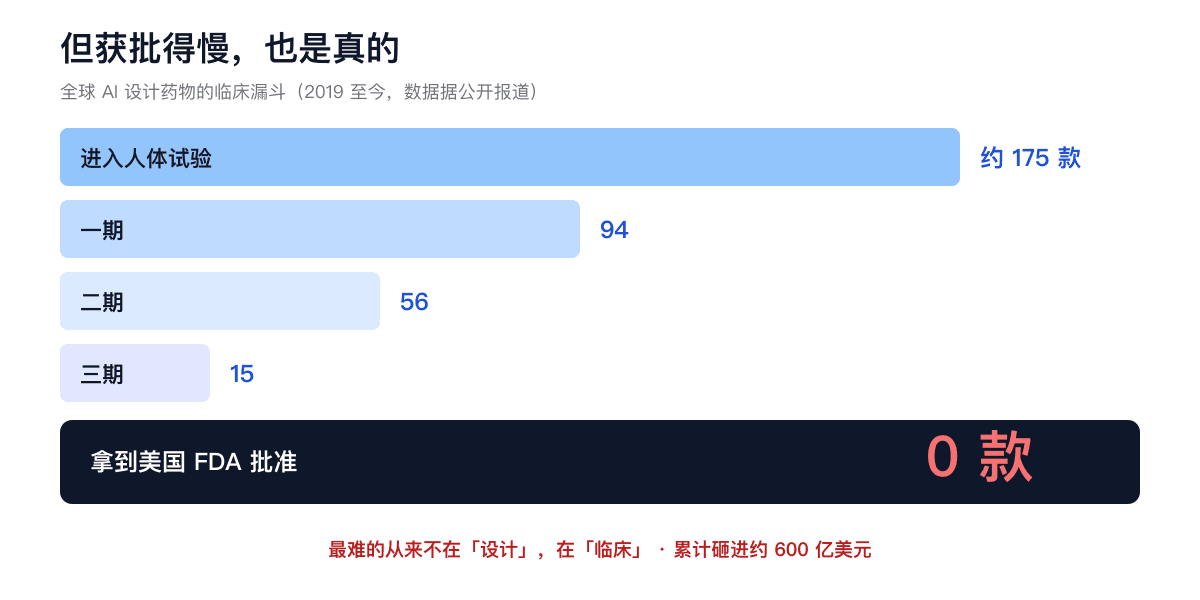
From 2019 to the present, about US$60 billion has been invested in AI pharmaceuticals around the world, and about 175 AI-designed drugs have been tested in humans. Sounds lively. But the one that reached the last level and received approval from the US FDA was-- Model 0 . Not one yet.
It's not that AI can't do it. When it comes to making drugs, the most difficult thing is never "design" but "clinical". No matter how fast the design is, you have to queue up honestly and do human trials one by one. You can't save a single step. The fastest is the first half; the slower, difficult, and decisive is the second half. In the second half, AI can't help much-the complexity of the human body cannot be understood quickly.
There is even a sobering example: an AI drug that was highly expected in the early years failed after completing the first phase. Speed never means success.
So where has this diet pill gone?
Back to Hangzhou for this medicine. Its location is like this:
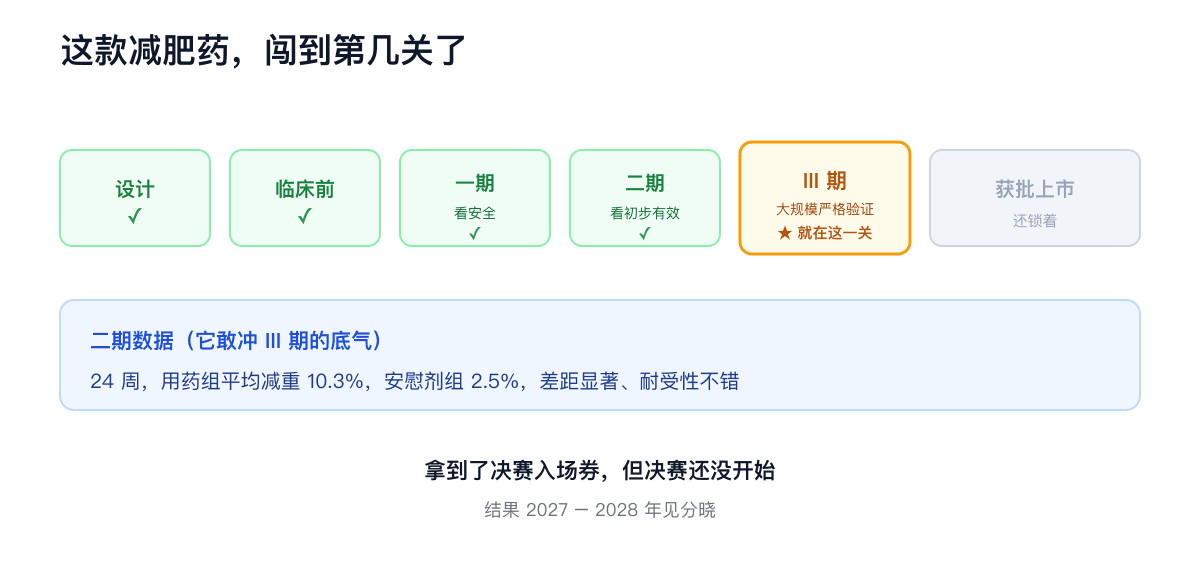
It has gone through design, pre-clinical, first and second phases, and now stands at the door of the last level-Phase III.
The data for the second phase are visible: at 24 weeks, the average weight loss in the drug group was 10.3%, while that in the placebo group was only 2.5%. The difference was significant and the tolerability was good. This is the confidence it dares to rush into Phase III.
But please note that the second and third phases are completely two orders of magnitude. The second phase has fewer people, short time, and loose requirements; the third phase involves bringing in hundreds of people, long-term observation, and strict control-this is where the real exam is. The second phase is beautiful, but it doesn't mean that the third phase can be passed. So the most honest way to say about this drug at the moment is: It got a ticket to the finals, but the finals have not yet begun.
In the end
2026 is a very special year for AI Pharmaceutical. A batch of AI-designed drugs have rushed to the stage III hurdle, and the report cards will be released one after another in the next year or two. The results of this batch will answer that question for the first time: Can AI-made drugs really cure diseases, or are they just designed beautifully?
So don't be fooled by "how fast AI is designed" and "how much money it has raised". The most important milestone has never been financing or design speed. It is-- Whether there is a model that has gone through the last hurdle and really put it on the shelves of pharmacies.
This weight-loss pill puts everyone in the examination room first. Whether it can pass, we will know in 2027 and 2028. I really hope it works-not only for people who want to lose weight, but also to prove one thing: this time, AI can really realize the benefits all the way to ordinary people, instead of stopping on a beautiful PPT.
(The data in this article comes from public reports; information related to diet drugs is for understanding only and does not constitute any medication advice.)