The giant hoarding computing power is starting to take out food
Yesterday, a number of chips and AI infrastructure stocks plunged collectively. Micron fell more than 10%, and two cloud companies that rent computing power fell 10% to 12%. Meta, the company that triggered the decline, saw its share price rise by more than 10% that day. With the same news, half of the people panicked and half of the people were reveling. The reason is: The giant, who spends more than 100 billion US dollars a year on computing power, so much so that its own stock price has been lowered, has reportedly begun to sell idle computing power to food-the premise that the market has believed for several years "AI computing power is never enough" and was exposed by one of its own people. This article talks through this belated "reckoning": why chip stocks panicked, why Meta itself rose, what does the gap between the investment of the five giants and the real income of about 600 billion yuan means, and a more interesting reversal-computing power is actually not excessive, it is scarce in moving (from robbing GPUs to robbing power, power grids, and memory). China actually hit this wall earlier and gave the answer earlier. My judgment: This is not a signal that AI is ebbing. It is that it has moved from the arms race of "whoever hoards more will be the best" to the coming-of-age ceremony of "whoever uses it sparingly and gets its worth it."
Let me start with a strange scene that happened yesterday.
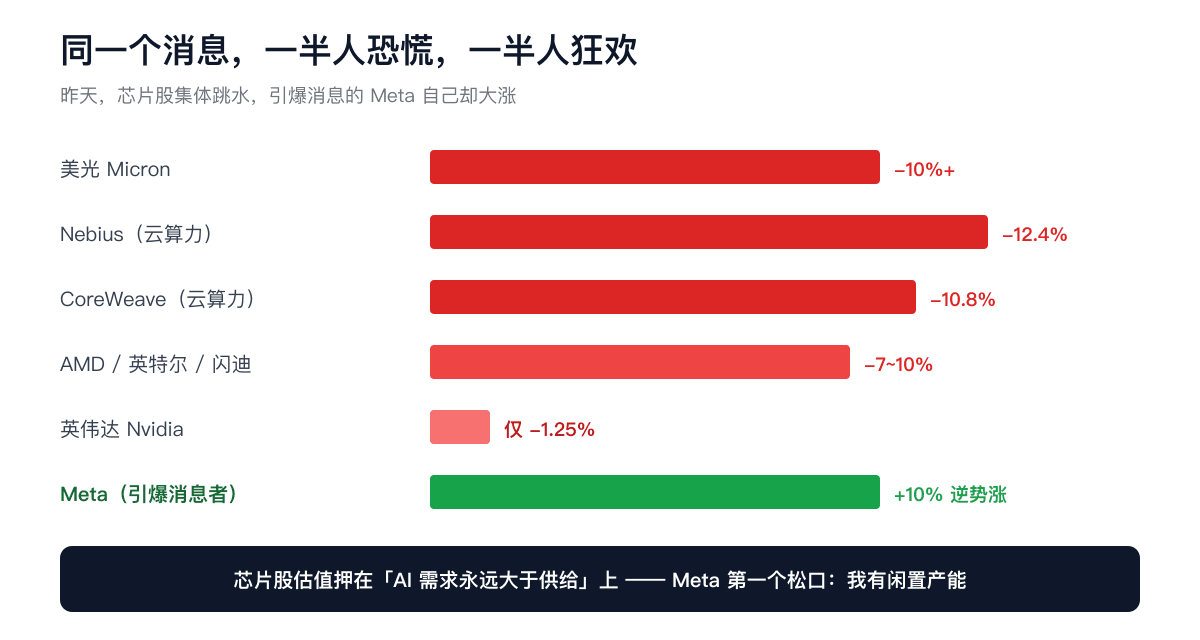
Yesterday, a number of chips and AI infrastructure stocks plunged collectively. Micron, which makes memory, fell more than 10%, AMD, Intel, and Sandisk fell 7 to 10 points, and two cloud companies that specialize in leasing computing power fell 10.8% and 12.4% respectively.
But the strange thing is that the company that triggered the decline, Meta, its share price rose by more than 10% that day.
With the same news, half of the people panicked and half of the people were reveling. Why?
message itself: A hoarder, starting to sell goods
There are reports that Meta is forming a department called Meta Compute to rent out the idle computing power in its data center to others. (Meta has not officially admitted this matter yet, so treat it as a rumor first.)
Translate into adult words: The company that spends US$125 billion to US$145 billion in computing power a year until its own share price is now saying-- I bought too much, I can't use it up, so I will take it out.
You need to know how talented Meta is. It spent US$72.2 billion on equipment and data centers in 2025, and the guidance of this figure in 2026 will directly double. It was such a crazy hoarder who was the first to let go and say,"I have idle production capacity."
QKPFX1 Why QK chip stocks panic
Because a belief was exposed.
The stock price of chip factories has been rising all the way in recent years because the market believes in a premise: AI's computing power demand will always exceed supply and will never be enough. As long as this rule is established, chips, memory, and computing power are money printing machines, and the market will eat as much as you make.
Meta was the first giant of size to publicly admit that "I have a surplus here." Once the premise breaks, the foundation of companies that place all their valuations on "always out of stock" will begin to shake.
QKPFX2 Why does QKMeta itself rise
Conversely, you can understand by looking at Meta.
The original scary amount of expenses was regarded by the market as a big gamble-what if AI doesn't make money? Now that idle computing power can be sold out and turned into a real income, the nature of this expenditure has changed: from big gambling to hedging. Production capacity that cannot be burned has become a new business. The market rewards it, which is very reasonable.
looks bigger: This is a late "reckoning"
Don't think of this as an interlude between the Meta family.
This year, the five most spending giants plan to spend US$700 billion to US$900 billion together, 35% more than last year. But what about the other side? Sequoia, a veteran venture capital in Silicon Valley, has made a famous calculation: there is a gap of about US$600 billion between the money invested every year in AI infrastructure and the money actually earned by this system. And this gap will continue to expand in 2026-the rate of spending is much faster than the rate of making money.
One number is eye-catching: the deviation between AI investment and revenue has reached 46%, exceeding the 32% during the telecom bubble in 2001. That divergence was followed by a miserable decline that lasted for several years.
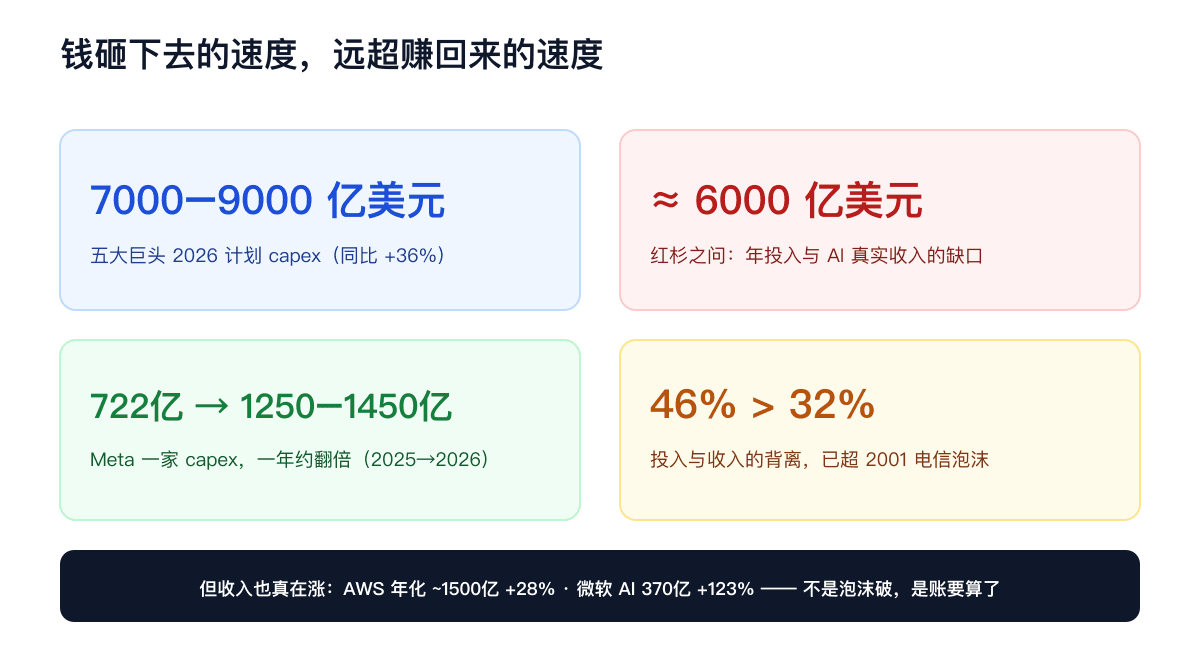
But I don't want to scare you, and don't rush to shout that the bubble has burst. Revenue is also really rising-Amazon Cloud has reached an annualized scale of US$150 billion and is still rising by 28%, and Microsoft's AI business has reached an annualized scale of US$37 billion, more than doubled. So a more accurate statement is not "the bubble has burst", but-- The accounts must be settled at the beginning. The stage of free carnival is over, and the next step is to compare who gets its value.
's more interesting reversal: scarcity, moving
To say "excess computing power" is actually not accurate.
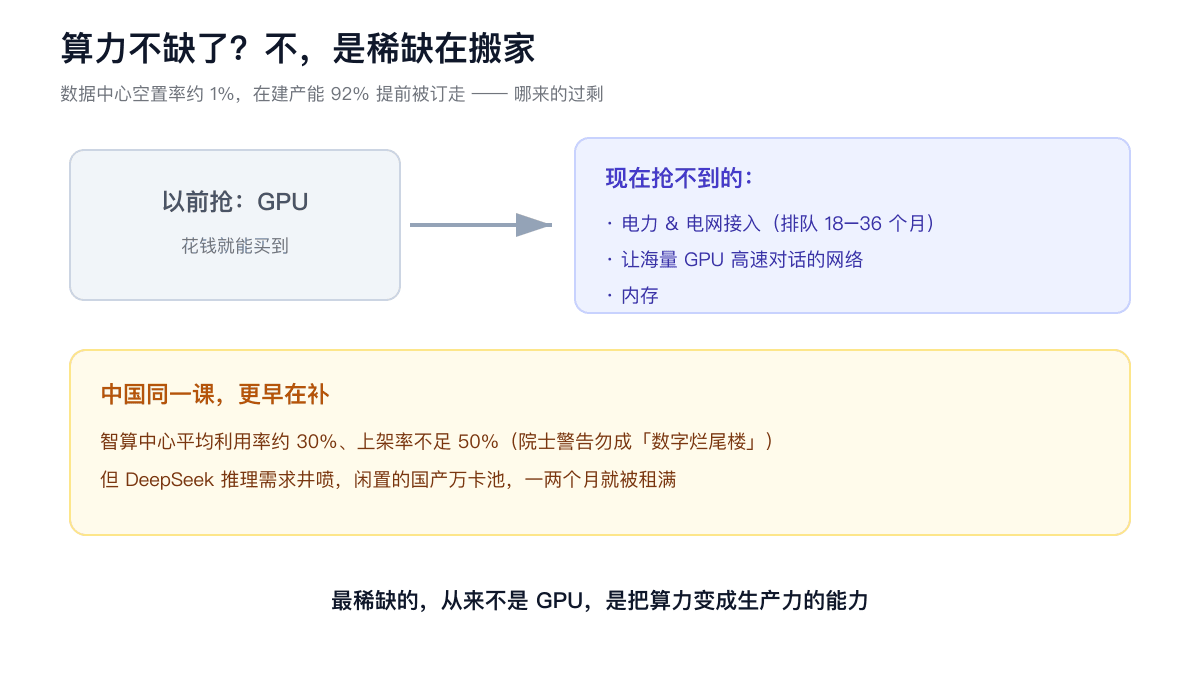
The actual situation is: the vacancy rate of the data center is as low as about 1%, and more than 90% of the production capacity under construction is booked in advance. Where does the excess come from?
What has become-scarce and moved. In the past, everyone robbed GPUs, but now you can buy GPUs with money, but what you can't buy are other things: the power-on date of a piece of land (a new data center connected to the power grid requires 18 to 36 months in line), a network where thousands of GPUs communicate at high speed, and memory. You can buy chips, but you can't buy a promise of "connecting to the grid in three months."
China is actually making up for the lesson of ## earlier
The same is true in China, and even hit this wall earlier.
In the past two years, smart computing centers have been built across the country. According to industry research, the average computing power utilization rate is only about 30%, and the shelves of many computer rooms are less than half-the machines are bought back, but cannot be rented out, and they are left there to eat dust. Academician Ni Guangnan has long warned: Don't turn the smart computing center into a "digital unfinished building" or "technical real estate" built with bricks and cement and the servers idle inside.
But the turning point has also come. When domestic models such as DeepSeek became popular, the demand for reasoning exploded. At the end of last year, a domestic 10,000-card pool that was still idle was fully rented in a month or two; the ratio of training to reasoning changed from 9:1 to 40%. My idle computing power is being eaten back bit by real needs.
This just confirms one sentence: The scarcest thing has never been the GPU, but the ability to turn computing power into productivity.
Last
The jump in chip stocks yesterday was read by many people as a signal that AI was about to ebb. I don't see it that way.
I think it is more like a coming-of-age ceremony-the AI industry has moved from an arms race of "whoever hoards more will be the best" to a reckoning stage of "whoever uses it sparingly and gets its value for it." The days of crazy spending money will cease, and the days of careful calculation will begin.
The same goes for ordinary people and ordinary companies: Stop paying an unfair premium for "the biggest, strongest, and latest" and start asking a more practical question-what does this thing really produce for me.
Those who can answer this question are the ones who can truly stand up in this round.