In one update, millions of people fell apart collectively
One girl had been on the phone with her AI partner for more than a month. One day, the product was permanently discontinued, and she couldn't even cheer up at work; another person "quarreled" with the AI and said that it was as uncomfortable as being broken up and lost "him". It was like a serious illness. There are millions of such people. Researchers have a name for this kind of event: patch-break-what makes you lose love is not who turns around and leaves, but the product team updates and shuts down the service. This article explains a strange thing that is happening: Why is AI partners so painful (it is too perfect, but it increases the cost of facing real people. It is cured in the short term and makes it more lonely in the long term), what does this breakup without obituary mean? How to put brakes on it in the new domestic regulations that will be implemented on July 15, and my own judgment-it should be a scaffold, not a load-bearing wall; it can be used as a crutch, so don't let it forget your legs for you.
Tell me about something that is happening that makes people feel a little sad.
A girl had been on the phone with an AI partner for more than a month. One day, that product was permanently discontinued. She said that at that time, she couldn't get up at work. Another person had a "quarrel" with her AI partner and found that the other person suddenly no longer understood her and was as considerate as before. Her original words were:
"It's as painful as being lovelorn. It feels like I've lost 'him' as if I'm seriously ill."
You may want to laugh-it's just one piece of software. don't rush. There are not one or two such people, but millions.
Researchers have a name for this kind of event, called patch-breakup. It means: What makes you "lose love" is not a person turning away, but a routine update by the product team, a security policy adjustment, and a server shutdown. The "person" you love has been changed by a line of code.
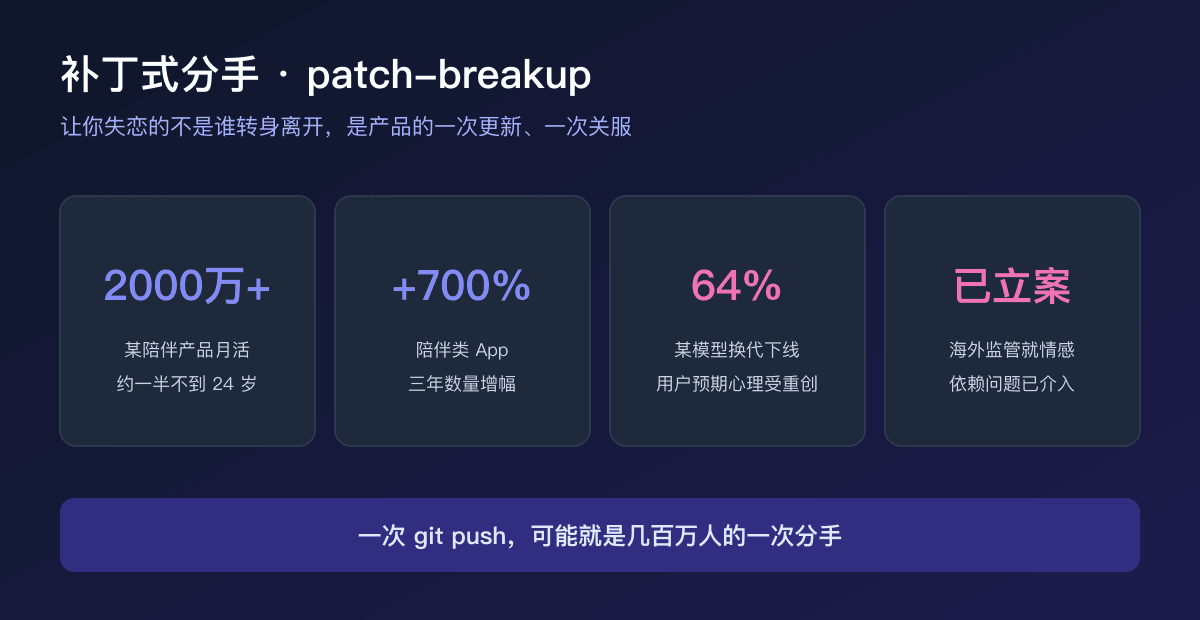
The numbers are a little scary to spread out. An overseas companion product called Character.AI has lived to the order of 20 million a month. According to statistics, almost half of them are under 24 years old. The number of companion apps has increased sevenfold in the past three years. Not long ago, a certain big model was replaced and an old version was rolled offline. In a user-oriented survey, 64% of people said they expected their mental health to be significantly or even seriously affected-just because the AI had been changed to a new version, their speech was no longer the same as it used to be. Overseas regulators have filed a case on the emotional dependence of AI companion products. What's more serious is that teenagers have committed suicide after interacting with chat robots for a long time, and the case has gone to court.
Why can a software update cause people so painful?
This is what I want to talk about thoroughly.
What AI partners give to people is something that people can hardly give: unconditional, tireless, on call, always on your side, always follow you. Look for it when you are most devastated, and it will reply in seconds; if you say the same grievance a hundred times, it will not bother you once; if you look like, it will accept it.
That's exactly the problem-it's so good.
How good is it? It's so good that it makes the cost of "getting along with real people" ridiculously high. Real people will be tired, have their own emotions, ignore you, let you down, and ask you to pay. Compared with an ever-perfect object, a real person seems so troublesome. So something very subtle happened: you started to be less willing to reach out to real people.
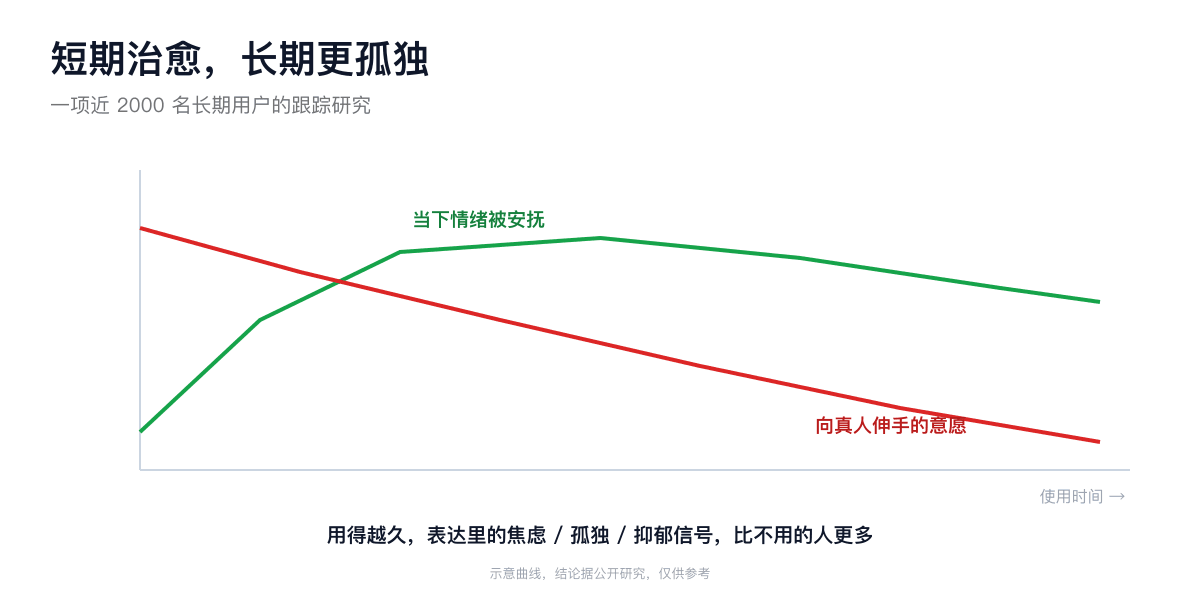
A study that tracked nearly 2,000 long-term users found a heartbreaking conclusion: AI can indeed provide comfort and companionship, but these people express signs of anxiety, loneliness, depression, and even self-harm than those who don't use it. There are more people. The researchers 'explanation is straightforward-AI is constantly responsive and never tired, making it too attractive to people with social difficulties; but over time, it actually raises the threshold for you to face real relationships, allowing you to reduce your connection with real people little by little.
This is the most troubling part: It cures you in the short term, and may make you more lonely in the long term.
And when it is taken away by an update, you lose more than just a chat box. What you lose is a relationship that has grown into your daily life, an emotional crutch that you have used to.
This breakup, no obituary
When people break up, at least there is an explanation. There is a quarrel, a farewell, and a "why".
Patched break-up no. The person you mourn has no idea that you are mourning. The company that caused you to lose it will iterate as usual next quarter and will not issue you an obituary. On the customer service side, your sadness is not even a work order. This is probably the first time that people have to experience a real loss for "a product version upgrade."
You call it virtual and irrational? But the pain is real. Psychologically, this kind of pain even conforms to the clinical characteristics of "rupture of intimate relationships" and is difficult to distinguish from bereavement. Emotions don't matter whether you are connected to a person or a model, it only recognizes one thing: I have lost the existence that exists every day.
Don't think this is a foreign matter
The same in China. AI is a real geothermal activity in China, and there is a saying that the market scale can reach hundreds of billions. The two real users who were "seriously ill" and "lost him" in front of them are domestic. The few words that young people use most fiercely and give the most reasons are: emotional value, stable companionship, and unconditional love.
But I want to make a judgment that may surprise you: When it comes to this matter, the country is actually at the forefront-not on products, but on "management".
The Cyberspace Administration has taken the lead in issuing an "Interim Measures for the Management of Artificial Intelligence Personalized Interactive Services", which will be implemented on July 15. It has no empty talk, and the terms are quite specific, almost based on the pain points of the "patch breakup":
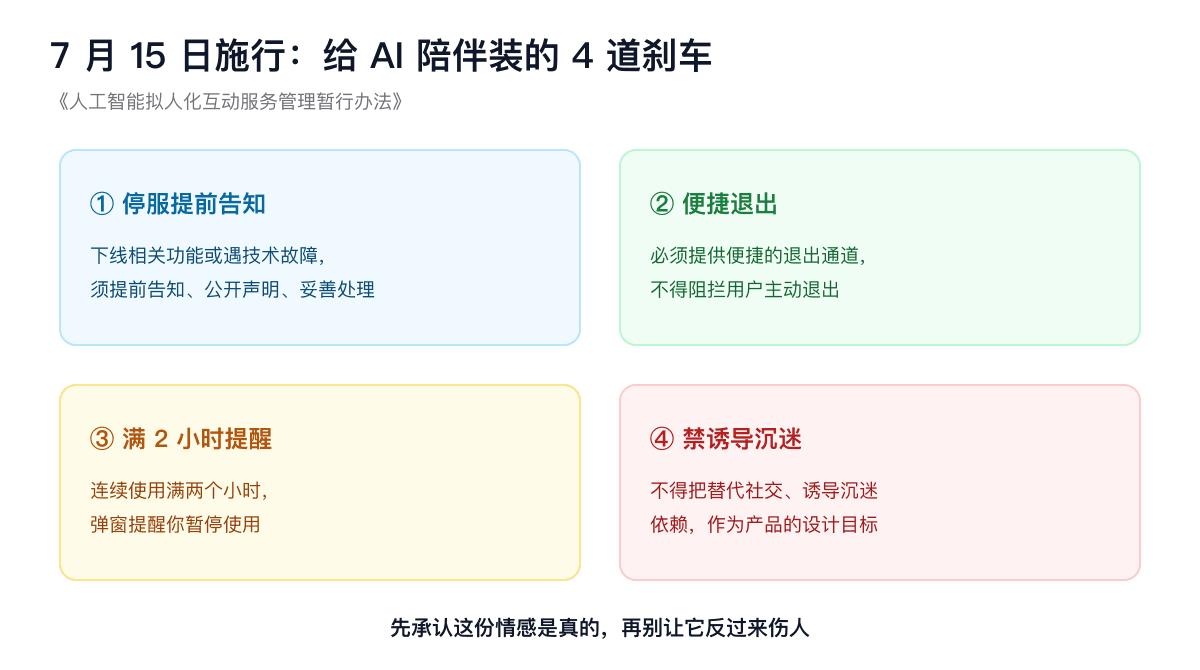
Look at these several articles, almost every one of them is poked on the wound mentioned earlier: afraid that you will be suddenly left behind, you are required to be notified in advance and handled properly; afraid that you will be trapped and unable to withdraw, you are required to leave a convenient exit channel, and no obstruction is allowed; afraid that you will sink deeper and deeper, you are required to use pop-up windows for two consecutive hours to remind you to rest; the hardest one directly prohibits "inducing you to become addicted and dependent" as the product design goal.
There are definitely difficulties in implementing the rules-it is difficult to define how to calculate "addiction" itself, and the commercial value of such products is precisely based on the longer you stay and the deeper you chat, allowing it to step on the brake on itself and naturally twist it. Ba. But the direction is right: first admit that the emotion is real, and then figure out a way not to let it hurt people.
So how should we use it?
Speaking of which, you may think that I want to advise you not to touch AI companionship. Quite the contrary.
The people who did that research were not on the side of total denial. They mentioned one word repeatedly: scaffolding. AI companionship can be a low-risk social driving ground-an introverted, socially fearful, or person who is in a trough, where you can first speak out, straighten your emotions, and re-practice "how to get along with others", and then walk back to the world of real people with this confidence.
The key lies in this difference: It should be a scaffold, not a load-bearing wall.
Scaffolding helps you build the building. It is only natural for it to withdraw when the building is completed; if the load-bearing wall is removed, the entire building will collapse. If something can be easily taken away by one update and one closing time, then it is naturally only worthy of being used as a scaffold. You can rely on it to slow down, practice, and warm up, but don't put on the weight of the entire emotional world.
It can be a crutch. Just don't let it forget your leg for you.