The more you use AI, the more tired you get, it's not your fault.
Give me a strange feeling that you may have, but you have been unable to explain: After using AI all day, the work is indeed faster than before, but at night, people are more tired, emptier, and a little irritable. It's not an illusion, nor is it hypocritical-the consulting circle has named it "AI brain fry"(AI blows up its brain). A survey of about 1500 professionals found that almost one in seven people was mentally exhausted by "switching back and forth between a bunch of AI tools." The more people use them, the more decision-making fatigue and the more mistakes they make. Why is it even more tiring to help you do the work? Because AI has not eliminated mental work, it has just changed its form-you have changed from "think and do it yourself"(flow and sense of accomplishment) to "constantly reviewing it, correcting it, staring at it, selecting tools, and changing prompt". You have gone from creator to supervisor. A more covert knife: The time saved does not turn into rest, but into higher expectations and more tasks. This article clarifies where the tiredness comes from and how not to let AI use you down.
Tell me a strange feeling you may have but have been unable to explain.
After using AI all day, the work was really done faster than before. But at night, you find yourself more tired, more empty, and even a little irritated than before. You can't tell why-don't they say that AI helps people save trouble? How can we save money and people collapse first?
This is not your delusion, nor is it your affectation. Someone gave this feeling a name.
It has a name,"AI explodes the brain"
The consulting circle coined a word, AI brain fry, which literally translates as "AI explodes your brain", which refers to the kind of exhaustion that you use AI and stare at AI beyond the line your brain can carry. exhaustion.
A survey covering about 1500 professionals found: Almost one in seven people said they were mentally exhausted by "switching back and forth between a bunch of AI tools." Moreover, the more and more people who use AI, the more they report decision-making fatigue, more mistakes, and slower decisions.
The researchers put it bluntly: AI fatigue is real, not an emotion fanned up by the media.
Then the question arises-AI clearly helps you do the work, but why is it more tired?
Because AI did not eliminate mental work, it changed its form
This is the core of what I want to say.
In the past, when you did something-write a paragraph, formulate a plan, write a piece of code-it was "think and do it yourself." This process has a sense of immersion and touch, the smoother it is done, and there is a sense of accomplishment after it is done. Tired, but that kind of comfortable tiredness.
Now that it's AI to do it, your job has also changed: it becomes constantly reviewing whether it is written correctly, correcting it for mistakes, staring at it not to stray, deciding which tool should be used, and prompting over and over again until it is correct.
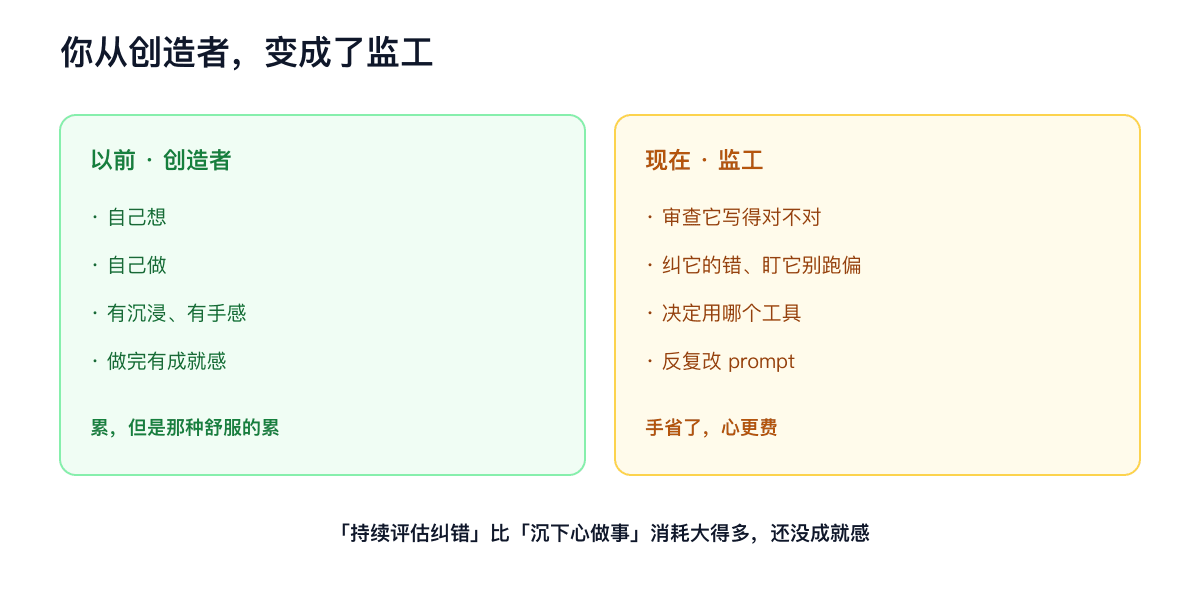
See the difference? You have gone from being a creator to a supervisor .
Supervising is not easy at all. It requires you to always be vigilant, constantly judge, and correct mistakes at any time. Psychologically, this state of "continuous evaluation and error correction" is much more expensive than doing things yourself with concentration, and you don't have the sense of accomplishment to finish it. I am saving my hands, but I am not saving my heart, and it is even more expensive.
When you take ## apart, this fatigue comes from three places
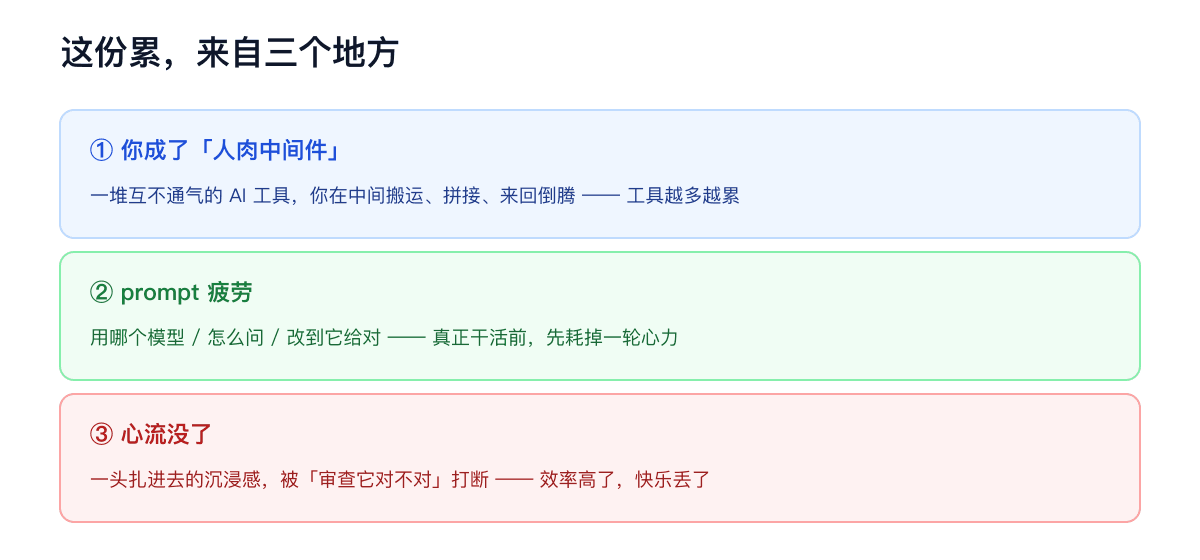
First, you have become a "human middleman". There are a bunch of AI tools in hand, one for writing copywriting, one for making forms, and the other for checking information. They don't communicate with each other. So you became the one who carried, spliced, and moved back and forth in the middle. The more tools you have, the more connections you have to maintain-not the easier it is, the more tiring it is.
Second, just "using AI" is exhausting. Every time you start work, you have to make a series of decisions: Which model should you use? How to ask it? It didn't answer correctly, change another version of prompt, change another version... A lot of effort is already spent on "How to let AI understand me" before you really start working.
Third, flow is gone. The state of diving head-on, time flies, and energy is the most precious thing in many people's work. The work of "looking at what AI writes and judging whether it is right" is interrupted and judgmental, and it is difficult to enter flow. You have become more efficient, but the joy of immersion is lost.
also has the most hidden knife
What I said above is "using AI itself is tiring." But there was still one knife, cut elsewhere.
Where did the time AI saved you go?
For many people, it has not turned into rest, but into higher expectations and more activity. You can do the amount of the past two days in one day with AI. Well, by default, you will have to do this much every day in the future. Speed dividends turn into new workload.
Some surveys even said that more than 40% of professionals feel that even if AI does not help much, they are required to use it-because "others are using it" and "don't have to appear backward." This pressure of "use it just to use it" is itself a classic source of burnout.
This will only be more obvious in domestic office scenarios: AI has been stuffed into nails, flying books, and various systems, and "AI utilization rate" has even begun to enter into KPIs. You have given the tools, you have no less work, and you have one more assessment.
So what should we do?
It's not that you don't use AI-it's a good tool. Don't let it wear you down. A few practical things:
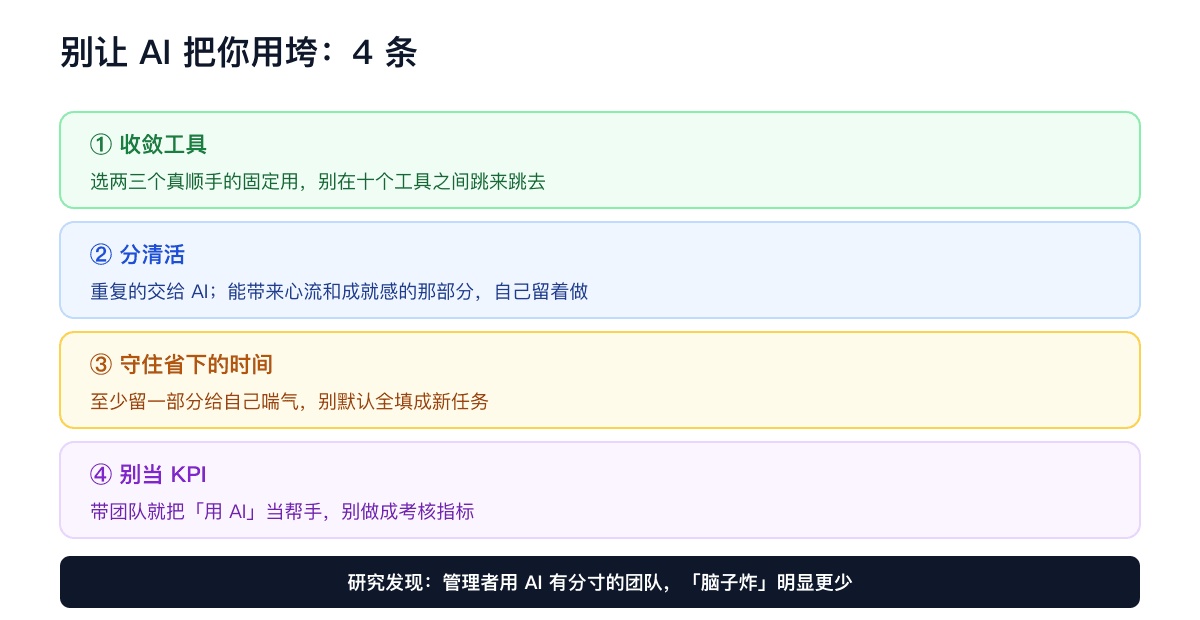
Convergence tool. Don't be greedy for too many, choose two or three ones that are really easy to use and don't let yourself jump between ten tools.
Distinguish which tasks are entrusted to it and which ones are to do by yourself. Leave it to AI for what you don't care about; but keep it for yourself that part you really want to do well and that brings flow and a sense of accomplishment. Don't outsource everything, you'll be tired and empty.
Keep the time saved. This is the most difficult and important one: When AI saves you time, at least part of it for yourself to breathe, and don't default to fill it all into new tasks.
There is a positive finding in the research: teams where managers use AI appropriately and do not blindly increase *, employees have significantly fewer "brain explosions". So if you lead a team, use "using AI" as a helper, not an assessment indicator.
In the end
AI is a good tool, I never doubt that. But it will save you ** time , but it will not automatically save you effort . You have to calculate these two separately.*
The thing to be careful is never "whether to use AI", but whether you are still the one who can calm down and dive in to do something well after using it for so long.
Don't unknowingly turn yourself from a creator to a supervisor.