800 online writers are at war with AI to wash manuscripts
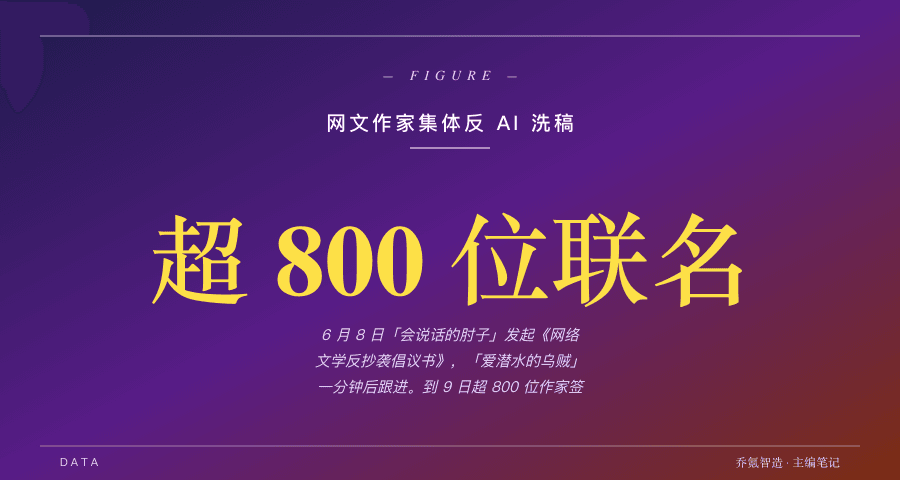
At noon on June 8, the well-known online writer "Talking Hutch" launched the "Internet Literature Anti-Plagiarism Initiative". One minute later, the "Diving Squid" followed up. By the 9th, more than 800 writers had signed the contract, and nearly 5500 readers had praised and supported it. Among the signatures were Tian Xia Ba Chang, author of "Ghost Blows Out the Lantern", author Ma Di, author of "Celebrating the Years", and author Tian Rui Shuofu, author of "We Live in Nanjing". A large number of leading authors. This time, the collective attack was directed at a new thing-AI rewriting. Writer Zhuo Mu casually said that his "Binjiang Police Affairs" was still put on shelves after being washed by AI, without even changing the place name or supporting role name."I wrote it for two years, and they spread millions of words in a few days." This is an inseparable knot in the content industry in the AI era: AI has hit the cost of "batch imitation" to the floor, while the cost of rights protection for original creators is still ridiculously high. The good news is that the law is beginning to move-the Shanghai High Court just convicted a criminal case involving an AI copy-laundering gang on May 28. This article clearly explains the ins and outs of this war and what it means to everyone who writes.
At noon on June 8, a big event occurred in the online literature circle.
Well-known writer "Talking Hutch" launched an "Anti-plagiarism Initiative for Internet Literature" on social platforms, with a sentence: Invite managers and industry authors of platforms such as Shuwen, Tomato, Qimao, Jinjiang, and Feilu to sign the proposal together to maintain the moral bottom line of the industry.
One minute after it was posted, another top-notch writer,"The Diving Squid"(author of "The Lord of the Mysteries "), followed up and responded.
Then it opened.
By the 9th of the next day, more than 800 online writers had signed the proposal, with nearly 5500 readers praising and supporting it, and the number was still rising. On the signature list, you can see a long list of names that are like thunder-the world's hegemony in "Ghost Blows Out the Lantern", the catty of "Celebrating the Years", the Tianrui Talisman of "We Live in Nanjing", and the Ji Yue people of "Xuanjian Xian Tribe".
This is almost half of China's online literature, and the collective has stood up.
What they have to deal with is a new thing that has only emerged in the past two years but is extremely destructive-AI copywriting.
This article I want to make this war clear: what it is fighting, why it is breaking out now, and what it means to everyone who earns a living by writing.
first explain clearly what AI copywriting is
Plagiarism has always been a problem in the online literature circle. But it keeps evolving.
The earliest plagiarism was "copy-paste", which was easy to catch directly. Later, it became "Chinese translation", which means rewriting other people's sentences in a different way. It is commonly known as "fusion" and is more difficult to grasp. Later, it was "manual transportation", hiring people to transform popular works.
Now it is time for the latest generation-AI to wash manuscripts.
What is the operation of AI manuscript washing? Simply put, throw a novel written by someone else to AI and let it be "recreated in a different way." The plot, character design, world view, and cool rhythm are all copied, but the specific words have been reorganized by AI and appear different from the original.
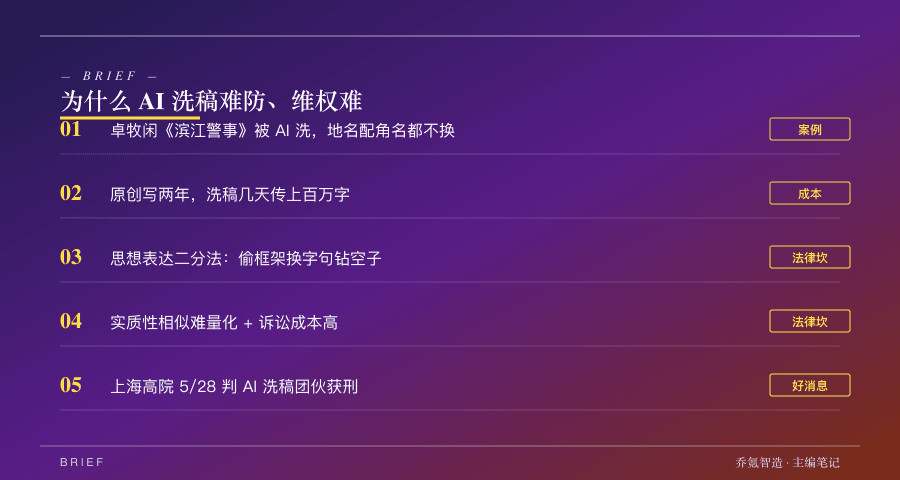
Writer Zhuo Muxian talked about his own experience, which is particularly illustrative. He wrote a book called "Binjiang Police Affairs". As a result, someone used AI to wash the book, redistribute it, and even put it on the shelves for money-ridiculously, they didn't even bother to change the place names in the book or the names of some supporting characters.
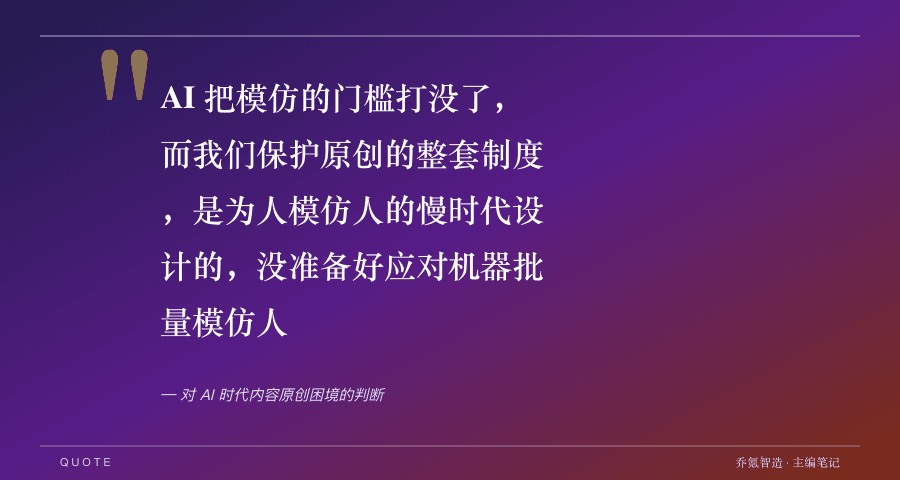
Zhuo Muxian said something very uncomfortable: "I have been writing for two years, but it took longer to prepare before. It's better for them to upload millions of words in a few days."
This sentence hides the most deadly thing about AI copywriting-it hits the cost of "imitation" to the floor.
Why is AI copywriting so difficult to prevent
You may be thinking, can the quality of manuscripts written by AI be good? Can't readers see it?
This is exactly the problem-in the specific field of online literature, the "cost performance" of AI copywriting is extremely high.
A large part of the consumption of online literature is "cool-driven". What readers want is that the plot is cool enough, the rhythm is fast enough, and they can keep chasing it. The most valuable thing about a book is its story framework, character setting, and cool design-these are what the author spent months or even years working out. However, the specific choice of words and sentences is not so critical.
What AI washes is to "steal the most valuable framework and rewrite the least valuable words." It takes the author's years of hard work and copies a version that can be sold on the shelves in a few days.
What's even worse is that the people who wash the manuscripts now form an industry. Zhuo Mu said that it is not just new people who are eager to make money, but also some so-called "startups" are doing it in batches because the cost of illegal activities is very low.
You will understand by calculating an account-the cost of AI washing a book is almost zero, and millions of words are shipped in a few days. Once someone buys it on the shelves, it's a net profit. Even if you are sued, the road to rights protection is long and expensive, and the probability of winning is not high. No matter how you calculate this account, it was worthwhile, so more and more people did it.
original author Why is it so difficult to defend rights
This is the most powerful part of the whole thing.
Logically speaking, plagiarism should be punished. However, the new type of plagiarism such as AI copy-washing happens to be stuck in the most difficult cracks in the existing legal system.
The first hurdle is the "dichotomy of thought and expression." The law protects "expression" and not "thoughts." Plot routines and character types are considered "thoughts" and are not protected; only specific textual "expressions" are protected. What AI washes is to "steal ideas and change expressions"-it changes all protected words and leaves all unprotected frameworks behind. This just takes advantage of a loophole in the law.
The second hurdle is that "substantial similarity" is difficult to quantify. To prove that the other party copied you, you have to prove that the two works are "substantially similar." But to what extent are they similar? There is no accurate ruler. AI washes the manuscript and changes the words into pieces, and the superficial similarity is suppressed very low, making it extremely difficult to provide evidence.
The third hurdle is litigation costs. Fighting a copyright lawsuit takes time, money and energy. An author should have spent his time writing a new book, but instead he has to go to court, and the money he wins may not be enough for legal fees. Many people calculated and simply endured it.
When these three obstacles are combined, the result is that the cost of violating the law for the copywriter is extremely low, and the cost of rights protection for the original creator is extremely high. Between low and high, bad money begins to drive out good money.
This is the core reason why 800 writers came out collectively to launch an initiative. They want to go through legal procedures, but the existing legal procedures alone cannot stop the wave of AI rewriting. Therefore, we can only use industry self-discipline first to collectively express our position, exert pressure, and supervise them collectively.
The good news for ## is that things are changing
After saying so many heavy things, we have to talk about what is getting better.
This initiative is not an isolated voice. It is connected to the entire industry and legal system.
In fact, on the industry side, it has been trying for a long time. On April 29, 2025, China Audiovisual and Digital Publishing Association issued a "Self-Regulation Convention on Anti-Washing of Copyrights in the Internet Literature Industry" on 16 online literature platforms including Joint Reading, Migu, and Tomato, specifically targeting AI copyrights laundering. This initiative by 800 writers is a larger-scale collective action based on this.
The platform also expressed its stance. Reading from the beginning of reading, responded that originality is the most important background that online writing should not be lost.
But the most significant change comes from the law.
On May 28, 2026, the Shanghai High Court issued a typical case: someone organized others to use AI to wash manuscripts and also provided paid publishing services. He was finally sentenced to fixed-term imprisonment, ranging from ten months to six months a year (suspended for one year and six months).
This verdict is of great significance-it means that the gray business of AI copy-laundering has officially entered the scope of criminal crackdowns. In the past, manuscript washing might just be a civil compensation, but now he will be imprisoned. This is a real wake-up call for those "startups" that regard AI copywashing as a business.
Industry self-discipline is at the forefront, and the sword of law follows. In this war, it is not that the original party is powerless to fight back.
But the deeper problem is actually not solved
I have to say something to throw cold water on it. Whether it is a proposal or a jurisprudence, it is all pursued "after the fact". The most difficult thing about AI rewriting is that it happens "beforehand" and it is almost impossible to stop it.
You can't stop others from using AI. You can't tell 100% whether a book was washed before it hits the shelves. Once the hole in technology is opened, it cannot be closed.
This is actually a common problem faced by all content industries in the AI era, not just online text. Music, painting, videos, news, academic papers-as long as it is a field where "people spend their efforts to create and AI can imitate them in batches", they are all experiencing the same impact. AI has eliminated the threshold of "imitation", and our entire system for protecting originality was designed for the slow era of "people imitating people" and is not ready to deal with the dimensional-reduction blow of "machines imitating people in batches."
By standing up this time, the online literature circle is in a sense taking the first shot for all content creators.
How they fight, how they fight, and whether they can find a set of really effective methods will have reference significance for all industries in the future.
QKPFX 5 What does QK mean to you
When it comes to you, there are a few real things--
First, if you are writing something, whether it is an online article, a public account, or any original content, remember one judgment: In the AI era,"parts that can be easily imitated by AI" will quickly depreciate, and "parts that AI cannot imitate" will become more and more valuable. AI can imitate frameworks, routines, and information organization in a few seconds. But your real experience, your unique views, the trust you have built with readers, and the degree of recognition you are a person-these AI cannot imitate. Shifting the focus back is the only talisman for creators in the AI era.
Second, if you are a reader, support more authentic versions and the original authors you like. In an environment where AI copywashing is rampant, readers are actually voting every time they choose-are you supporting the original creator or the gray property of copywashing? This is more important than you think.
Third, if you are doing a content platform or related business, don't touch the AI cleanup line. The jurisprudence of the Shanghai High Court has made it clear: this is a matter of imprisonment. In the short term, the cost of illegal activities is low, but the wind direction is already changing. Once the opening of criminal strikes is torn open, it will become tighter and tighter.
Last
800 online writers jointly joined forces to fight AI to wash manuscripts. Simply looking at it, it is an industry self-discipline in the online literature circle.
Digging down one layer, it is AI that has hit the cost of "batch imitation" to the floor, while the cost of rights protection for creators is still ridiculously high. Between low and high, bad money is driving out good money.
Digging further down, the entire content industry-online literature, music, painting, video, academia-is experiencing the same impact: our entire system of protecting originality is designed for the slow era of "people imitating people", and we are not ready to deal with "machines imitating people in batches."
This time, online writers stood up collectively to shout out for all those who rely on creation for a living.
This battle is not easy to fight. The AI hole has been opened and cannot be closed back. But the industry is self-disciplined, the legal sword is following, and readers are voting with their feet to help-the original party is learning to fight back in new ways.
People like the world's bully singer and cat cati have written stories for a lifetime. Now they are fighting for "their stories not to be stolen by machines."
This matter in itself is quite worthy of us standing on their side.